Spaces interoperability and usability Natalia Daz Rodrguez & - - PowerPoint PPT Presentation

spaces interoperability and usability
SMART_READER_LITE
LIVE PREVIEW

Spaces interoperability and usability Natalia Daz Rodrguez & - - PowerPoint PPT Presentation

Extending Semantic Web tools for improving Smart Spaces interoperability and usability Natalia Daz Rodrguez & Johan Lilius Turku Centre for Computer Science (TUCS), bo Akademi University, Turku, Finland M.P. Cullar & Miguel


slide-1
SLIDE 1

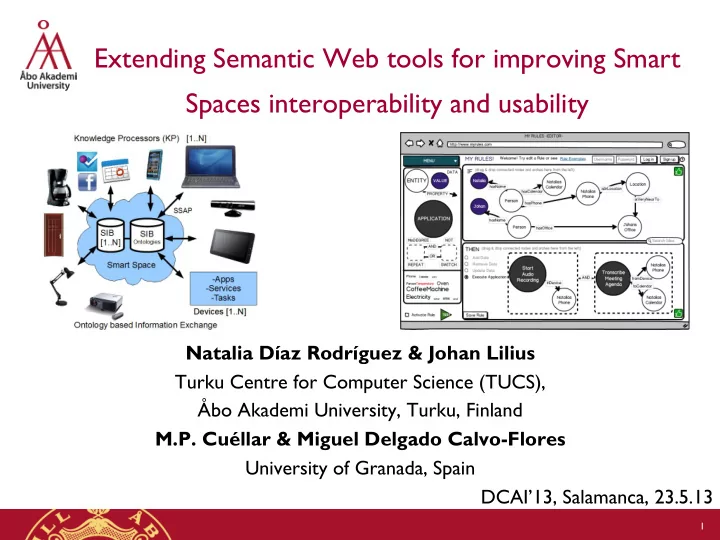
Extending Semantic Web tools for improving Smart Spaces interoperability and usability

Natalia Díaz Rodríguez & Johan Lilius Turku Centre for Computer Science (TUCS), Åbo Akademi University, Turku, Finland M.P. Cuéllar & Miguel Delgado Calvo-Flores University of Granada, Spain DCAI’13, Salamanca, 23.5.13

1

slide-2
SLIDE 2

Introduction

§ Smart Spaces (UbiComp): interoperability, working on behalf of the user, handle unanticipated situations

2

slide-3
SLIDE 3

Introduction

§ Context-awareness for machine processing and reasoning. § Semantic Technologies and Ontologies: independent knowledge sharing minimizing redundancy.

3

slide-4
SLIDE 4

Programming environments for novice programmers

4

[Scratch] [IFTTT]

slide-5
SLIDE 5

5

Programming environments for novice programmers

[Twine] [Valpas]

slide-6
SLIDE 6

Related Work

§ End-user Domain Specific Languages – IF-THEN and ECA rule languages to create services – Rapid test and iteration of ubicomp applications § What is missing? – Underlying semantic capabilities – Support for imprecise expressions – Visual GUI for interacting with both fuzzy ontologies and fuzzy rules – General Domain

6

slide-7
SLIDE 7

Our proposal’s Contribution

A GUI model to visualize and interact with Smart Space information. – User-customized applications – No knowledge of programming nor Semantic Web – Semantic graph-based data – Simple IF-THEN rules – Publish/subscribe architecture using Smart-M3. – Imprecise knowledge support – Guidelines for visual language design

7

slide-8
SLIDE 8

Mapping OWL 2 to visual rule entities

8

slide-9
SLIDE 9

9

slide-10
SLIDE 10

Equivalent SPARQL Query

10

§ Each rule is converted into a SPARQL query, which can be transformed to a Smart-M3 subscription.

slide-11
SLIDE 11

Mapping a visual rule to SPARQL

Algorithm § Input: Graphical IF-THEN rule. § Output: SPARQL query, [subscription]. § IF-THEN rule parsing algorithm principles: – IF conditions => Add RDF Triple patterns to WHERE clause – THEN actions => a) Add Triple patterns to INSERT or DELETE clause b) External application execution Parameters:

  • Must be defined in IF clause
  • Add Triple to SELECT clause

11

slide-12
SLIDE 12

Conclusions

§ Providing ordinary end-users with flexible and functional Smart Space environment:

– Rapid development of mash-ups applications with rules – Abstracting away technical details – Exploiting potential of SW technologies – General purpose visual language, correct by construction. – Query federation and imprecise knowledge representation

§ Evolve the SW from data modelling to computational medium § Applications: AmI, e-Health, Home Automation, etc.

12

slide-13
SLIDE 13

Future Work

§ Work in progress: further usability studies § Support for fuzzy reasoning § Visual model for defining higher level human behaviours § Functionality: rule sharing and access control

13

slide-14
SLIDE 14

References

§ [Scratch] M. Resnick, J. Maloney, A. Monroy- Hernandez, N. Rusk, E. Eastmond, K. Brennan, A. Millner, E. Rosenbaum, J. Silver, B. Silverman, and Y. B.

  • Kafai. Scratch: programming for all.

§ [Valpas] Communications of the ACM, 52(11):60–67,

  • 2009. A. Rex. Design of a caregiver programmable

assistive intelligent environment. Aalto University, 2011. § [Twine] http://supermechanical.com/twine § [IFTTT] http://ifttt.com

14

slide-15
SLIDE 15

Thank you for your attention!

Natalia Díaz Rodríguez ndiaz@abo.fi

Embedded Systems Lab. Department of Information Technologies Åbo Akademi University, Turku, Finland TUCS (Turku Centre for Computer Science) Department of Computer Science and Artificial Intelligence University of Granada, Spain

15