South Dakota Board of Regents Fiscal Year 2018 Budget Hearing - - PowerPoint PPT Presentation

south dakota board of regents
SMART_READER_LITE
LIVE PREVIEW

South Dakota Board of Regents Fiscal Year 2018 Budget Hearing - - PowerPoint PPT Presentation

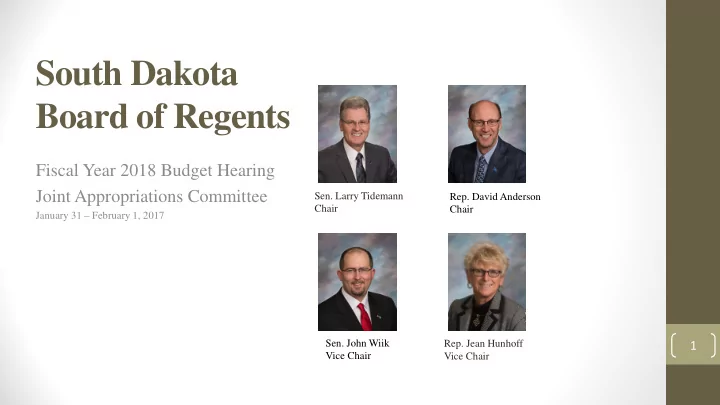
South Dakota Board of Regents Fiscal Year 2018 Budget Hearing Joint Appropriations Committee Sen. Larry Tidemann Rep. David Anderson Chair Chair January 31 February 1, 2017 Sen. John Wiik Rep. Jean Hunhoff 1 Vice Chair Vice Chair


slide-1
SLIDE 1

South Dakota Board of Regents

Fiscal Year 2018 Budget Hearing Joint Appropriations Committee

January 31 – February 1, 2017

  • Sen. Larry Tidemann

Chair

  • Rep. David Anderson

Chair

  • Sen. John Wiik

Vice Chair

  • Rep. Jean Hunhoff

Vice Chair

1

slide-2
SLIDE 2

Stewardship of Public Higher Education in South Dakota

2

John W. Bastian Harvey C. Jewett Kathryn Johnson Jim Morgan Conrad Adam Pam Roberts Bob Sutton

Vice President

Kevin Schieffer

Secretary

Randy Schaefer

President

slide-3
SLIDE 3

Board of Regents’ Vision

  • Randy Schaefer, President

3

slide-4
SLIDE 4

The 2020 Mission Statement

  • The South Dakota Board of Regents’ mission is to provide an excellent, efficient,

accessible, equitable, and affordable public university and special schools system

  • that improves South Dakota’s overall educational attainment and research

productivity,

  • while enriching the intellectual, economic, civic, social, and cultural life of the state, its

residents, and its communities.

4

slide-5
SLIDE 5

65 Percent by 2025!

  • Goal is based on projections that roughly 65 percent of all jobs in our state will

require some level of postsecondary education by 2020.

  • Data from Georgetown University Public Policy Institute’s Center on Education and the Workforce.

5

slide-6
SLIDE 6

Projected Revenues from Meeting 65% Goal

$107,600,000 $0 $20,000,000 $40,000,000 $60,000,000 $80,000,000 $100,000,000 $120,000,000 2011 2012 2013 2014 2015 2016 2017 2018 2019 2020 2021 2022 2023 2024 2025 State Revenues

6

Source: NCHEMS; CLASP

slide-7
SLIDE 7

Growth in Economic Impact

Annual economic impact of the state’s public universities has grown by 35 percent since 2010!

  • 2016
  • SD public universities generate about $2.66 BILLION

in annual economic impact to South Dakota.

  • 2010
  • SD public universities generate about

$1.97 BILLION in annual

economic impact to South Dakota.

7

Source: The Economic Impact of the SD Public University System, November 2016

slide-8
SLIDE 8

University System and Special Schools

8

slide-9
SLIDE 9

Regents’ Mission Includes Schools Serving Special K-12 Populations in South Dakota

  • South Dakota School for the Blind & Visually Impaired
  • Aberdeen campus
  • Meets educational needs of students birth to 21 who are blind, visually impaired, or multi-

handicapped.

  • Curriculum blends academic coursework and expanded core curriculum skills to address each

student’s individual learning modes and achieve his/her maximum independence.

  • Statewide outreach
  • Outreach vision consultants provide

information, recommendations, and assistance to students, families, and educators across the state. 9

slide-10
SLIDE 10

Regents’ Mission Includes Schools Serving Special K-12 Populations in South Dakota

  • South Dakota School for the Deaf
  • Statewide outreach
  • Comprehensive educational evaluations and assistance with instructional

design, serving children, parents, and teachers across South Dakota.

  • Bilingual deaf education program
  • ffered through contract with

Harrisburg School District.

10

slide-11
SLIDE 11

SDSD/SDSBVI Teachers’ Salary Increase

  • Amount needed to match public school teacher increase from

last year

  • South Dakota School for the Deaf - $59,508
  • South Dakota School for the Blind & Visually Impaired -

$86,985

11

LRC Budget Briefing, Pages 49-52

slide-12
SLIDE 12

Higher Education in South Dakota

12

slide-13
SLIDE 13

Higher Education

  • Attracts income
  • Generates income
  • Attracts business
  • Enhances individual wealth

13

slide-14
SLIDE 14

Attracts Income

  • $272 million in federal money in FY16
  • Compares to $197 million from state’s General Fund

14

Source: SDBOR FY2017 Fact Book

slide-15
SLIDE 15

Economic Impact of the South Dakota Public University System

15

  • Study Sponsors
  • SD Board of Regents
  • SD Chamber of Commerce &

Industry

  • Research Team
  • Michael Allgrunn, Associate Professor
  • f Economics, USD
  • Travis L. Letellier, Visiting Assistant

Professor of Economics, USD

  • Joslynn Clauson, Research Assistant
slide-16
SLIDE 16

Generates Income

  • $2.66 BILLION
  • South Dakota public universities

generated about $2.66 billion of annual economic impact to South Dakota.

  • State’s investment was $197 million in

Fiscal Year 2016.

16

Source: The Economic Impact of the SD Public University System, November 2016

slide-17
SLIDE 17

Generates Income

  • $162 MILLION
  • Sales and property tax revenues due

to economic activity generated by the public universities.

17

Source: The Economic Impact of the SD Public University System, November 2016

slide-18
SLIDE 18

Generates Income

  • 5,628 full-time jobs
  • Public universities directly supported 5,628

jobs in South Dakota.

  • 21,950 other jobs
  • Other South Dakota industries generated

21,950 jobs as a result of the state’s public universities.

18

Source: The Economic Impact of the SD Public University System, November 2016

slide-19
SLIDE 19

Attracts Business

  • Workforce
  • Family benefits
  • Social and

economic climate

19

  • Business expertise
  • Research partnerships
slide-20
SLIDE 20

Milken Institute Study on Economic Development

20

A Matter of Degrees:

The Effect of Educational Attainment on Regional Economic Prosperity

slide-21
SLIDE 21

Milken Institute Study

A Matter of Degrees: The effect of educational attainment

  • n regional economic prosperity
  • Key findings:
  • Education increases regional prosperity.
  • Better educated, bigger benefits.

21 ’

slide-22
SLIDE 22

Enhances Individual Income

Source: Georgetown University, Center on Education and the Workforce. (2011). The college payoff: Education, Occupations, Lifetime Earnings. Retrieved from file:///C:/Users/tasha.dannenbring/AppData/Local/Microsoft/Windows/INetCache/IE/QG3X22NQ/collegepayoff-complete.pdf Note: Salary wage calculations based on median earning data, numbers in millions..

22

$0.973 M $1.547 M $1.727 M $2.268 M $2.671 M $3.252 M $3.648 M $0.0 $0.5 $1.0 $1.5 $2.0 $2.5 $3.0 $3.5 $4.0 Less than HS Some College Associate Bachelor's Master's Doctoral Professional

+59% +78% +133% +175% +234% +275%

Median Lifetime Earnings in Millions 22

slide-23
SLIDE 23

New U.S. High-Paying Jobs by Degree Level

2,800 152

  • 39
  • 500

500 1,500 2,500 3,500 Bachelor's Degree or Higher Some College or Associate Degree High School or Less 23

Source: Georgetown University Center on Education and the Workforce (2015). Good Jobs are Back: College Graduates are First in Line

2010-2014

(in Thousands)

slide-24
SLIDE 24

Impact of Education on Income

10% 15% 20% 25% 30% 35% 40% 45% $15,000 $20,000 $25,000 $30,000 $35,000 $40,000 SD 24

Source: US Census Bureau, American Community Survey, 2013

States by Income and Education, 2013

Per Capita Income, 2013 Percent with Bachelor’s Degree or Higher

slide-25
SLIDE 25

Strengthening South Dakota

Its Economic, Social, and Human Capital

25

Source: The College Board (2013). Education Pays; Institute for Higher Education Policy (1998). Reaping the Benefits: Defining the Public and Private Good of Going to College

slide-26
SLIDE 26

Board of Regents’ Goals

  • Student Success
  • Increase degree production

26

slide-27
SLIDE 27

Strategies to Achieve 65% Goal by 2025

Examples:

  • Enact proactive admission
  • Increase first-year enrollment of traditional-age

students

  • Marketing campaign for non-traditional students and

students with prior credits

  • Increase use of Prior Learning Assessment
  • College Application Week

27

slide-28
SLIDE 28

Programs Fostering Early Completion

  • “15-to-Finish” models
  • Reduce credit-hour graduation requirement from 128

to 120

  • Co-requisite remediation models
  • Exploratory Studies – Reduce “catalog wandering”
  • Redesign General Education & transfer frameworks

28

slide-29
SLIDE 29

Dual Credit Enrollments

29

1,333 2173 2590 1632 2307 352 371 500 1,000 1,500 2,000 2,500 3,000 2014 2015 2016

HSDC Enrollments by Semester Type

Fall Enrollments Spring Enrollments Summer Enrollments

slide-30
SLIDE 30

Dual Credit Grades

30 53.8% 29.3% 8.9% 2.3% 2.4% 3.1% 0.2%

High School Dual Credit Program Grades by Percentage

A B C D F W Other

Success Rates

ABC Rate: 92 percent since HSDC program started DFW Rate: 8 percent since HSDC program started

Increase in Success Rates:

Fall 2016 Semester ABC Rate: 94 percent

slide-31
SLIDE 31

Affordability Measures Pay Off

31

  • Reduction of credit hours required for degree
  • Governor’s Dual Credit Program
  • Exploratory Studies

6%

5%

2% 4%

$20,000 $22,000 $24,000 $26,000 $28,000 $30,000 $32,000 Total Tuition & Fees for B.S. Degree 128 Credits 120 Credits 120 Credits w/Exp. Studies 120 Credits w/ 1 dual credit course 120 Credits w/3 dual credit courses

Savings = 17%

slide-32
SLIDE 32

Improving System Completion

5,599 5,858 6,355 6,172 6,346 6,614 5,000 5,200 5,400 5,600 5,800 6,000 6,200 6,400 6,600 6,800 FY11 FY12 FY13 FY14 FY15 FY16

18% Increase in Total Graduates Since FY11

Total Graduates

32

slide-33
SLIDE 33

At-Risk Student Completions

108 990 1,320 2,343 145 1,287 1,342 2,641 500 1,000 1,500 2,000 2,500 3,000 Amer.Ind Nontrad Underprepared Low Income FY11 FY16

12% 34% 30% 1.7%

33

slide-34
SLIDE 34

Source: Peace Bransberger and Demarée K. Michelau. Knocking at the College Door: Projections of High School Graduates, 9th Edition. Boulder, CO: Western Interstate Commission for Higher Education, 2016.

9,391 10,000 7,500 8,000 8,500 9,000 9,500 10,000 10,500

Projected High School Graduates

34

slide-35
SLIDE 35

2.48% 2.07% 12.05% 65.99% 5.68% 13.58% 14.90% 7.62% 0.00% 10.00% 20.00% 30.00% 40.00% 50.00% 60.00% 70.00% Iowa Minnesota Montana North Dakota Nebraska Wyoming South Dakota Total

Source: Peace Bransberger and Demarée K. Michelau. Knocking at the College Door: Projections of High School Graduates, 9th

  • Edition. Boulder, CO: Western Interstate Commission for Higher Education, 2016.

35

Projected Growth of HS Graduates by State

slide-36
SLIDE 36

South Dakota School of Mines Math at Mines

  • Requested, not recommended by the Governor
  • FY17 one-time appropriation of $250,000
  • $250,000 base funding to continue the program

36

Continuing Priority

LRC Budget Brief Page 35

slide-37
SLIDE 37

Board of Regents’ Goals

  • Academic Quality and Performance
  • Document that academic programs are of the highest quality

37

slide-38
SLIDE 38

Responsive Academic Programming

  • Rigorous approval process for new programs
  • Initial Intent-to-Plan request
  • Formal program approval

38

Campus Review

(Faculty, Departments, Committees, Industry Representatives)

Board Review & Approval System Review

(Board Staff, System Provosts/Presidents, Consultants)

slide-39
SLIDE 39

Program Changes – 2014-16

39

Added Terminated

Undergraduate Associate & Bachelor’s Degrees 23 23 Undergraduate Minors 23 6 Graduate Degrees 14 3

slide-40
SLIDE 40

Filling the Workforce Pipeline

  • Preparing South Dakotans for tomorrow’s workforce

40

Source: Regents’ Information Systems

1,732 1,203 1,086 620 554 526 502 358 327

2015-2016 Degrees from SD Public Universities

slide-41
SLIDE 41

2020 Vision: The South Dakota Science and Innovation Strategy

1,559 1,630 1,693 1,734 1,860

  • 500

1,000 1,500 2,000 FY12 FY13 FY14 FY15 FY16 STEM Graduates

  • Promote study in Science,

Technology, Engineering and Math

41

Source: Regents’ Information Systems

slide-42
SLIDE 42

Academic Programming for Economic Development

42

2020 Vision: The South Dakota Science & Innovation Strategy prepared by the South Dakota EPSCoR Reach Committee identified five high-growth, STEM-oriented target sectors to drive a robust, higher-value future South Dakota economy.

  • 1. Value-Added Agriculture & Agribusiness

BS, Precision Agriculture (SDSU) ’16 Minor, Meat Science (SDSU) ’15

slide-43
SLIDE 43

43

  • 2. Energy & Environment

Minor, Environmental Science (SDSMT) ’15 Minor, Petroleum Systems (SDSMT) ’14

  • 3. Human Health and Nutrition

BS, Human Biology (SDSU) ’16 PhD, Health Sciences (USD) ’16 Certificate, Allied Health (NSU) ’15

Academic Programming for Economic Development

slide-44
SLIDE 44

44

4, IT/Cyber Security/Information Assurance DSc, Cyber Security (DSU) ’14 Certificate, Bank Security (DSU) ’14

  • 5. Materials & Advanced Manufacturing

AS, Manufacturing Technology (SDSU) ’16 BBA, Operational Analytics (USD) ’16

Academic Programming for Economic Development

slide-45
SLIDE 45

Fact Check: What kind of graduates does a major South Dakota employer hire?

  • College majors of recently-hired graduates

working for Wells Fargo

  • Finance
  • Accounting
  • Business Administration, Business

Management, Business Marketing, Business Economics

  • Computer Science
  • Education-Teaching, Special Education
  • Speech Communications
  • Economics
  • Sociology
  • Agricultural Science, Agricultural

Business/Economics

  • Communications-Public Relations
  • Banking and Finance
  • Service Management
  • Music
  • Spanish
  • Biology

45

slide-46
SLIDE 46

University of South Dakota Law School

  • Governor’s recommendation:

$1,200,000 one-time

  • FY17 General Bill adjustment
  • Senate Bill 32

46

LRC Budget Briefing, Page 18

slide-47
SLIDE 47

Board of Regents’ Goals

  • Research and Economic Development
  • Increase annual research and contract expenditures

47

  • Advance knowledge
  • Enhance technology transfer and

commercialization

  • Catalyze economic development
slide-48
SLIDE 48

Research is Economic Development

$102,563,284 $89,921,781 $0 $50,000,000 $100,000,000 $150,000,000 $200,000,000 FY02 FY03 FY04 FY05 FY06 FY07 FY08 FY09 FY10 FY11 FY12 FY13 FY14 FY15 FY16

SDBOR Research Activity FY02-FY16

Awards Expenditures

48

Source: SDBOR Office of Academic and Research Affairs

slide-49
SLIDE 49

Research is Job Development

  • FY16 job creation – Faculty research efforts (FTE): 686
  • Research innovations – FY07-FY16
  • Invention disclosures – 508
  • Patent and intellectual property protections filed – 241
  • Patents/licenses issued – 138

49

Source: BOR system office

slide-50
SLIDE 50

Governor Research Centers

A Snapshot of Success

Centers funded: 14 Funding leverage: 6:1 Students trained: 943 Innovations disclosed: 156 Patent filings: 70 Patents issued: 11 License agreements: 17 50

$136,692,895 $92,291,788 $41,156,646 $20,676,519

Research Funding: $290,817,848

Federal Private RCC Other State

slide-51
SLIDE 51

Governor Research Centers and Economic Development

  • Twenty start-up companies affiliated with research centers have:
  • Created 187 jobs in South Dakota
  • Received 27 federal small business research (SBIR) awards, totaling

$7,877,510

  • Raised in excess of $23 million in private equity

51

slide-52
SLIDE 52

Broader Impacts of the Governor Research Centers on University Research

20 40 60 80 100 120

Baseline (FY05) FY16 $55.5M $102.6M

Research Awards in Millions of Dollars

52 39 13 21 11 3

10 20 30 40 50 60

Disclosures Patent Filings Licenses

Technology Transfer

FY16 Baseline (FY07)

52

slide-53
SLIDE 53

Animal Disease Research and Diagnostic Laboratory

  • Governor’s recommendation:
  • $5 million in one-time funding
  • $800,000 in ongoing funds
  • Balance of funding
  • SDSU/ADRDL
  • Industry partners

53

LRC Budget Brief Pages 25

SD BOR Strategic Goal 3: Research and Economic Development

slide-54
SLIDE 54

Statewide Continuing Priority

  • Dakota Lakes Research Farm
  • Requested, not recommended by the Governor
  • Important investment in precision agriculture research
  • $120,286 base funding
  • $75,000 one-time

funding

  • 0.75 FTE

54

slide-55
SLIDE 55

Board of Regents’ Goals

  • Affordability and Accountability
  • Reduce tuition and fee ranking to regional average
  • Create and capitalize on efficiencies

55

slide-56
SLIDE 56

Focus on Efficiencies

  • Created a central electronic transcript processing center
  • Looking at new single-instance student system
  • New common tools provided for decision support
  • Centralizing and cataloging common reports
  • New library system with improved functionality
  • Continued focus on shared services

56

Continued focus on doing things more efficiently and effectively

slide-57
SLIDE 57

System FTE Utilization

1000 2000 3000 4000 5000 6000 FY13 FY14 FY15 FY16 FY17 Budgeted

System FTE Utilization

Utilized FTE Unutilized FTE

93.3% 93.2% 94.7% 94.1% 6.8% 6.7% 5.3% 5.9%

57

  • Overall system FTE budget reduced by 22.0 FTE in FY17.
slide-58
SLIDE 58

Measuring Our Progress

Ensuring Accountability and Transparency

  • Board of Regents’ Fact Book
  • www.sdbor.edu/mediapubs/factbook/index.htm
  • Board of Regents’ Interactive Dashboards
  • www.sdbor.edu/dashboards
  • Board of Regents’ Strategic Plan – 17 System Metrics
  • www.sdbor.edu/theboard/StrategicPlan

58 58

slide-59
SLIDE 59

Interactive Dashboard Reporting

  • Fall enrollment
  • High school transition
  • College matriculation
  • Freshmen migration
  • University affordability
  • Distance education

Access and Enrollment

59 59 59

slide-60
SLIDE 60

Interactive Dashboard Reporting

Other Dashboard Categories

  • Institutional/peer analysis
  • BOR policies
  • State labor force (wages, labor force, employment projections)

60 60

slide-61
SLIDE 61

Affordability Issues and Solutions

61

slide-62
SLIDE 62

Decisions Driving Student Costs

Cumulative budget impact since FY99

  • Utility funding shortfall - $14,201,944
  • No inflation on operating base - $3,618,997
  • Health insurance shortfall - $14,485,060
  • Budget cuts - $26,861,982
  • Salary shortfall - $5,161,357
  • Reduction from 128 to 120 credit hours - $12,762,089
  • Total reduction to BOR budget - $77,091,429

62

slide-63
SLIDE 63

Lower State Support Drives Higher Tuition

63

Source: SHEEO State Higher Education Finance (SHEF) Report, 2014

(Note: SHEF data adjusted for enrollment mix and cost of living, so numbers will differ from BOR Fact Book.)

Iowa Minnesota Montana Nebraska North Dakota South Dakota Wyoming National Average Appropriations Per FTE $5,335 $5,327 $4,939 $7,840 $7,888 $4,878 $15,561 $6,552 Net Tuition Revenue Per FTE $8,118 $7,111 $5,505 $5,401 $6,752 $8,221 $2,761 $5,777 $0 $2,000 $4,000 $6,000 $8,000 $10,000 $12,000 $14,000 $16,000

FY14 Public Postsecondary Education Educational Appropriations and Net Tuition Revenue Per FTE

slide-64
SLIDE 64

Student Affordability – #1 Priority

Thank you for supporting tuition freezes in FY15 & FY17!

Tuition and Mandatory Fees Dollar Change From Prior Year Percent Change From Prior Year FY13* $7,675.62

  • $45.43
  • 0.6%

FY14 $8,038.50 $362.88 4.7% FY15 $8,038.50 $0.00 0.0% FY16 $8,475.00 $436.50 5.4% FY17 $8,503.75 $28.75 0.3% *Net change, including reduction from 128 to 120 credit hours 64

slide-65
SLIDE 65

State Support Impacts Affordability

  • FY15 and FY17 tuition freezes, supported by Gov. Daugaard

and the Legislature, improved affordability for SD students.

65

Source: BOR Fact Book FY 2017

State support of South Dakota public higher education increased from 41% to 46% over the past five years.

51% 55% 52% 51% 47% 44% 41% 41% 43% 44% 44% 46% 49% 45% 48% 49% 53% 56% 59% 59% 57% 56% 56% 54% 30% 35% 40% 45% 50% 55% 60% 65% 2006 2007 2008 2009 2010 2011 2012 2013 2014 2015 2016 2017 Projected

General Student

slide-66
SLIDE 66

66

$13.57 $201.62 $481.14 $645.95 $779.47 $952.34 $958.01 $1,561.22 $1,798.81 $0.00 $200.00 $400.00 $600.00 $800.00 $1,000.00 $1,200.00 $1,400.00 $1,600.00 $1,800.00 $2,000.00 South Dakota Montana Nebraska Iowa North Dakota Colorado Total/Average Minnesota Wyoming

In the Region: Need-Based Funding per Pell Eligible Student

slide-67
SLIDE 67

Shared Responsibility Model

Source: WICHE: States in the Drivers Seat

67 67

slide-68
SLIDE 68

South Dakota Opportunity Scholarship

68

  • 2016-17 academic year: 3,875 recipients funded
  • Total of 14,721 recipients over program’s lifetime

500 1,000 1,500 2,000 2,500 3,000 3,500 4,000 2012-13 2013-14 2014-15 2015-16 2016-17 1,217 1,220 1,239 1,252 1,300 2,432 2,533 2,606 2,577 2,575 New Recipients Continuing Recipients

3,649 3,753 3,845 3,829 3,875

slide-69
SLIDE 69

Opportunity Scholarship Recipient Placement

69 Average placement rate of recipients is 70.1% over last 5 years.

Source: BOR Graduate Placement Dashboard 72.6% 67.9% 70.8% 70.7% 68.9% 100 200 300 400 500 600 700 800 FY10 FY11 FY12 FY13 FY14

Placed by Graduation Year

(in South Dakota)

slide-70
SLIDE 70

South Dakota Opportunity Scholarship

  • Governor’s recommendation for

additional funding: $412,798

  • Scholarship award increased Fall 2015

from $5,000 to $6,500

  • 1,300 new students each year

70

LRC Budget Briefing, Pages 12-15

slide-71
SLIDE 71

Student Funding of Buildings – Unique to South Dakota

  • Iowa: General obligation bonds or general funds cash
  • Minnesota: General obligation bonds
  • Montana: General obligation bonds or general funds cash
  • Nebraska: General funds cash
  • North Dakota: General funds cash
  • Wyoming: General funds cash

71

slide-72
SLIDE 72

Funding New Facilities and Major Renovations

Academic Buildings

  • HEFF – 11.5 percent of tuition projected to generate $28.2 million in FY18
  • $16.2 million for M&R
  • $14.3 million for SD Building Authority lease payments
  • New buildings when cash flow permits
  • In the last 20 years:
  • HEFF - $274 million
  • Grants and private fundraising by presidents

and foundations - $270 million

  • State funding - $64.8 million

72

slide-73
SLIDE 73

FY18 Additional M&R Investment

(estimates)

  • 2% goal - $27 million
  • Student contribution - $17.4 million
  • State contribution - $8.7 million
  • Needed to meet goal - .9 million

LRC Budget Briefing Pages 8-9

73

slide-74
SLIDE 74

Maintenance and Repair

  • Thank you, Governor Daugaard and Legislature!
  • M&R investments protect significant building and infrastructure assets
  • Governor recommends $918,737 for M&R
  • 2 percent replacement value

74

LRC Budget Briefing Pages 8-9

Fiscal Year Replacement Value (in millions) M&R Allocated (in millions) % of Replacement Values

FY14 $1,135,770,710 $18,590,650 1.6% FY15 $1,184,230,289 $20,068,760 1.7% FY16 $1,260,771,828 $22,563,326 1.8% FY17 $1,291,889,484 $25,837,790 2.0% FY18 $1,354,015,821 $27,080,316 2.0%

slide-75
SLIDE 75

System Budget Adjustments

  • Central Office FTE Use
  • Utility adjustments
  • Federal and other authority adjustments
  • Research grants and contracts
  • Senate Bill 19

75

slide-76
SLIDE 76

76

35%

slide-77
SLIDE 77

77

slide-78
SLIDE 78

Board of Regents Central Office FTE Use

78

  • FY16
  • Budgeted – 75.3
  • Used – 60.1
  • FY17
  • Budgeted – 70.3
  • Board office – 23.0
  • Regents Information Systems – 25.0
  • Enrollment Services Center – 12.3
  • South Dakota Library Network – 9.0
  • Academic initiatives – 1.0
  • Remaining unfilled - 10
  • 2.0 FTE Enrollment Services Center
  • 6.0 FTE South Dakota Library Network
  • 2.0 FTE Regents Information Systems
slide-79
SLIDE 79

Central Office – FY18 Governor’s Recommended Budget Items

  • Lease payment adjustments
  • ($3,502) general funds for annual lease payment
  • $656,535 other fund authority for SDSU Performing Arts Center
  • Other fund authority
  • $3,672,951 for research grants and contracts
  • $500,000 other fund authority for Regents Information Systems

79

LRC Budget Brief Pages 6-10

slide-80
SLIDE 80

FY18 Utility Support for Academic Facilities

  • Based on FY16 usage and additional square footage
  • Senate Bill 20 - Realign utility funding

Governor’s recommendation: Reduction of $2,574,186

LRC Budget Brief Pages 17, 24, 34, 38, 42, 46, 50 & 52

80

slide-81
SLIDE 81

Federal and Other Informational Budgets

  • Senate Bill 19
  • Research Grants and Contracts Funds
  • Elimination of excess budget authority
  • More accurate budgeting

81

slide-82
SLIDE 82

Federal Fund Authority

82 FY17 Federal Fund Authority Budget Fund Authority Transferred to Informational Budget Reduction of Federal Fund Authority

Central Office $574,447 $0 $0 USD $13,547,785 $7,917,246 ($5,630,539) USD-SSOM $11,932,296 $9,177,870 ($2,754,426) SDSU $30,849,738 $24,000,000 ($6,849,738) SDSU-EXT* $8,564,458 $2,000,000 ($2,564,458) SDSU-AES* $17,830,207 $7,250,000 ($6,973,652) SDSM&T $34,219,819 $15,219,810 ($19,000,009) NSU $1,983,236 $1,978,117 ($5,119) BHSU $4,958,587 $4,277,168 ($681,419) DSU $5,545,182 $3,445,182 ($2,100,000) SDSD/SDBVI $201,361 $0 $0 Total $130,207,116 $75,265,393 ($46,559,356)

*SDSU-EXT and SDSU-AES both have federally appropriated funds of $4 million and $3,606,555, respectively.

slide-83
SLIDE 83

Other Fund Authority

83 FY17 Other Fund Authority Budget Fund Authority Transferred to Informational Budget Fund Authority Transferred to Tuition Budget Adjustment to Other Fund Authority

Central Office $45,641,056 $3,672,951 $0 $4,829,486 USD $109,908,163 $5,665,623 $10,990,406 ($13,301,059) USD-SSOM $19,840,657 $1,403,821 $1,221,441 $3,289,429 SDSU $196,825,758 $5,600,000 $17,602,595 ($22,625,432) SDSU-EXT $2,423,536 $300,000 $0 ($400,000) SDSU-AES $15,432,703 $5,500,000 $0 ($1,500,000) SDSM&T $47,933,352 $2,310,100 $750,000 ($9,457,257) NSU $26,589,864 $325,530 $4,454,938 ($1,427,115) BHSU $37,056,671 $634,850 $11,461,982 ($4,415,584) DSU $26,438,356 $1,840,000 $8,509,954 ($800,000) SDSD/SDSBVI $1,161,964 $0 $0 $0 Total $529,252,080 $23,579,924 $54,991,316 ($45,807,532)