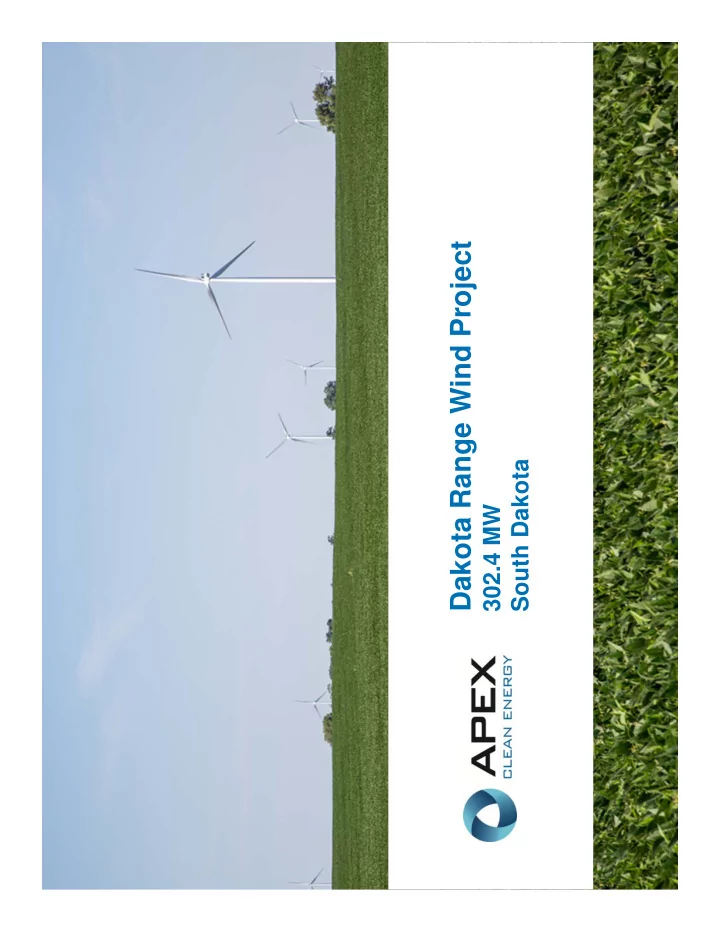
Dakota Range Wind Project South Dakota 302.4 MW Dakota Range Wind - - PDF document

dakota range wind project
SMART_READER_LITE
LIVE PREVIEW

Dakota Range Wind Project South Dakota 302.4 MW Dakota Range Wind - - PDF document

Dakota Range Wind Project South Dakota 302.4 MW Dakota Range Wind Project Overview Capacity = 302.4 MW Land = 100% of land under easement, approximately 44,500 acres Proposed Facility Up to 72 turbines in Grant and Codington Counties


slide-1
SLIDE 1

Dakota Range Wind Project

302.4 MW South Dakota

slide-2
SLIDE 2

l

Dakota Range Wind Project Overview

2

Capacity = 302.4 MW Land = 100% of land under easement, approximately 44,500 acres Proposed Facility

  • Up to 72 turbines in Grant and Codington Counties
  • Access roads, collector lines, and fiber-optic cables
  • Operations and maintenance (“O&M”) facility
  • Up to 5 permanent meteorological towers
  • Project substation

Site Selection

  • Strong wind resource
  • Available transmission
  • Community and landowner support
  • Compatible land use

Buyer = Xcel Energy (2021 Commercial Operation Date)

slide-3
SLIDE 3

Dakota Range Wind Project Basics

slide-4
SLIDE 4

l

Dakota Range Wind Project Site Plan

4

slide-5
SLIDE 5

l

Why Now? Big Stone to Ellendale Line

5

  • IA: Signed early 2018
  • Earthwork for POI

Substation: Q3 2018

  • Electric work on POI

Substation: Q2 2019

  • Available Trans: Q3 2019
  • Commercial Operations

Date: Late 2020/Early 2021

slide-6
SLIDE 6

SD Perfectly Positioned for Wind Opportunities

6

l

slide-7
SLIDE 7

l

Who is Apex Clean Energy?

7

Acquisition and Development Financing and Construction Asset Management

Apex Clean Energy is a U.S.-focused independent renewable energy company based in Charlottesville, Virginia. Apex’s mission: Accelerate the shift to clean electricity To learn more, visit apexcleanenergy.com.

slide-8
SLIDE 8

l

Apex and the Community

8

“With farming, it’s different year to year. You can do everything right, and Mother Nature can decide differently. Construction is kind of the same way. With the wind, it’s a steady flow of income coming in, and that’s what we liked about it.”

—Doug Merz, Landowner Kay Wind, Oklahoma

“We’re capitalizing on a natural resource. I can diversify my acreage, and the landowners that live locally spend their dollars back in the community.”

—Pete Hatfield, Landowner Hoopeston Wind, Illinois

Apex is committed to the responsible development of renewable energy

  • facilities. To us, that means establishing

long-lasting relationships and ensuring that our projects benefit both our host landowners and their communities.

slide-9
SLIDE 9

l

Xcel Energy to Own Dakota Range Wind Project

9

slide-10
SLIDE 10

l

Xcel Service Territory

10

slide-11
SLIDE 11

l

A Reliable Energy Source for South Dakota

Xcel and MISO’s ability to integrate electricity from a diverse set of generation sources helps them maintain a reliable and stable grid.

  • Xcel Energy electric reliability is among the top one-third of U.S. electric utilities.
  • Xcel Energy is transitioning its fleet to include more natural gas, wind, and solar

energy with a plan that will keep costs affordable.

  • Xcel Energy is the nation’s leading utility wind provider and is taking advantage of

historically low wind prices to install new wind energy that will save money on fuel and other costs over the life of the projects.

11

slide-12
SLIDE 12

Dakota Range Wind Project Benefits

slide-13
SLIDE 13

l

Community Economic Benefits

13

25-Year Projected Tax Revenue for the Dakota Range Wind Project

Recipient Annual Tax Revenue (Approximate) Total Tax Revenue (Approximate) Codington County $80,000 $2,000,000 Leola Township $6,000 $150,000 Germantown Township $30,000 $700,000 Grant County $280,000 $6,900,000 Lura Township $25,000 $600,000 Mazeppa Township $90,000 $2,300,000 Waverly School District $225,000 $5,600,000 Summit School District $280,000 $7,000,000 South Dakota $420,000 $10,600,000

slide-14
SLIDE 14

l

Landowner Lease Payments

  • Over its 25-year life, Dakota Range Wind will generate $39 million in lease payments to participating

landowners.

  • Prior to construction, project landowners will receive over $500,000 in development payments.
  • Throughout commercial operations, all participants will receive “community based” pay.

Local Spending During Construction

  • During construction, about 300 construction workers will be living and shopping in the area, creating a

boost for the local economy.

  • Several key construction materials will be sourced locally, supporting local suppliers.

Long-term Jobs

  • Throughout operation, Dakota Range Wind will employ about 10 full-time operations and maintenance

employees, creating approximately $17 million in wages paid to community members.

  • The country’s fastest-growing occupation is wind turbine technician, according to the Bureau of Labor

Statistics—with numbers expected to more than double over the next decade.*

* Bureau of Labor Statistics, U.S. Department of Labor, Occupational Outlook Handbook, Wind Turbine Technicians, https://www.bls.gov/ooh/installation-maintenance-and-repair/wind-turbine-technicians.htm (visited March 12, 2018).

14

Benefiting South Dakota Communities

slide-15
SLIDE 15

l

Community Outreach and Support

15

Apex Clean Energy is dedicated to being a strong community partner. Dakota Range has been in regular contact with stakeholders, including:

  • Both counties (including their highway superintendents)
  • All involved townships
  • The Punished Woman’s Lake Association
  • USFWS
  • SD Game & Fish
  • SWO
  • SHPO
  • The Town of South Shore

Dakota Range has an active office in Summit to provide information about the project and answer questions from the community. Additional community support has included:

  • Donation to the addition to the high school in Summit
  • Regular contributions to community events (e.g., Fog Days, etc.)
  • Donation to fundraising efforts for Summit’s Volunteer Fire Department
  • Support for Summit High School History Club’s trip to Washington, DC
  • Contributions to the local Boys & Girls Club
  • Dakota Range Community Grant Program (under way)
slide-16
SLIDE 16

Serving South Dakota

  • 104 South Dakota jobs
  • $192,000 foundation giving
  • $15.9 million local taxes
  • $3.9 million spending in state
  • $100,000 economic development
  • 92,150 customers
  • Two wind farms in the works

24 / 7 / 365 Clean, Safe, Reliable

slide-17
SLIDE 17

Serving a Need in South Dakota

slide-18
SLIDE 18

l

Creating Savings for South Dakota Ratepayers

Dakota Range Wind is expected to save Xcel’s South Dakota ratepayers millions over the life of the project.

18

slide-19
SLIDE 19

l

Wind Power Lowers Energy Prices

Even unsubsidized, wind energy is the cheapest form of energy currently available.*

19

*Lazard’s Levelized Cost of Energy Analysis – Version 11.0. 2017.

slide-20
SLIDE 20

l

Demand for Renewable Energy Is Growing

The market for renewables is stronger than ever, and South Dakota is poised to take advantage of increasing demand for renewables.*

20

slide-21
SLIDE 21

l

Trend Reflected in Apex’s Recent Partners

  • 2014: IKEA purchases Apex’s 98

MW Hoopeston Wind facility in Illinois

  • 2015: IKEA purchases Apex’s

165 MW Cameron Wind facility in Texas

  • These facilities offset more than

3x IKEA’s U.S. energy demand

  • Apex operates both facilities
  • n behalf of IKEA
  • 2016: Steelcase, the world’s

largest furniture manufacturer, signs 12- year PPA with Apex

  • The 25 MW PPA offsets 70% of

Steelcase’s U.S. energy demand and 50% of global demand

  • The PPA is with the 147 MW

GrantPlains Wind project in Oklahoma

  • Army’s largest renewable project and first hybrid; will

avoid $168 million in costs over agreement term

  • Helps U.S. Army achieve ongoing goal of increasing

energy security

  • 2017: Alliant subsidiary Interstate

Power and Light purchased Apex’s 300 MW Upland Prairie Wind

  • Apex completed project

development work on Alliant’s behalf meeting the utility’s rigorous design and siting standards

  • Upland Prairie will contribute

toward Alliant’s goal of having

  • ne-third of its energy in Iowa

come from wind starting in 2020

  • 2016: The U.S. Army enters into a 28-

year PPA with Apex to serve Fort Hood in Killeen, Texas

  • The 65 MW hybrid agreement

combines on-site solar at Fort Hood and off-site wind from the Cotton Plains Wind project

21

slide-22
SLIDE 22

Dakota Range Wind Meets All PUC Requirements

slide-23
SLIDE 23

l

PUC Requirements for Permit Consideration

As required, our application shows that Dakota Range Wind will comply with the PUC’s siting requirements and will adhere to all applicable laws and rules.

I. Will not pose a threat of serious injury to the environment nor to the social and economic condition of inhabitants or expected inhabitants in the siting area. II. Will not substantially impair the health, safety or welfare of the inhabitants. III. Will not unduly interfere with the orderly development of the region, with due consideration given to the views of governing bodies of affected local units of government.

23

slide-24
SLIDE 24

l

We Follow an Evidence-Based Approach

  • Apex follows a rigorous standard, as we conduct our assessments.
  • We rely upon qualified/peer-reviewed studies and scientific research in the design of
  • ur facilities to ensure compliance with all laws and regulations, and to eliminate or

minimize impacts to wildlife, people, and property.

  • We encourage interested parties to critically consider information presented in a

vague manner, often evidenced by introductions like “studies have shown,” “experts agree,” and “everyone knows.”

  • We welcome any questions regarding the scientific veracity of our evidence; we will

be happy to provide citations, clearly footnoted in these slides, as desired.

24

slide-25
SLIDE 25

l

A complex range of factors goes into where we can ultimately site turbines. These images demonstrate the many different setbacks we account for when siting—in the end, very little land is actually available for turbines.

25

Overcoming Siting and Setback Challenges

slide-26
SLIDE 26

l

Compliance with All Applicable Laws and Rules

Codington and Grant County Setbacks:

  • 1,000 feet from existing off-site residences, businesses, churches, and

buildings owned and/or maintained by a government entity.

  • 500 feet from onsite or lessor’s residence.
  • 110% the height of the wind turbines from the centerline of public roads.
  • 110% the height of the wind turbines from any property line unless a wind

easement has been obtained from adjoining property owner. Voluntary: Dakota Range Wind has voluntarily agreed to additional setbacks from Punished Woman’s Lake.

26

slide-27
SLIDE 27

l

Environmental Analysis

Apex coordinated with state and federal agencies to accurately assess potential impact (and included supportive reports in our PUC filing). Apex conducted numerous environmental and cultural studies to greatly minimize impacts to the environment and its residents, including:

a. Habitat Surveys b. 2016 Raptor Nest Survey c. 2017 Raptor Nest Survey d. Avian Use Survey (2016-2018) e. 2016 Grouse Lek Survey f. 2017 Grouse Lek Survey g. Sound Level Modeling Report h. Tribal Consultation i. Shadow Flicker Modeling Report j. Property Value Effects Studies (wrapping up now) k. Decommissioning Plan l. Level I Cultural Resources Review

  • m. Cultural Resources Monitoring and

Management Plan n. Architectural Surveys

  • .

Level III Cultural Resources Surveys

27

slide-28
SLIDE 28

l

Meeting Project County’s Sound Requirements

Codington and Grant County requirements (See Table 10-1 of the PUC App.): Noise level shall not exceed 50 dBA average A-weighted sound pressure including constructive interference effects at the property line of existing offsite residences, businesses, and buildings owned and/or maintained by a governmental entity. Therefore, the study listed sensitive receptors were evaluated in this analysis against the 50 dBA limit. Apex sound studies demonstrate:

  • The sound levels modeled at sensitive receptors in Codington County

ranged from 17 to 43 dBA.

  • Sound levels modeled at sensitive receptors in Grant County ranged from

22 to 45 dBA.

  • Project meets/exceeds the sound requirements, within the county

regulations.

28

slide-29
SLIDE 29

l

Sound: Frames of Reference

29

* Source: Hearing Link, an organization devoted to protecting our hearing; https://www.hearinglink.org/your- hearing/about-deafness-hearing-loss/protecting-your-hearing/

slide-30
SLIDE 30

l

Additional Sound Questions

1. This Canadian study is widely regarded as the most comprehensive analysis: https://www.canada.ca/en/health-canada/services/environmental-workplace- health/noise/wind-turbine-noise/wind-turbine-noise-health-study-summary-results.html 2. Popular Science article: https://www.popsci.com/blog-network/unpopular science/%E2%80%9Cscience%E2%80%9D-wind-turbine-syndrome 3. Additional informative articles: https://skeptoid.com/episodes/4388 https://www.quora.com/Is-Dr-Nina-Pierponts-Wind-Turbine-Syndrome-a-real-medical- syndrome-caused-by-wind-turbines http://www.energyandpolicy.org/wind-health-impacts-dismissed-in-court/challenge-of- inexpert-experts/dr-nina-pierpont/ http://www.mlui.org/mlui/news-views/articles-from-1995-to- 2012.html?archive_id=1049%20%2801/2011%29#.WqfosYco6M9

*Please feel free to ask Stephanie for these links after the meeting.

30

Studies that focus on “the Infrasound Question”:

slide-31
SLIDE 31

l

Minimizing Shadowing Impacts

Apex’s Shadowing design goal: No more than 30 hours per year at non-participating occupied structures.

  • Apex shadow flicker analysis:
  • Conducted to determine the duration of shadow flicker in the vicinity of the proposed Dakota Range Wind

facility within Codington and Grant Counties.

  • Shadow flicker calculated at 189 occupied structures from wind turbines resulting from the operation of the

proposed wind turbine layout and alternate wind turbine locations.

  • Modeling results are conservative: Modeling receptors treated as structures with windows on all sides

(“glass house” assumption) and surrounding area assumed to be without vegetation or structures (“bare earth”). Most conservative scientific method for gathering such data.

  • Analysis results:
  • Maximum expected annual duration of flicker at a non-participating receptor: 29 hours, 0 minutes. Project

design goal is met. “Large turbines rotate at a rate below that at which the flicker is likely to present a risk.” * *Smedley, Andrew R. D. , Webb, and Wilkins. “Potential of Wind Turbines to Elicit Seizures Under Various Meteorological Conditions.” Epilepsia, 51(7):1146–1151, 2010 *Harding, Graham, Harding, and Wilkins. “Wind turbines, flicker, and photosensitive epilepsy: Characterizing the flashing that may precipitate seizures and optimizing guidelines to prevent them.” Epilepsia, 49(6):1095– 1098, 2008.

31

slide-32
SLIDE 32

l

Wind Turbines and Property Values

The nation’s most comprehensive study to date on wind farms and property values* concluded that, “Regardless of model specification, we find no statistical evidence that home values near turbines were affected in the post-construction or post- announcement/pre-construction periods.” About the Study

  • Researchers analyzed 51,276 home sales near 67 wind farms in 27 counties

across 9 U.S. states

  • All homes were within 10 miles of wind facilities
  • 1,198 sales were within 1 mile of a turbine
  • 331 sales were within 1/2 mile of a turbine
  • Data was collected before, during and after wind farm construction

A “rural focused” property Value Effects Studies will be submitted to the PUC, coupled with its previous analysis of land values in MN, and it largely mirrors the findings of Berkeley Lab.

* Hoen, Ben, Brown, Jackson, et. al. “A Spatial Hedonic Analysis of the Effects of Wind Energy Facilities on Surrounding Property Values in the United States.” Ernest Orlando Lawrence Berkeley National Laboratory. 2013.

32

slide-33
SLIDE 33

Dakota Range Wind’s Technology

slide-34
SLIDE 34

l

Turbine Model for Dakota Range Wind Project

Dakota Range Wind will utilize the Vestas V136 4.2 MW turbine (82 meter hub height)

  • The performance and versatility of the 4 MW platform has been proven with more than 17 GW installed in 35 countries

since 2010.

  • The 4 MW platform is a low-risk choice. It is based on the proven technologies that underpin more than 62,000 Vestas

turbines installed around the world.

  • Each turbine is connected to a Supervisory Control and Data Acquisition (“SCADA”) system via fiber-optic cable,

which allows the turbines to be monitored in real time by the O&M staff.

  • The SCADA system also allows the facility to be remotely monitored, thus increasing facility oversight, as well as the

performance and reliability of the turbines.

  • The Vestas De-Icing System is fully SCADA integrated and can be triggered automatically or manually,

depending on the de-icing strategy.

  • Not only would the local O&M office have full control of the wind turbines, but a 24/7 remote operations facility would

also have control of the individual turbines. These two teams coordinate to ensure that the wind turbines operate safely and efficiently.

34

  • Rated Power = 4,200 kW
  • Hub Height = 105 meters
  • Rotor Diameter = 136 meters
  • Total Height = 173 meters
  • Cut-in Wind Speed = 3 m/s
  • Cut-out Wind Speed = 25 m/s
  • Maximum RPM = 14 rpm

Vestas V136-4.2

slide-35
SLIDE 35

l

  • Up to five permanent met towers

would be installed as part of the project.

  • These met towers are used to obtain

wind data for performance management once the facility is

  • perational.
  • The met towers will be self-

supporting with heights not to exceed the hub height of the wind turbines.

  • The met towers will be marked

and lighted as specified by the FAA and local/state law. Each met tower will occupy an area of approximately 42 feet by 42 feet (0.3 acre), or less if guy wires are not employed.

Dakota Range Wind Project’s Met Towers

35

slide-36
SLIDE 36

l

Turbine Technology Continues to Improve

Wind energy projects will require less and less land in the future.

  • A project of this size ten years ago would have required approximately 200
  • turbines. This project will comprise just 72 turbines.
  • This facility will generate enough electricity to power more than 130,000

homes.

  • The cost of wind energy will continue to fall because of these efficiencies.
  • Because future advancements in turbine technology will cause these

numbers to shrink even more in years to come, developers in ND are already planning to repower projects with fewer/more efficient turbines.

  • Our “community based” compensation model is designed to ensure that

communities benefit broadly from facilities, even if fewer turbines are

  • needed. Landowners generate lease income largely from the amount
  • f acres in the project (vs. the number of turbines they host).

36

slide-37
SLIDE 37

The Future of Dakota Range Wind

slide-38
SLIDE 38

l

Post-Construction and Safety Commitments

The anticipated life of the project is approximately 25 years, but could be extended through retrofitting, repowering, or other upgrades to the existing components.

  • The project will be decommissioned in accordance with all applicable local and State

requirements, as well as requirements set forth in the project’s easement agreements. A decommissioning plan for the project is included in PUC application (Appendix P).

  • The construction contractor will provide training, as well as site maps, haul routes, schedules,

contact numbers, and other information to local and county emergency management.

  • During operations, Dakota Range Wind operator will coordinate with local and county

emergency management to protect the public and project facilities in the event of natural, manmade, or other incidents.

  • Dakota Range Wind will register each turbine location and the O&M facility with the rural

identification/addressing (fire number) and 911 systems.

  • Minimum of 1 year of continued bird/bat impact monitoring.

The counties have oversight regarding the operation of this project. If violations against the county or state ordinances occur, the host counties have stated that: operations would likely be curtailed until those issues are corrected.

38

slide-39
SLIDE 39

Confidential

Conclusion