South Bay Metro Green Line Extension Scoping Meetings April/May - - PowerPoint PPT Presentation

south bay metro green line extension
SMART_READER_LITE
LIVE PREVIEW

South Bay Metro Green Line Extension Scoping Meetings April/May - - PowerPoint PPT Presentation

1 South Bay Metro Green Line Extension Scoping Meetings April/May 2010 2 Agenda April/May 2010 Meeting Objectives Project Overview Alternatives Analysis Recap Project Need and Objectives Draft Environmental Impact


slide-1
SLIDE 1

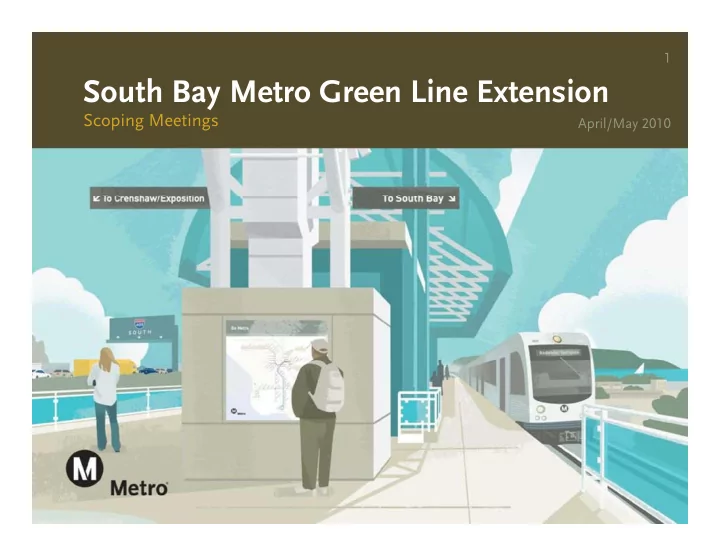
South Bay Metro Green Line Extension

Scoping Meetings

April/May 2010 1
slide-2
SLIDE 2

Agenda

  • Meeting Objectives
  • Project Overview
  • Alternatives Analysis Recap
  • Project Need and Objectives
  • Draft Environmental Impact Study (EIS)/Environmental

Impact Report (EIR) Alternatives

  • Evaluation Criteria and Environmental Issues
  • Comments

April/May 2010 2

slide-3
SLIDE 3

Scoping Meeting Objectives

  • First step in the environmental clearance process.

Consistent with:

– National Environmental Protection Act (NEPA) – California Environmental Quality Act (CEQA)

  • Scoping Meeting Objectives:

– Describe Draft EIS/EIR Process – Solicit Comments on:

  • Project need and objectives
  • Alternatives under consideration
  • Evaluation criteria / methodologies
  • Environmental issues to be addressed

April/May 2010 3

slide-4
SLIDE 4

Project Development Process

Environmental (EIS/EIR)

Alternatives Analysis

Where We Are Now

Engineering Completed December 2009 Construction Transit Service Future Phases

Five phases of project development:

April/May 2010 4

slide-5
SLIDE 5

Project History

  • 1990s-2008: Initial studies of Harbor Subdivision

ROW

  • Jun. 2008 – Nov. 2009: Harbor Subdivision

Alternatives Analysis (AA) Study analyzed transit alternatives along the Harbor Subdivision

  • Nov. 2008: Measure R approved, providing partial

funding for a Metro Green Line Extension

  • Dec. 2009: Metro Board approved AA Study results

and preparation of Draft EIS/EIR

  • Early 2010: Begin Draft EIS/EIR

April/May 2010 5

slide-6
SLIDE 6
  • Study Area:

– Downtown Los Angeles, Los Angeles International Airport (LAX), South Bay and the Harbor area

  • Initial Alternatives Examined Included:

– 6 bus and rail vehicle options – 25 routing / terminus options between Downtown, LAX and the Harbor area

  • Four Build Alternatives:

– Local North: Local service from Los Angeles Union Station (LAUS) to LAX – Local South: Local service from LAX to Harbor area – Regional: Regional service from LAUS to Harbor area – Express: Express (non-stop) service from LAUS to LAX

  • Phased Implementation Strategy:

– Priority 1: Local South Alternative from Metro Green Line Redondo Beach (Marine) Station to Torrance RTC

April/May 2010 6

Harbor Subdivision Alternatives Analysis

slide-7
SLIDE 7

South Bay Metro Green Line Extension

  • 29 square-mile Study Area from LAX area

through South Bay to Torrance

  • Includes portions of nine jurisdictions:

– Inglewood – Los Angeles – El Segundo – Hawthorne – Manhattan Beach – Lawndale – Redondo Beach – Torrance – Unincorporated Los Angeles County

  • Lennox
  • Del Aire

April/May 2010 7

slide-8
SLIDE 8

Transit Projects in Measure R

  • The South Bay

Metro Green Line Extension is included in Measure R

slide-9
SLIDE 9

Draft EIS/EIR

What are we analyzing?

April/May 2010 9

slide-10
SLIDE 10

EIS/EIR Purpose/Process

  • Draft EIS/EIR:

– Define/refine alternatives – Study potential benefits/impacts of alternatives – Evaluate measures to avoid, minimize and mitigate reasonable adverse impacts – Selection of a Locally Preferred Alternative (LPA) by the Metro Board

  • Final EIS/EIR:

– Response to comments received after circulation of Draft EIS/EIR – Response to potential engineering issues

April/May 2010 10

slide-11
SLIDE 11

Project Need

  • Access to Major Activity Centers
  • Heavy Traffic Congestion (Arterials and Freeways)
  • Long Transit Travel Times
  • Transit Schedule Reliability
  • Challenging Transit Connections
  • Limited Access to the Metro Rail System

April/May 2010 11

slide-12
SLIDE 12

Project Objectives

  • Improve mobility in South Bay area by introducing high-

frequency transit service options

  • Enhance the transit network by providing more direct

connections to travel destinations

  • Provide an alternative mode of transportation for commuters

using the congested I-405 corridor

  • Improve transit accessibility for residents along the corridor
  • Encourage a mode shift to transit, reducing air pollution and

greenhouse gas emissions

April/May 2010 12

slide-13
SLIDE 13

Alternatives

  • No Build
  • Transportation Systems Management (TSM)
  • Light Rail
  • Freight Track

April/May 2010 13

slide-14
SLIDE 14

No Build and TSM Alternatives

No Build:

  • Represents the Study Area in 2035

if the Project is not built

  • Includes all existing highway and

transit services and facilities, and the committed highway and transit projects specified in:

– Southern California Association of Governments (SCAG) 2008 Regional Transportation Plan (RTP) – Metro 2009 Long Range Transportation Plan (LRTP)

TSM:

  • Low cost improvements to the No

Build

  • Includes:

– Intersection improvements – Signal synchronization – Rapid bus line that resembles service of the Build Alternatives

14 April/May 2010

slide-15
SLIDE 15

Light Rail Alternative Route & Stations

  • Extend Metro Green Line 4.6 miles from

existing Redondo Beach (Marine) Station to proposed Torrance Regional Transit Center (RTC)

  • Operate on two light rail tracks next to

existing freight track within Harbor Subdivision ROW

  • Serve up to four new stations with bus

transfer facilities and potential park-and- ride lots:

– Manhattan Beach/Inglewood – Redondo Beach RTC – Hawthorne/190th – Torrance RTC April/May 2010 15

slide-16
SLIDE 16

Light Rail Alternative Vehicles

  • Electrically powered by overhead wires
  • Vehicles can be linked together to accommodate up to 500

passengers per 3-car train

  • Requires traction power substations every mile along

tracks

  • LRT vehicles already operate on existing Metro Blue, Green

and Gold Lines and will operate on the planned Crenshaw/LAX Transit Corridor

April/May 2010 16

slide-17
SLIDE 17

Freight Track Alternative Route & Stations

  • 8.7-mile rail line from LAX area to

proposed Torrance RTC

  • Operate on upgraded freight track in

the Harbor Subdivision ROW

  • Serve up to four new stations with

bus transfer facilities and potential park-and-ride lots:

– Century/Aviation or Aviation/LAX – Douglas or Redondo Beach (Marine) – Redondo Beach RTC – Torrance RTC

April/May 2010 17

slide-18
SLIDE 18

Freight Track Alternative Vehicles

  • Light Self-Propelled Railcar (SPR)

– Railcars powered by non-electric sources (diesel, fuel cell, hybrid technology, etc.) – Cannot operate at same time as freight – freight service would be moved to late night/early morning hours – Accommodates up to 675 passengers per three-car train – Example: Sprinter (San Diego County)

  • Freight-Compatible SPR

– Similar to Light SPR, but heavier vehicles that can operate at same time as freight – Accommodates up to 380 passengers per three-car train – Example: Westside Express Service (Portland)

  • Commuter Rail Transit (CRT)

– Locomotives pushing or pulling unpowered passenger coaches – Can operate at same time as freight – Accommodates up to 426 passengers per three-car train – Example: Metrolink

April/May 2010 18

slide-19
SLIDE 19

Evaluation Criteria

  • Transportation System

Performance

  • Travel Time Reliability
  • System Connectivity
  • Intermodal Compatibility
  • Accessibility
  • Vehicle Efficiency
  • Cost Effectiveness
  • Capital & Operating Costs
  • Ridership & User Benefits
  • Financial Feasibility
  • Community Acceptability
  • Service Attractiveness
  • Community Integration
  • Public Meeting Input
  • Environmental Benefits & Impacts
  • Acquisitions / Relocations
  • Construction Impacts
  • Traffic / Intersection Operations
  • Air Quality
  • Visual / Aesthetics
  • Noise / Vibration
  • Economic Development
  • Cultural Resources
  • Parklands
  • Equity / Environmental Justice
  • Safety / Security
  • Transit-Supportive Land Use

19 April/May 2010

slide-20
SLIDE 20

Environmental Issues to be Studied

  • Transportation
  • Land Use & Development
  • Real Estate & Acquisitions
  • Communities & Neighborhoods
  • Visual & Aesthetics
  • Air Quality
  • Noise & Vibration
  • Ecosystems & Biological

Resources

  • Geotechnical / Subsurface /

Seismic / Hazardous Materials

  • Water Resources
  • Energy
  • Historical, Archaeological &

Paleontological Resources

  • Parklands & Community

Facilities

  • Economic Development &

Fiscal

  • Safety & Security
  • Construction Impacts
  • Growth Inducing Impacts
  • Environmental Justice
  • Climate Change
  • Cumulative Impacts

April/May 2010 20

slide-21
SLIDE 21

Scoping Meetings

  • April 26, 2010, 6-8 PM

– Nakano Theater, 3330 Civic Center Dr, Torrance, 90503

  • April 28, 2010, 6-8 PM

– North Redondo Senior Center, Perry Park, 2308 Rockefeller Ln, Redondo Beach, 90278

  • May 1, 2010, 10 AM – 12 PM

– Lawndale City Hall, 14717 Burin Ave, Lawndale, 90260

  • May 5, 2010, 6-8 PM

– Automobile Driving Museum, 610 Lairport St, El Segundo, 90245

April/May 2010 21

slide-22
SLIDE 22

Opportunities to Provide Input

Please submit comments by May 28, 2010

April/May 2010 22

  • By Email:

southbayextension@metro.net

  • On the web at:

http://www.metro.net/projects/ southbayextension (Click on “Contact Us”)

  • On Facebook at:

South Bay Metro Green Line Extension

  • Complete Comment Card at Meeting
  • By Mail:

Randy Lamm, Project Manager One Gateway Plaza – MS 99-22-3 Los Angeles, CA 90012

  • By Phone:

(213) 922-4004

slide-23
SLIDE 23

Your Turn to Comment

  • Comments

– Please restrict comments to two minutes

  • Key topics we want to hear about:

– Purpose and Need for Transit Improvements – Alternatives to be Evaluated – Benefits/Impacts to be Evaluated

April/May 2010 23