Source: Connected Water, Commonwealth Government Surface Water - - PowerPoint PPT Presentation
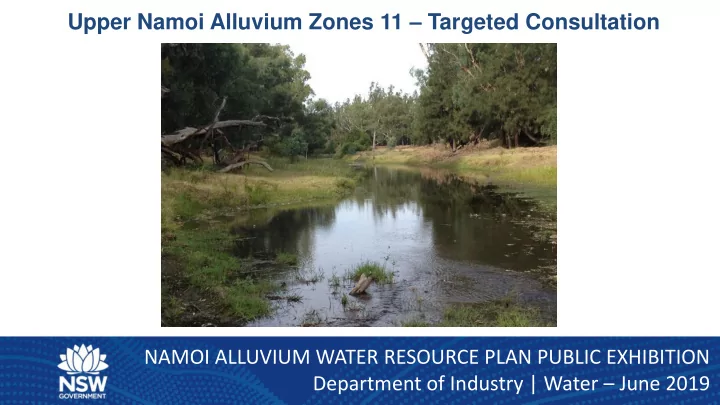
Upper Namoi Alluvium Zones 11 Targeted Consultation NAMOI ALLUVIUM WATER RESOURCE PLAN PUBLIC EXHIBITION Department of Industry | Water June 2019 Source: Connected Water, Commonwealth Government Surface Water Groundwater Interaction
Surface Water – Groundwater Interaction
Source: Connected Water, Commonwealth Government
Mechanisms for impact:
- 1. Reduction in baseflow
- 2. Increase in losses
- 3. Reversal of baseflow to
losses The magnitude and timing of impacts variable according to:
- 1. Total extracted volume
- 2. Rates of extraction
- 3. Distance of bore from river
Source: Connected Water, Commonwealth Government
Rainfall Residual Mass
Upper Namoi Zone 11
Hydrograph – Maules Creek Rd
Hydrograph – Therribri Rd
Hydrograph – Elfin Crossing
Hydrograph – Green Gully
Hydrograph – Thornfield Crossing
Comparison of Groundwater and Surface Water Levels with Average Rainfall
GW967137 Pipe 1 Screens: 8 – 11 m
Cease to Flow Height
Upper Namoi Zone 11
- Independent research by the University of New South Wales shows:
- Monitoring bores upstream of Elfin Crossing show significant connection/
influence from surface water
Upstream of Elfin Crossing Maules Creek is gaining Downstream of Elfin Crossing Maules Creek losing Adjacent to Elfin Crossing There is a series of perennial or near-perennial pools
Prior temporary water restrictions in Zone 11
- Temporary water restrictions on groundwater pumping applied from 2007-
2010 under section 323 of the WMA 2000 (replaced by section 324 in 2009).
- Applied to 15 licence holders - restricted groundwater pumping from
groundwater bores (other than domestic and stock bores) as follows:
- When surface flows in Maules Creek (Elfin Crossing) were less than 1
ML/day - pumping was limited to 12 hours/day.
- Flows ceased in Maules Creek - pumping restricted to 4 hours/day.
More recent concerns in Zone 11
- Concern regarding the equity in access to the surface
water and groundwater resources between all water users, including:
- Users of the pool at Elfin Crossing,
- landholders with basic rights,
- Irrigators, and
- Near-by coal mines (through indirect inflow)
Surface Water / Groundwater Connectivity Macro Approach
Water sharing plans (WSP) that commenced post 2009 included a method to assess surface water - groundwater (SW-GW) connectivity categories. Three criteria for determining areas of high hydraulic connectivity: a) Average width of the groundwater source of no more than 4 km b) Average saturated thickness of no more than 30 m c) Sufficiently shallow water table in the groundwater source to be connected to the associated surface water.
Surface Water / Groundwater Connectivity Macro Approach
Where considered ‘Highly connected’; the principles are used to specify which types of management rules used to manage the SW-GW connectivity:
- 1. ‘Highly connected’ classified as - where 70% or more of the groundwater extracted is from
surface water within an irrigation season. All other systems are considered ‘less highly connected’.
- 2. Highly connected alluvial systems within a regulated river system - link Available Water
Determinations (AWDs) for the groundwater to the AWDs for the surface water.
- 3. Highly connected alluvial systems within perennial unregulated systems - daily access
rules linking their management to the associated unregulated surface water daily access rules. Non-perennial systems will have groundwater only rules.
Stream Depletion from Groundwater Pumping
10 20 30 40 50 60 70 80 90 100 1 2 3 4 5 6 7 8 9 10 11 12 13 14 15 16 17 18 19 20 21 22 23 24 25 26 27 28 29 30 31 32 33 34 35 36 37 % Loss from the River Time (months)
Variable Distance from River Aquifer (K =9.5 m/day, Sy =0.012, B = 15 m)]
100 200 300 400 500 600 800
If 70% impact on the river is the triggered then surface ater rules after: <4 weeks at 100 m 5 weeks at 200 m 11 weeks at 300 m 5 months at 400 m 7 months at 500 m 10 months at 600 m 19 months at 800 m
Zone 11 Proposed Plan Rules – Management Zone
Zone 11 Proposed Plan Rules
Option 1. The management rules that were applied between 2007 and 2010 in Maules Creek under the Section 324 Order:
- When the surface flows at Elfin Crossing were less than 1 ML/day, pumping of
near-by groundwater production bores was limited to 12 hours per day.
- When the flows ceased, pumping was restricted to 4 hours per day.
Option 2. Management rules similar to those in existing Plans:
- E.G: an aquifer access licence located in the Upper Namoi Zone 11 (Upstream Elfin
Crossing) Management Zone, must not take water after there has been zero flow in gauge 419051 for 14 consecutive days. Proposed management rules would apply to – any work approval linked to an access licence within the proposed Management Zone; Upper Namoi Zone 11 (Upstream Elfin Crossing) Management Zone only.
Application of 324 Order / Plan Management Rules to Induced Take by Mines
- The proposed rules are to manage short term impacts from pumping stresses on
surface water.
- Any restrictions will apply to bores linked to access licences authorised to take
groundwater in Zone 11.
- Induced take from Zone 11 resulting from mine pit activity would not be subject
to the proposed rules:
- Take is not from a bore.
- Induced take from mining is diffuse in both time and space.
- The impact of take from the mine assessed and authorised under the