
SLIDE 1
Sou
- uth C
Carol
- lina T
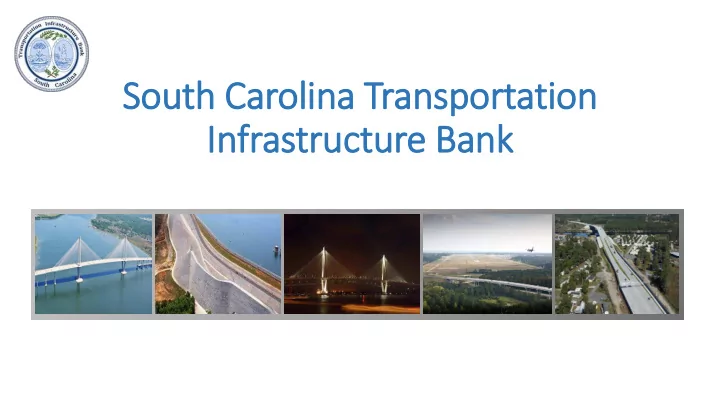
Sou outh C Carol olina T Transportation Infrastructure B Bank - - PowerPoint PPT Presentation
Sou outh C Carol olina T Transportation Infrastructure B Bank Introduction to the SCTIB South Carolina Transportation Infrastructure Bank Act was signed on June 26, 1997 Purpose of Act: To focus greater attention on larger
Introduction to the SCTIB
Transportation (SCDOT) to devote resources to maintenance of the existing state highway system and other important transportation projects
2016) by providing loans and other financial assistance ... for constructing and improving highway and transportation facilities necessary for public purposes including economic development
transportation infrastructure includes over 100 projects in 29 counties and 5 municipalities.
$1.48 billion of debt outstanding, and the outlook is stable. The credit opinion released on October 8, 2019, states, “ The Aa3 revenue bond rating is supported by a history of oversight from the State of South Carolina (Aaa, stable), which relies on the SCTIB to finance large road and bridge projects. The state consistently has allocated additional financial resources to SCTIB, both to ensure adequate debt service coverage for the revenue bonds and to help fund projects. SCTIB's recent upgrade was driven largely by our expectation the state will keep providing such support, while avoiding actions that materially erode the ratio of pledged revenue to debt service, indicating a closer credit alignment between the SCTIB and its parent government.”
2
SCTIB Staff
Staff and Management:
number of staff and by outsourcing. Seven Member Board of Directors:
John B. White, Jr. Ernest L. Duncan
Representative J. Gary Simrill Harry B. “Chip” Limehouse, III
Senator Hugh K. Leatherman, Sr. David Shehan
Currently three (3) full-time staff members: Tami Reed, Chief Financial Officer Jerri Butler, Accounting Manager Sheila Bryant, Accountant
3
1997 F Financia ial A l Assistance A e Applic pplicatio ion 5/ 5/12 12/20 /2008 Rev evis ised ed 12/15/ 5/16 R 16 Revise sed 8/ 8/7/20 7/2019 R 9 Revised ( (Curr rrent) 10/ 10/8/20 /2013 R 3 Revised 10/ 10/19 19/2 /2005 05 Rev evis ised ed 1997 S 1997 SCTIB A Act C Created
20 Points 5 requirements
40 Points 9 requirements
20 Points 5 requirements
20 Points
Eligibility defined as Major Project which provides public benefit.
30 Points 8 requirements
50 Points 11 requirements
20 Points 4 requirements
30 Points 10 requirements
50 Points 25 requirements
20 Points 4 requirements
50 Points 16 requirements
50 Points 24 requirements
30 Points 8 requirements
50 Points 25 requirements
20 Points 4 requirements Major Project re-defined as at least $25 million, projects cannot be combined to meet minimum.
30 Points 10 requirements
50 Points 25 requirements
20 Points 4 requirements
History of Application Refinement
4
Project Selection & Criteria
in one or more of the following areas: enhancement of mobility an safety; promotion of economic development; or, increase in the quality of life and general welfare of the public. Projects may not be combined to meet the minimum project cost of $25 million.
for each increase in the local contribution of 5% of the total project costs up to a maximum of 50 points.
points for each increase in the local contribution of 5% of the total project costs up to a maximum of 50 points.
5
54% 2% 44%
Project Funding Sources to Date
SCTIB Revenue Bonds State General Obligation Bonds for SCTIB SCTIB Highway Fund
Approved SCTIB Financial Assistance
Project Total SCTIB Contributions Aiken County* $208 Beaufort County* 65 Charleston County Ravenel Bridge* 325 Horry County Ride* 383 Jasper /Hardeeville Exit 3 I-95 1.3 Lexington County* 48 Median Barrier 30 SCDOT Statewide Bridge 12 Upstate GRID* 406 York County* 176.8 Berkeley County 8.5 Beaufort County SC 170 24.9 Berkeley County Sheep Island/I-26 21.5 Mount Pleasant 57.41 U.S. 17 Widening 102 Total
$1,869
Completed Projects ($ in millions)
Amount Paid to 11/30/2019 Charleston County Mark Clark* $420 $42 Florence County 309 286 Horry County 2007 Program 225 175 City of Aiken - Various Widenings 6.2 Dorchester County-Various widenings 23 17 Dorchester County-Berlin Myers 30 City of Charleston Septima Clark 88 31 Total $1,132 $551 Current Projects Approved by the Bank for Funding ($ in millions) Project Total SCTIB Contributions
*SCTIB, Charleston County and SCDOT entered into an Amended Intergovernmental Agreement dated January 10, 2019,
and on June 4, 2019, the Joint Bond Review Committee took action to authorize a $12 million dollar commitment from the Bank and a matching $12 million dollar commitment from the County to fund the remaining preliminary work reflected in the amended agreement.
* Original projects
6
SCTIB Master Revenue Bond Resolution Bond Flow of Revenues
System Payments Series Payments Pledged Revenue Fund Senior Lien Debt Service Fund
Principal Account Interest Account Debt Service Reserve Account
Junior Lien Debt Service Fund
Principal Account Interest Account Debt Service Reserve Account
Revenue Stabilization Fund* Projects Fund General Reserve Fund
The two largest components of the Pledged Revenues are System Payments and Series Payments
System Payments 74.2% Series Payments 25.8% Investment Earnings 0.3%
FY2019 Pledged Revenues
FY2019 Pledged Revenues were approximately $210.7 million, including $156.3 million of System Payments and $54.5 million of Series Payments
Pledged Revenues
1. System Payments, include portions of 4 streams of annually recurring revenues allocated to the Bank:
2. Series Payments include revenues received pursuant to certain loan agreements, including: 1. SCDOT Cooper River Bridge 2. SCDOT Multi Project Funding Agreement 3. SCDOT US 17 Project Payment
1 2 2 1
* The Revenue Stabilization Fund is established to ensure a proper
matching, over time, of System Payments and Annual Net Debt
Truck Registration Fees (“TRF”) and penalties in determining (i) the amount of any required deposit into the RSF, or (ii) the amount of any available transfer from the RSF to the Pledged Revenue Fund.
7
Sources of Revenues for Existing SCTIB Bonds – System Revenues
Fiscal Motor Vehicle Wholesale Electric State Truck Total System Year Registration Fees Power Funds Highway Funds Registration Fees Payments 2010 35,813,672 4,109,516 25,671,014 58,805,091 124,399,293 2011 37,901,362 4,197,737 25,857,527 60,093,311 128,049,937 2012 37,570,955 3,581,762 26,100,142 61,769,704 129,022,563 2013 39,271,026 3,415,698 26,055,312 61,964,721 130,706,757 2014 39,463,422 3,746,976 26,534,357 65,494,147 135,238,902 2015 41,224,566 4,241,590 27,443,640 67,539,769 140,449,565 2016 41,082,751 4,081,976 28,383,414 71,745,820 145,293,961 2017 42,281,984 4,139,134 28,792,520 71,840,209 147,053,847 2018 42,837,844 4,501,616 28,441,793 76,362,296 152,143,549 2019 44,573,660 4,538,271 28,586,311 78,584,888 156,283,131
50 100 150 2010 2011 2012 2013 2014 2015 2016 2017 2018 2019
Millions
Annual System Payments
Motor Vehicle Registration Fees Wholesale Electric Power Funds State Highway Funds
state tax revenue sources available to SCDOT an amount equal to revenues produced by 1 cent per gallon of gasoline tax
Reimbursement Funds
South Carolina Code
in each state
the South Carolina Code
million in FY 2008 from non-state tax funds
10-Year Historical System Revenues
8
Sources of Revenues for Existing SCTIB Bonds – Series Payments
Horry Horry Horry Lexington SCDOT SCDOT SCDOT County County County County Conway Conway Cooper SCDOT SCDOT SCDOT Total Fiscal Loan I Insured Uninsured Loan Bypass Bypass River US 17 Loan Exchange Series Year Payments Loan II Loan II Payments Loan I Loan II Bridge Project Payments Payments Payments 2010 15,000,000 10,400,000 5,900,000 7,600,000 8,000,000 4,979,751 10,000,000 2,815,081 64,694,832 2011 15,000,000 11,500,000 5,900,000 7,600,000 8,000,000 4,979,751 10,000,000 2,843,684 65,823,435 2012 15,000,000 12,600,000 5,900,000 7,600,000 8,000,000 4,979,751 10,000,000 2,917,432 66,997,183 2013 15,000,000 13,900,000 5,900,000 7,600,000 8,000,000 4,979,751 10,000,000 2,838,129 68,217,880 2014 15,000,000 15,200,000 5,900,000 7,600,000 8,000,000 4,979,751 10,000,000 2,807,654 69,487,405 2015 15,000,000 16,800,000 7,600,000 8,000,000 4,979,751 10,000,000 2,527,960 64,907,711 2016 15,000,000 17,600,000 7,600,000 8,000,000 4,979,751 10,000,000 3,272,718 66,452,469 2017 15,000,000 7,600,000 8,000,000 4,979,751 10,000,000 4,693,476 50,273,227 2018 19,177,658 7,600,000 8,000,000 4,979,751 10,000,000 4,693,476 54,450,885 2019 19,177,658 7,600,000 8,000,000 4,979,751 10,000,000 4,693,476 54,450,885
10-Year Historical Series Payments
Multi-Project Funding Agreement
and apply such funds toward required Bank payments
Highway Reimbursement Funds, or if such Funds are insufficient, other non-state tax revenues of the Department
9
SCTIB Revenue Bonds
debt service savings (net of all fees) through the refunding of outstanding bonds which equates to $445 million gross savings
40 60 80 100 120 140 160 2016 2017 2018 2019 2020 2021 2022 2023 2024 2025 2026 2027 2028 2029 2030 2031 2032 2033 2034 2035 2036 2037 2038 2039 2040 2041 Millions
Outstanding Debt Service
Outstanding Debt 2003B (Reoffered June 2019) 2019A
10
Project Funding Capacity – $280 million Cash on Hand
may become available for projects over the following 5 year horizon
11
Total Project Funding Capacity - $380 million Bonding Capacity
Payments Revenue Growth Estimates
escalation
rates*
service coverage of 1.45 times
the SCTIB could bond fund approximately $380 million of additional project costs via a public debt issuance in the coming year
12
*Analysis based on ‘A’ rated Revenue Bond yields per TM3 as of /12/2019
Future Funding Capacity (above approved SCTIB funding commitments)
coming months.
revenue bonds to add a series payment
tax
principal amount of the bonds outstanding
13
*Refer to the Master Bond Resolution for Series Payment requirements
Project History
14
1997 2019
Cash and Cash Equivalents
15
Cash and Cash Equivalents, Bond Issues and Debt Service
16
Implementation of ACT 275 / ACT 40
as the various revenues associated with loan agreements entered into by the Bank
275 / 40 while achieving the following objectives: ‒ Maximum flexibility to SCDOT to manage project construction program ‒ SCTIB to function as a conduit issuer with respect to Acts 275 / 40; Separate lien from SCTIB’s existing revenue bond program ‒ Maintain solid credit ratings for new Act 275 / 40 revenue bonds ‒ Structure should protect the credit of existing SCTIB Revenue Bonds ‒ Flexibility to optimize timing and structure of SCTIB Acts 275 / 40 revenue bonds to fund related projects ‒ Flexibility to continue and manage existing SCTIB program, including that SCTIB and SCDOT could enter into more loan agreements for additional projects under the existing Bank structure
*Act 275 made several substantive changes to the original SCTIB ACT (e.g. $25 million threshold to qualify as a “major project”; no local match requirement for certain bridge and road projects identified by SCDOT; enhanced role of SCDOT Commission in project selection). 17
18
SCTIB Acts and Board Actions
Act No. 148 of 1997, effective June 26, 1997 Established the SCTIB to finance the cost of major transportation infrastructure projects. Provided for the establishment of four Bank funds: the state highway account, state transit account, federal highway account, and federal transit account. Permitted the Bank to issue bonds pledged to Bank revenues and general obligation bonds. Provided that qualified borrowers could pledge and assign certain revenues to secure their obligations to the Bank for qualified projects. Provided that, beginning in fiscal year 1998-1999, revenues collected pursuant to S.C. Code Ann. §§ 56-3-660 and 56-3-670 (i.e., “truck fees”) would be used to provide capital for the Bank. Provided that Bank could provide funding to eligible projects it had selected to be qualified to receive financial assistance; the Bank must consider projected feasibility and the amount and degree of risk assumed by the Bank, and may consider six other
Act No. 100 of 1999, effective July 1, 1999 Appropriations bill that changed a previous funding mechanism of three percent of funds for state highway maintenance to a
Act No. 184 of 2004, effective March 15, 2004 Minor modification to wording of prohibition on issuing general obligation bonds unless there are sufficient revenues to cover principal and interest. Modification to wording of general obligation bond language to strengthen ability of state treasurer to pay principal and interest from general tax revenues.
19
SCTIB Acts and Board Actions Cont.
Act No. 176 of 2006, effective June 14, 2005 Modified S.C. Code Ann. § 56-3-910 to provide that all fees and penalties collected by DOT must be placed in the state highway account of the Bank (except for those otherwise allocated by law) Modified S.C. Code Ann. § 12-28-2915(B)(2) to provide that DOT must make an annual contribution from nonstate tax sources to the State Highway Account of the Bank Act No. 98 of 2013, July 1, 2013 Provided for the annual transfer of $50 million of non-tax revenues from the DOT to the Bank for “bridge replacement, rehabilitation projects, and expansion and improvements to existing mainline interstates.” Act No. 121 of 2014, effective July 1, 2015 Changed State Budget and Control Board to State Fiscal Accountability Authority for purposes of issuing general obligation bonds. Act No. 275 of 2016, effective July 1, 2016 Required approval by the DOT Commission before Bank can provide financial assistance. Required that the Bank prioritize all projects according to the prioritization criteria provided at S.C. Code Ann. § 57-1- 370(B)(8); these prioritization criteria is a new, subsequent step to the Bank finding that an eligible project is a project qualified to receive funding from the Bank pursuant to S.C. Code Ann. § 11-43-180(B). Provided that the General Assembly can enact a joint resolution allowing the Bank to fund a project without using the prioritization criteria. Placed a minimum on projects funded by the Bank of $25 million. Created a revenue stream from the various DOT fees and fines to be credited to the State Highway Fund, some funds of which may be allocated to the Bank for certain bridge and road projects identified by DOT.
20
SCTIB Acts and Board Actions Cont.
Act No. 40 of 2017, effective May 10, 2017 Repealed S.C. Code Ann. § 11-43-165, which had provided for $50 million in annual revenues from the DOT for certain types
Somewhat minor statutory changes impacting the Bank; primary impact was to DOT Commission and establishment of Infrastructure Maintenance Trust Fund. Bank Board Action, October 24, 2018 Board voted to adopt Evaluation Committee’s recommendation that it hold consideration of pending applications in abeyance until litigation against Act Nos. 275 and 40 Bank Board Action, March 25, 2019 Board voted to adopt Evaluation Committee’s recommendation to adopt the Revised Policy & Prioritization Process. Act No. 1 of 2019, effective January 31, 2019 Minor modifications to language related to board appointments.
21
Glossary
FHWA – Federal Highways Administration JBRC – Joint Bond Review Committee Restricted cash and cash equivalents - Generally, under the applicable bond indentures, the earnings and receipts of loans and certain receivables are required to be used for the related bonds payable debt service payment. Because these assets are generally restricted for this purpose, they have been reflected in the restricted portion of the financial statements. SCDOT – South Carolina Department of Transportation SCTIB/Bank – South Carolina Transportation Infrastructure Bank STO – State Treasurer’s Office Unrestricted cash and cash equivalents - Holds no restriction regarding their usage. The agency uses these funds to pay general expenses or to pay project expenses.