Sorting Almost half of all CPU cycles are spent on sorting! Input: - - PowerPoint PPT Presentation

sorting
SMART_READER_LITE
LIVE PREVIEW

Sorting Almost half of all CPU cycles are spent on sorting! Input: - - PowerPoint PPT Presentation

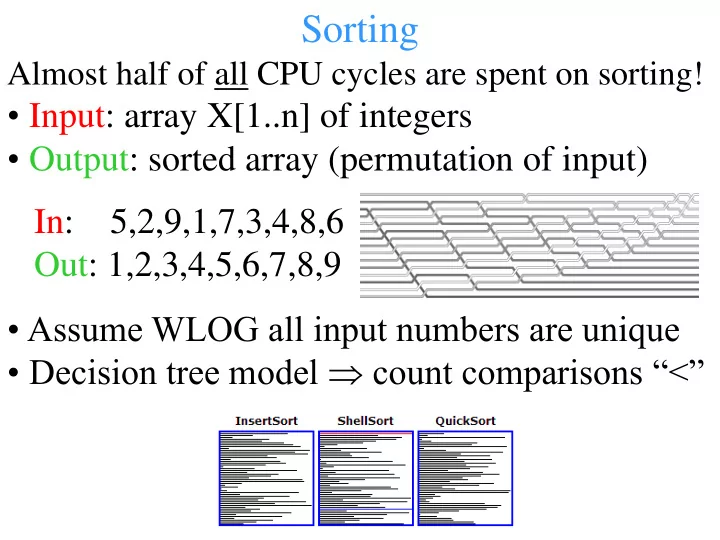
Sorting Almost half of all CPU cycles are spent on sorting! Input: array X[1..n] of integers Output: sorted array (permutation of input) In: 5,2,9,1,7,3,4,8,6 Out: 1,2,3,4,5,6,7,8,9 Assume WLOG all input numbers are unique


slide-1
SLIDE 1

Sorting

Almost half of all CPU cycles are spent on sorting!

  • Input: array X[1..n] of integers
  • Output: sorted array (permutation of input)

In: 5,2,9,1,7,3,4,8,6 Out: 1,2,3,4,5,6,7,8,9

  • Assume WLOG all input numbers are unique
  • Decision tree model  count comparisons “<”
slide-2
SLIDE 2

Lower Bound for Sorting

Theorem: Sorting requires W(n log n) time Proof: Assume WLOG unique numbers  n! different permutations  comparison decision tree has n! leaves  tree height >  W(n log n) decisions / time necessary to sort

< < < < < < < < < < < < < < < n! permutations (i.e., distinct sorted outcomes ) W(n log n)

n) log (n e n log n e n log ) (n! log

n

W                        

Unique execution path

slide-3
SLIDE 3
  • 1. AKS sort
  • 2. Bead sort
  • 3. Binary tree sort
  • 4. Bitonic sorter
  • 5. Block sort
  • 6. Bogosort
  • 7. Bozo sort
  • 8. Bubble sort
  • 9. Bucket sort
  • 10. Burstsort
  • 11. Cocktail sort
  • 12. Comb sort
  • 13. Counting sort
  • 14. Cubesort
  • 15. Cycle sort
  • 16. Flashsort

Sorting Algorithms (Sorted!)

  • 17. Franceschini's sort
  • 18. Gnome sort
  • 19. Heapsort
  • 20. In-place merge sort
  • 21. Insertion sort
  • 22. Introspective sort
  • 23. Library sort
  • 24. Merge sort
  • 25. Odd-even sort
  • 26. Patience sorting
  • 27. Pigeonhole sort
  • 28. Postman sort
  • 29. Quantum sort
  • 30. Quicksort
  • 31. Radix Sort
  • 32. Sample sort
  • 33. Selection sort
  • 34. Shaker sort
  • 35. Shell sort
  • 36. Simple pancake sort
  • 37. Sleep sort
  • 38. Smoothsort
  • 39. Sorting network
  • 40. Spaghetti sort
  • 41. Splay sort
  • 42. Spreadsort
  • 43. Stooge sort
  • 44. Strand sort
  • 45. Timsort
  • 46. Tree sort
  • 47. Tournament sort
  • 48. UnShuffle Sort
slide-4
SLIDE 4

Q: Why so many sorting algorithms? A: There is no “best” sorting algorithm! Some considerations:

  • Worst case?
  • Average case?
  • In practice?
  • Input distribution?
  • Near-sorted data?
  • Stability?
  • In-situ?
  • Randomized?
  • Stack depth?
  • Internal vs. external?
  • Pipeline compatible?
  • Parallelizable?
  • Locality?
  • Online

Sorting Algorithms

slide-5
SLIDE 5
  • What approaches fail?
  • What techniques work and why?
  • Lessons and generalizations

Problem: Given n pairs of integers (xi,yi), where 0≤xi≤n and 1≤yi≤n for 1≤i≤n, find an algorithm that sorts all n ratios xi / yi in linear time O(n).

slide-6
SLIDE 6
  • What approaches fail?
  • What techniques work and why?
  • Lessons and generalizations

Problem: Given n integers, find in O(n) time the majority element (i.e., occurring ≥ n/2 times, if any).

slide-7
SLIDE 7
  • What approaches fail?
  • What techniques work and why?
  • Lessons and generalizations

Problem: Given n objects, find in O(n) time the majority element (i.e., occurring ≥ n/2 times, if any), using only equality comparisons (=).

slide-8
SLIDE 8
  • What approaches fail?
  • What techniques work and why?
  • Lessons and generalizations

Problem: Given n integers, find both the maximum and the next-to-maximum using the least number of comparisons (exact comparison count, not just O(n)).

slide-9
SLIDE 9

Input: array X[1..n] of integers Output: sorted array (monotonic permutation) Idea: keep swapping adjacent pairs

  • O(n2) time worst-case,

but sometimes faster

  • Adaptive, stable, in-situ, slow

Bubble Sort

until array X is sorted do for i=1 to n-1 if X[i+1]<X[i] then swap(X,i,i+1)

slide-10
SLIDE 10

Input: array X[1..n] of integers Output: sorted array (monotonic) Idea: swap even and odd pairs

  • O(n2) time worst-case,

but faster on near-sorted data

  • Adaptive, stable, in-situ, parallel

Odd-Even Sort

until array X is sorted do for even i=1 to n-1 if X[i+1]<X[i] swap(X,i,i+1) for odd i=1 to n-1 if X[i+1]<X[i] swap(X,i,i+1)

Nico Habermann

slide-11
SLIDE 11

Input: array X[1..n] of integers Output: sorted array (monotonic permutation) Idea: move the largest to current pos

  • Q(n2) time worst-case
  • Stable, in-situ, simple, not adaptive
  • Relatively fast (among quadratic sorts)

Selection Sort

for i=1 to n-1 let X[j] be largest among X[i..n] swap(X,i,j)

slide-12
SLIDE 12
  • Input: array X[1..n] of integers
  • Output: sorted array (monotonic permutation)

Idea: insert each item into list

  • O(n2) time worst-case
  • O(nk) where k is max dist of

any item from final sorted pos

  • Adaptive, stable, in-situ, online

Insertion Sort

for i=2 to n insert X[i] into the sorted list X[1..(i-1)]

slide-13
SLIDE 13

Input: array X[1..n] of integers Output: sorted array (monotonic) Idea: exploit a heap to sort

  • Q(n log n) optimal time
  • Not stable, not adaptive, in-situ

Heap Sort

InitializeHeap For i=1 to n HeapInsert(X[i]) For i=1 to n do M=HeapMax; Print(M) HeapDelete(M)

J.W.J. Williams Robert Floyd

slide-14
SLIDE 14

SmoothSort

Input: array X[1..n] of integers Output: sorted array (monotone) Idea: adaptive heapsort

  • Uses multiple (Leonardo) heaps
  • O(n log n)
  • O(n) if list is mostly sorted
  • Not stable, adaptive, in-situ

Edsger Dijkstra

InitializeHeaps for i=1 to n HeapsInsert(X[i]) for i=1 to n do M=HeapsMax; Print(M) HeapsDelete(M)

slide-15
SLIDE 15

Historical Perspectives

Edsger W. Dijkstra (1930-2002)

  • Pioneered software engineering, OS design
  • Invented concurrent programming,

mutual exclusion / semaphores

  • Invented shortest paths algorithm
  • Advocated structured (GOTO-less) code
  • Stressed elegance & simplicity in design
  • Won Turing Award in 1972
slide-16
SLIDE 16

Quotes by Edsger W. Dijkstra (1930-2002)

  • “Computer science is no more about computers

than astronomy is about telescopes.”

  • “If debugging is the process of removing software bugs,

then programming must be the process of putting them in.”

  • “Testing shows the presence, not the absence of bugs.”
  • “Simplicity is prerequisite for reliability.”
  • “The use of COBOL cripples the mind; its teaching should,

therefore, be regarded as a criminal offense.”

  • “Object-oriented programming is an exceptionally bad idea

which could only have originated in California.”

  • “Elegance has the disadvantage, if that's what it is, that hard work

is needed to achieve it and a good education to appreciate it.”

Edsger Dijkstra

slide-17
SLIDE 17

InitializeHeap For i=1 to n HeapInsert(X[i]) For i=1 to n do M=HeapMax; Print(M) HeapDelete(M)

Generalizing Heap Sort

InitializeTree For i=1 to n TreeInsert(X[i]) For i=1 to n do M=TreeMax; Print(M) TreeDelete(M)

Input: array X[1..n] of integers Output: sorted array

  • Observation: other data structures can work here!
  • Ex: replace heap with any height-balanced tree
  • Retains O(n log n) worst-case time!
slide-18
SLIDE 18

Input: array X[1..n] of integers Output: sorted array (monotonic) Idea: populate a tree & traverse

  • Use balanced tree (AVL, B, 2-3, splay)
  • O(n log n) time worst-case
  • Faster for near-sorted inputs
  • Stable, adaptive, simple

Tree Sort

InitializeTree for i=1 to n TreeInsert(X[i]) traverse tree in-order to produce sorted list

slide-19
SLIDE 19

B-Tree Sort

  • Multi-rotations occur infrequently
  • Rotations don’t propagate far
  • Larger tree fewer rotations
  • Same for other height-balanced trees
  • Non-balanced search trees average O(log n) height
slide-20
SLIDE 20

AVL-Tree Sort

  • Multi-rotations occur infrequently
  • Rotations don’t propagate far
  • Larger tree fewer rotations
  • Same for other height-balanced trees
  • Non-balanced trees average O(log n) height
slide-21
SLIDE 21

Input: array X[1..n] of integers Output: sorted array (monotonic) Idea: sort sublists & merge them

  • T(n)=2T(n/2)+n=Q(n log n) optimal!
  • Stable, parallelizes, not in-situ
  • Can be made in-situ & stable

Merge Sort

MergeSort(X,i,j) if i<j then m=(i+j)/2 MergeSort(X,i..m) MergeSort(X,m+1..j) Merge(X,i..m,m+1..j)

John von Neumann

slide-22
SLIDE 22

Theorem: MergeSort runs within time Q(n log n) which is optimal. Proof: Even-split divide & conquer: T(n) = 2·T(n/2) + n Total time is O(n log n); W(n log n)  Q(n log n)

Merge Sort

John von Neumann

n/2 n/2 n/8 n/8 n/8 n/8 n/8 n/8 n/8 n/8 n/4 n/4 n/4 n/4 1 1 … 1 … 1 1 1

… …

n total / level log n levels

  • f recursion

n

slide-23
SLIDE 23

Input: array X[1..n] of integers Output: sorted array (monotonic) Idea: sort two sublists around pivot

  • Q(n log n) time average-case
  • Q(n2) worst-case time (rare)
  • Unstable, parallelizes, O(log n) space
  • Ave: only beats Q(n2) sorts for n>40

Quicksort

QuickSort(X,i,j) If i<j Then p=Partition(X,i,j) QuickSort(X,i,p) QuickSort(X,p+1,j)

Tony Hoare

slide-24
SLIDE 24

Input: array X[1..n] of integers Output: sorted array (monotonic) Idea: generalize insertion sort

  • Array is sorted after last pass (hi=1)
  • Long swaps quickly reduce disorder
  • O(n2), O(n3/2), O(n4/3), … ?
  • Complexity still open problem!
  • LB is W(N(log/log log n) 2)
  • Not stable, adaptive, in-situ

Shell Sort

for each hi in sequence hk,…,h1=1 Insertion-sort all items hi apart

Donald Shell

slide-25
SLIDE 25

Input: array X[1..n] of integers in small range 1..k Output: sorted array (monotonic)

Idea: use values as array indices

  • Q(n) time, Q(k) space
  • Not comparison-based
  • For specialized data only
  • Stable, parallel, not in-situ

Counting Sort

for i=1 to k do C[i] = 0 for i=1 to n do C[X[i]]++ for i=1 to k do if C[i]  0 then print(i) C[i] times

Harold Seward

slide-26
SLIDE 26

Q: Why not use counting sort for arbitrary 32-bit integers? (i.e., range k is “fixed”) A: Range is fixed (232) but very large (4,294,967,296). Space/time: the counts array will be huge (4 GB) Much worse for 64-bit integers (264> 1019): Time: 5 GHz PC will take over 264 / (5·109) / (60·60·24·365) sec >116 years to initialize array! Memory: 264>1019> 18 Exabytes 2.3 million TB RAM chips!  total amount of Google’s data! Q: What’s an Exabyte? (1018)

Counting Sort

Harold Seward

slide-27
SLIDE 27

What does an Exabyte look like?

slide-28
SLIDE 28

What does an Exabyte look like?

slide-29
SLIDE 29

What does an Exabyte look like?

slide-30
SLIDE 30

What does an Exabyte look like?

slide-31
SLIDE 31

What does an Exabyte look like?

slide-32
SLIDE 32

What does an Exabyte look like?

slide-33
SLIDE 33

What does an Exabyte look like?

  • All content of Library of Congress: ~ 0.001 Exabytes
  • Total words ever spoken by humans:

~ 5 Exabytes

  • Total data stored by Google:

~ 15 Exabytes

  • Total monthly world internet traffic: ~ 110 Exabytes
  • Storage capacity of 1 gram of DNA: ~ 455 Exabytes
slide-34
SLIDE 34

Orders-of-Magnitude

Standard International (SI) quantities:

Deca 101 Hecto 102 Kilo 103 Mega 106 Giga 109 Tera 1012 Peta 1015 Exa 1018 Zetta 1021 Yotta 1024 Deci 10-1 Centi 10-2 Milli 10-3 Micro 10-6 Nano 10-9 Pico 10-12 Femto 10-15 Atto 10-18 Zepto 10-21 Yocto 10-24

slide-35
SLIDE 35

Orders-of-Magnitude

  • “Powers of Ten”, Charles and Ray Eames, 1977
slide-36
SLIDE 36

Orders-of-Magnitude

  • “Scale of the Universe”, Cary and Michael Huang, 2012
  • 10-24 to 1026 meters  50 orders of magnitude!
slide-37
SLIDE 37

Input: array X[1..n] of real numbers in [0,1] Output: sorted array (monotonic)

Idea: spread data among buckets

  • O(n+k) time expected, O(n) space
  • O(Sort) time worst-case
  • Assumes subtantial data uniformity
  • Stable, parallel, not in-situ
  • Generalizes counting sort / quicksort

Bucket Sort

for i=1 to n do insert X[i] into bucket n·X[i] for i=1 to n do Sort bucket i concatenate all the buckets

0.0-0.2 0.2-0.4 0.4-0.6 0.6-0.8 0.8-1.0

slide-38
SLIDE 38

Bucket Sort

Q: How does bucket sort generalize counting sort? Quicksort?

slide-39
SLIDE 39

Input: array X[1..n] of integers each with d digits in range 1..k Output: sorted array (monotonic)

Idea: sort each digit in turn

  • Makes d calls to bucket sort
  • Q(d·n) time, Q(k+n) space
  • Not comparison-based
  • Stable
  • Parallel
  • Not in-situ

Radix Sort

For i=1 to d do StableSort(X on digit i)

Harold Seward Herman Hollerith

slide-40
SLIDE 40

Radix Sort

Q: is Radix Sort faster than Merge Sort? Q(d·n) vs. Q(n log n)

slide-41
SLIDE 41

Sorting Comparison

  • O(n log n) sorts tend to beat the O(n2) sorts (n>50)
  • Some sorts work faster on random data vs. near-sorted data
  • For more details see http://www.sorting-algorithms.com
slide-42
SLIDE 42

Q: how can we easily modify quicksort to have O(n log n) worst-case time? Idea: combine two algorithms to leverage the best behaviors of each one.

  • Ave-case time is Min of both: O(n log n)
  • Worst-case time is Min of both: O(n log n)
  • Meta-algorithms / meta-heuristics generalize!

Meta Sort

MetaSort(X,i,j): parallel-run:

  • QuickSort(X,i,j)
  • MergeSort(X,i,j)

when either stops, abort the other

slide-43
SLIDE 43
slide-44
SLIDE 44
slide-45
SLIDE 45

“The Sound of Sorting” (15 algorithms)

https://www.youtube.com/watch?v=kPRA0W1kECg

  • Sound pitch is proportional to value of current sort element sorted!
slide-46
SLIDE 46
  • What approaches fail?
  • What techniques work and why?
  • Lessons and generalizations

Problem: Given n pairs of integers (xi,yi), where 0≤xi≤n and 1≤yi≤n for 1≤i≤n, find an algorithm that sorts all n ratios xi / yi in linear time O(n).

slide-47
SLIDE 47
  • What approaches fail?
  • What techniques work and why?
  • Lessons and generalizations

Problem: Given n integers, find in O(n) time the majority element (i.e., occurring ≥ n/2 times, if any).

slide-48
SLIDE 48
  • What approaches fail?
  • What techniques work and why?
  • Lessons and generalizations

Problem: Given n objects, find in O(n) time the majority element (i.e., occurring ≥ n/2 times, if any), using only equality comparisons (=).

slide-49
SLIDE 49
  • What approaches fail?
  • What techniques work and why?
  • Lessons and generalizations

Problem: Given n integers, find both the maximum and the next-to-maximum using the least number of comparisons (exact comparison count, not just O(n)).

slide-50
SLIDE 50

Finding the Minimum

slide-51
SLIDE 51

Input: array X[1..n] of integers Output: minimum element Theorem: W(n) time is necessary to find Min. Proof 1: each element must be examined at least

  • nce, otherwise we may miss the true minimum.

Therefore W(n) work is required. Proof 2: Assume a correct min-finding algorithm didn’t examine element Xi for some array X. Then the same algorithm will be wrong on X with Xi replaced with say -10100.

Finding the Minimum

slide-52
SLIDE 52

Finding the Minimum

slide-53
SLIDE 53

Input: array X[1..n] of integers Output: minimum element Idea: keep track of the best-so-far

  • Exact comparison count: n-1

Theorem: n-1 comparisons are sufficient for finding the minimum. Corollary: This Q(n)-time algorithm is optimal. Q: What about finding the maximum?

Finding the Minimum

Min = X[1] for i = 2 to n if X[i] < min then min = X[i]

slide-54
SLIDE 54

Q: Can we do better than n-1 comparisons? Theorem: n/2 comparisons are necessary for finding the minimum. Idea: must examine all n inputs! Proof: each element must participate in at least 1 comparison (otherwise we may miss e.g. -10100).

  • Each comparison involves 2 elements
  • At least n/2 comparisons are necessary

Q: Can we improve lower bound up to n-1?

Finding the Minimum

slide-55
SLIDE 55

Theorem: n-1 comparisons are necessary for finding the minimum (or maximum). Idea: keep track of “knowledge” gained! Proof: consider two classes of elements:

  • At each comparison, at most 1 element

moves from “unknown” to “won (Min)”.

  • At least n-1 moves / comparisons are necessary

to convert the initial state into the final state Corollary: The (n-1)-comparison algorithm is optimal.

Finding the Minimum

unknown won (Min)

< X Y Z < > <

unknown n won (Min)

Initial state:

unknown 1 won (Min) n-1

Final state: Min

slide-56
SLIDE 56

Input: array X[1..n] of integers Output: minimum and maximum elements

Idea: find Min independently from Max

  • n-1 comparisons to find Min
  • n-1 comparisons to find Max
  • Total 2n-2 comparisons needed

Observation: much information is discarded! Q: Can we do better than 2n-2 comparisons?

Finding the Min and Max

FindMin(X) FindMax(X) ≡ FindMin(-X)

slide-57
SLIDE 57

Input: array X[1..n] of integers Output: minimum and maximum elements

Idea: pairwise compare to reduce work

Theorem: 3n/2-2 comparisons are sufficient for finding the minimum and maximum.

Finding the Min and Max

n/2 comparisons Max( ) n/2-1 comparisons n/2-1 comparisons Min ( )

Max Max Max Max Max Max Max Max

Min Min Min Min Min Min Min Min

n/2 Max values n/2 Min values

1 2 3 … 4

… n

X:

slide-58
SLIDE 58

Theorem: 3n/2-2 comparisons are necessary for finding the minimum and maximum. Idea: keep track of “knowledge” gained! Proof: consider four classes of elements:

Finding the Min and Max

not tested Unknown

  • nly won

not Min

  • nly lost

not Max won & lost Min&Max

not tested n

  • nly won

Initial state:

  • nly lost

won & lost not tested

  • nly won

1

Final state:

  • nly lost

1 won & lost n-2

Min Max

slide-59
SLIDE 59

N < N L &W N < WL &W N < L L & B N < BL & B W< WB &W W< L B & B W< B B & B L< L L & B L< B L & B B< B B & B

Finding the Min and Max

Not tested unknown

  • nly Won

not Min

  • nly Lost

not Max Both Min&Max

N > N W& L N > WW& B N > L W& L N > BW& B W >WW& B W > LW& L W > BW& B L > L B & L L > B B & B B > B B & B 2 1 1 1 1 1 Minimum guaranteed knowledge gained i.e. “moves” towards final state

slide-60
SLIDE 60
  • Moving from N to B forces passing through W or L
  • Emptying N into W & L takes n/2 comparisons
  • Emptying most of W takes n/2-1 comparisons
  • Emptying most of L takes n/2-1 comparisons
  • Other moves will not reach the “final state” any faster
  • Total comparisons required: 3n/2-2

3n/2-2 comparisons are necessary for finding the minimum and maximum. Theorem: Our Min&Max algorithm is optimal.

Finding the Min and Max

Not tested unknown

  • nly Won

not Min

  • nly Lost

not Max Both Min&Max

slide-61
SLIDE 61
  • What approaches fail?
  • What techniques work and why?
  • Lessons and generalizations

Problem: Given n integers, find both the maximum and the next-to-maximum using the least number of comparisons (exact comparison count, not just O(n)).

slide-62
SLIDE 62

Theorem: (n-2) + log n comparisons are sufficient for finding the maximum and next-to-maximum.

Proof: consider elimination tournament:

Theorem: (n-2) + log n comparisons are necessary for finding the maximum and next-to-maximum.

Finding the Max and Next-to-Max

Max Max Max Max

1 2 … … n

Max Max Max Max

n - 1 comparisons (log n) - 1 comparisons

maximum next-to-maximum

slide-63
SLIDE 63

Input: array X[1..n] of integers and i Output: ith largest integer Obvious: ith-largest subroutine can find median since median is the special case (n/2)th-largest Not obvious: repeat medians can find ith largest: Two cases:

Selection (Order Statistics)

87th largest

1 2 … … 50 51 … … 99 100 1 2 … … n/2-1 n/2 … … n-1 n

37th largest i < n/2  find ith largest i > n/2 find (i-n/2)th largest

  • r

median

slide-64
SLIDE 64

Run time for ith largest: T(n) = T(n/2) + M(n) where M(n) is time to find median

  • Finding median in O(n log n) time is easy (why?)
  • Assume M(n) = c·n = O(n)

T(n) < c·(n + n/2 + n/4 + n/8 + …) < c·(2n) = O(n) Conclusion: linear-time median algorithm automatically yields linear-time ith selection! New goal: find the median in O(n) time!

Selection (Order Statistics)

1 2 … … n/2-1 n/2 … … n-1 n

i < n/2  find ith largest i > n/2 find (i-n/2)th largest

  • r
slide-65
SLIDE 65

p p+1 … q+1 … r-1 r q

Idea: partition around pivot and recurse

  • O(n) time average-case (analysis like QuickSort’s)
  • Q(n2) worst-case time (very rare)

QuickSelect (ith-Largest)

QuickSelect(X,p,r,i) if p == r then return(X[p]) q = RandomPartition(X,p,r) k = q – p + 1 If i ≤ k then return(QuickSelect(X,p,q,i)) else return(QuickSelect(X,q+1,r,i-k))

i < k  QuickSelect ith largest i > k QuickSelect (i-k)th largest

  • r

k=q-p+1 elements r – q elements

X:

slide-66
SLIDE 66

Idea: quickly eliminate a constant fraction & repeat

[Blum, Floyd, Pratt, Rivest, and Tarjan, 1973]

  • Partition into n/5 groups of 5 each
  • Sort each group (high to low)
  • Compute median of medians (recursively)
  • Move columns with larger medians to right
  • Move columns with smaller medians to left

Median in Linear Time

n/5 groups 5 per group median

  • f group

median of medians

RSA

< < < < high low < < < < < < < < < <

slide-67
SLIDE 67

Idea: quickly eliminate a constant fraction & repeat

[Blum, Floyd, Pratt, Rivest, and Tarjan, 1973]

  • > 3/10 of elements larger than median of medians
  • > 3/10 of elements smaller than median of medians
  • Partition all elements around median of medians
  • Each partition contains at most 7n/10 elements
  • Recurse on the proper partition (like in QuickSelect)

Median in Linear Time

n/5 groups 5 per group median

  • f group

median of medians < < < < high low < < < < < < < < < <

slide-68
SLIDE 68

Idea: quickly eliminate a constant fraction & repeat

[Blum, Floyd, Pratt, Rivest, and Tarjan, 1973]

T(n) = T(n/5) + T(7n/10) + O(n) = T(2n/10) + T(7n/10) + O(n) 2n/10 + 7n/10) + O(n) since T(n)= W(n) = T(9n/10) + O(n)  T(n) = O(n)

  • Median is found in Q(n) time worst-case!

Median in Linear Time

n/5 groups 5 per group median

  • f group

median of medians < < < < high low < < < < < < < < < <

slide-69
SLIDE 69

Median selection in Q(n) time worst-case Exact upper bounds: < 24n, 5.4n, 3n, 2.95n, …+ o(n) Exact lower bounds: >1.5n, 1.75n, 1.8n, 1.837n, 2n,…+ O(1) Closing this comparisons gap further is still an open problem!

Median in Linear Time