Sorting and Searching Topic 11 Sorting and Searching S ti d S - - PowerPoint PPT Presentation

sorting and searching topic 11 sorting and searching s ti
SMART_READER_LITE
LIVE PREVIEW

Sorting and Searching Topic 11 Sorting and Searching S ti d S - - PowerPoint PPT Presentation

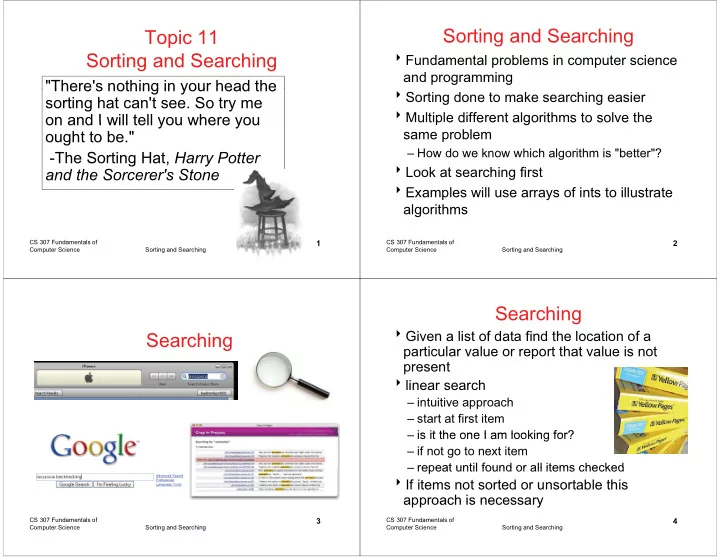
Sorting and Searching Topic 11 Sorting and Searching S ti d S hi Fundamental problems in computer science and programming "There's nothing in your head the There s nothing in your head the Sorting done to make searching easier


slide-1
SLIDE 1

Topic 11 S ti d S hi Sorting and Searching

"There's nothing in your head the There s nothing in your head the sorting hat can't see. So try me

  • n and I will tell you where you
  • n and I will tell you where you
  • ught to be."

The Sorting Hat Harry Potter

  • The Sorting Hat, Harry Potter

and the Sorcerer's Stone

CS 307 Fundamentals of Computer Science Sorting and Searching

1

Sorting and Searching

Fundamental problems in computer science and programming Sorting done to make searching easier Multiple different algorithms to solve the u t p e d e e t a go t s to so e t e same problem

– How do we know which algorithm is "better"? How do we know which algorithm is better ?

Look at searching first E amples ill se arra s of ints to ill strate Examples will use arrays of ints to illustrate algorithms

CS 307 Fundamentals of Computer Science Sorting and Searching

2

Searching

CS 307 Fundamentals of Computer Science Sorting and Searching

3

Searching

Gi li t f d t fi d th l ti f Given a list of data find the location of a particular value or report that value is not present present linear search

int iti e approach – intuitive approach – start at first item is it the one I am looking for? – is it the one I am looking for? – if not go to next item repeat until found or all items checked – repeat until found or all items checked

If items not sorted or unsortable this approach is necessary

CS 307 Fundamentals of Computer Science Sorting and Searching

4

approach is necessary

slide-2
SLIDE 2

Linear Search

/* pre: list != null p post: return the index of the first occurrence

  • f target in list or -1 if target not present in

list */ */ public int linearSearch(int[] list, int target) { for(int i = 0; i < list.length; i++) if( list[i] == target ) if( list[i] target ) return i; return -1; }

CS 307 Fundamentals of Computer Science Sorting and Searching

5

Linear Search, Generic

/* pre: list != null, target != null post: return the index of the first occurrence

  • f target in list or -1 if target not present in

list list */ public int linearSearch(Object[] list, Object target) { for(int i = 0; i < list.length; i++) i i i i i if( list[i] != null && list[i].equals(target) ) return i; return -1; }

T(N)? Big O? Best case, worst case, average case?

CS 307 Fundamentals of Computer Science Sorting and Searching

6

Attendance Question 1

What is the average case Big O of linear search in an array with N items, if an item is present?

  • A. O(N)
  • B. O(N2)

C O(1)

  • C. O(1)
  • D. O(logN)

E O(Nl N)

  • E. O(NlogN)

CS 307 Fundamentals of Computer Science Sorting and Searching

7

Searching in a Sorted List

If it t d th di id d If items are sorted then we can divide and conquer di idi k i h lf ith h t dividing your work in half with each step

– generally a good thing

Th Bi S h Li t i A di d The Binary Search on List in Ascending order

– Start at middle of list i th t th it ? – is that the item? – If not is it less than or greater than the item? l th t d h lf f li t – less than, move to second half of list – greater than, move to first half of list repeat until found or sub list size = 0

CS 307 Fundamentals of Computer Science Sorting and Searching

8

– repeat until found or sub list size = 0

slide-3
SLIDE 3

Binary Search

list low item middle item high item Is middle item what we are looking for? If not is it Is middle item what we are looking for? If not is it more or less than the target item? (Assume lower) list low middle high item item item

CS 307 Fundamentals of Computer Science Sorting and Searching

9

and so forth…

Binary Search in Action

1 2 3 4 5 6 7 8 9 10 11 12 13 14 15

2 3 5 7 11 13 17 19 23 29 31 37 41 47 43 53

0 1 2 3 4 5 6 7 8 9 10 11 12 13 14 15

public static int bsearch(int[] list, int target) public static int bsearch(int[] list, int target) { int result = -1; int low = 0; int high = list.length - 1; int mid; while( result == -1 && low <= high ) { mid = low + ((high - low) / 2); if( list[mid] == target ) result = mid; else if( list[mid] < target) low = mid + 1; else high = mid - 1; }

return result; } // mid = ( low + high ) / 2; // may overflow!!! // id (l hi h) 1 i bi i

CS 307 Fundamentals of Computer Science Sorting and Searching

10

// or mid = (low + high) >>> 1; using bitwise op

Trace When Key == 3 Trace When Key == 30 Variables of Interest?

CS 307 Fundamentals of Computer Science Sorting and Searching

11

Attendance Question 2

What is the worst case Big O of binary search in an array with N items, if an item is present?

  • A. O(N)
  • B. O(N2)
  • C. O(1)
  • D. O(logN)
  • E. O(NlogN)

CS 307 Fundamentals of Computer Science Sorting and Searching

12

slide-4
SLIDE 4

Generic Binary Search

public static int bsearch(Comparable[] list, Comparable target) { int result = -1; int low = 0; int high = list.length - 1; g g int mid; while( result == -1 && low <= high ) { mid = low + ((high - low) / 2); if( target equals(list[mid]) ) if( target.equals(list[mid]) ) result = mid; else if(target.compareTo(list[mid]) > 0) low = mid + 1; l else high = mid - 1; } return result; }

CS 307 Fundamentals of Computer Science Sorting and Searching

13

Recursive Binary Search

public static int bsearch(int[] list int target){ public static int bsearch(int[] list, int target){ return bsearch(list, target, 0, list.length – 1); } bli i i b h(i [] li i public static int bsearch(int[] list, int target, int first, int last){ if( first <= last ){ int mid = low + ((high - low) / 2); if( list[mid] == target ) return mid; else if( list[mid] > target ) return bsearch(list, target, first, mid – 1); return bsearch(list, target, first, mid 1); else return bsearch(list, target, mid + 1, last); } return -1; return 1; }

CS 307 Fundamentals of Computer Science Sorting and Searching

14

Other Searching Algorithms

Interpolation Search

– more like what people really do

Indexed Searching Binary Search Trees Binary Search Trees Hash Table Searching G ' Al ith (W iti f Grover's Algorithm (Waiting for quantum computers to be built) best-first A*

CS 307 Fundamentals of Computer Science Sorting and Searching

15

Sorting Sorting

CS 307 Fundamentals of Computer Science Sorting and Searching

16

slide-5
SLIDE 5

Sorting Fun Sorting Fun Why Not Bubble Sort? y

CS 307 Fundamentals of Computer Science Sorting and Searching

17

Sorting

A fundamental application for computers A fundamental application for computers Done to make finding data (searching) faster M diff t l ith f ti Many different algorithms for sorting One of the difficulties with sorting is working ith fi d i t t i ( ) with a fixed size storage container (array)

– if resize, that is expensive (slow)

The "simple" sorts run in quadratic time O(N2)

b bbl t – bubble sort – selection sort i ti t

CS 307 Fundamentals of Computer Science Sorting and Searching

18

– insertion sort

Stable Sorting

A t f t A property of sorts If a sort guarantees the relative order of l it t th th it i t bl equal items stays the same then it is a stable sort [7 6 7 5 1 2 7 5] [71, 6, 72, 5, 1, 2, 73, -5]

– subscripts added for clarity

[ 5 1 2 5 6 7 7 7 ] [-5, 1, 2, 5, 6, 71, 72, 73]

– result of stable sort

R l ld l Real world example:

– sort a table in Wikipedia by one criteria, then another – sort by country then by major wins

CS 307 Fundamentals of Computer Science Sorting and Searching

19

– sort by country, then by major wins

Selection sort

Algorithm

– Search through the list and find the smallest element – swap the smallest element with the first element repeat starting at second element and find the second – repeat starting at second element and find the second smallest element

public static void selectionSort(int[] list) { int min; { int min; int temp; for(int i = 0; i < list.length - 1; i++) { min = i; for(int j = i + 1; j < list.length; j++) if( list[j] < list[min] ) min = j; t li t[i] temp = list[i]; list[i] = list[min]; list[min] = temp; }

CS 307 Fundamentals of Computer Science Sorting and Searching

20

} }

slide-6
SLIDE 6

Selection Sort in Practice

44 68 191 119 119 37 83 82 191 45 158 130 76 153 39 25

What is the T(N) actual number of statements What is the T(N), actual number of statements executed, of the selection sort code, given a list

  • f N elements? What is the Big O?

CS 307 Fundamentals of Computer Science Sorting and Searching

21

g

Generic Selection Sort

public void selectionSort(Comparable[] list) { int min; Comparable temp; for(int i = 0; i < list.length - 1; i++) { ( ; g ; ) { { min = i; for(int j = i + 1; j < list.length; j++) if( list[min].compareTo(list[j]) > 0 ) min = j; temp = list[i]; list[i] = list[min]; list[min] = temp; } }

B t t Bi O?

CS 307 Fundamentals of Computer Science Sorting and Searching

22

Best case, worst case, average case Big O?

Attendance Question 3

Is selection sort always stable?

  • A. Yes
  • B. No

CS 307 Fundamentals of Computer Science Sorting and Searching

23

Insertion Sort

Another of the O(N^2) sorts The first item is sorted Compare the second item to the first

– if smaller swap if smaller swap

Third item, compare to item next to it

need to swap – need to swap – after swap compare again

A d f th And so forth…

CS 307 Fundamentals of Computer Science Sorting and Searching

24

slide-7
SLIDE 7

Insertion Sort Code

public void insertionSort(int[] list) { int temp, j; for(int i = 1; i < list.length; i++) for(int i 1; i < list.length; i++) { temp = list[i]; j = i; while( j > 0 && temp < list[j - 1]) while( j > 0 && temp < list[j 1]) { // swap elements list[j] = list[j - 1]; list[j - 1] = temp; list[j 1] temp; j--; } } }

Best case, worst case, average case Big O?

CS 307 Fundamentals of Computer Science Sorting and Searching

25

Attendance Question 4

Is the version of insertion sort shown always stable?

  • A. Yes
  • B. No

CS 307 Fundamentals of Computer Science Sorting and Searching

26

Comparing Algorithms

Which algorithm do you think will be faster given random data, selection sort or insertion sort? Why?

CS 307 Fundamentals of Computer Science Sorting and Searching

27

Sub Quadratic Sorting Algorithms

Sub Quadratic means having a Big O better than O(N2) g ( )

CS 307 Fundamentals of Computer Science Sorting and Searching

28

slide-8
SLIDE 8

ShellSort

Created by Donald Shell in 1959 Wanted to stop moving data small distances (in the case of insertion sort and bubble sort) and stop making swaps that are not helpful (in the case of selection sort) Start with sub arrays created by looking at S a sub a ays c ea ed by oo g a data that is far apart and then reduce the gap size

CS 307 Fundamentals of Computer Science Sorting and Searching

29

ShellSort in practice

46 2 83 41 102 5 17 31 64 49 18 46 2 83 41 102 5 17 31 64 49 18 Gap of five. Sort sub array with 46, 5, and 18 5 2 83 41 102 18 17 31 64 49 46 5 2 83 41 102 18 17 31 64 49 46 Gap still five. Sort sub array with 2 and 17 5 2 83 41 102 18 17 31 64 49 46 5 2 83 41 102 18 17 31 64 49 46 Gap still five. Sort sub array with 83 and 31 5 2 31 41 102 18 17 83 64 49 46 Gap still five Sort sub array with 41 and 64 5 2 31 41 102 18 17 83 64 49 46 Gap still five. Sort sub array with 102 and 49 5 2 31 41 49 18 17 83 64 102 46

CS 307 Fundamentals of Computer Science Sorting and Searching

30

Continued on next slide:

Completed Shellsort

5 2 31 41 49 18 17 83 64 102 46 Gap now 2: Sort sub array with 5 31 49 17 64 46 Gap now 2: Sort sub array with 5 31 49 17 64 46 5 2 17 41 31 18 46 83 49 102 64 Gap still 2: Sort sub array with 2 41 18 83 102 p y 5 2 17 18 31 41 46 83 49 102 64 Gap of 1 (Insertion sort) p ( ) 2 5 17 18 31 41 46 49 64 83 102 Array sorted

CS 307 Fundamentals of Computer Science Sorting and Searching

31

Shellsort on Another Data Set

1 2 3 4 5 6 7 8 9 10 11 12 13 14 15 44 68 191 119 119 37 83 82 191 45 158 130 76 153 39 25 0 1 2 3 4 5 6 7 8 9 10 11 12 13 14 15

Initial gap = length / 2 = 16 / 2 = 8 initial sub arrays indices: y

{0, 8}, {1, 9}, {2, 10}, {3, 11}, {4, 12}, {5, 13}, {6, 14}, {7, 15} next gap = 8 / 2 = 4 {0, 4, 8, 12}, {1, 5, 9, 13}, {2, 6, 10, 14}, {3, 7, 11, 15} next gap = 4 / 2 = 2 {0 2 4 6 8 10 12 14} {1 3 5 7 9 11 13 15} {0, 2, 4, 6, 8, 10, 12, 14}, {1, 3, 5, 7, 9, 11, 13, 15} final gap = 2 / 2 = 1

CS 307 Fundamentals of Computer Science Sorting and Searching

32

slide-9
SLIDE 9

ShellSort Code

public static void shellsort(Comparable[] list) public static void shellsort(Comparable[] list) { Comparable temp; boolean swap; for(int gap = list.length / 2; gap > 0; gap /= 2) for(int i = gap; i < list.length; i++) { Comparable tmp = list[i]; int j = i; j for( ; j >= gap && tmp.compareTo( list[j - gap] ) < 0; j -= gap ) list[ j ] = list[ j - gap ]; list[ j ] = tmp; list[ j ] tmp; } }

CS 307 Fundamentals of Computer Science Sorting and Searching

33

Comparison of Various Sorts

Num Items Selection Insertion Shellsort Quicksort 1000 16 5 2000 59 49 6 2000 59 49 6 4000 271 175 6 5 8000 1056 686 11 16000 4203 2754 32 11 32000 16852 11039 37 45 64000 expected? expected? 100 68 64000 expected? expected? 100 68 128000 expected? expected? 257 158 256000 expected? expected? 543 335 512000 expected? expected? 1210 722 1024000 expected? expected? 2522 1550

CS 307 Fundamentals of Computer Science Sorting and Searching

34

times in milliseconds

Quicksort

Invented by C.A.R. (Tony) Hoare A divide and conquer approach that uses recursion 1. If the list has 0 or 1 elements it is sorted 2.

  • therwise, pick any element p in the list. This is

called the pivot value 3. Partition the list minus the pivot into two sub lists according to values less than or greater than the pivot (equal values go to either)

  • pivot. (equal values go to either)

4. return the quicksort of the first list followed by the quicksort of the second list

CS 307 Fundamentals of Computer Science Sorting and Searching

35

quicksort of the second list

Quicksort in Action

39 23 17 90 33 72 46 79 11 52 64 5 71 Pick middle element as pivot: 46 Partition list 23 17 5 33 39 11 46 79 72 52 64 90 71 quick sort the less than list Pi k iddl l t i t 33 Pick middle element as pivot: 33 23 17 5 11 33 39 quicksort the less than list pivot now 5 quicksort the less than list, pivot now 5 {} 5 23 17 11 quicksort the less than list, base case quicksort the less than list, base case quicksort the greater than list Pick middle element as pivot: 17

CS 307 Fundamentals of Computer Science Sorting and Searching

36

and so on….

slide-10
SLIDE 10

Quicksort on Another Data Set

1 2 3 4 5 6 7 8 9 10 11 12 13 14 15 44 68 191 119 119 37 83 82 191 45 158 130 76 153 39 25 0 1 2 3 4 5 6 7 8 9 10 11 12 13 14 15

Big O of Quicksort?

CS 307 Fundamentals of Computer Science Sorting and Searching

37

g Q

public static void swapReferences( Object[] a, int index1, int index2 ) { Object tmp = a[index1]; a[index1] = a[index2]; a[index2] = tmp; } public void quicksort( Comparable[] list, int start, int stop ) { if(start >= stop) return; //base case list of 0 or 1 elements int pivotIndex = (start + stop) / 2; int pivotIndex (start + stop) / 2; // Place pivot at start position swapReferences(list, pivotIndex, start); Comparable pivot = list[start]; // Begin partitioning // Begin partitioning int i, j = start; // from first to j are elements less than or equal to pivot // from j to i are elements greater than pivot // elements beyond i have not been checked yet i 1 i i for(i = start + 1; i <= stop; i++ ) { //is current element less than or equal to pivot if(list[i].compareTo(pivot) <= 0) { // if so move it to the less than or equal portion j++; swapReferences(list, i, j); p ( , , j); } } //restore pivot to correct spot swapReferences(list, start, j); quicksort( list start j - 1 ); // Sort small elements CS 307 Fundamentals of Computer Science Sorting and Searching

38

quicksort( list, start, j 1 ); // Sort small elements quicksort( list, j + 1, stop ); // Sort large elements }

Attendance Question 5

What is the best case and worst case Big O

  • f quicksort?

Best Worst

  • A. O(NlogN)

O(N2)

  • B. O(N2)

O(N2) C O(N2) O(N!)

  • C. O(N )

O(N!)

  • D. O(NlogN)

O(NlogN) E O(N) O(Nl N)

  • E. O(N)

O(NlogN)

CS 307 Fundamentals of Computer Science Sorting and Searching

39

Quicksort Caveats

Average case Big O? Worst case Big O? Coding the partition step is usually the hardest part a dest pa t

CS 307 Fundamentals of Computer Science Sorting and Searching

40

slide-11
SLIDE 11

Attendance Question 6

You have 1,000,000 items that you will be

  • searching. How many searches need to be

performed before the data is changed to make sorting worthwhile?

  • A. 10
  • B. 40
  • C. 1,000

D 10 000

  • D. 10,000
  • E. 500,000

CS 307 Fundamentals of Computer Science Sorting and Searching

41

Merge Sort Algorithm

D K h i J h N h Don Knuth cites John von Neumann as the creator

  • f this algorithm
  • 1. If a list has 1 element or 0

elements it is sorted

  • 2. If a list has more than 2 split

into into 2 separate lists

  • 3. Perform this algorithm on each
  • f those smaller lists
  • f those smaller lists
  • 4. Take the 2 sorted lists and

merge them together

CS 307 Fundamentals of Computer Science Sorting and Searching

42

merge them together

Merge Sort

When implementing

  • ne temporary array

is used instead of multiple temporary arrays. y Why? Why?

CS 307 Fundamentals of Computer Science Sorting and Searching

43

Merge Sort code

/** * perform a merge sort on the data in c * @param c c != null, all elements of c * are the same data type */ public static void mergeSort(Comparable[] c) { Comparable[] temp = new Comparable[ c.length ]; sort(c, temp, 0, c.length - 1); } private static void sort(Comparable[] list, Comparable[] temp, int low, int high) int low, int high) { if( low < high){ int center = (low + high) / 2; sort(list, temp, low, center); sort(list, temp, low, center); sort(list, temp, center + 1, high); merge(list, temp, low, center + 1, high); }

CS 307 Fundamentals of Computer Science Sorting and Searching

44 } }

slide-12
SLIDE 12

Merge Sort Code

private static void merge( Comparable[] list, Comparable[] temp, int leftPos int rightPos int rightEnd){ int leftPos, int rightPos, int rightEnd){ int leftEnd = rightPos - 1; int tempPos = leftPos; int numElements = rightEnd - leftPos + 1; //main loop while( leftPos <= leftEnd && rightPos <= rightEnd){ if( list[ leftPos ] compareTo(list[rightPos]) <= 0){ if( list[ leftPos ].compareTo(list[rightPos]) <= 0){ temp[ tempPos ] = list[ leftPos ]; leftPos++; } else{ temp[ tempPos ] = list[ rightPos ]; rightPos++; rightPos++; } tempPos++; } //copy rest of left half while( leftPos <= leftEnd){ temp[ tempPos ] list[ leftPos ]; temp[ tempPos ] = list[ leftPos ]; tempPos++; leftPos++; } //copy rest of right half while( rightPos <= rightEnd){ t [ t P ] li t[ i htP ] temp[ tempPos ] = list[ rightPos ]; tempPos++; rightPos++; } //Copy temp back into list for(int i = 0; i < numElements; i++, rightEnd--) li t[ i htE d ] t [ i htE d ]

CS 307 Fundamentals of Computer Science Sorting and Searching

45

list[ rightEnd ] = temp[ rightEnd ]; }

Final Comments

Language libraries often have sorting algorithms in them

– Java Arrays and Collections classes – C++ Standard Template Library – Python sort and sorted functions

Hybrid sorts y

– when size of unsorted list or portion of array is small use insertion sort, otherwise use O(N log N) sort like Quicksort of Mergesort

Many other sorting algorithms exist.

CS 307 Fundamentals of Computer Science Sorting and Searching

46

y g g