Some notes on continuous time finance Basics: Instantaneous total - - PDF document

some notes on continuous time finance basics
SMART_READER_LITE
LIVE PREVIEW

Some notes on continuous time finance Basics: Instantaneous total - - PDF document

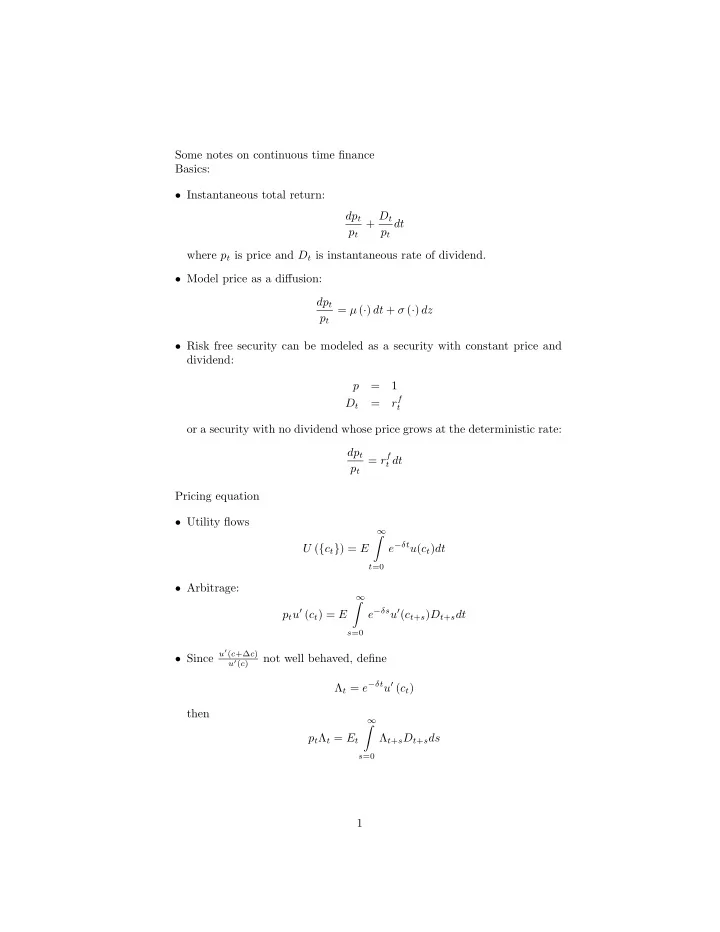
Some notes on continuous time finance Basics: Instantaneous total return: dp t + D t dt p t p t where p t is price and D t is instantaneous rate of dividend. Model price as a diffusion: dp t = ( ) dt + ( ) dz p t Risk free


slide-1
SLIDE 1

Some notes on continuous time finance Basics:

  • Instantaneous total return:

dpt pt + Dt pt dt where pt is price and Dt is instantaneous rate of dividend.

  • Model price as a diffusion:

dpt pt = µ (·) dt + σ (·) dz

  • Risk free security can be modeled as a security with constant price and

dividend: p = 1 Dt = rf

t

  • r a security with no dividend whose price grows at the deterministic rate:

dpt pt = rf

t dt

Pricing equation

  • Utility flows

U ({ct}) = E

  • t=0

e−δtu(ct)dt

  • Arbitrage:

ptu′ (ct) = E

  • s=0

e−δsu′(ct+s)Dt+sdt

  • Since u′(c+∆c)

u′(c)

not well behaved, define Λt = e−δtu′ (ct) then ptΛt = Et

  • s=0

Λt+sDt+sds 1

slide-2
SLIDE 2
  • Write this as

ptΛt = Et

s+∆

  • s=0

Λt+sDt+sds + Etpt+∆Λt+∆ + ΛtDt∆ + Etpt+∆Λt+∆

  • For small ∆ approximate integral as ΛtDt∆ so that

0 = ΛtDt∆ + Et (pt+∆Λt+∆ − ptΛt) Now take ∆ → 0 0 = ΛtDt + Et [d (Λtpt)]

  • This is continuous time equivalent to p = E (mx) for return x and stochas-

tic discount factor m. Risk premium

  • Ito’s Lemma implies

d (Λp) = pdΛ + Λdp + dpdΛ which for diffusions we can write as 0 = D P dt + Et dΛ Λ + dp p + dΛ Λ dp p

  • If p = 1 and D = rf

t we have the risk-free rate equation

rf

t dt = −Et

dΛt Λt

  • We can then get the risk-premium equation as

Et dpt pt

  • + Dt

Pt dt − rf

t dt = −Et

dΛt Λt dpt pt

  • CRRA:
  • Taylor series expansion:

dΛ = −δe−δtdt + e−δtu′′(c)dc + 1 2e−δtu′′′(c)dc2

  • Local curvature:

γ = −cu′′(c) u′c) η = γ(γ + 1) = −c2u′′′(c) u′(c) so that dΛ Λ = −δdt + γ dc c + 1 2η dc2 c2 2

slide-3
SLIDE 3

Risk premium with CRRA:

  • Risk free rate

rf

t dt = δdt + γEt

dct ct − 1 2ηEt dc2

t

c2

t

  • Risk premium

Et dpt pt

  • + Dt

Pt dt − rf

t dt = γEt

dct ct dpt pt

  • Let

dc = µccdt + σccdz then Sharpe-ratio satisfies µp + Dt

Pt dt − rf t dt

σp ≤ γσc where µp = Et

dpt pt , σp = Et

  • dpt

pt

2 Stochastic discount factor for stock with geometric brownian motion:

  • Assume stock value follows

dS = µSdt + σSdz

  • Market completeness: all stochastic discount factors that price the stock

S satisfy dΛ Λ = −rdt − (µ − r) σ dz − σwdw where E (dw dz) = 0 Since dw uncorrelated we can set it to zero to price the asset.

  • Ito’s lemma implies

d ln S =

  • µ − 0.5σ2

dt + σdz d ln Λ = −

  • r + 0.5µ − r

σ

  • dt − µ − r

σ dz Integrating these expression implies ln ST = ln So +

  • µ − 0.5σ2

T + σ √ Tε ln Λt = ln Λo −

  • r + 0.5µ − r

σ

  • T − µ − r

σ √ Tε where ε = zt − zo √ T ∼ N(0, 1) 3

slide-4
SLIDE 4

European call option:

  • Let X denote strike price and ST denote stock value on expiration day.

Payoff is C = max (ST − X, 0)

  • Option value:

Co = Et T ΛT Λt max (ST − X, 0) = Et ∞

ST =X

ΛT Λt (ST − X) d f (Λt, ST ) = Et ∞

ST =X

ΛT Λt (ST (ε) − X) d f (ε) Deriving the Black-Scholes Formula:

  • Guess C = C (S, t) ie. function of price and time to expiration.
  • Ito’s Lemma:

dC = Ctdt + CsdS + 1 2CssdS2 =

  • Ct + CsSµ + 1

2CssS2σ2

  • + CsSσdz
  • Asset pricing equation:

0 = Et (dΛC) = CEtdΛ + ΛEtdC + EtdΛdC Since Et dΛ Λ = −rdt we have 0 = −rC + Ct + CsSµ + 0.5CssS2σ2 − S (µ − r) Cs which gives the Black-Scholes Formula 0 = −rC + Ct + SrCS + 1 2CSSS2σ2 Solution:

  • We are looking for a solution to

0 = −rC + Ct + SrCS + 1 2CSSS2σ2 with boundary condition C = max [ST − X, 0] 4

slide-5
SLIDE 5
  • Guess the solution satisfies:

Co = SoΦ

  • ln So/X +
  • r + σ2/2
  • T

σ √ T

  • −Xe−rT Φ
  • ln So/X +
  • r − σ2/2
  • T

σ √ T

  • 5