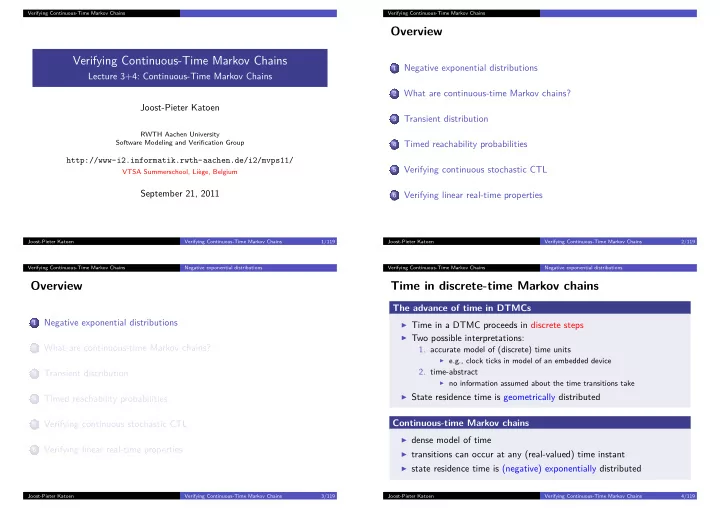
Overview Verifying Continuous-Time Markov Chains Negative - - PowerPoint PPT Presentation

overview verifying continuous time markov chains
SMART_READER_LITE
LIVE PREVIEW

Overview Verifying Continuous-Time Markov Chains Negative - - PowerPoint PPT Presentation

Verifying Continuous-Time Markov Chains Verifying Continuous-Time Markov Chains Overview Verifying Continuous-Time Markov Chains Negative exponential distributions 1 Lecture 3+4: Continuous-Time Markov Chains What are continuous-time Markov


slide-1
SLIDE 1

logoRWTH Verifying Continuous-Time Markov Chains

Verifying Continuous-Time Markov Chains

Lecture 3+4: Continuous-Time Markov Chains Joost-Pieter Katoen

RWTH Aachen University Software Modeling and Verification Group

http://www-i2.informatik.rwth-aachen.de/i2/mvps11/

VTSA Summerschool, Liège, Belgium

September 21, 2011

Joost-Pieter Katoen Verifying Continuous-Time Markov Chains 1/119 Verifying Continuous-Time Markov Chains

Overview

1

Negative exponential distributions

2

What are continuous-time Markov chains?

3

Transient distribution

4

Timed reachability probabilities

5

Verifying continuous stochastic CTL

6

Verifying linear real-time properties

Joost-Pieter Katoen Verifying Continuous-Time Markov Chains 2/119 Verifying Continuous-Time Markov Chains Negative exponential distributions

Overview

1

Negative exponential distributions

2

What are continuous-time Markov chains?

3

Transient distribution

4

Timed reachability probabilities

5

Verifying continuous stochastic CTL

6

Verifying linear real-time properties

Joost-Pieter Katoen Verifying Continuous-Time Markov Chains 3/119 Verifying Continuous-Time Markov Chains Negative exponential distributions

Time in discrete-time Markov chains

The advance of time in DTMCs

◮ Time in a DTMC proceeds in discrete steps ◮ Two possible interpretations:

  • 1. accurate model of (discrete) time units

◮ e.g., clock ticks in model of an embedded device

  • 2. time-abstract

◮ no information assumed about the time transitions take

◮ State residence time is geometrically distributed

Continuous-time Markov chains

◮ dense model of time ◮ transitions can occur at any (real-valued) time instant ◮ state residence time is (negative) exponentially distributed

Joost-Pieter Katoen Verifying Continuous-Time Markov Chains 4/119

slide-2
SLIDE 2

Verifying Continuous-Time Markov Chains Negative exponential distributions

Continuous random variables

◮ X is a random variable (r.v., for short)

◮ on a sample space with probability measure Pr ◮ assume the set of possible values that X may take is dense

◮ X is continuously distributed if there exists a function f (x) such that:

Fx(d) = Pr{X d} =

d

−∞

f (x) dx for each real number d where f satisfies: f (x) 0 for all x and

−∞

f (x) dx = 1

◮ FX(d) is the (cumulative) probability distribution function ◮ f (x) is the probability density function

Joost-Pieter Katoen Verifying Continuous-Time Markov Chains 5/119 Verifying Continuous-Time Markov Chains Negative exponential distributions

Negative exponential distribution

Density of exponential distribution The density of an exponentially distributed r.v. Y with rate λ ∈ R>0 is: fY (x) = λ·e−λ·x for x > 0 and fY (x) = 0 otherwise The cumulative distribution of r.v. Y with rate λ ∈ R>0 is: FY (d) =

d

λ·e−λ·x dx = [−e−λ·x]d

0 = 1 − e−λ·d.

The rate λ ∈ R>0 uniquely determines an exponential distribution. Variance and expectation Let r.v. Y be exponentially distributed with rate λ ∈ R>0. Then:

◮ Expectation E[Y ] =

0 x·λ·e−λ·x dx = 1 λ ◮ Variance Var[Y ] =

0 (x − E[X])2λ·e−λ·x dx = 1 λ2

Joost-Pieter Katoen Verifying Continuous-Time Markov Chains 6/119 Verifying Continuous-Time Markov Chains Negative exponential distributions

Exponential pdf and cdf

The higher λ, the faster the cdf approaches 1.

Joost-Pieter Katoen Verifying Continuous-Time Markov Chains 7/119 Verifying Continuous-Time Markov Chains Negative exponential distributions

Why exponential distributions?

◮ Are adequate for many real-life phenomena

◮ the time until a radioactive particle decays ◮ the time between successive car accidents ◮ inter-arrival times of jobs, telephone calls in a fixed interval

◮ Are the continuous counterpart of the geometric distribution ◮ Heavily used in physics, performance, and reliability analysis ◮ Can approximate general distributions arbitrarily closely ◮ Yield a maximal entropy if only the mean is known

Joost-Pieter Katoen Verifying Continuous-Time Markov Chains 8/119

slide-3
SLIDE 3

Verifying Continuous-Time Markov Chains Negative exponential distributions

Memoryless property

Theorem

  • 1. For any exponentially distributed random variable X:

Pr{X > t + d | X > t} = Pr{X > d} for any t, d ∈ R0.

  • 2. Any cdf which is memoryless is a negative exponential one.

Proof:

Proof of 1. : Let λ be the rate of X’s distribution. Then we derive: Pr{X > t + d | X > t} = Pr{X > t+d ∩ X > t} Pr{X > t} = Pr{X > t+d} Pr{X > t} = e−λ·(t+d) e−λ·t = e−λ·d = Pr{X > d}. Proof of 2. : By contraposition, using the total law of probability.

Joost-Pieter Katoen Verifying Continuous-Time Markov Chains 9/119 Verifying Continuous-Time Markov Chains Negative exponential distributions

Closure under minimum

Minimum closure theorem For independent, exponentially distributed random variables X and Y with rates λ, µ ∈ R>0, the r.v. min(X, Y ) is exponentially distributed with rate λ+µ, i.e.,: Pr{min(X, Y ) t} = 1 − e−(λ+µ)·t for all t ∈ R0.

Joost-Pieter Katoen Verifying Continuous-Time Markov Chains 10/119 Verifying Continuous-Time Markov Chains Negative exponential distributions

Proof

Let λ (µ) be the rate of X’s (Y ’s) distribution. Then we derive: Pr{min(X, Y ) t} = PrX,Y {(x, y) ∈ R2

0 | min(x, y) t}

= ∞ ∞ Imin(x,y)t(x, y) · λe−λx · µe−µy dy

  • dx

= t ∞

x

λe−λx · µe−µy dy dx + t ∞

y

λe−λx · µe−µy dx dy = t λe−λx · e−µx dx + t e−λy · µe−µy dy = t λe−(λ+µ)x dx + t µe−(λ+µ)y dy = t (λ+µ) · e−(λ+µ)z dz = 1 − e−(λ+µ)t

Joost-Pieter Katoen Verifying Continuous-Time Markov Chains 11/119 Verifying Continuous-Time Markov Chains Negative exponential distributions

Closure under minimum

Minimum closure theorem for several exponentially distributed r.v. ’s For independent, exponentially distributed random variables X1, X2, . . . , Xn with rates λ1, λ2, . . . , λn ∈ R>0 the r.v. min(X1, X2, . . . , Xn) is exponentially distributed with rate

0<in λi, i.e.,:

Pr{min(X1, X2, . . . , Xn) t} = 1 − e−

0<in λi·t

for all t ∈ R0. Proof: Generalization of the proof for the case of two exponential distributions.

Joost-Pieter Katoen Verifying Continuous-Time Markov Chains 12/119

slide-4
SLIDE 4

Verifying Continuous-Time Markov Chains Negative exponential distributions

Winning the race with two competitors

The minimum of two exponential distributions For independent, exponentially distributed random variables X and Y with rates λ, µ ∈ R>0, it holds: Pr{X Y } = λ λ+µ.

Joost-Pieter Katoen Verifying Continuous-Time Markov Chains 13/119 Verifying Continuous-Time Markov Chains Negative exponential distributions

Proof

Let λ (µ) be the rate of X’s (Y ’s) distribution. Then we derive: Pr{X Y } = PrX,Y {(x, y) ∈ R2

0 | x y}

= ∞ µe−µy y λe−λx dx

  • dy

= ∞ µe−µy 1 − e−λy dy = 1 − ∞ µe−µy·e−λy dy = 1 − ∞ µe−(µ+λ)y dy = 1 − µ µ+λ · ∞ (µ+λ)e−(µ+λ)y dy

  • =1

= 1 − µ µ+λ = λ µ+λ

Joost-Pieter Katoen Verifying Continuous-Time Markov Chains 14/119 Verifying Continuous-Time Markov Chains Negative exponential distributions

Winning the race with many competitors

The minimum of several exponentially distributed r.v. ’s For independent, exponentially distributed random variables X1, X2, . . . , Xn with rates λ1, λ2, . . . , λn ∈ R>0 it holds: Pr{Xi = min(X1, . . . , Xn)} = λi

n

j=1 λj

. Proof: Generalization of the proof for the case of two exponential distributions.

Joost-Pieter Katoen Verifying Continuous-Time Markov Chains 15/119 Verifying Continuous-Time Markov Chains What are continuous-time Markov chains?

Overview

1

Negative exponential distributions

2

What are continuous-time Markov chains?

3

Transient distribution

4

Timed reachability probabilities

5

Verifying continuous stochastic CTL

6

Verifying linear real-time properties

Joost-Pieter Katoen Verifying Continuous-Time Markov Chains 16/119

slide-5
SLIDE 5

Verifying Continuous-Time Markov Chains What are continuous-time Markov chains?

Continuous-time Markov chain

Continuous-time Markov chain A CTMC is a tuple (S, P, r, ιinit, AP, L) where

◮ (S, P, ιinit, AP, L) is a DTMC, and ◮ r : S → R>0, the exit-rate function

Interpretation

◮ residence time in state s is exponentially distributed with rate r(s). ◮ phrased alternatively, the average residence time of state s is 1 r(s). ◮ thus, the higher the rate r(s), the shorter the average residence time

in s.

Joost-Pieter Katoen Verifying Continuous-Time Markov Chains 17/119 Verifying Continuous-Time Markov Chains What are continuous-time Markov chains?

Example

r(s) = 25, r(t) = 4, r(u) = 2 and r(v) = 100

Joost-Pieter Katoen Verifying Continuous-Time Markov Chains 18/119 Verifying Continuous-Time Markov Chains What are continuous-time Markov chains?

Example: a classical perspective

r(s) = 25, r(t) = 4, r(u) = 2 and r(v) = 100 The transition rate R(s, s′) = P(s, s′)·r(s) We use (S, P, r, ιinit, AP, L) and (S, R, ιinit, AP, L) interchangeably.

Joost-Pieter Katoen Verifying Continuous-Time Markov Chains 19/119 Verifying Continuous-Time Markov Chains What are continuous-time Markov chains?

CTMC semantics by example

CTMC semantics

◮ Transition s → s′ := r.v. Xs,s′ with rate R(s, s′) ◮ Probability to go from state s0 to, say, state s2 is:

Pr{Xs0,s2 Xs0,s1 ∩ Xs0,s2 Xs0,s3} = R(s0, s2) R(s0, s1) + R(s0, s2) + R(s0, s3) = R(s0, s2) r(s0)

◮ Probability of staying at most t time in s0 is:

Pr{min(Xs0,s1, Xs0,s2, Xs0,s3) t} = 1 − e−(R(s0,s1)+R(s0,s2)+R(s0,s3))·t = 1 − e−r(s0)·t

Joost-Pieter Katoen Verifying Continuous-Time Markov Chains 20/119

slide-6
SLIDE 6

Verifying Continuous-Time Markov Chains What are continuous-time Markov chains?

CTMC semantics

Enabledness The probability that transition s → s′ is enabled in [0, t] is 1 − e−R(s,s′)·t. State-to-state timed transition probability The probability to move from non-absorbing s to s′ in [0, t] is: R(s, s′) r(s) ·

  • 1 − e−r(s)·t

. Residence time distribution The probability to take some outgoing transition from s in [0, t] is:

t

r(s)·e−r(s)·x dx = 1 − e−r(s)·t

Joost-Pieter Katoen Verifying Continuous-Time Markov Chains 21/119 Verifying Continuous-Time Markov Chains What are continuous-time Markov chains?

CTMC semantics

State-to-state timed transition probability The probability to move from non-absorbing s to s′ in [0, t] is: R(s, s′) r(s) ·

  • 1 − e−r(s)·t

.

Joost-Pieter Katoen Verifying Continuous-Time Markov Chains 22/119 Verifying Continuous-Time Markov Chains What are continuous-time Markov chains?

CTMC semantics

Residence time distribution The probability to take some outgoing transition from s in [0, t] is:

t

r(s)·e−r(s)·x dx = 1 − e−r(s)·t

Joost-Pieter Katoen Verifying Continuous-Time Markov Chains 23/119 Verifying Continuous-Time Markov Chains What are continuous-time Markov chains?

Enzyme-catalysed substrate conversion

Source: wikipedia (June 2011)

Joost-Pieter Katoen Verifying Continuous-Time Markov Chains 24/119

slide-7
SLIDE 7

Verifying Continuous-Time Markov Chains What are continuous-time Markov chains?

Stochastic chemical kinetics

◮ Types of reaction described by stochiometric equations:

E + S

k1

k2 ES k3

− − → E + P

◮ N different types of molecules that randomly collide

where state X(t) = (x1, . . . , xN) with xi = # molecules of sort i

◮ Reaction probability within infinitesimal interval [t, t+∆):

αm( x) · ∆ = Pr{reaction m in [t, t+∆) | X(t) = x} where αm( x) = km · # possible combinations of reactant molecules in x

◮ This process is a continuous-time Markov chain.

Joost-Pieter Katoen Verifying Continuous-Time Markov Chains 25/119 Verifying Continuous-Time Markov Chains What are continuous-time Markov chains?

Enzyme-catalyzed substrate conversion as a CTMC

Joost-Pieter Katoen Verifying Continuous-Time Markov Chains 26/119 Verifying Continuous-Time Markov Chains What are continuous-time Markov chains?

CTMCs are omnipresent!

◮ Markovian queueing networks

(Kleinrock 1975)

◮ Stochastic Petri nets

(Molloy 1977)

◮ Stochastic activity networks

(Meyer & Sanders 1985)

◮ Stochastic process algebra

(Herzog et al., Hillston 1993)

◮ Probabilistic input/output automata

(Smolka et al. 1994)

◮ Calculi for biological systems

(Priami et al., Cardelli 2002)

CTMCs are one of the most prominent models in performance analysis

Joost-Pieter Katoen Verifying Continuous-Time Markov Chains 27/119 Verifying Continuous-Time Markov Chains What are continuous-time Markov chains?

Summary

Main points

◮ Exponential distributions are closed under minimum. ◮ The probability to win a race amongst several exponential

distributions only depends on their rates.

◮ A CTMC is a DTMC where state residence times are exponentially

distributed.

◮ CTMC semantics distinguishes between enabledness and taking a

transition.

◮ CTMCs are frequently used as semantical model for high-level

formalisms.

Joost-Pieter Katoen Verifying Continuous-Time Markov Chains 28/119

slide-8
SLIDE 8

Verifying Continuous-Time Markov Chains Transient distribution

Overview

1

Negative exponential distributions

2

What are continuous-time Markov chains?

3

Transient distribution

4

Timed reachability probabilities

5

Verifying continuous stochastic CTL

6

Verifying linear real-time properties

Joost-Pieter Katoen Verifying Continuous-Time Markov Chains 29/119 Verifying Continuous-Time Markov Chains Transient distribution

Transient distribution of a CTMC

Transient state probability Let X(t) denote the state of a CTMC at time t ∈ R0. The probability to be in state s at time t is defined by: ps(t) = Pr{ X(t) = s } =

  • s′∈S

Pr{ X(0) = s′ } · Pr{ X(t) = s | X(0) = s′ } Theorem: transient distribution as linear differential equation The transient probability vector p(t) = (ps1(t), . . . , psk(t)) satisfies: p′(t) = p(t) · (R − r) given p(0) where r is the diagonal matrix of vector r.

Joost-Pieter Katoen Verifying Continuous-Time Markov Chains 30/119 Verifying Continuous-Time Markov Chains Transient distribution

Transient distribution theorem

Theorem: transient distribution as linear differential equation The transient probability vector p(t) = (ps1(t), . . . , psk(t)) satisfies: p′(t) = p(t) · (R − r) given p(0) where r is the diagonal matrix of vector r.

Joost-Pieter Katoen Verifying Continuous-Time Markov Chains 31/119 Verifying Continuous-Time Markov Chains Transient distribution

Computing transient probabilities

The transient probability vector p(t) = (ps1(t), . . . , psk(t)) satisfies: p′(t) = p(t) · (R−r) given p(0). Solution using standard knowledge yields: p(t) = p(0)·e(R−r)·t. Computing a matrix exponential First attempt: use Taylor-Maclaurin expansion. This yields p(t) = p(0)·e(R−r)·t = p(0) ·

  • i=0

((R−r)·t)i i! But: numerical instability due to fill-in of (R−r)i in presence of positive and negative entries in the matrix R−r.

Joost-Pieter Katoen Verifying Continuous-Time Markov Chains 32/119

slide-9
SLIDE 9

Verifying Continuous-Time Markov Chains Transient distribution

Uniformization

Let CTMC C = (S, P, r, ιinit, AP, L) with S finite. Uniform CTMC CTMC C is uniform if r(s) = r for all s ∈ S for some r ∈ R>0. Uniformization

[Gross and Miller, 1984]

Let r ∈ R>0 such that r maxs∈S r(s). Then unif(r, C) is the tuple (S, P, r, ιinit, AP, L) with r(s) = r for all s ∈ S , and: P(s, s′) = r(s) r ·P(s, s′) if s′ = s and P(s, s) = r(s) r ·P(s, s) + 1 − r(s) r . It follows that P is a stochastic matrix and unif(r, C) is a CTMC.

Joost-Pieter Katoen Verifying Continuous-Time Markov Chains 33/119 Verifying Continuous-Time Markov Chains Transient distribution

Uniformization: example

Uniformization

Let r ∈ R>0 such that r maxs∈S r(s). Then unif(r, C) = (S, P, r, ιinit, AP, L) with r(s) = r for all s ∈ S, and: P(s, s′) = r(s) r ·P(s, s′) if s′ = s and P(s, s) = r(s) r ·P(s, s) + 1 − r(s) r .

CTMC C and its uniformized counterpart unif(6, C)

Joost-Pieter Katoen Verifying Continuous-Time Markov Chains 34/119 Verifying Continuous-Time Markov Chains Transient distribution

Uniformization: intuition

Uniformization

Let r ∈ R>0 such that r maxs∈S r(s). Then unif(r, C) = (S, P, r, ιinit, AP, L) with r(s) = r for all s ∈ S, and: P(s, s′) = r(s) r ·P(s, s′) if s′ = s and P(s, s) = r(s) r ·P(s, s) + 1 − r(s) r .

Intuition

◮ Fix all exit rates to (at least) the maximal exit rate r occurring in CTMC C. ◮ Thus, 1

r is the shortest mean residence time in the CTMC C.

◮ Then normalize the residence time of all states with respect to r as follows:

  • 1. replace an average residence time

1 r(s) by a shorter (or equal) one, 1 r

  • 2. decrease the transition probabilities by a factor r(s)

r , and

  • 3. increase the self-loop probability by a factor r−r(s)

r

That is, slow down state s whenever r(s) < r.

Joost-Pieter Katoen Verifying Continuous-Time Markov Chains 35/119 Verifying Continuous-Time Markov Chains Transient distribution

Strong bisimulation on DTMCs

Probabilistic bisimulation

[Larsen & Skou, 1989]

Let D = (S, P, ιinit, AP, L) be a DTMC and R ⊆ S × S an equivalence. Then: R is a probabilistic bisimulation on S if for any (s, t) ∈ R:

  • 1. L(s) = L(t), and
  • 2. P(s, C) = P(t, C) for all equivalence classes C ∈ S/R

where P(s, C) =

s′∈C P(s, s′).

For states in R, the probability of moving by a single transition to some equivalence class is equal.

Probabilistic bisimilarity

Let D be a DTMC and s, t states in D. Then: s is probabilistically bisimilar to t, denoted s ∼p t, if there exists a probabilistic bisimulation R with (s, t) ∈ R.

Joost-Pieter Katoen Verifying Continuous-Time Markov Chains 36/119

slide-10
SLIDE 10

Verifying Continuous-Time Markov Chains Transient distribution

Strong bisimulation on CTMCs

Probabilistic bisimulation

[Buchholz, 1994]

Let C = (S, P, r, ιinit, AP, L) be a CTMC and R ⊆ S × S an equivalence. Then: R is a probabilistic bisimulation on S if for any (s, t) ∈ R:

  • 1. L(s) = L(t), and
  • 2. r(s) = r(t), and
  • 3. P(s, C) = P(t, C) for all equivalence classes C ∈ S/R

The last two conditions amount to R(s, C) = R(t, C) for all equivalence classes C ∈ S/R.

Probabilistic bisimilarity

Let C be a CTMC and s, t states in C. Then: s is probabilistically bisimilar to t, denoted s ∼m t, if there exists a probabilistic bisimulation R with (s, t) ∈ R.

Joost-Pieter Katoen Verifying Continuous-Time Markov Chains 37/119 Verifying Continuous-Time Markov Chains Transient distribution

Weak bisimulation on DTMCs

Weak probabilistic bisimulation

[Baier & Hermanns, 1996]

Let D = (S, P, ιinit, AP, L) be a DTMC and R ⊆ S × S an equivalence. Then: R is a weak probabilistic bisimulation on S if for any (s, t) ∈ R:

  • 1. L(s) = L(t), and
  • 2. if P(s, [s]R) < 1 and P(t, [t]R) < 1, then:

P(s, C) 1 − P(s, [s]R) = P(t, C) 1 − P(t, [t]R) for allC ∈ S/R, C = [s]R = [t]R.

  • 3. s can reach a state outside [s]R iff t can reach a state outside [t]R.

For states in R, the conditional probability of moving by a single transition to another equivalence class is equal. In addition, either all states in an equivalence class C almost surely stay there, or have an option to escape from C.

Joost-Pieter Katoen Verifying Continuous-Time Markov Chains 38/119 Verifying Continuous-Time Markov Chains Transient distribution

Weak bisimulation on DTMCs

Weak probabilistic bisimulation

[Baier & Hermanns, 1996]

Let D = (S, P, ιinit, AP, L) be a DTMC and R ⊆ S × S an equivalence. Then: R is a weak probabilistic bisimulation on S if for any (s, t) ∈ R:

  • 1. L(s) = L(t), and
  • 2. if P(s, [s]R) < 1 and P(t, [t]R) < 1, then:

P(s, C) 1 − P(s, [s]R) = P(t, C) 1 − P(t, [t]R) for allC ∈ S/R, C = [s]R = [t]R.

  • 3. s can reach a state outside [s]R iff t can reach a state outside [t]R.

Probabilistic weak bisimilarity

Let D be a DTMC and s, t states in D. Then: s is probabilistically weak bisimilar to t, denoted s ≈p t, if there exists a probabilistic weak bisimulation R with (s, t) ∈ R.

Joost-Pieter Katoen Verifying Continuous-Time Markov Chains 39/119 Verifying Continuous-Time Markov Chains Transient distribution

Weak bisimulation on DTMC: example

The equivalence relation R with S/R =

  • {s1, s2, s3, s4}, {u1, u2, u3}
  • is a

weak bisimulation. This can be seen as follows. For C = { u1, u2, u3 } and s1, s2, s4 with P(si, [si]R) < 1 we have: P(s1, C) 1 − P(s1, [s1]) = 1/8 1−5/8 = 1/4 1−1/4 = P(s2, C) 1 − P(s2, [s2]) = 1/3 1 = P(s4, C) 1 − P(s4, [s4]). Note that P(s3, [s3]R) = 1. Since s3 can reach a state outside [s3] as s1, s2 and s4, it follows that s1 ≈p s2 ≈p s3 ≈p s4.

Joost-Pieter Katoen Verifying Continuous-Time Markov Chains 40/119

slide-11
SLIDE 11

Verifying Continuous-Time Markov Chains Transient distribution

Reachability condition

Remark

Consider the following DTMC: It is not difficult to establish s1 ≈ s2. Note: P(s1, [s1]) = 1, but P(s2, [s2]R) < 1. Both s1 and s2 can reach a state outside [s1]R = [s2]R. The reachability condition is essential to establish s1 ≈ s2 and cannot be dropped: otherwise s1 and s2 would be weakly bisimilar to an equally labelled absorbing state.

Joost-Pieter Katoen Verifying Continuous-Time Markov Chains 41/119 Verifying Continuous-Time Markov Chains Transient distribution

Weak bisimulation on CTMCs

Weak probabilistic bisimulation

[Bravetti, 2002]

Let C = (S, P, r, ιinit, AP, L) be a CTMC and R ⊆ S × S an equivalence. Then: R is a weak probabilistic bisimulation on S if for any (s, t) ∈ R:

  • 1. L(s) = L(t), and
  • 2. R(s, C) = R(t, C) for all C ∈ S/R with C = [s]R = [t]R

Weak probabilistic bisimilarity

Let C be a CTMC and s, t states in C. Then: s is weak probabilistically bisimilar to t, denoted s ≈m t, if there exists a weak probabilistic bisimulation R with (s, t) ∈ R.

Joost-Pieter Katoen Verifying Continuous-Time Markov Chains 42/119 Verifying Continuous-Time Markov Chains Transient distribution

A useful lemma

Let C be a CTMC and R an equivalence relation on S with (s, t) ∈ R. Then: the following two statements are equivalent:

  • 1. If P(s, [s]R) < 1 and P(t, [t]R) < 1 then for all C ∈ S/R, C = [s]R = [t]R:

P(s, C) 1 − P(s, [s]R) = P(t, C) 1 − P(t, [t]R) and R(s, S \ [s]R) = R(t, S \ [t]R)

  • 2. R(s, C) = R(t, C) for all C ∈ S/R with C = [s]R = [t]R.

Proof: Left as an exercise.

Joost-Pieter Katoen Verifying Continuous-Time Markov Chains 43/119 Verifying Continuous-Time Markov Chains Transient distribution

Weak bisimulation on CTMCs: example

Equivalence relation R with S/R =

  • {s1, s2, s3, s4, s5, s6}, {u1, u2, u3, u4, u5}
  • is

a weak bisimulation on the CTMC depicted above. This can be seen as follows. For C = { u1, u2, u3, u4, u5 }, we have that all s-states enter C with rate 2. The rates between the s-states are not relevant.

Joost-Pieter Katoen Verifying Continuous-Time Markov Chains 44/119

slide-12
SLIDE 12

Verifying Continuous-Time Markov Chains Transient distribution

Properties (without proof)

Strong and weak bisimulation in uniform CTMCs For all uniform CTMCs C and states s, u in C, we have: s ∼m u iff s ≈m u iff s ∼p u. For any CTMC C, we have: C ≈m unif(r, C) with r maxs∈S r(s). Preservation of transient probabilities For all CTMCs C with states s, u in C and t ∈ R0, we have: s ≈m u implies p(t) = p(t) where p(0) = 1s and p(0) = 1u where 1s is the characteristic function for state s, i.e., 1s(s′) = 1 iff s = s′.

Joost-Pieter Katoen Verifying Continuous-Time Markov Chains 45/119 Verifying Continuous-Time Markov Chains Transient distribution

Computing transient probabilities

The transient probability vector p(t) = (ps1(t), . . . , psk(t)) satisfies: p′(t) = p(t) · (R−r) given p(0). Standard knowledge yields: p(t) = p(0)·e(R−r)·t. As uniformization preserves transient probabilities, we replace R−r by its variant for the uniformized CTMC, i.e., R−r. We have: R(s, s′) = P(s, s′)·r(s) = P(s, s′)·r and r = I·r. Thus: p(0)·e(R−r)·t = p(0)·e(P·r−I·r)·t = p(0)·e(P−I)·r·t = p(0)·e−rt·er·t·P.

Joost-Pieter Katoen Verifying Continuous-Time Markov Chains 46/119 Verifying Continuous-Time Markov Chains Transient distribution

Computing transient probabilities

p(t) = p(0)·e(R−r)·t = p(0)·e(P·r−I·r)·t = p(0)·e(P−I)·r·t = p(0)·e−rt·er·t·P.

Computing a matrix exponential Exploit Taylor-Maclaurin expansion. This yields: p(0)·e−rt·er·t·P = p(0)·e−rt ·

  • i=0

(r·t)i i! ·P

i = p(0) · ∞

  • i=0

e−r·t (r·t)i i!

  • Poisson prob.

·P

i

As P is a stochastic matrix, computing the matrix exponential P

i is

numerically stable.

Joost-Pieter Katoen Verifying Continuous-Time Markov Chains 47/119 Verifying Continuous-Time Markov Chains Transient distribution

Intermezzo: Poisson distribution

Poisson distribution The Poisson distribution is a discrete probability distribution that expresses the probability of a given number i of events occurring in a fixed interval

  • f time [0, t] if these events occur with a known average rate r and

independently of the time since the last event. Formally, the pdf is: f (i; r·t) = e−r·t (r·t)i i! where r is the mean of the Poisson distribution. Remark

The Poisson distribution can be derived as a limiting case to the binomial distribution as the number of trials goes to infinity and the expected number of successes remains fixed.

Joost-Pieter Katoen Verifying Continuous-Time Markov Chains 48/119

slide-13
SLIDE 13

Verifying Continuous-Time Markov Chains Transient distribution

Transient probabilities: example

P =

  • 1

1

  • , r =
  • 3

2

  • and P3 =
  • 1

2 3 1 3

  • Let initial distribution p(0) = (1, 0), and time bound t=1. Then:

p(1) = p(0)·

  • i=0

e−3 3i i! ·P

i

= (1, 0)·e−3 1

0!·

1 1

  • + (1, 0)·e−3 3

1!·

1

2 3 1 3

  • + (1, 0)·e−3 9

2!·

1

2 3 1 3

2 + . . . . . . ≈ (0.404043, 0.595957)

Joost-Pieter Katoen Verifying Continuous-Time Markov Chains 49/119 Verifying Continuous-Time Markov Chains Transient distribution

Truncating the infinite sum

Computing transient probabilities p(t) = p(0) ·

  • i=0

e−r·t (r·t)i i! ·P

i ◮ Summation can be truncated a priori for a given error bound ε > 0. ◮ The error that is introduced by truncating at summand kε is:

  • i=0

e−rt (rt)i i! ·p(i) −

  • i=0

e−rt (rt)i i! ·p(i)

  • =
  • i=kε+1

e−rt (rt)i i! ·p(i)

  • ◮ Strategy: choose kε minimal such that:

  • i=kε+1

e−rt (rt)i i! =

  • i=0

e−rt (rt)i i! −

  • i=0

e−rt (rt)i i! = 1 −

  • i=0

e−rt (rt)i i! ε

Joost-Pieter Katoen Verifying Continuous-Time Markov Chains 50/119 Verifying Continuous-Time Markov Chains Transient distribution

Summary

Main points

◮ Bisimilar states are equally labelled and their cumulative rate to any

equivalence class coincides.

◮ Weak bisimilar states have equal conditional probabilities to move to

some equivalence class, and can either both leave their class or both can’t.

◮ Uniformization normalizes the exit rates of all states in a CTMC. ◮ Uniformization transforms a CTMC into a weak bisimilar one. ◮ Transient distribution are obtained by solving a system of linear

differential equations.

◮ These equations can be solved conveniently on the uniformized

CTMC.

Joost-Pieter Katoen Verifying Continuous-Time Markov Chains 51/119 Verifying Continuous-Time Markov Chains Timed reachability probabilities

Overview

1

Negative exponential distributions

2

What are continuous-time Markov chains?

3

Transient distribution

4

Timed reachability probabilities

5

Verifying continuous stochastic CTL

6

Verifying linear real-time properties

Joost-Pieter Katoen Verifying Continuous-Time Markov Chains 52/119

slide-14
SLIDE 14

Verifying Continuous-Time Markov Chains Timed reachability probabilities

Paths in a CTMC

Timed paths Paths in CTMC C are maximal (i.e., infinite) paths of alternating states and time instants: π = s0

t0

− − → s1

t1

− − → s2 · · · such that si ∈ S and ti ∈ R>0. Let Paths(C) be the set of paths in C and Paths∗(C) the set of finite prefixes thereof. Time instant ti is the amount of time spent in state si. Notations

◮ Let π[i] := si denote the (i+1)-st state along the timed path π. ◮ Let πi := ti the time spent in state si. ◮ Let π@t be the state occupied in π at time t ∈ R0, i.e. π@t := π[i]

where i is the smallest index such that i

j=0 πj > t.

Joost-Pieter Katoen Verifying Continuous-Time Markov Chains 53/119 Verifying Continuous-Time Markov Chains Timed reachability probabilities

Paths and probabilities

To reason quantitatively about the behavior of a CTMC, we need to define a probability space over its paths. Intuition For a given state s in CTMC C:

◮ Sample space := set of all interval-timed paths s0 I0 . . . Ik−1 sk with

s = s0

◮ Events := sets of interval-timed paths starting in s ◮ Basic events := cylinder sets ◮ Cylinder set of finite interval-timed paths := set of all infinite timed

paths with a prefix in the finite interval-timed path

Joost-Pieter Katoen Verifying Continuous-Time Markov Chains 54/119 Verifying Continuous-Time Markov Chains Timed reachability probabilities

Probability measure on DTMCs

Cylinder set

Let s0, . . ., sk ∈ S with P(si, si+1) > 0 for 0 i < k and I0, . . ., Ik−1 non-empty intervals in R0. The cylinder set of s0 I0 s1 I1 . . . Ik−1 sk is defined by: Cyl(s0, I0, . . ., Ik−1, sk) =

  • π ∈ Paths(C) | ∀0 i k. π[i] = si

and i < k ⇒ πi ∈ Ii

  • The cylinder set spanned by s0, I0, . . ., Ik−1, sk thus consists of all infinite timed

paths that have a prefix ˆ π that lies in s0, I0, . . ., Ik−1, sk. Cylinder sets serve as basic events of the smallest σ-algebra on Paths(C).

σ-algebra of a CTMC

The σ-algebra associated with CTMC C is the smallest σ-algebra F(Paths(s0)) that contains all cylinder sets Cyl(s0, I0, . . ., Ik−1, sk) where s0 . . . sk is a path in the state graph of C (starting in s0) and I0, . . ., Ik−1 range over all sequences of non-empty intervals in R0.

Joost-Pieter Katoen Verifying Continuous-Time Markov Chains 55/119 Verifying Continuous-Time Markov Chains Timed reachability probabilities

Probability measure on CTMCs

Cylinder set The cylinder set Cyl(s0, I0, . . ., Ik−1, sk) of s0 I0 . . . Ik−1 sk is defined by:

π ∈ Paths(C) | ∀0 i k. π[i] = si and i < k ⇒ πi ∈ Ii

  • Probability measure

Pr is the unique probability measure on the σ-algebra F(Paths(s0)) defined by induction on k as follows: Pr(Cyl(s0)) = ιinit(s0) and for k > 0:

Pr

  • Cyl(s0, I0, . . ., Ik−1, sk)
  • =

Pr

  • Cyl(s0, I0, . . ., Ik−2, sk−1)
  • ·
  • Ik−1

R(sk−1, sk)·e−r(sk−1)τ dτ.

Solving the integral

Pr

  • Cyl(s0, I0, . . ., Ik−2, sk−1)
  • · P(sk−1, sk)·
  • e−r(sk)· inf Ik−1 − e−r(sk)· sup Ik−1

.

Joost-Pieter Katoen Verifying Continuous-Time Markov Chains 56/119

slide-15
SLIDE 15

Verifying Continuous-Time Markov Chains Timed reachability probabilities

Zeno theorem

Zeno path Path s0

t0

− − → s1

t1

− − → s2

t2

− − → s3 . . . . . . is called Zeno 1 if

i ti converges.

Intuition

In case

i ti does not diverge, the timed path represents an“unrealistic”

computation where infinitely many transitions are taken in a finite amount of

  • time. Example:

s0

1

− → s1

1 2

− − → s2

1 4

− − → s3 . . . si

1 2i

− − → si+1 . . . In real-time systems, such executions are typically excluded from the analysis. Thanks to the following theorem, Zeno paths do not harm for CTMCs.

Zeno theorem For all states s in any CTMC, Pr{ π ∈ Paths(s) | π is Zeno } = 0.

1Zeno of Elea (490–430 BC), philosopher, famed for his paradoxes. Joost-Pieter Katoen Verifying Continuous-Time Markov Chains 57/119 Verifying Continuous-Time Markov Chains Timed reachability probabilities

Proof of Zeno theorem

Zeno theorem For all states s in any CTMC, Pr{ π ∈ Paths(s) | π is Zeno } = 0.

Joost-Pieter Katoen Verifying Continuous-Time Markov Chains 58/119 Verifying Continuous-Time Markov Chains Timed reachability probabilities

Reachability events

Let CTMC C with (possibly infinite) state space S. (Simple) reachability Eventually reach a state in G ⊆ S. Formally: ♦G = { π ∈ Paths(C) | ∃i ∈ N. π[i] ∈ G } Invariance, i.e., always stay in state in G: G = { π ∈ Paths(C) | ∀i ∈ N. π[i] ∈ G } = ♦G. Constrained reachability Or “reach-avoid” properties where states in F ⊆ S are forbidden: F U G = { π ∈ Paths(C) | ∃i ∈ N. π[i] ∈ G ∧ ∀j < i. π[j] ∈ F }

Joost-Pieter Katoen Verifying Continuous-Time Markov Chains 59/119 Verifying Continuous-Time Markov Chains Timed reachability probabilities

Measurability

Measurability theorem Events ♦G, G, F U G, ♦G and ♦G are measurable on any CTMC. Proof: Left as an exercise.

Joost-Pieter Katoen Verifying Continuous-Time Markov Chains 60/119

slide-16
SLIDE 16

Verifying Continuous-Time Markov Chains Timed reachability probabilities

Reachability probabilities in finite CTMCs

Problem statement Let C be a CTMC with finite state space S, s ∈ S and G ⊆ S. Aim: determine Pr(s | = ♦G) = Prs(♦G) = Prs{ π ∈ Paths(s) | π | = ♦G } where Prs is the probability measure in C with single initial state s. Characterisation of reachability probabilities

◮ Let variable xs = Pr(s |

= ♦G) for any state s

◮ if G is not reachable from s, then xs = 0 ◮ if s ∈ G then xs = 1

◮ For any state s ∈ Pre∗(G) \ G:

xs =

  • t∈S\G

P(s, t) · xt

  • reach G via t ∈ S \ G

+

  • u∈G

P(s, u)

  • reach G in one step

Joost-Pieter Katoen Verifying Continuous-Time Markov Chains 61/119 Verifying Continuous-Time Markov Chains Timed reachability probabilities

Verifying CTMCs

Verifying untimed properties So, computing reachability probabilities is exactly the same as for DTMCs. The same holds for constrained reachability, persistence and repeated

  • reachability. In fact, all PCTL and LTL formulas can be checked on the

embedded DTMC (S, P, ιinit, AP, L) using the techniques described before in these lecture slides. Justification: As the above temporal logic formulas or events do not refer to elapsed time, it is not surprising that they can be checked on the embedded DTMC.

Joost-Pieter Katoen Verifying Continuous-Time Markov Chains 62/119 Verifying Continuous-Time Markov Chains Timed reachability probabilities

Timed reachability events

Let CTMC C with (possibly infinite) state space S. (Simple) timed reachability Eventually reach a state in G ⊆ S in the interval I. Formally: ♦I G = { π ∈ Paths(C) | ∃t ∈ I. π@t ∈ G } Invariance, i.e., always stay in state in G in the interval I: I G = { π ∈ Paths(C) | ∀t ∈ I. π@t ∈ G } = ♦I G. Constrained timed reachability Or “reach-avoid” properties where states in F ⊆ S are forbidden: F UI G = { π ∈ Paths(C) | ∃t ∈ I. π@t ∈ G ∧ ∀d < t. π@d ∈ F }

Joost-Pieter Katoen Verifying Continuous-Time Markov Chains 63/119 Verifying Continuous-Time Markov Chains Timed reachability probabilities

Measurability

Measurability theorem Events ♦I G, I G, and F UI G are measurable on any CTMC. Proof: Left as an exercise.

Joost-Pieter Katoen Verifying Continuous-Time Markov Chains 64/119

slide-17
SLIDE 17

Verifying Continuous-Time Markov Chains Timed reachability probabilities

Timed reachability probabilities in finite CTMCs

Problem statement

Let C be a CTMC with finite state space S, s ∈ S, t ∈ R0 and G ⊆ S. Aim: Pr(s | = ♦t G) = Prs(♦t G) = Prs{ π ∈ Paths(s) | π | = ♦t G } where Prs is the probability measure in C with single initial state s.

Characterisation of timed reachability probabilities

◮ Let function xs(t) = Pr(s |

= ♦t G) for any state s

◮ if G is not reachable from s, then xs(t) = 0 for all t ◮ if s ∈ G then xs(t) = 1 for all t

◮ For any state s ∈ Pre∗(G) \ G:

xs(t) =

t

  • s′∈S

R(s, s′) · e−r(s)·x

  • probability to move to

state s′ at time x

· xs′(t−x)

  • prob. to fulfill

♦t−x G from s′ dx

Joost-Pieter Katoen Verifying Continuous-Time Markov Chains 65/119 Verifying Continuous-Time Markov Chains Timed reachability probabilities

Reachability

Reachability probabilities in finite DTMCs and CTMCs Can be obtained by solving a system of linear equations for which many efficient techniques exists. Timed reachability probabilities in finite CTMCs Can be obtained by solving a system of Volterra integral equations. This is in general a non-trivial issue, inefficient, and has several pitfalls such as numerical stability. Solution Reduce the problem of computing Pr(s | = ♦t G) to an alternative problem for which well-known efficient techniques exist: computing transient probabilities (see previous lecture).

Joost-Pieter Katoen Verifying Continuous-Time Markov Chains 66/119 Verifying Continuous-Time Markov Chains Timed reachability probabilities

Timed reachability probabilities = transient probabilities

Aim Compute Pr(s | = ♦tG) in CTMC C. Observe that once a path π reaches G within t time, then the remaining behaviour along π is not important. This suggests to make all states in G absorbing. Let CTMC C = (S, P, r, ιinit, AP, L) and G ⊆ S. The CTMC C[G] = (S, PG, r, ιinit, AP, L) with PG(s, t) = P(s, t) if s / ∈ G and PG(s, s) = 1 if s ∈ G.

All outgoing transitions of s ∈ G are replaced by a single self-loop at s.

Lemma Pr(s | = ♦tG)

  • timed reachability in C

= Pr(s | = ♦=tG)

  • timed reachability in C[G]

= p(t) with p(0) = 1s

  • transient prob. in C[G]

.

Joost-Pieter Katoen Verifying Continuous-Time Markov Chains 67/119 Verifying Continuous-Time Markov Chains Timed reachability probabilities

Constrained timed reachability probabilities

Problem statement

Let C be a CTMC with finite state space S, s ∈ S, t ∈ R0 and G, F ⊆ S. Aim: Pr(s | = F Ut G) = Prs(F Ut G) = Prs{ π ∈ Paths(s) | π | = F Ut G }.

Characterisation of timed reachability probabilities

◮ Let function xs(t) = Pr(s |

= F Ut G) for any state s

◮ if G is not reachable from s via F, then xs(t) = 0 for all t ◮ if s ∈ G then xs(t) = 1 for all t

◮ For any state s ∈ Pre∗(G) \ (F ∪ G):

xs(t) =

t

  • s′∈S

R(s, s′) · e−r(s)·x

  • probability to move to

state s′ at time x

· xs′(t−x)

  • prob. to fulfill

F Ut−x G from s′ dx

Joost-Pieter Katoen Verifying Continuous-Time Markov Chains 68/119

slide-18
SLIDE 18

Verifying Continuous-Time Markov Chains Timed reachability probabilities

Constrained timed reachability = transient probabilities

Aim Compute Pr(s | = F Ut G) in CTMC C. Observe (as before) that once a path π reaches G within time t via F, then the remaining behaviour along π is not important. Now also observe that once s ∈ F \ G is reached within time t, then the remaining behaviour along π is not important. This suggests to make all states in G and F \ G absorbing. Lemma

Pr(s | = F Ut G)

  • timed reachability in C

= Pr(s | = ♦=tG)

  • timed reachability

in C[F ∪ G]

= p(t) with p(0) = 1s

  • transient prob. in C[F ∪ G]

.

Joost-Pieter Katoen Verifying Continuous-Time Markov Chains 69/119 Verifying Continuous-Time Markov Chains Timed reachability probabilities

Strong and weak bisimulation

Bisimulation preserves timed reachability events Let C be a CTMC with state space S, s, u ∈ S, t ∈ R0 and G, F ⊆ S. Then:

  • 1. s ∼m u implies Pr(s |

= F Ut G) = Pr(u | = F Ut G)

  • 2. s ≈m u implies Pr(s |

= F Ut G) = Pr(u | = F Ut G) provided F and G are closed under ∼m and ≈m, respectively. Proof: Left as an exercise.

Joost-Pieter Katoen Verifying Continuous-Time Markov Chains 70/119 Verifying Continuous-Time Markov Chains Timed reachability probabilities

Summary

Main points

◮ Cylinder sets in a CTMC are paths that share interval-timed path

prefixes.

◮ Reachability, persistence and repeated reachability can be checked as

  • n DTMCs.

◮ Timed reachability probabilities can be characterised as Volterra

integral equation system.

◮ Computing timed reachability probabilities can be reduced to

transient probabilities.

◮ Weak and strong bisimulation preserves timed reachability

probabilities.

Joost-Pieter Katoen Verifying Continuous-Time Markov Chains 71/119 Verifying Continuous-Time Markov Chains Verifying continuous stochastic CTL

Overview

1

Negative exponential distributions

2

What are continuous-time Markov chains?

3

Transient distribution

4

Timed reachability probabilities

5

Verifying continuous stochastic CTL

6

Verifying linear real-time properties

Joost-Pieter Katoen Verifying Continuous-Time Markov Chains 72/119

slide-19
SLIDE 19

Verifying Continuous-Time Markov Chains Verifying continuous stochastic CTL

Continuous Stochastic Logic

◮ CSL is a language for formally specifying properties over CTMCs. ◮ It is a branching-time temporal logic based on CTL. ◮ Formula interpretation is Boolean, i.e., a state satisfies a formula or

not.

◮ Like in PCTL, the main operator is PJ(ϕ)

◮ where ϕ constrains the set of paths and J is a threshold on the

probability.

◮ it is the probabilistic counterpart of ∃ and ∀ path-quantifiers in CTL.

◮ The new features are a timed version of the next and until-operator.

◮ I Φ asserts that a transition to a Φ-state can be made at time t ∈ I. ◮ Φ UIΨ asserts that a Ψ-state can be reached via Φ-states at time t ∈ I. Joost-Pieter Katoen Verifying Continuous-Time Markov Chains 73/119 Verifying Continuous-Time Markov Chains Verifying continuous stochastic CTL

CSL syntax

[Baier, Katoen & Hermanns, 1999]

Continuous Stochastic Logic: Syntax CSL consists of state- and path-formulas.

◮ CSL state formulas over the set AP obey the grammar:

Φ ::= true

  • a
  • Φ1 ∧ Φ2
  • ¬Φ
  • PJ(ϕ)

where a ∈ AP, ϕ is a path formula and J ⊆ [0, 1], J = ∅ is a non-empty interval.

◮ CSL path formulae are formed according to the following grammar:

ϕ ::= I Φ

  • Φ1 UI Φ2

where Φ, Φ1, and Φ2 are state formulae and I ⊆ R0 an interval.

Abbreviate P[0,0.5](ϕ) by P0.5(ϕ) and P]0,1](ϕ) by P>0(ϕ).

Joost-Pieter Katoen Verifying Continuous-Time Markov Chains 74/119 Verifying Continuous-Time Markov Chains Verifying continuous stochastic CTL

Continuous Stochastic Logic

◮ CSL state formulas over the set AP obey the grammar:

Φ ::= true

  • a
  • Φ1 ∧ Φ2
  • ¬Φ
  • PJ(ϕ)

where a ∈ AP, ϕ is a path formula and J ⊆ [0, 1], J = ∅.

◮ CSL path formulae are formed according to the following grammar:

ϕ ::= I Φ

  • Φ1 UI Φ2

where Φ, Φ1, and Φ2 are state formulae and I ⊆ R0 an interval. Intuitive semantics

◮ s0t0s1t1 . . . |

= Φ UI Ψ if Ψ is reached at t ∈ I and prior to t, Φ holds.

◮ s |

= PJ(ϕ) if probability that paths starting in s fulfill ϕ lies in J.

Joost-Pieter Katoen Verifying Continuous-Time Markov Chains 75/119 Verifying Continuous-Time Markov Chains Verifying continuous stochastic CTL

Derived operators

♦Φ = true U Φ ♦IΦ = true U IΦ Pp(Φ) = P>1−p(♦¬Φ) P(p,q)(IΦ) = P[1−q,1−p](♦I¬Φ)

Joost-Pieter Katoen Verifying Continuous-Time Markov Chains 76/119

slide-20
SLIDE 20

Verifying Continuous-Time Markov Chains Verifying continuous stochastic CTL

Paths in a CTMC

Timed paths Paths in CTMC C are maximal (i.e., infinite) paths of alternating states and time instants: π = s0

t0

− − → s1

t1

− − → s2 · · · such that si ∈ S and ti ∈ R>0. Let Paths(C) be the set of paths in C and Paths∗(C) the set of finite prefixes thereof. Notations

◮ Let π[i] := si denote the (i+1)-st state along the timed path π. ◮ Let πi := ti the time spent in state si. ◮ Let π@t be the state occupied in π at time t ∈ R0, i.e. π@t := π[i]

where i is the smallest index such that i

j=0 πj > t.

Joost-Pieter Katoen Verifying Continuous-Time Markov Chains 77/119 Verifying Continuous-Time Markov Chains Verifying continuous stochastic CTL

Example properties

◮ Transient probabilities to be in goal state at time point 4:

P0.92

  • ♦=4 goal
  • ◮ With probability 0.92, a goal state is reached legally:

P0.92 (¬ illegal U goal)

◮ . . . in maximally 137 time units:

P0.92

¬ illegal U137 goal

  • ◮ . . . once there, remain there almost surely for the next 31 time units:

P0.92

  • ¬ illegal U 137 P=1([0,31] goal)
  • Joost-Pieter Katoen

Verifying Continuous-Time Markov Chains 78/119 Verifying Continuous-Time Markov Chains Verifying continuous stochastic CTL

CSL semantics (1)

Notation

C, s | = Φ if and only if state-formula Φ holds in state s of CTMC C.

Satisfaction relation for state formulas

The satisfaction relation | = is defined for CSL state formulas by: s | = a iff a ∈ L(s) s | = ¬ Φ iff not (s | = Φ) s | = Φ ∧ Ψ iff (s | = Φ) and (s | = Ψ) s | = PJ(ϕ) iff Pr(s | = ϕ) ∈ J where Pr(s | = ϕ) = Prs{ π ∈ Paths(s) | π | = ϕ }.

This is as for PCTL, except that Pr is the probability measures on cylinder sets of timed paths in CTMC C.

Joost-Pieter Katoen Verifying Continuous-Time Markov Chains 79/119 Verifying Continuous-Time Markov Chains Verifying continuous stochastic CTL

CSL semantics (2)

Satisfaction relation for path formulas Let π = s0 t0 s1 t1 s2 . . . be an infinite path in CTMC C. The satisfaction relation | = is defined for state formulas by: π | = I Φ iff s1 | = Φ ∧ t0 ∈ I π | = Φ UI Ψ iff ∃t ∈ I. ((∀t′ ∈ [0, t). π@t′ | = Φ) ∧ π@t | = Ψ) Standard next- and until-operators

◮ XΦ ≡ I Φ with I = R0. ◮ Φ U Ψ ≡ Φ UI Ψ with I = R0.

Joost-Pieter Katoen Verifying Continuous-Time Markov Chains 80/119

slide-21
SLIDE 21

Verifying Continuous-Time Markov Chains Verifying continuous stochastic CTL

Measurability

CSL measurability For any CSL path formula ϕ and state s of CTMC C, the set { π ∈ Paths(s) | π | = ϕ } is measurable. Proof: Rather straightforward; left as an exercise.

Joost-Pieter Katoen Verifying Continuous-Time Markov Chains 81/119 Verifying Continuous-Time Markov Chains Verifying continuous stochastic CTL

CSL model checking

CSL model checking problem Input: a finite CTMC C = (S, P, r, ιinit, AP, L), state s ∈ S, and CSL state formula Φ Output: yes, if s | = Φ; no, otherwise. Basic algorithm In order to check whether s | = Φ do:

  • 1. Compute the satisfaction set Sat(Φ) = { s ∈ S | s |

= Φ }.

  • 2. This is done recursively by a bottom-up traversal of Φ’s parse tree.

◮ The nodes of the parse tree represent the subformulae of Φ. ◮ For each node, i.e., for each subformula Ψ of Φ, determine Sat(Ψ). ◮ Determine Sat(Ψ) as function of the satisfaction sets of its children:

e.g., Sat(Ψ1 ∧ Ψ2) = Sat(Ψ1) ∩ Sat(Ψ2) and Sat(¬Ψ) = S \ Sat(Ψ).

  • 3. Check whether state s belongs to Sat(Φ).

Joost-Pieter Katoen Verifying Continuous-Time Markov Chains 82/119 Verifying Continuous-Time Markov Chains Verifying continuous stochastic CTL

Core model checking algorithm

Probabilistic operator P In order to determine whether s ∈ Sat(PJ(ϕ)), the probability Pr(s | = ϕ) for the event specified by ϕ needs to be established. Then Sat(PJ(ϕ)) =

s ∈ S | Pr(s |

= ϕ) ∈ J

.

Let us consider the computation of Pr(s | = ϕ) for all possible ϕ.

Joost-Pieter Katoen Verifying Continuous-Time Markov Chains 83/119 Verifying Continuous-Time Markov Chains Verifying continuous stochastic CTL

The next-step operator

Recall that: s | = PJ(IΦ) if and only if Pr(s | = IΦ) ∈ J. Lemma Pr(s | = IΦ) =

  • e−r(s)· inf I − e−r(s)· sup I
  • probability to leave s in interval I

·

  • s′∈Sat(Φ)

P(s, s′). Algorithm Considering the above equation for all states simultaneously yields:

Pr(s |

= Φ)

  • s∈S = bT

I · P

with bI is defined by bI(s) = e−r(s)· inf I − e−r(s)· sup I if s ∈ Sat(Φ) and 0

  • therwise, and bT

I is the transposed variant of bI.

Joost-Pieter Katoen Verifying Continuous-Time Markov Chains 84/119

slide-22
SLIDE 22

Verifying Continuous-Time Markov Chains Verifying continuous stochastic CTL

Time-bounded until (1)

Recall that: s | = PJ(Φ Ut Ψ) if and only if Pr(s | = Φ Ut Ψ) ∈ J. Lemma

Let S=1 = Sat(Ψ), S=0 = S \ (Sat(Φ) ∪ Sat(Ψ)), and S? = S \ (S=0 ∪ S=1). Then: Pr(s | = Φ Ut Ψ) =

      

1 if s ∈ S=1 if s ∈ S=0

t

  • s′∈S

R(s, s′) · e−r(s)·x·Pr(s′ | = Φ Ut−x Ψ) dx

  • therwise

This is a slight generalisation of the Volterra integral equation system for timed reachability.

Joost-Pieter Katoen Verifying Continuous-Time Markov Chains 85/119 Verifying Continuous-Time Markov Chains Verifying continuous stochastic CTL

Time-bounded until (2)

Let S=1 = Sat(Ψ), S=0 = S \ (Sat(Φ) ∪ Sat(Ψ)), and S? = S \ (S=0 ∪ S=1). Then: Pr(s | = Φ Ut Ψ) =

      

1 if s ∈ S=1 if s ∈ S=0

t

  • s′∈S

R(s, s′) · e−r(s)·x·Pr(s′ | = Φ Ut−x Ψ) dx

  • therwise

Recall that

Pr(s | = F Ut G)

  • timed reachability in C

= Pr(s | = ♦=tG)

  • in C[F ∪ G]

= p(t) with p(0) = 1s

  • transient prob. in C[F ∪ G]

.

Phrased using CSL state formulas

Pr(s | = Φ Ut Ψ)

  • timed reachability in C

= Pr(s | = ♦=tΨ)

  • in C[Sat(¬Φ) ∪ Sat(Ψ)]

= p(t) with p(0) = 1s

  • C[Sat(¬Φ) ∪ Sat(Ψ)]

.

Joost-Pieter Katoen Verifying Continuous-Time Markov Chains 86/119 Verifying Continuous-Time Markov Chains Verifying continuous stochastic CTL

Time-bounded until (3)

Algorithm for checking Pr(s | = Φ Ut Ψ) ∈ J

  • 1. If t = ∞, then use approach for until (as in PCTL): solve a system of linear

equations.

  • 2. Determine recursively Sat(Φ) and Sat(Ψ).
  • 3. Make all states in S \ Sat(Φ) and Sat(Ψ) absorbing.
  • 4. Uniformize the resulting CTMC with respect to its maximal rate.
  • 5. Determine the transient probability at time t using s as initial distribution.
  • 6. Return yes if transient probability of all Ψ-states lies in J, and no otherwise.

Joost-Pieter Katoen Verifying Continuous-Time Markov Chains 87/119 Verifying Continuous-Time Markov Chains Verifying continuous stochastic CTL

Time-bounded until (4)

Possible optimizations

  • 1. Make all states in S \ Sat(∃(Φ U Ψ)) absorbing.
  • 2. Make all states in Sat(∀(Φ U Ψ)) absorbing.
  • 3. Replace the labels of all states in S \ Sat(∃(ΦΨ)) by unique label zero.
  • 4. Replace the labels of all states in Sat(∀(Φ U Ψ)) by unique label one.
  • 5. Perform bisimulation minimization on all states.

The last step collapses all states in S \ Sat(∃(Φ U Ψ)) into a single state, and does the same with all states in Sat(∀(Φ U Ψ)).

Joost-Pieter Katoen Verifying Continuous-Time Markov Chains 88/119

slide-23
SLIDE 23

Verifying Continuous-Time Markov Chains Verifying continuous stochastic CTL

Preservation of CSL-formulas

Bisimulation and CSL-equivalence coincide Let C be a finitely branching CTMC and s, t states in C. Then: s ∼m t if and only if s and t are CSL-equivalent. Remarks If for CSL-formula Φ we have s | = Φ but t | = Φ, then it follows s ∼m t. A single CSL-formula suffices!

Joost-Pieter Katoen Verifying Continuous-Time Markov Chains 89/119 Verifying Continuous-Time Markov Chains Verifying continuous stochastic CTL

Preservation of CSL-formulas

Weak bisimulation and CSL-without-next-equivalence coincide Let C be a finitely branching CTMC and s, t states in C. Then: s ≈m t if and only if s and t are CSL-without-next-equivalent.

  • Here. CSL-without-next is the fragment of CSL where the next-operator

does not occur. Remarks If for CSL-without-next-formula Φ we have s | = Φ but t | = Φ, then it follows s ≈m t.

Joost-Pieter Katoen Verifying Continuous-Time Markov Chains 90/119 Verifying Continuous-Time Markov Chains Verifying continuous stochastic CTL

Uniformization and CSL

Uniformization and CSL For any finite CTMC C with state space S, r max{ r(s) | s ∈ S } and Φ a CSL-without-next-formula: SatC(Φ) = SatC′(Φ) where C′ = unif(r, C). Uniformization and CSL For any uniformized CTMC: CSL-equivalence coincides with CSL-without-next-equivalence.

Joost-Pieter Katoen Verifying Continuous-Time Markov Chains 91/119 Verifying Continuous-Time Markov Chains Verifying continuous stochastic CTL

Time complexity

Let |Φ| be the size of Φ, i.e., the number of logical and temporal operators in Φ.

Time complexity of CSL model checking For finite CTMC C and CSL state-formula Φ, the CSL model-checking problem can be solved in time O

poly(size(C)) · tmax · |Φ|

  • where tmax = max{ t | Ψ1 U tΨ2 occurs in Φ } with and tmax = 1 if Φ

does not contain a time-bounded until-operator.

Joost-Pieter Katoen Verifying Continuous-Time Markov Chains 92/119

slide-24
SLIDE 24

Verifying Continuous-Time Markov Chains Verifying continuous stochastic CTL

Some practical verification times

5105 1106 1.5106 2106 2.5106 101 102 103 104

Crowds protocol (DTMC) Randomised mutex (DTMC) Workstation cluster (CTMC) Tandem queue (CTMC) verication time (in ms) state space size

◮ command-line tool MRMC ran on a Pentium 4, 2.66 GHz, 1 GB RAM laptop. ◮ CSL formulas are time-bounded until-formulas.

Joost-Pieter Katoen Verifying Continuous-Time Markov Chains 93/119 Verifying Continuous-Time Markov Chains Verifying continuous stochastic CTL

Summary

◮ CSL is a variant of PCTL with timed next and timed until. ◮ Sets of paths fulfilling CSL path-formula ϕ are measurable. ◮ CSL model checking is performed by a recursive descent over Φ. ◮ The timed next operator amounts to a single vector-matrix

multiplication.

◮ The time-bounded until-operator Ut is solved by uniformization. ◮ The worst-case time complexity is polynomial in the size of the

CTMC and linear in the size of the formula.

Joost-Pieter Katoen Verifying Continuous-Time Markov Chains 94/119 Verifying Continuous-Time Markov Chains Verifying linear real-time properties

Overview

1

Negative exponential distributions

2

What are continuous-time Markov chains?

3

Transient distribution

4

Timed reachability probabilities

5

Verifying continuous stochastic CTL

6

Verifying linear real-time properties

Joost-Pieter Katoen Verifying Continuous-Time Markov Chains 95/119 Verifying Continuous-Time Markov Chains Verifying linear real-time properties

Robot navigation

◮ The robot randomly moves through the cells, and resides in a cell for

an exponentially distributed amount of time.

Joost-Pieter Katoen Verifying Continuous-Time Markov Chains 96/119

slide-25
SLIDE 25

Verifying Continuous-Time Markov Chains Verifying linear real-time properties

Robot navigation: property

Property: What is the probability to reach B from A within 10 time units while residing in any dangerous zone for at most 2 time units?

Joost-Pieter Katoen Verifying Continuous-Time Markov Chains 97/119 Verifying Continuous-Time Markov Chains Verifying linear real-time properties

Deterministic timed automata

A Deterministic Timed Automaton (DTA) A is a tuple (Σ, X, Q, q0, F, →):

◮ Σ - alphabet ◮ X - finite set of clocks ◮ Q - finite set of locations ◮ q0 ∈ Q - initial location ◮ F ⊆ Q - accept locations ◮ → ∈ Q×Σ×C(X)×2X×Q

  • transition relation;

Determinism: q

a,g,X

− − − − → q′ and q

a,g′,X ′

− − − − − → q′′ implies g ∩ g′ = ∅

Joost-Pieter Katoen Verifying Continuous-Time Markov Chains 98/119 Verifying Continuous-Time Markov Chains Verifying linear real-time properties

Model checking Markov chains

branching time linear time PCTL LTL discrete- linear equations automata-based tableau-based time

[HJ94] (⋆) [V85,CSS03] (⋆⋆) [CY95]

(DTMC D) PTIME PSPACE-C

Joost-Pieter Katoen Verifying Continuous-Time Markov Chains 99/119 Verifying Continuous-Time Markov Chains Verifying linear real-time properties

Model checking Markov chains

branching time linear time PCTL LTL discrete- linear equations automata-based tableau-based time

[HJ94] (⋆) [V85,CSS03] (⋆⋆) [CY95]

(DTMC D) PTIME PSPACE-C untimed untimed continuous- PCTL LTL time emb(C) emb(C) (CTMC C)

(⋆) (⋆⋆)

PTIME PSPACE-C

Joost-Pieter Katoen Verifying Continuous-Time Markov Chains 100/119

slide-26
SLIDE 26

Verifying Continuous-Time Markov Chains Verifying linear real-time properties

Model checking Markov chains

branching time linear time PCTL LTL discrete- linear equations automata-based tableau-based time

[HJ94] (⋆) [V85,CSS03] (⋆⋆) [CY95]

(DTMC D) PTIME PSPACE-C untimed real-time untimed continuous- PCTL CSL LTL time emb(C) integral equations emb(C) (CTMC C)

(⋆) [BHHK03] (⋆⋆)

PTIME PTIME PSPACE-C

Joost-Pieter Katoen Verifying Continuous-Time Markov Chains 101/119 Verifying Continuous-Time Markov Chains Verifying linear real-time properties

Model checking Markov chains

branching time linear time PCTL LTL discrete- linear equations automata-based tableau-based time

[HJ94] (⋆) [V85,CSS03] (⋆⋆) [CY95]

(DTMC D) PTIME PSPACE-C untimed real-time untimed real-time continuous- PCTL CSL LTL DTA time emb(C) integral equations emb(C) integral equations (CTMC C)

(⋆) [BHHK03] (⋆⋆)

  • f second type (PDPs)

PTIME PTIME PSPACE-C PSPACE-C

Joost-Pieter Katoen Verifying Continuous-Time Markov Chains 102/119 Verifying Continuous-Time Markov Chains Verifying linear real-time properties

What are we interested in?

Problem statement: Given model CTMC C and specification DTA A, determine the fraction of runs in C that satisfy A: Pr(C | = A) := PrCPaths in C accepted by A

  • Joost-Pieter Katoen

Verifying Continuous-Time Markov Chains 103/119 Verifying Continuous-Time Markov Chains Verifying linear real-time properties

Theoretical facts

Well-definedness For any CTMC C and DTA A, the set

Paths in C accepted by A is

measurable. Characterizing the probability of C | = A Pr(C | = A) equals the reachability probability of accepting paths in C ⊗ A. Characterizing the probability of C | = A under finite acceptance Pr(C | = A) equals the reachability probability of accepting paths in C ⊗ RG(A). Characterizing the probability of C | = A under Muller acceptance Pr(C | = A) equals the reachability probability of accepting terminal strongly connected components in C ⊗ RG(A). Region construction

  • 1. Reachability probabilities in C

A and RG C A coincide

Joost-Pieter Katoen Verifying Continuous-Time Markov Chains 104/119

slide-27
SLIDE 27

Verifying Continuous-Time Markov Chains Verifying linear real-time properties

Product construction

CTMC C DTA A with state space S with state space Q

Joost-Pieter Katoen Verifying Continuous-Time Markov Chains 105/119 Verifying Continuous-Time Markov Chains Verifying linear real-time properties

Product construction ⊗

CTMC C DTA A with state space S with state space Q product C ⊗ A

Joost-Pieter Katoen Verifying Continuous-Time Markov Chains 106/119 Verifying Continuous-Time Markov Chains Verifying linear real-time properties

Product construction: example

An example CTMC C (left) and DTA A (right) An example CTMC C (left up) and DTA A (right up) and C ⊗ RG(A) (below)

Joost-Pieter Katoen Verifying Continuous-Time Markov Chains 107/119 Verifying Continuous-Time Markov Chains Verifying linear real-time properties

One-clock DTA: partitioning C ⊗ RG(A)

◮ constants c0 < . . . < cm in A yields m+1 subgraphs. ◮ subgraph i captures behaviour of C and A in [ci, ci+1). ◮ any subgraph is a CTMC, resets lead to subgraph 0, delays to i+1. ◮ a subgraph with its resets yields an “augmented” CTMC.

Joost-Pieter Katoen Verifying Continuous-Time Markov Chains 108/119

slide-28
SLIDE 28

Verifying Continuous-Time Markov Chains Verifying linear real-time properties

One-clock DTA: partitioning C ⊗ RG(A)

Joost-Pieter Katoen Verifying Continuous-Time Markov Chains 109/119 Verifying Continuous-Time Markov Chains Verifying linear real-time properties

One-clock DTA: characterizing Pr(C | = A)

Theorem For CTMC C with initial distribution α, 1-clock DTA A we have that: Pr(C | = A) = α · u where u is the solution of the linear equation system x · M = f, with M =

  In0 − Bm−1

Am−1 ˆ Pa

m

Inm − Pm

 

and f is the characterizing vector of the final states in subgraph m, and A and B are obtained from transient probabilities in all subgraphs.

Joost-Pieter Katoen Verifying Continuous-Time Markov Chains 110/119 Verifying Continuous-Time Markov Chains Verifying linear real-time properties

One-clock DTA: algorithm

Joost-Pieter Katoen Verifying Continuous-Time Markov Chains 111/119 Verifying Continuous-Time Markov Chains Verifying linear real-time properties

Reachability in (our) PDPs

◮ For single-clock DTA, reachability probabilities in (our) PDPs are

characterized by the least solution of a linear equation system, whose coefficients are solutions of some ordinary differential equations (ODEs).

◮ For these coefficients either an analytical solution (for small state

space) can be obtained or an arbitrarily closely approximated solution can be determined efficiently.

◮ In multi-clock DTA, reachability probabilities in (our) PDPs are

characterized as the least solution of a Volterra integral equation system of the second type.

◮ This solution can be approximated by solving a system of partial

differential equations (PDEs).

Joost-Pieter Katoen Verifying Continuous-Time Markov Chains 112/119

slide-29
SLIDE 29

Verifying Continuous-Time Markov Chains Verifying linear real-time properties

Robot navigation revisited

Black squares are walls. The residence time in consecutive C-cells < T1. The residence time in consecutive D-cells < T2.

Joost-Pieter Katoen Verifying Continuous-Time Markov Chains 113/119 Verifying Continuous-Time Markov Chains Verifying linear real-time properties

Verification results

#CTMC No lumping With lumping N states # ⊗ states time(s) %transient #blocks time(s) %transient %lumping 10 100 148 0.09 59% 78 0.09 43% 32% 20 400 702 6.7 18% 380 7.1 14% 7% 30 900 1248 32 17% 619 26 14% 6% 40 1600 2672 119 13% 1296 93 10% 5% 50 2500 4174 135 17% 2015 138 12% 7% 60 3600 4232 309 16% 1525 261 12% 7% 70 4900 8661 904 12% 4212 1130 7% 3% 80 6400 9529 1753 12% 4339 1429 14% 4% 90 8100 9812 2433 8% 2613 1922 6% 5%

Product construction and solving the linear equation system is most time-consuming

Joost-Pieter Katoen Verifying Continuous-Time Markov Chains 114/119 Verifying Continuous-Time Markov Chains Verifying linear real-time properties

Systems biology: immune-receptor signaling

[Goldstein et. al., Nat. Reviews Immunology, 2004]

Joost-Pieter Katoen Verifying Continuous-Time Markov Chains 115/119 Verifying Continuous-Time Markov Chains Verifying linear real-time properties

Systems biology: immune-receptor signaling

◮ M ligands can react with a receptor R with rate k+1 yielding a

ligand-receptor LR

◮ LR undergoes a sequence of N modifications with a constant rate kp

yielding B1, . . . , BN

◮ LR BN can link with an inactive messenger with rate k+x yielding a

ligand-receptor-messenger (LRM).

◮ The LRM decomposes into an active messenger with rate kcat

Joost-Pieter Katoen Verifying Continuous-Time Markov Chains 116/119

slide-30
SLIDE 30

Verifying Continuous-Time Markov Chains Verifying linear real-time properties

Verification results

#CTMC No lumping With lumping M states # ⊗ states time(s) #blocks time(s) %transient %lumping 1 18 31 13 0% 0% 2 150 203 0.06 56 0.05 58% 39% 3 774 837 1.36 187 0.84 64% 30% 4 3024 2731 17.29 512 9.19 73% 24% 5 9756 7579 152.54 1213 73.4 76% 21% 6 27312 18643 1547.45 2579 457.35 78% 20% 7 68496 41743 11426.46 5038 3185.6 85% 14% 8 157299 86656 23356.5 9200 11950.8 81% 18% 9 336049 169024 71079.15 15906 38637.28 76% 22% 10 675817 312882 205552.36 26256 116314.41 71% 26%

In the case of no lumping, 99% of time is spent on transient analysis

Joost-Pieter Katoen Verifying Continuous-Time Markov Chains 117/119 Verifying Continuous-Time Markov Chains Verifying linear real-time properties

Multi-multi-core model checking

4 Cores 20 Cores N time(s) speedup time(s) speedup 3 0.45 3.03 0.42 3.22 4 5.3 3.26 3.44 5.02 5 44.73 3.41 15.87 9.61 6 620.16 2.50 160.58 9.64 7 4142.19 2.76 949.32 12.04 8 8168.62 2.86 1722.63 13.56 9 23865.17 2.98 5457.01 13.03 10 70623.46 2.91 16699.22 12.31

Parallelization of the transient analysis only; not the lumping.

Joost-Pieter Katoen Verifying Continuous-Time Markov Chains 118/119 Verifying Continuous-Time Markov Chains Verifying linear real-time properties

Summary

Take-home messages

◮ Checking CTMCs against deterministic timed automata (DTA). ◮ Efficient numerical algorithm for one-clock DTA:

◮ using standard means: region construction, graph analysis,

transient analysis, linear equation systems.

◮ three orders of magnitude faster than alternative approaches. ◮ natural support for parallelization and bisimulation minimization.

◮ Discretization approach for multiple-clock DTA with error bounds.

Joost-Pieter Katoen Verifying Continuous-Time Markov Chains 119/119