
Slide 1 / 48
This material is made freely available at www.njctl.org and is intended for the non-commercial use of students and teachers. These materials may not be used for any commercial purpose without the written permission of the owners. NJCTL maintains its website for the convenience of teachers who wish to make their work available to other teachers, participate in a virtual professional learning community, and/or provide access to course materials to parents, students and others.
Click to go to website: www.njctl.org New Jersey Center for Teaching and Learning Progressive Science Initiative
Slide 2 / 48
www.njctl.org
Solutions: Formation and Properties
Slide 3 / 48
Solution Formation
Solute formation requires the weakening of the Coulombic attractions within the solvent and solute so new Coulombic attractions may form between the solvent and solute. Example: Formation of an aqueous glucose solution. C6H12O6(s) --> C6H12O6(aq) Step What happens? Enthalpy Change 1 Intermolecular forces between glucose (solute) molecules must weaken. + 2 Intermolecular forces between solvent (water) molecules must weaken. + 3 New coulombic attractions will form between the solute and solvent
- The net change in enthalpy for the solution formation
process is called the heat of solution and is specific to a particular solute-solvent combination.
Slide 4 / 48
Heats of Solution
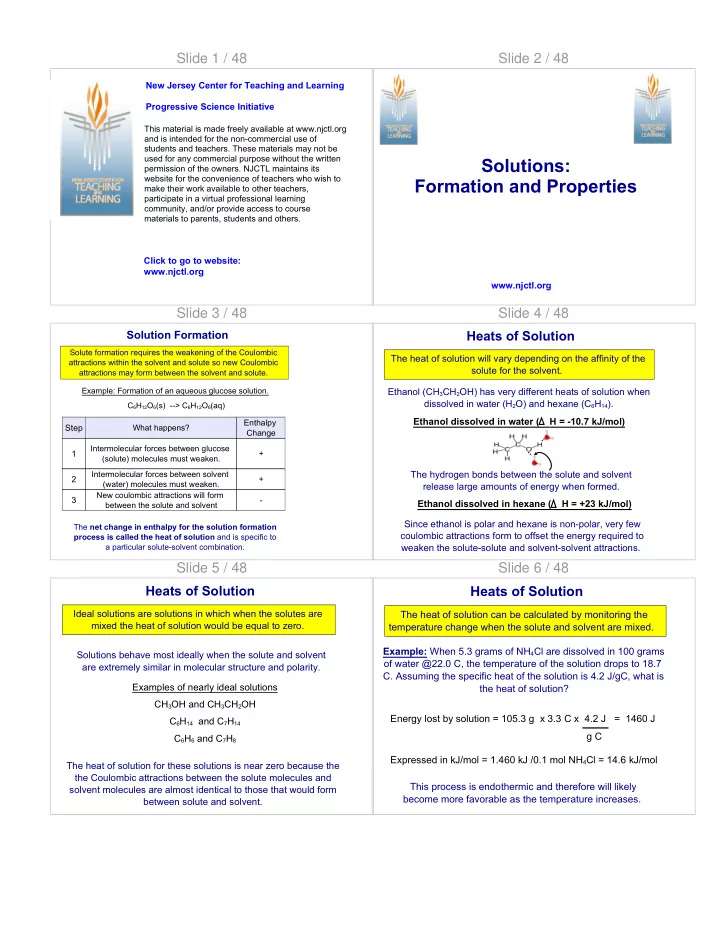
The heat of solution will vary depending on the affinity of the solute for the solvent. Ethanol (CH3CH2OH) has very different heats of solution when dissolved in water (H2O) and hexane (C6H14). Ethanol dissolved in water ( H = -10.7 kJ/mol) The hydrogen bonds between the solute and solvent release large amounts of energy when formed. Ethanol dissolved in hexane ( H = +23 kJ/mol) Since ethanol is polar and hexane is non-polar, very few coulombic attractions form to offset the energy required to weaken the solute-solute and solvent-solvent attractions.
Slide 5 / 48
Heats of Solution
Ideal solutions are solutions in which when the solutes are mixed the heat of solution would be equal to zero. Solutions behave most ideally when the solute and solvent are extremely similar in molecular structure and polarity. Examples of nearly ideal solutions CH3OH and CH3CH2OH C6H14 and C7H14 C6H6 and C7H8 The heat of solution for these solutions is near zero because the the Coulombic attractions between the solute molecules and solvent molecules are almost identical to those that would form between solute and solvent.
Slide 6 / 48 Heats of Solution
The heat of solution can be calculated by monitoring the temperature change when the solute and solvent are mixed. Example: When 5.3 grams of NH4Cl are dissolved in 100 grams
- f water @22.0 C, the temperature of the solution drops to 18.7
- C. Assuming the specific heat of the solution is 4.2 J/gC, what is