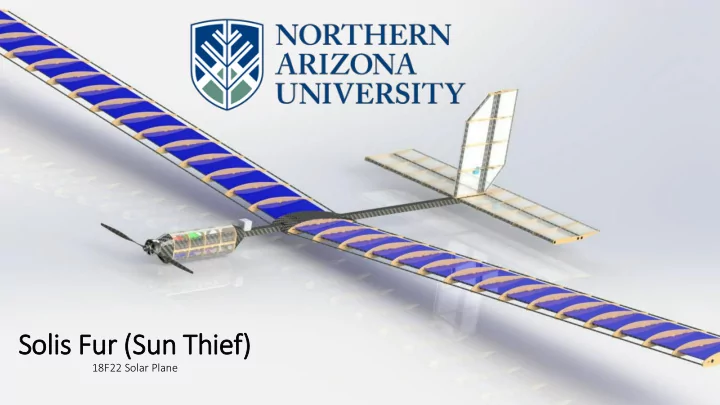
Solis Fur r (S (Sun Thief) 18F22 Solar Plane Project Title - - PowerPoint PPT Presentation

solis fur r s sun thief
SMART_READER_LITE
LIVE PREVIEW

Solis Fur r (S (Sun Thief) 18F22 Solar Plane Project Title - - PowerPoint PPT Presentation

Solis Fur r (S (Sun Thief) 18F22 Solar Plane Project Title Application of Photo-Voltaic Cells to Power a Remote Controlled Aircraft Capable of Indefinite Flight 4/26/2019 Ethan Smith - Solar Plane 2 The Team As viewed Left to right:


slide-1
SLIDE 1

Solis Fur r (S (Sun Thief)

18F22 Solar Plane
slide-2
SLIDE 2

2 4/26/2019 – Ethan Smith - Solar Plane

Application of Photo-Voltaic Cells to Power a Remote Controlled Aircraft Capable of Indefinite Flight

Project Title

slide-3
SLIDE 3

The Team

3 4/26/2019 – Solar Plane

As viewed Left to right:

Jonathan Hernandez -Website Designer Michael Broyles – Construction Manager Nathan Zufelt – Budget Manager Ethan Smith – Client Contact Brandon Beaudoin – Project Manager

slide-4
SLIDE 4

Project Sponsors / Customer

4

David Trevas, PhD

  • Provided customer requirements.
  • Crucial input for design requirements.

Sponsors

  • Northern Arizona University
  • Novakinetics Aerosystems
  • Prometheus Solar
  • Flagstaff Flyers
  • Coconino High School
  • Rock West Composites

Why is this important?

  • Teaches students to use engineering principles in a real life application.
  • Allows the use of renewable energy to power an RC plane.

4/26/2019 – Ethan Smith - Solar Plane

slide-5
SLIDE 5

Project Description

5

  • Achieve solar powered flight, which few have done

before.

  • Electric airplanes rely on batteries for energy

storage which is limited by the size and shape of current batteries.

  • Extending the range and reducing the weight of these

electric airplanes could make electric airplanes a viable source of travel and material transportation.

  • Indefinite flight through the use of solar power is an

important step in moving away from fossil fuels.

Plane Schematic [1]

4/26/2019 – Ethan Smith - Solar Plane

slide-6
SLIDE 6

Possible Applications

6

  • Conducting search and rescue missions
  • Game traffic study/mapping
  • Military surveillance
  • Scouting dangerous areas
  • Atmospheric data collection
  • Arial imaging
  • Infrastructure inspection

4/26/2019 – Brandon Beaudoin - Solar Plane

Surveillance Drone [2]

slide-7
SLIDE 7

Project Requirements and Goals

7

Customer Requirements

  • Indefinite flight while sun is present
  • Log flight data

These customer requirements were then translated into engineering requirements

4/26/2019 – Brandon Beaudoin - Solar Plane

slide-8
SLIDE 8

Final Design

8

Specifications:

  • Wing span: 4 m (13.25 ft)​
  • Wing dihedral: 6°
  • Wing area: 1.4 m2 (15.2 ft2 )​
  • Total weight: 3.5 kg (7.6 lbs)​
  • Number of solar cells: 60​
  • Maximum power output: 205 W
  • Operating voltage: 17.2 V
  • Propeller: 457x152mm (18x6 in)​
  • Flight speed: 10 m/s (22 mph)

4/26/2019 – Brandon Beaudoin - Solar Plane

slide-9
SLIDE 9

Manufacturing

9 4/26/2019 – Jonathan Hernandez - Solar Plane

Total Manufacturing Time

  • 218+ man hours
  • 32 hours soldering solar

panels

  • 58 hours building the wings

and tail

  • 15 hours machining wing

mounting brackets

slide-10
SLIDE 10

Manufacturing

10

Bottom fuselage shell Tail Nosecone molds, wing arms

4/26/2019 – Jonathan Hernandez - Solar Plane

Construction Tasks

  • Carbon fiber/balsa

wood assembly

  • Aluminum machining
  • Carbon fiber layup
  • Electrical soldering
  • Ultracote application
slide-11
SLIDE 11

Manufacturing

11

Laying up carbon fiber for wing shroud Applying Ultracote

4/26/2019 – Jonathan Hernandez - Solar Plane

slide-12
SLIDE 12

System Analysis

12

Magnet Tensile Testing

  • Maximum separation force was found using

a tensile tester.

  • Results showed an individual magnet was

strong enough to maintain fuselage closure.

  • 6 magnets were initially used to locate

fuselage.

  • Additional magnets were added to increase

separation force.

4/26/2019 – Michael Broyles - Solar Plane

slide-13
SLIDE 13

System Analysis

13

Aerodynamics

  • A MATLAB model was built to simulate wing lift
  • CFD used to simulate total lift and drag
  • Area relations used to ensure stability
  • Glide ratio of 24:1

4/26/2019 – Brandon Beaudoin - Solar Plane

slide-14
SLIDE 14

System Analysis

14 4/26/2019 – Jonathan Hernandez - Solar Plane

Wing Mount Stress

  • In-flight induced moment
  • Wings could see ~ 85.65 𝑚𝑐𝑔
  • Designs considered
  • 3D Printed ABS
  • T6 6061 Aluminum

𝑁𝑝 = Mwg Lcos θ 2

slide-15
SLIDE 15

System Analysis

15 4/26/2019 – Ethan Smith - Solar Plane

Solar losses due to Ultracote

  • Testing solar cells with and without Ultracote
  • vertop showed a 2% loss in voltage.
  • Tests were conducted outdoors and with

artificial lighting.

slide-16
SLIDE 16

System Analysis

16

Thrust and Power Draw Testing

  • Power consumption was found by using a Turnigy

thrust stand.

  • Voltage, amperage, wattage and thrust were

measured.

  • At full power our motor propeller combination

requires 7.8 amps, and 120.8 watts at 15.4 volts.

  • This test verified that we would be able to

fly our plane using only solar power.

  • Max thrust created by our system was 1030

grams.

4/26/2019 – Nathan Zufelt - Solar Plane

slide-17
SLIDE 17

Ground Testing Results

17

Ground Testing Results

  • Solar cells created higher voltage

but less amperage than battery.

  • Solar power remained consistent
  • ver time.
  • Plane can be powered by only

solar cells.

Estimated Flight Time

  • Indefinite while the sun is out!

4/26/2019 – Nathan Zufelt - Solar Plane

slide-18
SLIDE 18

Flight Testing

18

Initial Test Flight – 4/13/19

  • Location: Bellemont, Arizona
  • Fly on battery power to prove flight

characteristics.

  • 2nd flight would be on pure solar.
  • Elevator broke upon landing preventing

the 2nd flight.

  • Data collected:
  • Air speed & ground speed
  • Altitude
  • Power consumption
  • GPS positioning
  • Battery voltage

4/26/2019 – Michael Broyles - Solar Plane

slide-19
SLIDE 19

Testing Results

19

Flight Results

  • Test flight reached 170 ft off the ground.
  • The plane was able to exceed the calculated

speed.

Estimate Flight Time

  • Indefinite while the sun is out!

4/26/2019 – Michael Broyles - Solar Plane

slide-20
SLIDE 20

Future Work

20

Configuration Improvements

  • Incorporate a MPPT battery charge controller
  • Continue to develop fuselage
  • Increase system operating voltage
  • Decrease reliance on off the shelf parts

Plane Re-design

  • Increase wing stiffness to reduce deflection
  • Ailerons could be implemented
  • Winglets used to decrease drag
  • Add positioning lights
  • Higher strength construction materials

4/26/2019 – Michael Broyles - Solar Plane

slide-21
SLIDE 21

Conclusion

21 4/26/2019 – Nathan Zufelt- Solar Plane

Things we learned

  • Need to design for wing torsion
  • 5 minute epoxy works great
  • Maybe we don’t need a battery
  • Design for manufacturing
  • Charge controllers do not come in all

sizes and they weigh a lot.

  • Time is money!

Skills We Gained

  • Soldering solar connections
  • Apply Ultracote to aid with appearance

and strength.

  • How to glue with jigs to get

professional results.

  • Advanced wiring techniques.
  • How to design a solar array for specific

power needs.

Estimated Flight Time

  • Indefinite while the sun is out is possible!
slide-22
SLIDE 22

Acknowledgments

22

  • David Trevas, PhD
  • Northern Arizona University
  • Novakinetics Aerosystems
  • Prometheus Solar
  • Flagstaff Flyers
  • Coconino High School
  • Rock West Composites

4/26/2019 – Brandon Beaudoin - Solar Plane

slide-23
SLIDE 23

References

23

  • [1] "Free Vector," [Online]. Available: https://www.freevector.com/airplanes-blueprint-19757. [Accessed 24 September 2018].
  • [2] “Forces Network”, [Online]. Available: https://www.forces.net/news/tri-service/nato-takes-delivery-new-drones. [Accessed 25 April 2019].

4/26/2019 – Solar Plane

slide-24
SLIDE 24

24 4/26/2019 – Solar Plane https://youtu.be/QV1MH3HoIPM