SLIDE 1
Solar Heating and Cooling Market and Industry Trends
Vassiliki DROSOU, PhD. Head of Solar Thermal Systems Dept. CRES SKN Manager CEN/TC312 Secretary
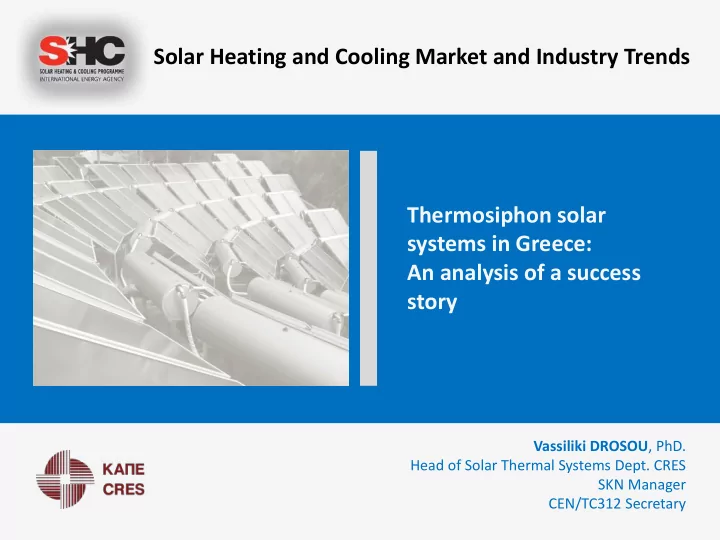
Thermosiphon solar systems in Greece: An analysis of a success story
SLIDE 2
Greece
In Greek: Ελλάδα, known also as Hellas Population: approx. 10.7 million Capital: Athens Area: 131,957 km2 Located in Southeast Europe, on the southern tip of the Balkan Peninsula GHI: 1450 kWh/m2 ~ 1800 kWh/m2
SLIDE 3 Solar Thermal: key figures
INSTALLED CAPACITY
3,407 MWth 4,867,500 m2 collector area 3,325 GWh/a energy yield
2019 NEW SYSTEMS
361,500 m2 collector area 10% increase compared to 2018
SOLAR FRACTION
80-90%
sanitary hot water needs of a single family
TYPICAL SYSTEM
Thermosiphon 150-300 l storage 2-4 m2 selective flat plate collector
SLIDE 4
Domestic and exporting market
Greek manufacturers export more than 50% of their production
SLIDE 5
Importing markets for Solar Thermal products (2019)
SLIDE 6
THERMOSIPHON SYSTEM
Highly efficient Easy to install Independence from other users Good value for money Long life Low maintenance Safe
SLIDE 7
Greek market
Growth of the branch Competitive Extended
SLIDE 8
1980s: Successful big installations
Historical milestones
1970s: Impact of rising energy prices due to the oil crises 1980s: Promotional campaigns and incentives in form of tax reductions and low interest loans 1970s: Domestic manufacturing Establishment of Greek solar thermal industry – EBHE (GSIA)
SLIDE 9
Standardization
CEN TC 312 Thermal solar systems and components Solar Keymark
10%
Of active SKN licenses are awarder to Greek products
SLIDE 10
Buildings
Ownership rate in Greece in excess of 75%. The typical Greek consumer prefers a high degree of autonomy Most urban buildings feature flat roofs, highly suitable for installation
SLIDE 11 “Regulation on the Energy Performance of Buildings” 60%
- f hot water needs in domestic
sector must covered by a solar thermal system (since 2010) “Saving Energy at Home I and II" programs” 70% installation costs of a solar thermal system for hot water production are funded by up to 70% PV with solar thermal The installation of PVs is allowed only upon the prerequisite that a solar thermal system is being used for hot water production
Governmental support
SLIDE 12
New buildings Renovations Electricity and oil price increase Price reduction of solar thermal products
After economic recession
SLIDE 13
Other factors
Improved manufacturing processes e –commerce & broad distribution network of shops Environmental concerns by the consumers
SLIDE 14
Numbers to remember
1700kg/a CO2 avoided emissions by a thermosiphon system
Solar collector ~ 675kgr CO2/m2y Electric car ~ 120gr/km.
1400kg/a CO2 avoided emissions by an electric car
SLIDE 15 Thank you for supporting solar thermal technology! drosou@cres.gr References
- DROSOU V., TRAVASAROS C., PAPADOPOULOS, A.M., Thermosiphon solar systems
in Greece: An analysis of a success story, 13th Eurosun International Conference on Solar Energy for Buildings and Industry, 1 – 4 September 2020, Virtual Conference (Invited presentation)
Pictures: Cover SOLE, p.3 CALPAK, p.4 SOLE, p.6 (up) PAPAEMMANOUEL, p.6 (down) COSMOSOLAR, p.7 MALTEZOS, p.10 SOLE, p.11 MELPO, p.13 SOLE, p14 PAPAEMMANOUEL.