Soft Power 1 what you want, you do not have to spend as much on - - PowerPoint PPT Presentation

soft power
SMART_READER_LITE
LIVE PREVIEW

Soft Power 1 what you want, you do not have to spend as much on - - PowerPoint PPT Presentation

Session 11: The Revival of Studies of Cultural Imperialism Soft Power 1 what you want, you do not have to spend as much on sticks and eyes of others, our soft power is enhanced (p. 256) ideals, and policies. When our policies are seen as


slide-1
SLIDE 1

1

Session 11: The Revival of Studies of Cultural Imperialism
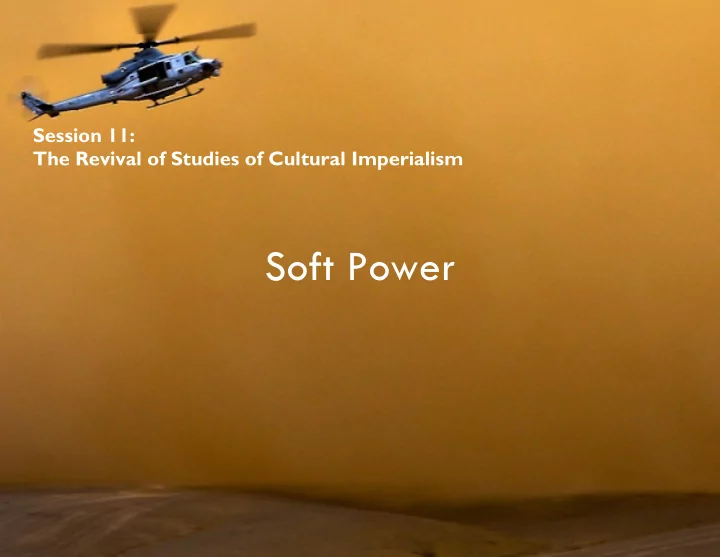
Soft Power

slide-2
SLIDE 2

2

Joseph Nye: “Soft power is the ability to get what you want through attraction rather than coercion or payments. When you can get others to want what you want, you do not have to spend as much on sticks and carrots to move them in your direction. Hard power, the ability to coerce, grows out of a country’s military and economic might. Soft power arises from the attractiveness of a country’s culture, political ideals, and policies. When our policies are seen as legitimate in the eyes of others, our soft power is enhanced” (p. 256)

slide-3
SLIDE 3

3

Cultural Imperialism, Revived

David Rothkopf: “For the United States, a central objective of an Information Age foreign policy must be to win the battle of the world’s information flows, dominating the airwaves as Great Britain once ruled the seas”. Zbigniew Brzezinski: “America stands supreme in the…decisive domains of global power....culturally...it enjoys an appeal that is unrivalled, especially among the world’s youth—all of which gives the United States a political clout that no other state comes close to matching”.

slide-4
SLIDE 4

4

 US State Department, and the Department of Defense.  “smart power,” “strategic communications,” “public diplomacy,” “cultural diplomacy,” “public affairs,” “information operations,” “psychological

  • perations”

 2007, State Department, “U.S. National Strategy for Public Diplomacy and Strategic Communication;” Department of Defense, “Execution Roadmap for Strategic Communication,” 2006.  2007, Under Secretary for Public Diplomacy and Public Affairs

slide-5
SLIDE 5

5

US Department of State, 2007: “The U.S. is engaged in an international struggle of ideas and ideologies, which requires a more extensive, sophisticated use of communications and public diplomacy programs to gain support for U.S. policies abroad. To effectively wage this struggle, public diplomacy must be treated—along with defense, homeland security and intelligence—as a national security priority in terms of resources”.

slide-6
SLIDE 6

6

Joint Forces Command, 2010: “The battle of the narrative is a full-blown battle in the cognitive dimension of the information environment, just as traditional warfare is fought in the physical domains (air, land, sea, space, and cyberspace)….a key component of the ‘Battle of the Narrative’ is to succeed in establishing the reasons for and potential outcomes of the conflict, on terms favorable to your efforts. Upon our winning the battle of the narrative, the enemy narrative doesn’t just diminish in appeal or followership, it becomes irrelevant. The entire struggle is completely redefined in a different setting and purpose”.

slide-7
SLIDE 7

7

Public diplomacy: “those overt international public information activities of the United States Government designed to promote United States foreign policy objectives by seeking to understand, inform, and influence foreign audiences and opinion makers, and by broadening the dialogue between American citizens and institutions and their counterparts abroad” + “civilian agency efforts to promote an understanding of the reconstruction efforts, rule of law, and civic responsibility through public affairs and international public diplomacy operations” (DoD, 2010a, pp. 214–215; DoD, 2012, p. xvi)

slide-8
SLIDE 8

8

Strategic objectives: 1) projecting “American values” by offering a “positive vision of hope and

  • pportunity”;

2) marginalizing “violent extremists” in order to defend the values cherished by the “civilized”; and, 3) working to “nurture common interests and values” between Americans and peoples around the globe (DoS, 2007, p. 3)

slide-9
SLIDE 9

9

Strategic audiences: 1) “key influencers” 2) “vulnerable” groups 3) “mass audiences” (DoS, 2007, pp. 4–5)

slide-10
SLIDE 10

10

Public Affairs (PA) Operations: “communicating information about military activities to domestic, international, and internal audiences,” “community engagement activities” (DoD, 2008, pp. 1, 9) + “to assure the trust and confidence of U.S. population, friends and allies, deter and dissuade adversaries, and counter misinformation and disinformation ensuring effective, culturally appropriate information delivery in regional languages” (DoD, 2008, p. 2)

slide-11
SLIDE 11

11

Strategic Communication: “focused USG efforts to understand and engage key audiences to create, strengthen, or preserve conditions favorable for the advancement of USG interests, policies, and objectives through the use of coordinated programs, plans, themes, messages, and products synchronized with and leveraging the actions of all instruments of national power. SC combines actions, words, and images to influence key audiences”. (DoD, 2011, p. II-9).

slide-12
SLIDE 12

12

Goals of SC:

 Improve U.S. credibility and legitimacy;  Weaken an adversary’s credibility and legitimacy;  Convince selected audiences to take specific actions that support U.S.

  • r international objectives;

 Cause a competitor or adversary to take (or refrain from taking)

specific actions. (DoD, 2009, p. 2)  “Interactive Internet activities are an essential part of DoD’s responsibilities to provide information to the public, shape the security environment, and support military operations” (DoD, 2007b, p. 1)  “shape emotions, motives, reasoning, and behaviors of selected foreign entities” (DoD, 2007b, p. 1)—“psychological operations” (DoD, 2006a, p. 10). What For?  Diverse? Universal? Common? Different? A reminder?