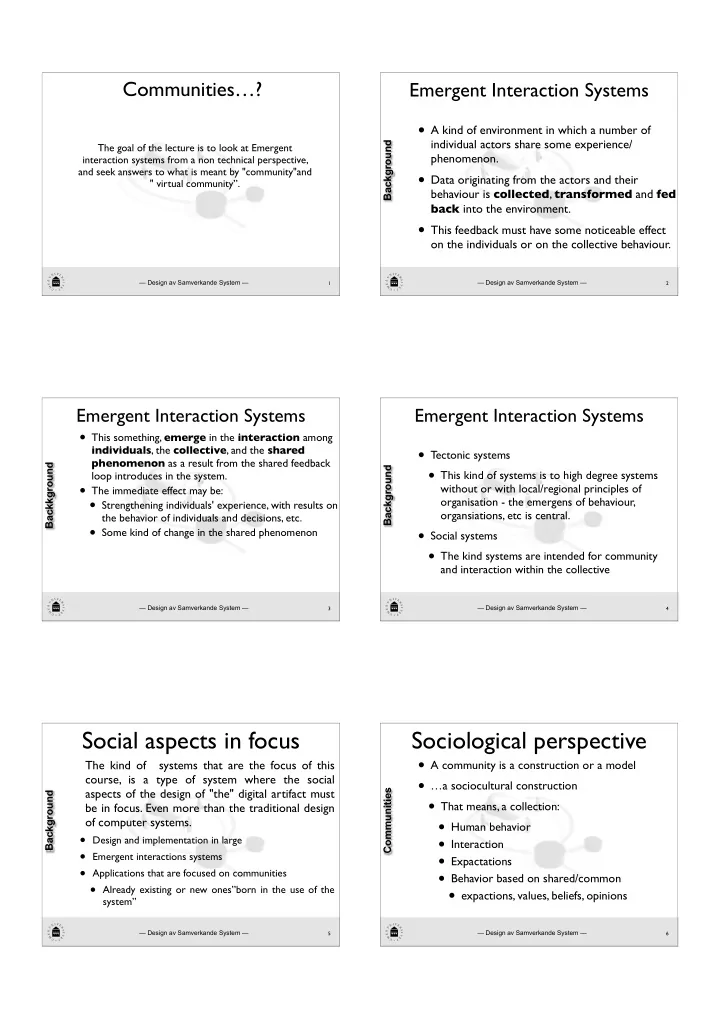
Social aspects in focus Sociological perspective A community is a - - PDF document

social aspects in focus sociological perspective
SMART_READER_LITE
LIVE PREVIEW

Social aspects in focus Sociological perspective A community is a - - PDF document

Communities? Emergent Interaction Systems A kind of environment in which a number of individual actors share some experience/ Background The goal of the lecture is to look at Emergent phenomenon. interaction systems from a non technical


slide-1
SLIDE 1

— Design av Samverkande System —

Communities…?

The goal of the lecture is to look at Emergent interaction systems from a non technical perspective, and seek answers to what is meant by "community"and " virtual community”.

1

— Design av Samverkande System —

Emergent Interaction Systems

  • A kind of environment in which a number of

individual actors share some experience/ phenomenon.

  • Data originating from the actors and their

behaviour is collected, transformed and fed back into the environment.

  • This feedback must have some noticeable effect
  • n the individuals or on the collective behaviour.

2

Background

— Design av Samverkande System —

Emergent Interaction Systems

  • This something, emerge in the interaction among

individuals, the collective, and the shared phenomenon as a result from the shared feedback loop introduces in the system.

  • The immediate effect may be:
  • Strengthening individuals' experience, with results on

the behavior of individuals and decisions, etc.

  • Some kind of change in the shared phenomenon

3

Backkground

— Design av Samverkande System —

Emergent Interaction Systems

  • Tectonic systems
  • This kind of systems is to high degree systems

without or with local/regional principles of

  • rganisation - the emergens of behaviour,
  • rgansiations, etc is central.
  • Social systems
  • The kind systems are intended for community

and interaction within the collective

4

Background

— Design av Samverkande System —

Social aspects in focus

The kind of systems that are the focus of this course, is a type of system where the social aspects of the design of "the" digital artifact must be in focus. Even more than the traditional design

  • f computer systems.
  • Design and implementation in large
  • Emergent interactions systems
  • Applications that are focused on communities
  • Already existing or new ones”born in the use of the

system”

5

Background

— Design av Samverkande System —

Sociological perspective

  • A community is a construction or a model
  • …a sociocultural construction
  • That means, a collection:
  • Human behavior
  • Interaction
  • Expactations
  • Behavior based on shared/common
  • expactions, values, beliefs, opinions

6

Communities

slide-2
SLIDE 2

— Design av Samverkande System —

“Communities…”

  • Communities in large defintion:
  • Group of individuals (people) tied to:
  • area/region
  • language
  • ethnicity, religion, values,…
  • ownership
  • occupation, profession,…
  • interest, agreement, …
  • 7

Communities

— Design av Samverkande System —

…a sociocultural construction

  • With a life by itself that goes beyond the sum of

the lives of its members

  • That means, a super-organic system
  • in-organic, organic, and super-organic
  • As consists of the learned, not the inherited
  • Dynamic and changing
  • Dvs, a community is a cultural organism
  • http://cec.vcn.bc.ca/cmp/whatcom.htm

8

Sociologisk perspektiv

— Design av Samverkande System —

Charateristics

  • Size
  • Age
  • Activities
  • Interactivity and communication
  • Organsiation

9

Sociologisk perspektiv

— Design av Samverkande System —

Charateristics

  • The members are well aware of his/her

membership

  • ”Community life” is the core (gemeinshaft also in

english) for the term “Community”

  • Fuzzy or vague boundaries
  • Communites exist within larger ones
  • More or less hetrogen in its compostion
  • Dynamic and changeble, more or less rapidly

10

Sociologisk perspektiv

— Design av Samverkande System —

Six dimmensions

  • All cultures/communities have these six dimensions
  • Technical
  • Economical
  • Political
  • Social
  • Ethic-values
  • Values and views

11

Sociologisk perspektiv

— Design av Samverkande System —

Technical

  • Is its capital, its tools and abilities to manage and

control the physical environment

  • It’s the interface between the humans and the

nature

  • But it is not the tools themselves, which

represent this dimension alone, ideas and behaviors that make it possible to: invent, use, teach about tools belong to it also.

  • The easiest to implement, affect the other five

dimmensions

12

Sociologisk perspektiv

slide-3
SLIDE 3

— Design av Samverkande System —

Economical

  • Are the ways and means of production and

allocation of resources, services, products, and other values

  • It is not physical things that money

represents, that make this dimension, but the ideas and behavior that gives value for money

  • Money has no value in itself, but it is society,

culture, community that creates it.

  • All in a community can’t be done with money !!!

13

Sociologisk perspektiv

— Design av Samverkande System —

Political

  • Are the ways and means to get: power,

influence, decisivenes

  • Includes everything from governmental power,

gang leaders, and to communities with no identifiable leader

  • Many different types of leaders and forms of

decision paths

14

Sociologisk perspektiv

— Design av Samverkande System —

Social

  • Composed of how people act, interact, react and

expects other to act and interact

  • Is about the whay people act in relations to
  • thers, ie the various roles existing
  • The dimmension the people deem to be

Sociology.

15

Sociologisk perspektiv

— Design av Samverkande System —

Aesthetic-values

  • Are structures of ideas that humans have about what is:
  • good or bad
  • nice or uggly
  • right or wrong
  • Used to explain the way people acts and behave
  • Sometime paradoxical, inconsistent, contradictory
  • Change slowly in a community and diffucult to change
  • Common/shared values are a important part of a

community

16

Sociologisk perspektiv

— Design av Samverkande System —

Perceptions & Opinions

  • Ideas that humans have on nature, the world

around them, their role in it, cause and effect, time perception, and behavior

  • Can be seen as a religious dimension, but is much

more

17

Sociologisk perspektiv

— Design av Samverkande System —

The six Dimmensions

  • Learned from "birth" ...
  • "if you do not learn you're dead"
  • Exists in all forms of human cultures
  • Links all six dimensions together
  • Change in one, inevitable impact on all other

dimensions are more or less

  • Experience, allows one to predict how various

changes will affect

18

Sociologisk perspektiv

slide-4
SLIDE 4

— Design av Samverkande System —

Why this...soft...

  • Social aspects must be in focus
  • Learning to understand how the six different

dimensions interact, makes you evolve as a designer in many dimmensions

  • Design and implementation in large
  • Emergent interaction systems
  • Applications that are focused on communities
  • Existing or new ones that arise

19

Gemenskaper

— Design av Samverkande System —

Empower Communities

  • How to measure the strength of a community?
  • What make a community strong?
  • How to Empower?

20

— Design av Samverkande System —

What to Empower?

  • Common
  • Values. The degree to which members of the community share values, especially the idea that they belong

to a common entity that supersedes the interest of members within it;

  • Altruism. The proportion of, and degree to which, individuals are ready to sacrifice benefits to themselves for the

benefit of the community as a whole (as reflected in degrees of generosity, individual humility, personal sacrifice, communal pride, mutual supportiveness, loyalty, concern, camaraderie, sister/brotherhood);

  • Communal Services. Facilities and services (such as roads, markets, potable water, access to education, health

services), their upkeep (dependable maintenance and repair), sustainability, and the degree to which all community members have access to them;

  • Communications. Within a community, and between itself and outside, communication includes roads, electronic

methods (eg telephone, radio, TV, InterNet), printed media (newspapers, magazines, books), networks, mutually understandable languages, literacy and the willingness and ability to communicate (which implies tact, diplomacy, willingness to listen as well as to talk) in general;

  • Confidence. Although expressed as confidence in individuals, how much confidence is shared among the community

as a whole? eg an understanding that the community can achieve what ever it wishes to do, positive attitudes, willingness, self motivation, enthusiasm, optimism, self-reliant rather than dependency attitudes, willingness to fight for its rights, avoidance of apathy and fatalism, a "vision" of what is possible;

  • Context (political and administrative). An environment that supports strengthening includes political (including the

values and attitudes of the national leaders, laws and legislation) and administrative (attitudes of civil servants and technicians, as well as Governmental regulations and procedures) elements, and the legal environment; 21

Gemenskaper

— Design av Samverkande System —

What to Empower?

  • Information. The ability to process and analyse information, the level of awareness, knowledge and wisdom found

among key individuals and within the group as a whole. When information is more effective and more useful, not just more in volume or amount;

  • Intervention. The extent and effectiveness of animation (mobilizing, management training, awareness raising,

stimulation) aimed at strengthening the community. Do outside or internal sources of charity increase the level of dependency and weaken the community, or do they challenge the community to act and therefore become stronger? Is the intervention sustainable or does it depend upon decisions by outside donors which have different goals and agendas than the community itself?

  • Leadership. Leaders have power, influence, and the ability to move the community. The most effective and sustainable

leadership is one that follows the decisions and desires of the community as a whole, taking an enabling and facilitating role. Leaders must possess skills, willingness, honesty and some charisma;

  • Networking. Not just "what you know." but "who you know." What is the extent to which community members,

especially leaders, know persons (and their agencies or organizations) who can provide useful resources that will strengthen the community as a whole? The useful linkages, potential and realized, within the community and with

  • thers outside it;
  • Organization. The degree to which different members of the community see themselves as each having a role in

supporting the whole (in contrast to being a mere collection of separate individuals), including organizational integrity, structure, procedures, decision making processes, effectiveness, division of labour and complementarity of roles and functions; 22

Gemenskaper

— Design av Samverkande System —

What to Empower?

  • Political Power. The degree to which the community can participate in national and district decision making. Just as

individuals have varying power within a community, so communities have varying power and influence within the district and nation;

  • Skills. The ability, manifested in individuals, that will contribute to the organization of the community and the ability
  • f it to get things done that it wants to get done, technical skills, management skills, organizational skills, mobilization

skills;

  • Trust. The degree to which members of the community trust each other, especially their leaders and community

servants, which in turn is a reflection of the degree of integrity (honesty, dependability, openness, transparency, trustworthiness) within the community;

  • Unity. A shared sense of belonging to a known entity (ie the group composing the community), although every

community has divisions or schisms (religious, class, status, income, age, gender, ethnicity, clans), the degree to which community members are willing to tolerate the differences and variations among each other and are willing to cooperate and work together, a sense of a common purpose or vision, shared values;

  • Wealth. The degree to which the community as a whole (in contrast to individuals within it) has control over actual

and potential resources, and the production and distribution of scarce and useful goods and services, monetary and non monetary (including donated labour, land, equipment, supplies, knowledge, skills). 23

Gemenskaper

— Design av Samverkande System —

Virtual Communities

  • A form of community where one of the

traditional characteristics of a community, exists in the virtual / digital world

  • A group of people trying to achieve something as

a group in which they use information technology as a means to this

24

Gemenskaper