Sociological Factors Voter preferences cant be predicted by just one - - PowerPoint PPT Presentation

sociological factors voter preferences can t be predicted
SMART_READER_LITE
LIVE PREVIEW

Sociological Factors Voter preferences cant be predicted by just one - - PowerPoint PPT Presentation

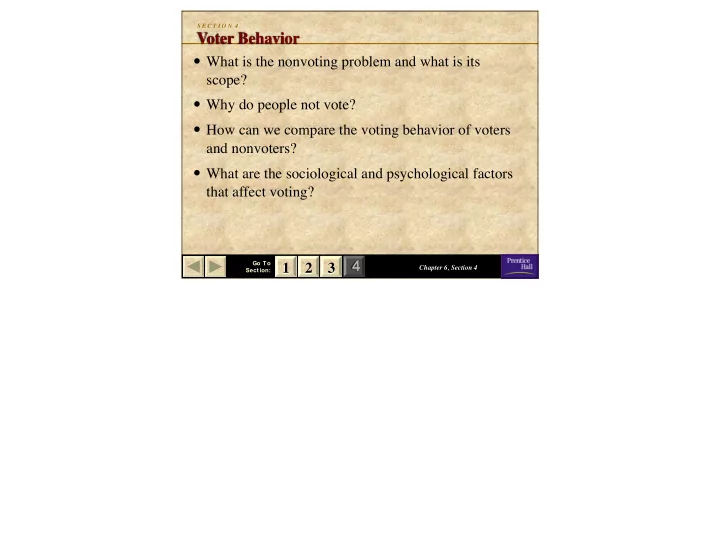
S E C T I O N 4 Voter Behavior What is the nonvoting problem and what is its scope? Why do people not vote? How can we compare the voting behavior of voters and nonvoters? What are the sociological and psychological factors that


slide-1
SLIDE 1

1 2 3

Go To Section:

4

S E C T I O N 4

Voter Behavior

  • What is the nonvoting problem and what is its

scope?

  • Why do people not vote?
  • How can we compare the voting behavior of voters

and nonvoters?

  • What are the sociological and psychological factors

that affect voting?

Chapter 6, Section 4

2 3 1

slide-2
SLIDE 2

1 2 3

Go To Section:

4

Nonvoters

Chapter 6, Section 4

2 3 1

  • Millions of Americans do not vote when elections are

held.

  • Only 50.1 percent of eligible voters cast ballots in the

2000 presidential election, and only 46.3 percent of the electorate voted for the members of the House of Representatives.

  • Voter turnout significantly decreases in off-year

elections, congressional elections held in years when there is no presidential election.

slide-3
SLIDE 3

1 2 3

Go To Section:

4

Why People Do Not Vote

  • Some people cannot vote for various reasons, such as

physical or mental illness, unexpected travel, and resident alien citizenship status.

  • However, most nonvoters do not vote because
  • voting is in some way inconvenient,
  • they do not believe that their vote will make a difference, or
  • they distrust politics and political candidates.

Chapter 6, Section 4

2 3 1

slide-4
SLIDE 4

1 2 3

Go To Section:

4

Voters and Voting Behavior

Voting is studied more than any other form of political participation in the United States. We learn about voting behavior from:

  • The results of elections—information can be gleaned by studying the results
  • f confidential voting compared to the population make-up of a particular sector
  • The field of survey research—data can be gathered by conducting polls

across specific cross sections of the population, as the Gallup Organization does

  • Studies of political socialization—studying political socialization, the

process by which people gain their political attitudes and opinions, can also be useful in predicting voting behavior

Chapter 6, Section 4

2 3 1

slide-5
SLIDE 5

1 2 3

Go To Section:

4

Sociological Factors Voter preferences can’t be predicted by just one sociological factor. Voter opinion is a combination of all of these factors and more.

Chapter 6, Section 4

2 3 1

slide-6
SLIDE 6

1 2 3

Go To Section:

4

Psychological Factors

Party Identification

  • The loyalty of people to a

particular political party is the single most significant and lasting predictor of how a person will vote.

Candidates and Issues

  • Candidates and issues are two

short-term factors that can influence even the most loyal Democrat or Republican. People may vote out of their chosen party if they dislike a candidate or the party’s stand on a particular issue.

Voters’ perceptions of their party, the candidates, and the issues significantly affects their voting.

Chapter 6, Section 4

2 3 1