Chapter 12: The Roman World Overview of Roman Drama we owe a great - - PowerPoint PPT Presentation

chapter 12 the roman world
SMART_READER_LITE
LIVE PREVIEW

Chapter 12: The Roman World Overview of Roman Drama we owe a great - - PowerPoint PPT Presentation

Chapter 12: The Roman World Overview of Roman Drama we owe a great debt to the Romans in terms of culture, language, politics, DNA and also theatre, but only in certain ways Greek terms: theatre, drama, tragedy, comedy, critic,


slide-1
SLIDE 1

Chapter 12: The Roman World

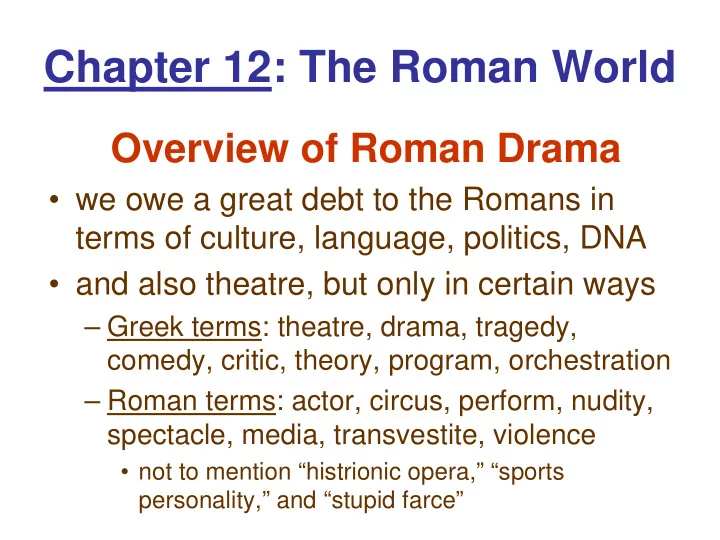
Overview of Roman Drama

  • we owe a great debt to the Romans in

terms of culture, language, politics, DNA

  • and also theatre, but only in certain ways

– Greek terms: theatre, drama, tragedy, comedy, critic, theory, program, orchestration – Roman terms: actor, circus, perform, nudity, spectacle, media, transvestite, violence

  • not to mention “histrionic opera,” “sports

personality,” and “stupid farce”

slide-2
SLIDE 2

Chapter 12: The Roman World

Overview of Roman Drama

  • but the Romans were, on the whole, not

innovators in theatre or drama

– they were mostly transmitters of Greek culture

  • Roman drama was largely dependent on

its inimitable Greek forebear

– to the Romans, theatre was a diversion and form of leisure, cf. neg-otium (“no business”) – not an art to be taken seriously per se

slide-3
SLIDE 3

Chapter 12: The Roman World

Overview of Roman Drama

  • the works of only three Roman playwrights

have been preserved whole

– Plautus (fl. 208-186 BCE): 19 comedies based on Greek originals by a variety of New Comedy dramatists (Middle Comedy?) – Terence (fl. 166-160 BCE): 6 comedies, all from Menander and Apollodorus of Carystus – Seneca (4 BCE - 65 CE): 8 tragedies based

  • n Greek tragedy, 1 fabula praetexta
slide-4
SLIDE 4

Chapter 12: The Roman World

Geography

  • Italy is the boot-

shaped peninsula west of Greece

  • Alps to the north
  • Sicily to the south
slide-5
SLIDE 5

Chapter 12: The Roman World

Early Rome

  • myth: the Romans

were Aeneas of Troy’s descendants

  • reality: they were a

branch of the Indo- Europeans

– closely related to the Celts (or Gauls)

slide-6
SLIDE 6

Chapter 12: The Roman World

Early Rome

  • myth: the early founders of the city of

Rome were the twin brothers Romulus and Remus in 753 BCE

BCE

slide-7
SLIDE 7

Chapter 12: The Roman World

Early Rome

  • reality: the early

Romans were the subjects of the Etruscans

– culturally, if not politically too

  • today, the Etruscans

are a linguistic and historical mystery

slide-8
SLIDE 8

Chapter 12: The Roman World

The Roman Republic

  • began in 510 BCE (or so we’re told)
  • governed by a Senate run by patricians
  • early Roman history was dominated by the

“Conflict of the Orders”

– the struggle for power between the patricians and the plebeians (commoners)

  • ultimately, the plebeians won many rights
slide-9
SLIDE 9

Chapter 12: The Roman World

The Roman Republic

  • also the period of the

development of the legion

slide-10
SLIDE 10

Chapter 12: The Roman World

The Roman Republic

  • the Romans conquered

most of Italy by 264 BCE

  • came into contact with

Greeks living in Magna Graecia (southern Italy)

slide-11
SLIDE 11

Chapter 12: The Roman World

The Punic Wars

  • expansion brought the

Romans into contact with Carthage

  • First Punic War

(264-241 BCE)

  • Second Punic War

(218-202 BCE)

– Hannibal

slide-12
SLIDE 12

Chapter 12: The Roman World

The Punic Wars

  • ultimately, the

Romans won the Battle of Zama (202 BCE)

  • led by the general

Scipio Africanus

slide-13
SLIDE 13

Chapter 12: The Roman World

Rome in the Second Century

  • the Romans were now an international

power, both militarily and economically

  • they began expanding to the east
  • conquered Greece by the mid-second

century BCE

  • the integration of Greek and Roman

culture is called Hellenism

slide-14
SLIDE 14

Chapter 12: The Roman World

The Roman Revolution

  • the rise of generals
  • the first was Marius

– a popularis, from the lower classes – reformed the army – tied his soldiers to himself directly by paying for their armor

slide-15
SLIDE 15

Chapter 12: The Roman World

The Roman Revolution

  • the next was Sulla

– from the upper class – at first, one of Marius’ lieutenants – rose to confront Marius – attacked and defeated the Senate – became dictator

slide-16
SLIDE 16

Chapter 12: The Roman World

The Roman Revolution

  • next up was Pompey

– one of Sulla’s lieutenants – adulescens carnufex – defeated Spartacus, then the Aegean pirates – by 62 BCE, Rome’s greatest general

slide-17
SLIDE 17

Chapter 12: The Roman World

The Roman Revolution

  • finally, Julius Caesar

– from a good Roman family, but poor – had great charisma – brought together Pompey and Crassus into the First Triumvirate (60 bce)

slide-18
SLIDE 18

Chapter 12: The Roman World

The Roman Revolution

  • Julius Caesar

– became proconsul of Gaul – brought the entire area under Roman control – like Marius, Caesar tied his legions to himself, not Rome

slide-19
SLIDE 19

Chapter 12: The Roman World

The Roman Revolution

  • Julius Caesar

– crossed the Rubicon – defeated Pompey at Pharsalus – met Cleopatra in Egypt – then defeated the Senate twice more

slide-20
SLIDE 20

Chapter 12: The Roman World

The Roman Revolution

  • Julius Caesar

– with that, he was in sole control of Rome – was assassinated on March 15, 44 BCE (Ides of March)

slide-21
SLIDE 21

Chapter 12: The Roman World

The Roman Revolution

  • Octavian

– Caesar’s teenage heir – teamed up with Mark Antony to defeat Caesar’s assassins at Philippi in 42 BCE

slide-22
SLIDE 22

Chapter 12: The Roman World

The Roman Revolution

  • Octavian

– but Antony went into league with Cleopatra – Octavian defeated them: Actium, 31 BCE

slide-23
SLIDE 23

Chapter 12: The Roman World

The Roman Revolution

  • Octavian

– became princeps

  • was renamed Augustus

– “restored” control of the Roman state to the Senate in 27 BCE – but it was only a hollow shell of representative government

slide-24
SLIDE 24

Chapter 12: The Roman World

The Roman Empire

  • The Pax Romana

– 200 years of relative peace (27

BCE -180 CE)

– by then, Rome was run by a succession of imperatores (“generals”)

slide-25
SLIDE 25

Chapter 12: The Roman World

The Roman Empire

  • The Pax Romana

– great age of prosperity and art – emperors: Trajan, Hadrian, Marcus Aurelius – authors: Vergil, Horace, Ovid, Juvenal

slide-26
SLIDE 26

Chapter 12: The Roman World

The Colosseum

slide-27
SLIDE 27

Chapter 12: The Roman World

Pompeii

slide-28
SLIDE 28

Chapter 12: The Roman World

Pompeii

slide-29
SLIDE 29

Chapter 12: The Roman World

Pompeii

slide-30
SLIDE 30

Chapter 12: The Roman World

Pompeii

slide-31
SLIDE 31

Chapter 12: The Roman World

Pompeii

slide-32
SLIDE 32

Chapter 12: The Roman World

The Decline and Fall of Rome

slide-33
SLIDE 33

Chapter 12: The Roman World

The Middle Ages

slide-34
SLIDE 34

Chapter 12: The Roman World

The Middle Ages