
SLIDE 1
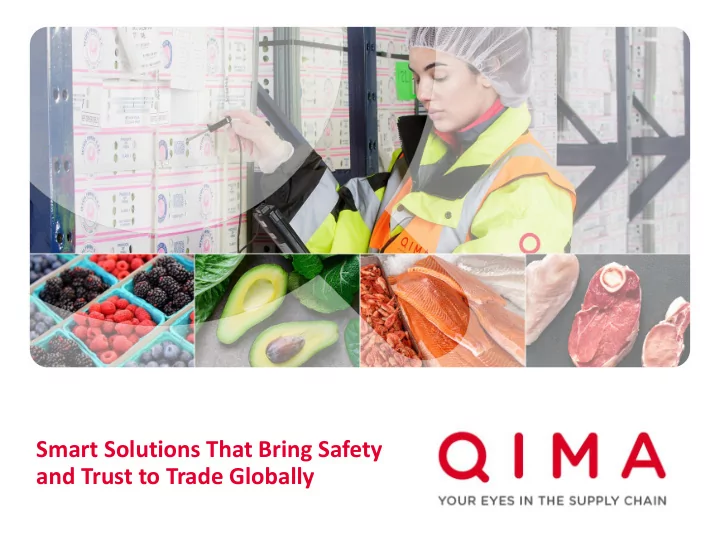
Smart Solutions That Bring Safety and Trust to Trade Globally - - PowerPoint PPT Presentation
Smart Solutions That Bring Safety and Trust to Trade Globally Safeguarding Food Quality and Safety in a Globalized World Food supply chains are more globalized than ever Food companies face increased pressure from consumers, governments,
info@qima.com
2
Food supply chains are more globalized than ever Food companies face increased pressure from consumers, governments, international
carcinogens, pesticides)
…across their entire food supply chain
info@qima.com
2
info@qima.com
3
Producer
Certification, audits, inspections
Exporter
Inspections (bulk and packed) at reception, process and dispatch Temperature control Certification, audits
Shipping
Inspections for shipping companies before / after shipment Certification, audits
Importer
Inspections (bulk and packed) at arrival, re- packing and dispatch supervision Temperature control Certification, audits
Retailer
Inspections at reception in DC’s and stores Process audits Temperature control Supply chain management Certification
Processing
Certification, audits, inspections
info@qima.com
4
Inspections at the source or destination
Ensure produce quality before and after shipping: On-site inspections: random sampling, visual checks, product-specific tests, defect sorting and counting Condition of inventory: ensure that products can be shipped safely. Temperature control: check and monitor post- harvest temperature and storage conditions for your produce. Orders supervision: to help you sort and dispatch your produce orders. Re-packing supervision Packaging and labeling checks, re-packing supervision Random sampling according to ISO procedures
info@qima.com
5
Secure food safety at every stage of your sourcing
Hygiene (GHP) Audits: Ensure compliance with international requirements on hygiene and your own HACCP plan. Good Manufacturing Practices (GMP) Audits: Achieve GMP compliance and secure food safety in your supply chain.
Build an ethical and sustainable food supply chain
Ethical Audits:
for human rights violations
BSCI, custom audit protocols.
schemes (UTZ, 4C, Rainforest Alliance)
info@qima.com
6
GlobalG.A.P. Assures responsible agriculture, including environmental impact, chemical use, animal welfare, and employee H&S PrimusGFS Certification of produce sector products: from growing
BRC Global Standards Set the standard for good manufacturing practices for all different productions from food and packaging industry to retail SQF – Safe Quality Food program Food safety and quality codes designed to meet requirements for all sectors of the supply chain – from the farm to the retail stores IFS Featured Standards IFS Standards are uniform food, product and service standards
info@qima.com
7
Proven Teams to Secure Your Food Supply Chain:
Experienced inspectors specializing in all food quality and safety areas Food inspectors with profile higher education (incl. agronomical engineers) and proven track record Auditors with a minimum of 5 years of field experience A certification team with over 25 years of experience in the food industry
Training Solutions with
Customized on-site training Scheme specific training Online training memberships for staff and companies Learning metrics for your employees Training video production
info@qima.com
7
info@qima.com
8
Access to reports can be shared and controlled between retailers and suppliers.
info@qima.com
8
info@qima.com
9
Growers I Food producers I Packaging I Retailers I Restaurants
info@qima.com
10
In 2019, we will perform more than 270,000 audits & inspections and 50,000 lab tests for brands, retailers and importers globally.
QIMA Food Support Offices
info@qima.com
11
Leading Flexibility & Turnaround
after inspection, with same-day turnaround guaranteed
Global Coverage
network
Real-Time Supply Chain Data
QIMA’s fully customizable dashboard
benchmarking
Product Expertise
canned meat, dried products); experienced professionals with industry background.
audit procedures.
Trustworthy Certification
government agencies and major food retailers
Comprehensive Online Management
quick decisions. Share access with stakeholders.
PRODUCT INSPECTIONS SUPPLIER AUDIT PROGRAMS CERTIFICATIONS LABORATORY TESTING
info@qima.com
13
Reception bulk and raw material from field Reception and inspection of Packed Product Inspections at process and packing Packed product inspection
info@qima.com
14
info@qima.com
15
Inspection Preparation
Arrival Onsite
Inspection
Report Preparation
Report Release
report access link
info@qima.com
15
info@qima.com
16
Speak to our Sales Staff to discuss your needs Audit Report Tech Review Certification Decision Application Pre-Assesment (optional) Audit On site Corrective actions and Continuous improvement solutions Surveillance audits
16
info@qima.com
info@qima.com
17
The Global Standard for Food
The Global Standard for Storage & Distribution
the end user, such as the retailer or the food service company.
The Global Standard for Packaging and Packaging Materials
The Global Standard START!
step towards the implementation of the BRCGS Food Standard.
BRCGS Standards
Designed to harmonize food safety standards across the supply chain. Focused on building trust and confidence throughout the supply chain
info@qima.com
18
SQF (Safe Quality Food) Program
The only scheme to integrate a quality component as well as food safety Links primary production certification to food manufacturing, distribution and agent/broker management certification Helps reduce assessment inconsistencies and costs of multiple assessment standards
SQF Food Safety Fundamentals
Entry-level Food Safety Code for small or developing food and pet food manufacturers (not GFSI approved).
SQF Food Safety Code for Primary Production
Food Safety Code for all primary production categories.
SQF Quality Code
Quality Code for all primary, manufacturing, storage and distribution, food packaging sector categories.
SQF Food Safety Code for Food Retail SQF Food Safety Code for Manufacturing SQF Food Safety Code for Manufacturing of Food Packaging SQF Food Safety Code for Storage and Distribution
info@qima.com
19
PrimusGFS
GFSI recognized certification scheme for the produce sector : from growing operations to minimally-processed (fresh-cut) produce Endorsed by over 7,000 organizations Provides total produce supply chain coverage The PrimusGFS Standard is divided into seven modules which are applicable depending on the operation:
info@qima.com
20
IFS (International Featured Standards)
Focused on processed foods and loose pack food products Useful for all types of food product manufacturing, especially regarding compliance with customer requirements and specifications. A robust system for maintaining the integrity of your product
IFS Food
IFS Logistics
IFS Global Markets
management systems and making the first step towards the implementation of the IFS Food Standard
info@qima.com
21
GlobalG.A.P.
Developed to ensure consumers that food production at the farm level is carried out through: Minimization of negative impacts of agricultural operations on the environment Assurance of a responsible approach to the health and safety-related matters of the employees, and animal health.
GlobalG.A.P. Grasp
Complements GlobalG.A.P. with social aspects, helping producers establish a good social management system on their farms.
GlobalG.A.P. IFA Fruits and Vegetable
Covers all stages of production, from pre-harvest activities to post-harvest produce handling, packing and storing.
GlobalG.A.P. CFM (Compound Feed Manufacturing)
Defines the control points and compliance criteria for quality assurance in the production, supply and purchase of raw materials and feed ingredients for compound feed.
GlobalG.A.P. Poultry
Covers stock sourcing, breeding flock, hatchery, feed and water, housed and outdoor poultry, mechanical equipment, poultry health, hygiene and pest control, handling, residue monitoring, emergency procedures, inspection, workers, humane slaughter
info@qima.com
22
Animal Welfare Certification Scheme
Scheme internally developed and designed to ensure animal welfare on farms, in transport, and slaughterhouses Covers different species: cattle, poultry/broilers and swine Animal welfare requires disease prevention and veterinary treatment, appropriate shelter, management, nutrition, humane handling, and humane slaughter Auditors approved by PAACO, the Professional Animal Auditor Certification Organization
info@qima.com
23
Raised Cage Free
Certification scheme developed by WQS-QIMA in partnership with PAC (Preparation Audit Consultants) Scheme aims to ensure that animals being raised for food are with respect and properly cared for during their lives Covers such aspects as:
info@qima.com
24
AVAL Antibiotic Free (Brazil)
AVAL: Brazil Association of Alternative Poultry Farming Focused on ensuring quality and safety during poultry breeding and production AVAL Guidelines for Production, Slaughtering and Laboratory Control for Alternative Certificate Chicken AVAL AF (Antibiotic Free): A poultry production system created without the use of:
info@qima.com
25
UTZ / Rainforest Alliance
UTZ and the Rainforest Alliance merged in 2018 Joint Rainforest Alliance Certification Program launching in 2020 Both schemes cover the social, economic and environmental aspects of sustainability The UTZ Code covers:
The Rainforest Alliance Sustainable Agriculture Standard covers:
info@qima.com
26
The 4C Association
An inclusive organization of coffee farmers, trade, industry and civil society working towards improving the lives of people in the entire coffee sector Working with over 500,000 farmers in 28 countries Operating within three dimensions of sustainability:
The 4C Code of Conduct:
management practices, international conventions and guidelines