
SLIDE 1
1
WEBINAR
Small Project Evaluation: Principles and Practices 3/23/2016 evalu‐ate.org
SMALL PROJECT EVALUATION
March 23, 2016
Lori
Wingate
Miranda
Lee
Elaine
Craft
INTRODUCTIONS
Charlotte
Forrest
Russell
Cannon
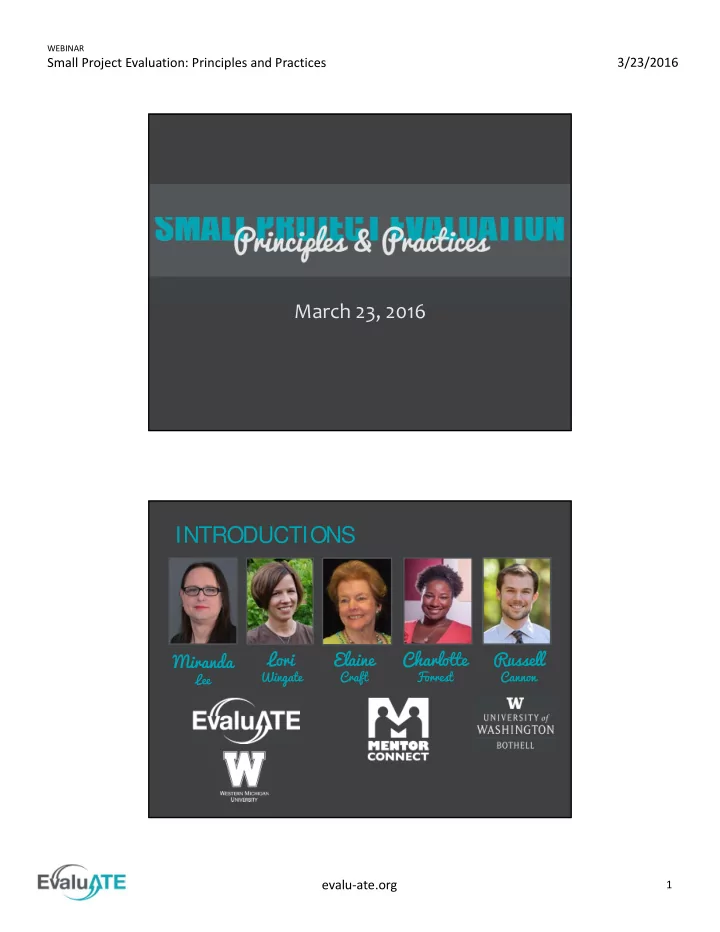
SMALL PROJECT EVALUATION March 23, 2016 INTRODUCTIONS Lori Elaine - - PDF document
WEBINAR Small Project Evaluation: Principles and Practices 3/23/2016 SMALL PROJECT EVALUATION March 23, 2016 INTRODUCTIONS Lori Elaine Charlotte Russell Miranda Wingate Craft Forrest Cannon Lee evalu ate.org 1 WEBINAR Small
1
WEBINAR
Small Project Evaluation: Principles and Practices 3/23/2016 evalu‐ate.org
March 23, 2016
Lori
Wingate
Miranda
Lee
Elaine
Craft
INTRODUCTIONS
Charlotte
Forrest
Russell
Cannon
2
WEBINAR
Small Project Evaluation: Principles and Practices 3/23/2016 evalu‐ate.org This material is based upon work supported by the National Science Foundation under grant number 1204683. Any opinions, findings, and conclusions or recommendations expressed in this material are those of the presenters and do not necessarily reflect the views of NSF.
Janet
Pinhorn
Mike
Lesiecki
Tim
Suchomski
BEHIND THE SCENES
Sharon
Gusky
Dennis
Faber
3
WEBINAR
Small Project Evaluation: Principles and Practices 3/23/2016 evalu‐ate.org
Slides
www.evalu‐ate.org/webinars/2016‐mar/
MATERIALS
Recording Handout
Tales from the Trenches Question Break Tales from the Trenches Question Break Tales from the Trenches Question Break Tales from the Trenches
SE TTING THE STAGE EVALUATION SCOPE DATA COLLECTION & DIVISION OF LABOR WORKING WITH INSTUTIONAL RESEARCH ATE PROGRAM & MENTOR-CONNECT
Tales from the Trenches Question Break
4
WEBINAR
Small Project Evaluation: Principles and Practices 3/23/2016 evalu‐ate.org
SE TTING THE STAGE
EVALUATION
the determination of something’s quality, value, or importance
5
WEBINAR
Small Project Evaluation: Principles and Practices 3/23/2016 evalu‐ate.org
that will help answer those questions.
and answer the evaluation questions.
information for accountability, improvement, and planning.
questions about a project’s processes and outcomes.
EVALUATION
Bio‐Inspired Solutions to Human Challenges
$198,913 | 2016‐19
Gwen Generickson
soon to be a new ATE project principal investigator This is a fictional project. Any resemblance to actual persons or projects is purely coincidental.
6
WEBINAR
Small Project Evaluation: Principles and Practices 3/23/2016 evalu‐ate.org
She’s been asked to submit a revised evaluation plan. What’s the FIRST thing she should do to get started?
Chat
7
WEBINAR
Small Project Evaluation: Principles and Practices 3/23/2016 evalu‐ate.org
INTELLECTUAL MERIT: Is the evaluation plan clearly tied to the project outcomes? Is the evaluation likely to provide useful information to the project and others? EVALUATION: All projects and centers carry out evaluative activities. The funds to support an evaluator independent of the project or center must be requested, and the requested funds must match the scope of the proposed evaluative activities.
Read ATE program solicitation:
The Project Description must begin with the subsection on Results from Prior NSF Support …. This subsection must contain specific outcomes and results including metrics to demonstrate the impact of the project activities.
How much is it going to cost?
8
WEBINAR
Small Project Evaluation: Principles and Practices 3/23/2016 evalu‐ate.org
The following budget examples are for illustrative purposes only. The information should not be construed as recommendations or guidelines for evaluator costs or time commitments.
9
WEBINAR
Small Project Evaluation: Principles and Practices 3/23/2016 evalu‐ate.org
Bio‐Inspired Solutions to Human Challenges Project Budget
Category Cost Salaries & Fringe Benefits $103,500 Equipment $12,000 Materials $20,000 Travel $3,600 Other – Evaluation Consultant $13,910 Modified Total Direct Costs $153,010 Indirect Costs (30% ) $45,903 TOTAL PROJECT COST $198,913
Total direct costs Total direct costs before before external external evaluation evaluation =$139,100 =$139,100 X 10% X 10% = $13,910 = $13,910
$13,910 over 3 years = $4,637 per year
But m more e effort w will b be r required i in Y Year 1 1 to s set u up the eval the evalua uation
, so…
Year 1: $4,800 Year 2: $4,000 Year 3: $3,600 Bio‐Inspired Solutions to Human Challenges Project Budget
10
WEBINAR
Small Project Evaluation: Principles and Practices 3/23/2016 evalu‐ate.org Category Year 1 Year 2 Year 3 Consultant fees $4,800 $4,000 $3,600 Travel $500 $500 $500 TOTAL EVALUATION COST $5,300 $4,500 $4,100
Bio‐Inspired Solutions to Human Challenges Project Budget
Annual site visits are important! Annual site visits are important!
Category Year 1 Year 2 Year 3 Consultant fees $4,800 $4,000 $3,600 Travel $500 $500 $500 TOTAL EVALUATION COST $5,300 $4,500 $4,100
Bio‐Inspired Solutions to Human Challenges Project Budget
@ @ $100 per hour, how many days $100 per hour, how many days can the external evaluator devote can the external evaluator devote to this project? to this project?
11
WEBINAR
Small Project Evaluation: Principles and Practices 3/23/2016 evalu‐ate.org Category Year 1 Year 2 Year 3 Consultant fees $4,800 $4,000 $3,600 Travel $500 $500 $500 TOTAL EVALUATION COST $5,300 $4,500 $4,100
Year 1: $4,800 = 48 hours or 6 days Year 2: $4,000 = 40 hours or 5 days Year 3 : $3,600= 36 hours or 4.5 days
Bio‐Inspired Solutions to Human Challenges Project Budget Answer the Poll
How I can use my evaluation resources efficiently?
12
WEBINAR
Small Project Evaluation: Principles and Practices 3/23/2016 evalu‐ate.org Match the scope of the evaluation to the scope of the project. Involve the project team in monitoring the project and implementing the evaluation. Use institutional data to the extent possible.
ENHANCING EVALUATION EFFICIENCY
TALES FROM THE TRENCHES
13
WEBINAR
Small Project Evaluation: Principles and Practices 3/23/2016 evalu‐ate.org
EVALUATION SCOPE
Match the scope of the evaluation to the scope of the project. Involve the project team in monitoring the project and implementing the evaluation. Use institutional data to the extent possible.
ENHANCING EVALUATION EFFICIENCY
14
WEBINAR
Small Project Evaluation: Principles and Practices 3/23/2016 evalu‐ate.org
EVALUATION
that will help answer those questions.
and answer the evaluation questions.
information for accountability, improvement, and planning.
questions about a project’s processes and outcomes.
15
WEBINAR
Small Project Evaluation: Principles and Practices 3/23/2016 evalu‐ate.org
EVALUATION QUESTIONS
should be
evaluative pertinent reasonable specific answerable
and the set of questions should be
complete
Engineering technicians: High demand, low supply
16
WEBINAR
Small Project Evaluation: Principles and Practices 3/23/2016 evalu‐ate.org
SCI 152: Bio‐Inspired Solutions to Human Challenges
Biology | Design | Economics | Engineering | Materials Science
Buteo College 60% female Engineering Technology & Preengineering
15% female
17
WEBINAR
Small Project Evaluation: Principles and Practices 3/23/2016 evalu‐ate.org
Project Goal: Attract female students to the course and motivate them to pursue degrees in engineering technology or preengineering
Raise awareness among college personnel Outreach to female students with undeclared majors Develop promotional video Complete course curriculum
18
WEBINAR
Small Project Evaluation: Principles and Practices 3/23/2016 evalu‐ate.org
52
ACTIVITIES OUTPUTS SHORT-TERM OUTCOME S MID-TERM OUTCOME S
ACTIVITIES
what a project does
PROJECT LOGIC MODEL
54
ACTIVITIES OUTPUTS SHORT-TERM OUTCOME S MID-TERM OUTCOME S
PROJECT LOGIC MODEL
Develop course curriculum Develop overview video Make presenta‐ tions to faculty, advisors, and admissions counselors Outreach to undeclared, female students
19
WEBINAR
Small Project Evaluation: Principles and Practices 3/23/2016 evalu‐ate.org
ACTIVITIES OUTPUTS SHORT-TERM OUTCOME S MID-TERM OUTCOME S
OUTPUTS
tangible products of activities
PROJECT LOGIC MODEL
ACTIVITIES OUTPUTS SHORT-TERM OUTCOME S MID-TERM OUTCOME S
PROJECT LOGIC MODEL
Course materials Promotional video Develop course curriculum Develop overview video Make presenta‐ tions to faculty, advisors, and admissions counselors Outreach to undeclared, female students
20
WEBINAR
Small Project Evaluation: Principles and Practices 3/23/2016 evalu‐ate.org
ACTIVITIES OUTPUTS SHORT-TERM OUTCOME S MID-TERM OUTCOME S
PROJECT LOGIC MODEL
OUTCOMES
changes brought about through project activities and outputs
ACTIVITIES OUTPUTS SHORT-TERM OUTCOME S MID-TERM OUTCOME S
PROJECT LOGIC MODEL
Course materials Promotional video Develop course curriculum Develop overview video Students enroll in course Student interest in pursuing STEM degree increases Make presentat‐ ions to faculty, advisors, and admissions counselors Outreach to undeclared, female students
21
WEBINAR
Small Project Evaluation: Principles and Practices 3/23/2016 evalu‐ate.org
ACTIVITIES OUTPUTS SHORT-TERM OUTCOME S MID-TERM OUTCOME S
PROJECT LOGIC MODEL
Course materials Promotional video Develop course curriculum Develop overview video Students enroll in course Student interest in pursuing engineering‐ related degrees increases Enrollment in engineering programs increases Representation
STEM programs increases Make presentations to faculty, advisors, and admissions counselors Outreach to undeclared, female students
EVALUATION
that will help answer those questions.
findings and answer the evaluation questions.
information for accountability, improvement, and planning.
questions about a project’s processes and outcomes.
22
WEBINAR
Small Project Evaluation: Principles and Practices 3/23/2016 evalu‐ate.org
ACTIVITIES OUTPUTS SHORT-TERM OUTCOME S MID-TERM OUTCOME S
EVALUATION QUESTIONS
Develop course curriculum Develop overview video Make presenta‐ tions to faculty, advisors, and admissions counselors
promotion activities?
Outreach to undeclared, female students
ACTIVITIES OUTPUTS SHORT-TERM OUTCOME S MID-TERM OUTCOME S
EVALUATION QUESTIONS
Develop course curriculum Develop overview video
Gather ongoing critical feedback during development
Make presenta‐ tions to faculty, advisors, and admissions counselors Course materials Promotional video Outreach to undeclared, female students
23
WEBINAR
Small Project Evaluation: Principles and Practices 3/23/2016 evalu‐ate.org
ACTIVITIES OUTPUTS SHORT-TERM OUTCOME S MID-TERM OUTCOME S
EVALUATION QUESTIONS
Students enroll in course Student interest in pursuing engineering‐ related degrees increases
course attracting the intended audience?
how is the course influencing students’ interest in pursuing engineering‐related degrees?
ACTIVITIES OUTPUTS SHORT-TERM OUTCOME S MID-TERM OUTCOME S
Enrollment in engineering programs increases Representation
STEM programs increases
the project contributing to enrollment in engineering and
EVALUATION QUESTIONS
24
WEBINAR
Small Project Evaluation: Principles and Practices 3/23/2016 evalu‐ate.org 1. How effective are the course promotion activities? 2. To what extent is the course attracting the intended audience? 3. To what extent and how is the course influencing students’ interest in pursuing engineering‐related degrees? 4. To what extent and how is the project contributing to enrollment in engineering and other STEM programs?
EVALUATION QUESTIONS
Bio‐Inspired Solutions to Human Challenges Project
Process Outcome
25
WEBINAR
Small Project Evaluation: Principles and Practices 3/23/2016 evalu‐ate.org
TALES FROM THE TRENCHES DATA COLLECTION & DIVISION OF LABOR
Lori Wingate
26
WEBINAR
Small Project Evaluation: Principles and Practices 3/23/2016 evalu‐ate.org Match the scope of the evaluation to the scope of the project. Involve the project team in monitoring the project and implementing the evaluation. Use institutional data to the extent possible.
ENHANCING EVALUATION EFFICIENCY
Maintain record of participants and partners Plan the evaluation
Project Team External Evaluator
Write reports Assist with data collection Analyze data Facilitate use of results Document project activities & accomplishments Interpret results Develop/select data collection instruments
27
WEBINAR
Small Project Evaluation: Principles and Practices 3/23/2016 evalu‐ate.org
Project Team External Evaluator
Write reports Assist with data collection Facilitate use of results Document project activities & accomplishments Interpret results Develop/select data collection instruments Analyze data Maintain record of participants and partners
EVALUATION
that will help answer those questions.
and answer the evaluation questions.
information for accountability, improvement, and planning.
questions about a project’s processes and outcomes.
28
WEBINAR
Small Project Evaluation: Principles and Practices 3/23/2016 evalu‐ate.org INDICATORS DATA SOURCES/ METHODS RESPONSIBILITY
Course enrollment numbers (as proportion
Institutional data Obtained from college institutional research office by project team Students’ reports of why they enrolled in the course Survey of students who enroll in course Survey development: External evaluator with project team input Survey administration: Course instructors Analysis: External evaluator
Evaluation Question 1:
How effective are the course promotion activities?
INDICATORS DATA SOURCES/ METHODS RESPONSIBILITY
Number and percentage of students who are female and/or undeclared majors Survey of students who enroll in course Survey development: External evaluator with project team input Survey administration: Course instructors Analysis: External evaluator
Evaluation Question 2:
To what extent is the course attracting the intended audience?
29
WEBINAR
Small Project Evaluation: Principles and Practices 3/23/2016 evalu‐ate.org INDICATORS DATA SOURCES/ METHODS RESPONSIBILITY
Number and percentage of students indicate intent to pursue STEM degree Survey of students who complete the course Survey development: External evaluator with project team input Survey administration: Course instructors Analysis: External evaluator Students’ reports of the degree to which and how the course influenced their decisions about what to major in
Evaluation Question 3:
To what extent and how is the course influencing students’ interest in pursuing engineering‐related degrees
INDICATORS DATA SOURCES/ METHODS RESPONSIBILITY
Change in enrollment trends Institutional data External evaluator, project team, and IR office: define needed data IR office: Supplies data to project team and evaluator
Evaluation Question 4:
To what extent and how is the project contributing to enrollment in engineering and other STEM programs?
30
WEBINAR
Small Project Evaluation: Principles and Practices 3/23/2016 evalu‐ate.org
Plan the evaluation
Project Team External Evaluator
Analyze data Write reports Develop/select data collection instruments Assist with data collection Maintain record of participants and partners Facilitate use of results Document project activities & accomplishments Interpret results
students – faculty – staff – partners – advisors
Use spreadsheet or database software to keep a log of WHO PARTICIPATED and their key demographics contact information involvement in the project, including dates
TRACKING REACH & ENGAGEMENT
31
WEBINAR
Small Project Evaluation: Principles and Practices 3/23/2016 evalu‐ate.org
Also needed for ‒ NSF annual reports ‒ ATE annual survey
PARTICIPANT & PARTNER DATA
Plan the evaluation Interpret results
Project Team External Evaluator
Analyze data Write reports Develop/select data collection instruments Assist with data collection Maintain record of participants and partners Document project activities & accomplishments Facilitate use of results
32
WEBINAR
Small Project Evaluation: Principles and Practices 3/23/2016 evalu‐ate.org
Create a project resume that includes a project profile and record of activities, products, people, etc. To learn more, see
www.evalu‐ate.org/webinars/2015‐may
The Project Description must begin with the subsection on Results from Prior NSF Support …. This subsection must contain specific outcomes and results including metrics to demonstrate the impact of the project activities.
33
WEBINAR
Small Project Evaluation: Principles and Practices 3/23/2016 evalu‐ate.org
TALES FROM THE TRENCHES
TIPS FOR WORKING WITH INSTITUTIONAL RESEARCH
34
WEBINAR
Small Project Evaluation: Principles and Practices 3/23/2016 evalu‐ate.org
IR AS EVALUATION RESOURCE: ALWAYS ASK THE ARCHIVIST
‒ What’s out there… and its limitations ‒ What ELSE is going on ‒ For many, social science methods and evaluation strategies feel like home
Source: Lucasfilm
Who ARE they? What do THEY know?
Approach IR early
35
WEBINAR
Small Project Evaluation: Principles and Practices 3/23/2016 evalu‐ate.org
Start the conversation with the goals of the evaluation, not just the data elements
Come bearing documentation ‐ plan ‐ requirements ‐ definitions ‐ dates
If they aren’t mandated, come to an agreement.
36
WEBINAR
Small Project Evaluation: Principles and Practices 3/23/2016 evalu‐ate.org
INSTITUTIONAL DATA: THE CLASSICS
“Source of Record”
– IPEDS, External Reporting – Imperfect, but as good as it gets
Student Demographics
‒ Race/Ethnicity, Sex, Low‐Income Status, Age, Veteran Status, Incoming Test Scores
Enrollment
‒ Courses, FT/PT Status, GPA, Major/Minor, Retention, Graduation
Surveys
‒ May be tied to student ID
‒ Surveys focused on Admitted Students, New Students, First Year/Senior Engagement, Graduating Students, and Alumni are common
INSTITUTIONAL DATA: OUTSIDE THE BOX
37
WEBINAR
Small Project Evaluation: Principles and Practices 3/23/2016 evalu‐ate.org
Lists of Student Support Services and Concurrent Interventions
– Partners, confounders,
and assessing
INSTITUTIONAL DATA: OUTSIDE THE BOX Data on Student Behavior
– Card‐swipe systems, club membership
INSTITUTIONAL DATA: OUTSIDE THE BOX
38
WEBINAR
Small Project Evaluation: Principles and Practices 3/23/2016 evalu‐ate.org
AND BEYOND…
National Student Clearinghouse Submissions State Longitudinal Datasets Rankings
EXAMPLE
39
WEBINAR
Small Project Evaluation: Principles and Practices 3/23/2016 evalu‐ate.org
Demographics
‒ Campus, engineering, existing intro‐ courses? (baseline) ‒ Of new course (outcome of outreach)
Retention
in course at institution to STEM major to STEM degree
40
WEBINAR
Small Project Evaluation: Principles and Practices 3/23/2016 evalu‐ate.org
Transfer
‒ National Student Clearinghouse or data sharing agreement
www.studentclearninghouse.org
Entering student beliefs, student activities, graduating student intent
‒ Campus survey paired with program survey ‒ Course evaluations?
41
WEBINAR
Small Project Evaluation: Principles and Practices 3/23/2016 evalu‐ate.org
TALES FROM THE TRENCHES THE ATE PROGRAM & MENTOR-CONNECT
42
WEBINAR
Small Project Evaluation: Principles and Practices 3/23/2016 evalu‐ate.org
focuses on strengthening technician education at the postsecondary and secondary levels for the high‐ technology fields that drive our nation's economy
ATE PROGRAM
ATE PROGRAM
Centers Targeted Research Projects
National Centers Regional Centers Support Centers Planning Exploratory Research Full‐Scale Research Program Dev. & Improvement Educational Materials Dev. Professional Dev. for Educators Leadership Capacity Building Teacher Preparation Small Grants for Institutions New to ATE Business & Entrepreneurial Skills Dev. Conferences & Workshops ATE Coordination Networks Planning Grants
43
WEBINAR
Small Project Evaluation: Principles and Practices 3/23/2016 evalu‐ate.org
BROADENING THE BASE OF COMMUNITY COLLEGES INVOLVED IN ATE Only community college campuses that have not had an ATE award in the past 10 years may apply $200,000 over 3 years 12‐20 awards made per year
ATE PROGRAM
Projects
Small Grants for Institutions New to ATE
65% of all ATE small grant proposals are funded
Source: Celeste Carter (personal communication, 2016)
22%
to
34% of all ATE proposals are funded
PROPOSAL SUCCESS RATES (APPROXIMATE)
44
WEBINAR
Small Project Evaluation: Principles and Practices 3/23/2016 evalu‐ate.org Support Center National or Regional Center Full‐Scale Project Small Project
SOMEFULL-SCALE PROJECTS EVOLVE INTO CENTERS MENTOR-CONNECT
provides comprehensive and interactive support for leadership development and knowledge transfer by developing and supporting potential, current and former grantees
Applications available this summer at
www.mentor-connect.org
45
WEBINAR
Small Project Evaluation: Principles and Practices 3/23/2016 evalu‐ate.org
GE TTING HELP FROM MENTOR-CONNECT
Mentor- Connect Mentees Everyone
Worksheet to guide development of project focus and rationale
2 workshops on grant writing and leadership skills
ATE mentor for personalized assistance with grant development and submission
3 technical assistance webinars
Online resources (e.g., samples, checklists, guidelines, tutorials, webinar recordings)
Help desk access (phone, email)
Meeting Requirements, Exceeding Expectations: Understanding the Role
E
VALUATE’s NEXT WEBINAR:
May 25 | 1‐2:30 p.m.
46
WEBINAR
Small Project Evaluation: Principles and Practices 3/23/2016 evalu‐ate.org
www.evalu‐ate.org
www.mentor‐connect.org