Small Business Innovation Research Small Business Technology - - PowerPoint PPT Presentation

small business innovation research small business
SMART_READER_LITE
LIVE PREVIEW

Small Business Innovation Research Small Business Technology - - PowerPoint PPT Presentation

Small Business Innovation Research Small Business Technology TRansfer Gynelle Steele| SBIR/STTR Overview - Reaching Higher: Aerospace Business Matchmaker | 7/17/18 1 1 www.nasa.gov SBIR/STTR Succe ccess Stories Modeling Based Decision


slide-1
SLIDE 1

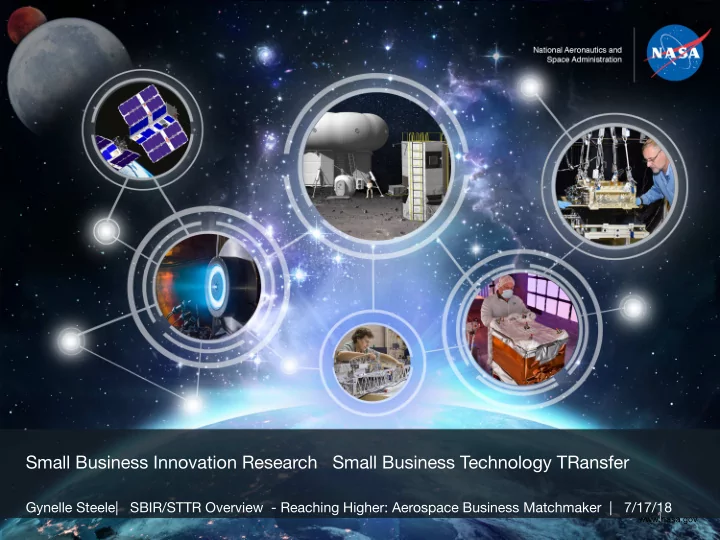
Small Business Innovation Research Small Business Technology TRansfer

Gynelle Steele| SBIR/STTR Overview - Reaching Higher: Aerospace Business Matchmaker | 7/17/18

1

www.nasa.gov

1
slide-2
SLIDE 2

SBIR/STTR Succe ccess Stories

2

Modeling Based Decision Support Environment

  • Phoenix Integration, Wayne, PA

Scientists and engineers at NASA are constantly inundated with raw data and numbers in an attempt to choose the best design

  • ption for future spacecraft. Since you can’t design a space

vehicle by looking at one engineering discipline alone, multiple components need to be considered simultaneously in order to select the best choice. What would be the most fuel-efficient

  • ption? Are there lighter materials that could be used? Which

design would be ready to launch the soonest?

slide-3
SLIDE 3

SBIR/STTR Succe ccess Stories

3

Safer Wilderness rescues Using Autonomous Aircraft Technology

  • Near Earth Autonomy, Inc., Pittsburgh, PA

One crucial way to improve emergency rescues in wilderness environments is to

  • ptimize how quickly aircraft can fly to injured parties in remote locations and

bring them to a hospital. Using funds from an SBIR Phase III Study, Near Earth Autonomy Inc., addressed wilderness rescue challenges by developing an aircraft capable of carrying 1-2 persons, having a gross takeoff weight of 800 to 1,200 lbs., and enabling carriage of a sensor suite weighing up to 30 lbs. The sensor suite leverages software algorithms and low-cost sensors that simultaneously solve navigation and obstacle detection problems. These sensors are used to assess potential in-flight and ground hazards during fully autonomous, safe

  • peration. This technology could eventually be utilized to assist in difficult and

dangerous tasks such as firefighting, search and rescue, and border patrol.

SNAPSHOT NASA leverages sensors and software to develop aircraft capable of conducting fully autonomous, safe operations for emergency rescues in the wilderness.

slide-4
SLIDE 4

SBIR/STTR Success

4

ISS Universal Battery Charger (UBC) Aurora Flight Sciences Corporation, Manassas, VA Innovation From camcorders and digital cameras, to science experiments, to drills, the International Space Station is home to a handful of tech gadgets and power tools that constantly need to be charged. Just like on Earth, all of these things require their own dedicated chargers. While the obvious inconvenience of lugging dozens of various adapters to space might seem like reason enough to invest in a universal battery charger, the driving force is actually the cost. The estimated total to launch 1 kg (a little over 2 pounds) of equipment into orbit is over $10,000. Although the newer launch vehicles may drive that figure down, it will still cost thousands of dollars to send equipment into space – necessitating a simpler, cost-effective system for use on the ISS.

https://sbir.nasa.gov/success-stories

PHASE III SUCCESS Recent Phase III follow-

  • n contracts with NASA

worth $200K to supply the UBC to the International Space Station; technology results in cost savings of $2 million per launch. SNAPSHOT Aurora Flight Science has utilized the NASA SBIR program to develop a Universal Battery Charger for use on the ISS capable of interfacing with the most commonly used batteries on board.

slide-5
SLIDE 5

SBIR / STTR Programs Vision and Mission

VISION Empower small businesses to deliver technological innovation that contributes to NASA’s missions, provides societal benefit, and grows the US economy. MISSION Create opportunities through SBIR/STTR awards to leverage small business knowledge and technology development for maximum impact and contribution

5

NASA’s SBIR and STTR programs have awarded more than $3.3 billion to research-intensive American small businesses Engineers and scientists from more than 12,000 small businesses in all 50 States, DC and Puerto Rico have participated

slide-6
SLIDE 6

The SBIR / STTR Programs

Small Business Innovation Research (SBIR)

  • A set-aside program for small business to engage

in Federal R&D – with potential for commercialization

  • For FY17, 3.2% of Federal agencies Extramural

R&D budgets greater than $100M per year

Small Business Technology Transfer (STTR)

  • A sister set-aside program to facilitate cooperative

R&D between small business concerns and U.S. research institutions – with potential for commercialization

  • For FY17, 0.4% of the extramural research budget

for all agencies with a budget greater than $1B per year

6

slide-7
SLIDE 7

NASA Program Background

  • NASA’s SBIR and STTR programs have awarded more

than $3.3B to research-intensive American small businesses to date

  • Engineers and scientists from more than 12,000 Firms in

all 50 States, DC, and Puerto Rico have participated across the two programs

  • Each year about 1,700 NASA scientists and engineers

support the program performing technical reviews

7

slide-8
SLIDE 8

Participating Federal Agencies

8

Department of Defense (DoD) Department of Health and Human Services (HHS) Department of Energy (DoE) National Aeronautics and Space Administration (NASA) National Science Foundation (NSF) Department of Agriculture (USDA) Environmental Protection Agency (EPA) Department of Homeland Security (DHS) Department of Commerce (DoC) Department of Education (DoEd) Department of Transportation (DoT)

SBIR + STTR Programs SBIR Program Only

slide-9
SLIDE 9

STTR Eligibility Requirements

  • Must be located in the United States and at least 51%
  • wned and controlled by one or more individuals who are

citizens of, or permanent resident aliens in, the United States

  • Formal Cooperative R&D effort with a U.S. Research

Institution

  • Minimum 40% by small business, 30% by U.S. Research

Institution (still have 30% that can be shared between the two parties or used for subcontracting, etc.)

  • Small business is Prime, Principal Investigator can be from

Small Business Concern or Research Institution

  • The U.S. research institution (RI) must be an accredited

college/university, a federal research and development center, or other non-profit research organization

  • Other SBIR requirements generally also apply

9

slide-10
SLIDE 10

SBIR/STTR Program Structure

10

Go to sbir.nasa.gov/guide for details

slide-11
SLIDE 11

Program 2018 Initiatives

I-Corps In partnership with the National Science Foundation (NSF), NASA is offering the I-Corps program to educate selected teams

  • n how to translate technologies from the laboratory into the

marketplace. http://sbir.nasa.gov/content/I-Corps

11

slide-12
SLIDE 12

Learning about NASA’s Needs

12

Focus Areas

NASA’s research subtopics are

  • rganized by “Focus Areas” that

group interests and related technologies.

  • Identify the Area(s) closest to

your innovation/idea

  • Go to our website to research
  • Prepare to write a proposal

tailored to NASA’s needs https://sbir.nasa.gov/solicitations

2018 Focus Areas

  • 1. In-Space Propulsion

Technologies 12.Entry, Descent and Landing Systems

  • 2. Power and Energy Storage

13.Information Technologies for Science Data

  • 3. Autonomous Systems for

Space Exploration 14.In-Space and Advanced Manufacturing

  • 4. Robotic Systems for Space

Exploration 15.Lightweight Materials, Structures, Assembly, and Construction

  • 5. Communications and

Navigation 16.Ground and Launch Processing

  • 6. Life Support and Habitation

Systems 17.Thermal Management Systems

  • 7. Human Research and

Health Maintenance 18.Air Vehicle Technology

  • 8. In-Situ Resource Utilization

19.Integrated Flight Systems

  • 9. Sensors, Detectors and

Instruments 20.Airspace Operations and Safety 10.Advanced Telescope Technologies 21.Small Spacecraft Technologies 11.Spacecraft and Platform Systems 22.ISS Utilization and Microgravity Research

slide-13
SLIDE 13

NASA SBIR/STTR Website www.sbir.nasa.gov

13

The NASA SBIR/STTR website is located at

www.sbir.nasa.gov

Research NASA’s Needs Annual Solicitations including past years Contact the Program SBIR/STTR Helpdesk and Program Points of Contact Looking to Join the Program?

  • Program Basics
  • Forms Library
  • Model Contract
  • In-depth Training Resources

and FAQs

slide-14
SLIDE 14

Mentor-Protégé Program

The NASA Mentor-Protégé Program encourages NASA prime contractors to assist eligible protégés to:

  • Enhance their capabilities to perform on NASA contracts and

subcontracts,

  • Foster the establishment of long-term business relationships

between these entities and NASA prime contractors, and

  • Increase the overall number of these entities that receive

NASA contract and subcontract awards. For more information on the Mentor-Protégé Program visit: http://www.osbp.nasa.gov/mpp/index.html

14

slide-15
SLIDE 15

Contact us and let’s innovate together

15

Website: www.sbir.nasa.gov NASA Help Desk: 301.937.0888