Naval Sea Systems Command Small Business Innovation Research (SBIR) - - PDF document

naval sea systems command
SMART_READER_LITE
LIVE PREVIEW

Naval Sea Systems Command Small Business Innovation Research (SBIR) - - PDF document

11/6/2019 MD1 KW1 KW2 Naval Sea Systems Command Small Business Innovation Research (SBIR) Small Business Technology Transfer (STTR) Dean


slide-1
SLIDE 1

11/6/2019 1

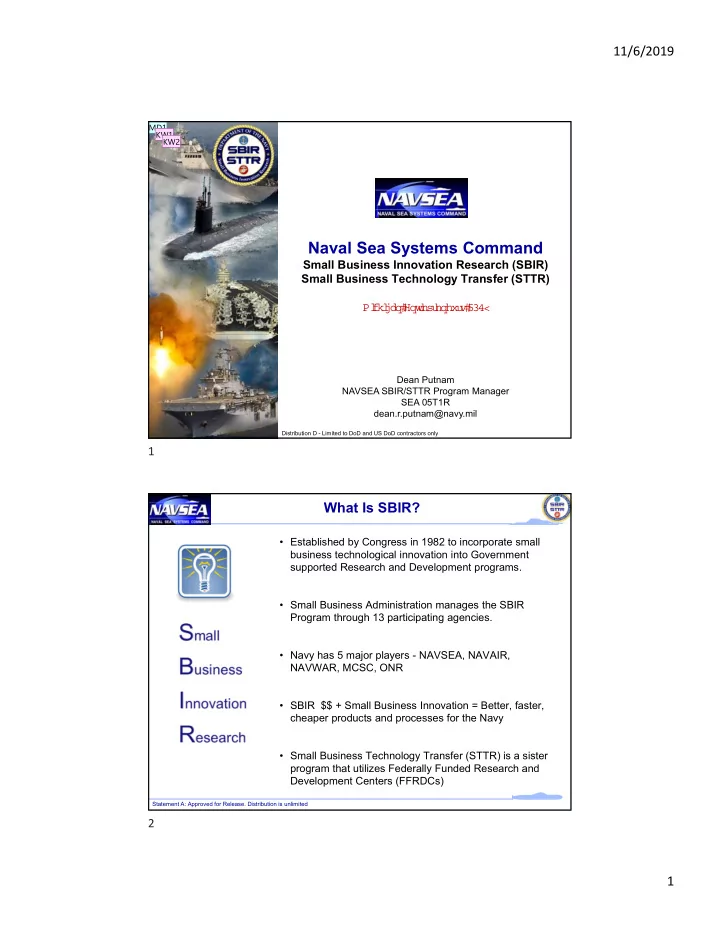
Naval Sea Systems Command

Small Business Innovation Research (SBIR) Small Business Technology Transfer (STTR)

  • Distribution D - Limited to DoD and US DoD contractors only

Dean Putnam NAVSEA SBIR/STTR Program Manager SEA 05T1R dean.r.putnam@navy.mil

MD1 KW1 KW2

What Is SBIR?

Statement A: Approved for Release. Distribution is unlimited

  • Established by Congress in 1982 to incorporate small

business technological innovation into Government supported Research and Development programs.

  • Small Business Administration manages the SBIR

Program through 13 participating agencies.

  • Navy has 5 major players - NAVSEA, NAVAIR,

NAVWAR, MCSC, ONR

  • SBIR $$ + Small Business Innovation = Better, faster,

cheaper products and processes for the Navy

  • Small Business Technology Transfer (STTR) is a sister

program that utilizes Federally Funded Research and Development Centers (FFRDCs)

1 2

slide-2
SLIDE 2

Slide 1 MD1

Mcnamara, Dick, 10/30/2019

KW1

Kathryn Williams, 10/30/2019

KW2

Kathryn Williams, 10/31/2019

slide-3
SLIDE 3

11/6/2019 2

NAVSEA SBIR Functional Organization

PEO CV TM Richard Park PEO IWS TM Douglas Marker PEO USC TM Bradley Goodrich PEO SHIPS TM Robert Mitchell PEO SUBS TM Brian Quarles HQ/DIR Acting TM Dean Putnam

NAVSEA SBIR/STTR Working Group

HQ/DIR & PEO SBIR/STTR TMs NAVSEA Board of Directors

NAVSEA

NAVSEA SBIR/STTR Program Office PM Dean Putnam

Statement A: Approved for Release. Distribution is unlimited

PEO CLB

MD2

Program Goals

Small Business Innovation Research (SBIR)

Stimulate technological innovation Increase small business participation in federally funded R&D Encourage participation by non- traditional technology companies Bridge funding gap between basic research and commercial product Create vehicles for moving ideas from research institutions to market Enable researchers to pursue commercial application of technologies

Small Business Technology Transfer (STTR)

Small business solutions for Navy technology needs

3 4

slide-4
SLIDE 4

Slide 3 MD2 DanQuarles is the new Deputy TM in PEOSUBS PEOCLB is part of team Sub so elimiinate the ? after PEOCLB in box I would make PEO CLB nbe a loke a shadow box behind the PEOSUB box

Mcnamara, Dick, 10/30/2019

slide-5
SLIDE 5

11/6/2019 3 Traditional SBIR / STTR Three-Phase Program

  • SBIR / STTR Buys Research and Development Not Parts and Services
  • Statement A: Approved for Release. Distribution is unlimited

6

Approved for public release - distribution unlimited

Phase III

Transition to Acquisition Program

  • Non‐SBIR/STTR $

(Private sector or non‐ SBIR/STTR Gov. $)

  • Unlimited POP
  • SBC Extension of Data

Rights and Sole Source Designation Contract Type Varies ‐ Phase III’s may be awarded without competition after Phase I or Phase II No limit on funding (only non‐SBIR/STTR)

TRL: 0 ‐ 3 2 ‐ 5 4 ‐ 7 6 ‐ 9

Phase II  3 years 

Phase II Base Phase II Option 1 Phase II Option 2

  • 12 months
  • $500K
  • 12 months
  • SBIR TM

review for Option 2 at exit

  • 12 months

CPFF Contract $1.6M SBIR/STTR Funding

Sequential Phase II Phase II  3 years 

Contingent upon having a successful project with a committed Transition Sponsor/Path

  • Subsequent Phase II
  • Up to 24 months
  • 1:1 cost match

CPFF Contract $1.6M SBIR/STTR Funding

TRL: 0 ‐ 3 2 ‐ 5 4 ‐ 7 6 ‐ 9

Phase I

Phase I Base Phase I Option

  • 6 months

(SBIR)

  • 6 months

(STTR)

  • $140K
  • 6 months
  • $100K

FFP Contract $225K SBIR/STTR Funding

Project Feasibility Technology Development and Prototype Demonstration Prototype Testing & Evaluation Technology Demo & Validation Phase III – can occur anytime after Phase I award and is funded with non‐SBIR/STTR funding

SBIR/STTR Timeline

Note: This phase is a requirement- driven process based upon Acquisition program needs. Commercialization Transition

5 6

slide-6
SLIDE 6

11/6/2019 4 Who and Where We Are

7

NSWC CORONA NSWC PORT HUENEME Pt Loma/ North Island DMF SUPSHIP Bath Detachment- San Diego, CA Southwest Regional Maintenance Center

Maine Pennsylvania

NSWC Ship Systems Engineering Station Naval Sea Logistics Center Navy Foundry and Propeller Center

Washington Indiana

NSWC CRANE SUPSHIP BATH PUGET SOUND NSY & IMF and RMC NUWC KEYPORT

California Virginia Washington DC

NAVSEA DIR & PEOs NSWC HQ NSWC CARDEROCK NSWC INDIAN HEAD Naval Ordnance Safety & Security Activity Naval Explosive Ordnance Disposal Technology Div

Maryland Connecticut Rhode Island

NUWC HQ NUWC NEWPORT SUPSHIP GROTON

New Jersey

AEGIS Technical Rep NORFOLK NSY SUPSHIP NEWPORT NEWS NSWC DAHLGREN NSWC Combat Direction Systems Activity Surface Combat Systems Center SEASPARROW Project Support Office AEGIS Ballistic Missile Defense Regional Maintenance Center Management Office Norfolk Ships Support Activity (NSSA)

Florida Mississippi and Louisiana

NSWC Coastal Systems Station Naval Experimental Diving Unit Cape Canaveral Southeast Regional Maintenance Center SUPSHIP GULF COAST (Pascagoula, MS & New Orleans, LA)

South Carolina

Naval Nuclear Power Training Unit Submarine Maintenance Engineering, Planning & Procurement PORTSMOUTH NSY PEARL HARBOR NSY & IMF and RMC Keyport Det Waipahu, HI CFFC Claimancy/ NAVSEA Operator Tech Mgmt

Hawaii Japan

Yokosuka- PSNS &IMF and RMC

Idaho

Bayview AUTEC ANDROS

Bahamas Georgia

Support from NNSY to TRF Kings Bay

Alabama

SUPSHIP Bath Onsite Office

Wisconsin

SUPSHIP Onsite Office Marinette, WI Memphis

Tennessee

Allegany Ballistic Laboratory

West Virginia

Louisville

Kentucky Bahrain/ Naples

NSSA Detachment

NAVSEA is located across the U.S.

Approved for public release - distribution unlimited

Where Are We?

Statement A: Approved for Release. Distribution is unlimited

3 4 2 3 3 2 17 7 2 4 4

Active SBIR Contracts 2019

MD3 MD4

7 8

slide-7
SLIDE 7

Slide 8 MD3

Mcnamara, Dick, 10/30/2019

MD4 i would show a chart of NAVSEA field activities and labs before this chart if w ehave one to demo NAVSEA is nearby and your backyard

Mcnamara, Dick, 10/30/2019

slide-8
SLIDE 8

11/6/2019 5

3 1 Largest source of Federal R&D funds for small businesses SBIR invests more than VC community in pre-seed and early stage technology Company retains data rights for 20 years from award date. 4 Follow-on Phase III awards can be sole sourced 5 Company may maintain

  • wnership of equipment

purchased under Phase I and II with government approval 6 Builds credibility of company’s research & learning government contracting processes

Why Small Businesses Participate Data Rights

  • SBIR/STTR Data Rights are Unique

– Applies to all SBIR/STTR awards that fall within the statutory definition of Phase I, II, or III, as described in § 4 of the SBA Policy Directive. – Restricts the Federal Government’s use and release of properly marked SBIR/STTR Data only during the SBIR/STTR Protection Period; after the protection period, the Federal Government has a royalty-free license to use for Government Purposes. – The Government must protect those right for 20 years at the beginning of award of Funding Agreement – SBIR data right are defined in FAR and DFAR 252.227-7018 – An SBC retains title and ownership of all SBIR/STTR Data it develops in the performance of an SBIR/ STTR award and retains all rights not granted to the Government. These rights of the SBC do not expire. – Data that is delivered must be marked with the appropriate SBIR/STTR Data Rights legend or notice, in accordance with agency procedures.

  • The law says the Government to the greatest extent practicable should award

follow on work to the SBIR firm

– This statute justifies sole source follow-on contracts – The requirement for competition has been satisfied in Phases I and II – The Federal Government may terminate the Funding Agreement under certain conditions.

  • Future company value is based on the Intellectual Property and Data rights –

so protect them!

– There is no limit on the value or number of Phase III contracts. – Phase III funds come from a Program Office (NOT SBIR “seed” funding)

Data Rights Belong to the Small Business!

9 10

slide-9
SLIDE 9

11/6/2019 6 Getting Started

https://www.navysbir.com/gettingstarted.htm

  • Traditional Solicitation Schedule

As the SBIR program implements changes for acceleration and agility, pilot programs provide opportunities that do not follow this traditional schedule.

*Dates subject to change*

MD5

11 12

slide-10
SLIDE 10

Slide 12 MD5 verify these dtes I belive they moved right for 20.1

Mcnamara, Dick, 10/30/2019

slide-11
SLIDE 11

11/6/2019 7 What Next?

  • Check for Broad Agency Announcements and Research Topics

– Topics are released three times a year for the Department of Defense

  • Next Opportunity to participate is August and December

– Information Sites:

  • Information on the SBIR/STTR programs can be found at www.sbir.gov
  • Information specifically for the Department of Defense:

www.sbir.defensebusiness.org

  • Information specifically for the United States Navy: http://www.navysbir.com
  • Information specifically for the NAVSEA SBIR Program:

https://www.navsea.navy.mil/Business-Partnerships/SBIR-STTR/

  • Write and Submit a Proposal

– Phase I proposals are limited to 20 pages, including resumes for key personnel.

  • ~15 Pages of Actual Technical "Meat"

– Narratives are provided in debriefs to unsuccessful companies. – Proposals are scored on three criteria areas:

  • Technical Merit
  • Quality of Personnel
  • Commercialization Potential

13

1 Each Service and agency is different. Read and follow announcement instructions 2 Know your customer. Make sure your approach is relevant 3 Take advantage of the pre‐release. Contact the TPOC to ask questions 4 Emphasize your innovative approach. Articulate how it compares to the state of the art 5 Clearly and concisely answer who, what, when, where, how, and importantly, why 6 If there are technical barriers…address them! 7 Don’t underestimate commercialization. State your plan NOW! 8 Provide a detailed work plan and schedule with tasks that flow smoothly 9 Ensure that the proposed solution is reasonable, realistic, and feasible 10 Check spelling and grammar. Proposals can be difficult to read due to poor grammar

READ AND FOLLOW ANNOUNCEMENT INSTRUCTIONS

Keys to Writing Winning Proposals

13 14

slide-12
SLIDE 12

11/6/2019 8 The End Goal: Phase III

Mitigates risk in development

  • r existing

systems Uses financial resources (non-SBIR)

  • utside

program budget Simplifies contracting actions Statutory competition provisions met during Phase I/II Get to know your local SBIR representatives Participate in the SBIR topic generation process Plan for SBIR technologies in your Technology Development Strategy (TDS) Discuss with TPOC the Program of Record

15

WHY? HOW?

DoD 5000.02 Instruction

  • Major acquisition programs must include SBIR in development plans
  • SBIR/STTR must be tied into major acquisition programs (ACAT I-IV)
  • SBIR/STTR subcontracting plans are required for $100M+ contracts
  • SBIR/STTR Data Collected, Reported, & Reviewed at milestones

16

Approved for public release - distribution unlimited

The End Goal: Phase III

Phase III innovation creates jobs, increases productivity, and spurs economic growth and competition. MOST importantly, it gives the technological edge to our warfighter; an edge that can save lives.

SBIR success is a win for EVERYONE!

15 16

slide-13
SLIDE 13

11/6/2019 9

Questions

DISTRIBUTION STATEMENT A. Approved for public release

  • 17