Slides for 'Making sense of the Adani coal mine in the midst of - - PDF document

slides for making sense of the adani coal mine in the
SMART_READER_LITE
LIVE PREVIEW

Slides for 'Making sense of the Adani coal mine in the midst of - - PDF document

Slides for 'Making sense of the Adani coal mine in the midst of coral bleaching', GCI seminar, 27 April 2016. Lecture outline Making sense of the Adani coal 1. Introduction mine approval in 2. Background to the mine & approval processes


slide-1
SLIDE 1

1

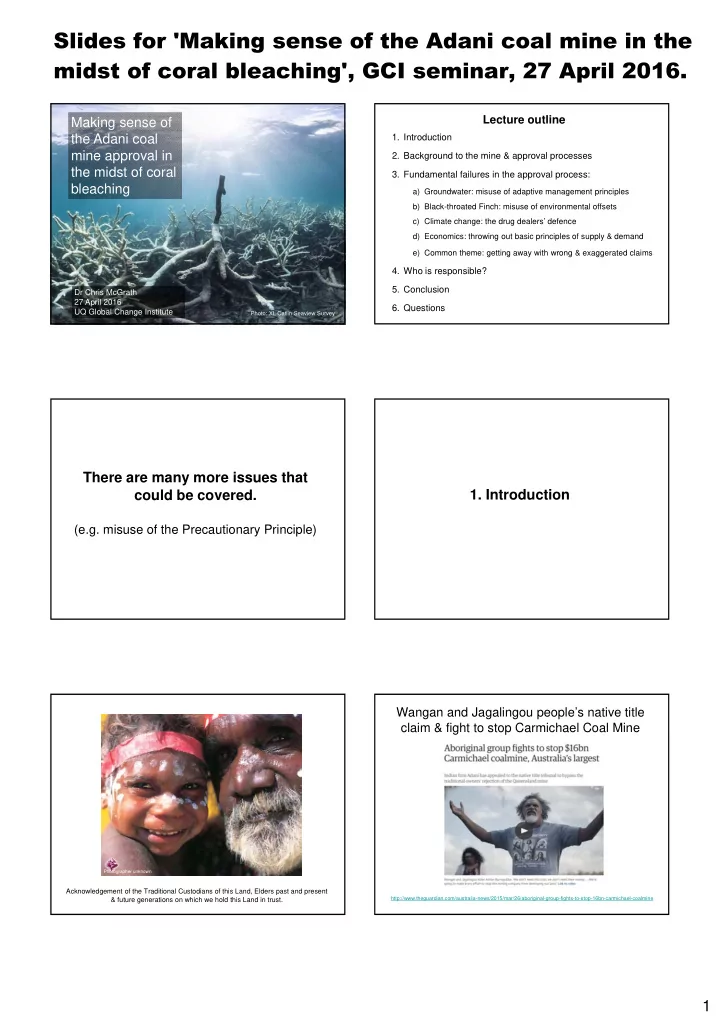
Making sense of the Adani coal mine approval in the midst of coral bleaching

Photo: XL Catlin Seaview Survey

Dr Chris McGrath 27 April 2016 UQ Global Change Institute

Lecture outline

  • 1. Introduction
  • 2. Background to the mine & approval processes
  • 3. Fundamental failures in the approval process:

a) Groundwater: misuse of adaptive management principles b) Black-throated Finch: misuse of environmental offsets c) Climate change: the drug dealers’ defence d) Economics: throwing out basic principles of supply & demand e) Common theme: getting away with wrong & exaggerated claims

  • 4. Who is responsible?
  • 5. Conclusion
  • 6. Questions

There are many more issues that could be covered.

(e.g. misuse of the Precautionary Principle)

  • 1. Introduction

Photographer unknown

Acknowledgement of the Traditional Custodians of this Land, Elders past and present & future generations on which we hold this Land in trust.

Wangan and Jagalingou people’s native title claim & fight to stop Carmichael Coal Mine

http://www.theguardian.com/australia-news/2015/mar/26/aboriginal-group-fights-to-stop-16bn-carmichael-coalmine

Slides for 'Making sense of the Adani coal mine in the midst of coral bleaching', GCI seminar, 27 April 2016.

slide-2
SLIDE 2

2

Photo: Mark McGrath (1986)

Photo by Bill McGrath (1986)

Will we leave the Great Barrier Reef for our children?

Photo: Greens MP

Coral bleaching at Pelorus Island, GBR

1998 2002 2004

Photos: Schuttenberg and Marshall (2006) Reef Manager’s Guide to Coral Bleaching

Alarm bells rang loud & clear in 1998 for coral reefs, one of the Earth’s most important ecosystems, which millions of people depend upon for food and livelihoods.

slide-3
SLIDE 3

3

Mass bleaching occurring now on the Great Barrier Reef driven by climate change: “this will change the GBR forever”

ABC 7.30 Report 28 March 2016: http://www.abc.net.au/7.30/content/2015/s4432792.htm [play first 1.20 mins]

We are witnessing a major step in the loss of the Great Barrier Reef happening right now. It hardly causes a ripple in the news.

Our Federal Environment Minister, Greg Hunt, deflects attention by talking about “El Niño” without mentioning climate change.

Photo: SMH

The Federal Environment Minister displays a pattern of discounting links between extreme heat events and climate change.

Image: Greg Hunt MP, Minister for the Environment disputed any link between intense bushfires burning in NSW in October 2013 and climate change based on a Wikpedia search: http://www.smh.com.au/federal- politics/political-news/greg-hunt-uses- wikipedia-research-to-dismiss-links-between- climate-change-and-bushfires-20131023- 2w1w5.html

  • 2. Background to the mine &

approval processes

Carmichael Coal Mine (approx. 1000km NW of Brisbane)

Brisbane

500 km

Abbot Point Port Mackay

slide-4
SLIDE 4

4

Carmichael Coal Mine & Rail Project location

Source: Adani Mining Pty Ltd EIS, Exec Summary

Carmichael Coal Mine Lease area, surrounding pastoral properties & lagoons

Source: Coast & Country Association of Queensland Inc

Carmichael Coal Mine layout

Source: Adani Mining Pty Ltd EIS, Project Description

Photographer: unknown Photo: Tony Nielsen (2008)

An open-cut coal mine in Queensland showing scale of

  • perations.

This mine is the Curragh Coal Mine in the Bowen Basin near Blackwater, Queensland, approximately two hours west of Rockhampton. Curragh is one of Australia’s largest independent coal mines, producing around 8.5 Mt of export metallurgical coal and 3 Mt of domestic steaming coal every year. The mine employs around 600 permanent employees. Source: Westfarmers Resources: http://www.wesresources.com.au/media- center/gallery/curragh

Coal train

Source: iMinco, GVK and Hancock Prospecting Pty Ltd The existing Abbot Point Bulk Coal Terminal (T1). Source: Australian Bulk Handling Review

slide-5
SLIDE 5

5

Terminal 1 (T1) is the existing Abbot Point terminal Terminal 0 (T0) is proposed by Adani Abbot Point Terminal Pty Ltd (EPBC 2011/6194) Terminal 2 (T2) is/was proposed by BHP Billiton (EPBC 2011/6185). Terminal 3 (T3) is/was proposed by Hancock Coal Infrastructure Pty Ltd (EPBC 2008/4468). Waratah Terminal is/was proposed by Waratah Coal (Clive Palmer) Source: Greenpeace & Abbot Point dredging EPBC referral

The enormous scale of coal mines, especially the new mega- mines like Carmichael, is difficult to comprehend.

Carmichael Coal Mine layout

Source: Adani Mining Pty Ltd EIS, Project Description

25 km 32 km

1 km

Understanding the scale of the Carmichael Coal Mine compared to UQ

Comparable area to a mine pit of 4 km x 4 km

Comparable area to Carmichael Coal Mine mine pits (A-P), underground mines and mine waste disposal area (~8 km x 32 km)

Petrie

UQ

Strathpine

slide-6
SLIDE 6

6

4km

Brisbane City Carmichael Coal Mine layout overlaid on Brisbane City

4km

Context of the mine & opening of the Galilee Basin in the Queensland coal industry

Context of Carmichael Coal Mine Map of Queensland’s major mining areas – the Bowen Basin, Galilee Basin and Surat Basin

Source: Qld Govt Carmichael Coal Mine

Map of coal mines in Queensland’s major mining area – the Bowen Basin (mostly high quality coking coal)

Source: Qld Govt

Map of Queensland’s new mega-mines in the Galilee Basin (largely below average quality thermal coal)

Source: Qld Govt

slide-7
SLIDE 7

7

Main approvals for coal mines in Queensland:

  • 1. Environmental authority under the Environmental

Protection Act 1994 (Qld)

  • 2. Mining lease under the Mineral Resources Act 1989

(Qld)

  • 3. Approval under the Environment Protection &

Biodiversity Conservation Act 1999 (Cth) (EPBC Act)

  • Environmental impact statement & Coordinator-

General’s report under the State Development and Public Works Organisation Act 1971 (Qld)

No. Year Litigant Court Issue 1 2014 NQCC AAT Dredge spoil disposal from Abbot Point in the GBR 2 2014 MCG FCA Dredging & disposal from Abbot Point in the GBR 3 2015 ASH FCA Disposal of dredge spoil in Caley Valley Wetlands 4 2015 Wangan & Jagalingou People NNTT & FCA Native title (ILUA) 5 2015 LSCC Land Court Objection hearing to environmental authority & mining lease 6 2015 MCG FCA First EPBC Act approval of mine 7 2016 ACF FCA Second EPBC Act approval of mine

Summary of litigation against mine & associated expansion of Abbot Point – 7 cases and counting More information about litigation available online:

http://envlaw.com.au/carmichael-coal-mine-case/

Separate case study on EPBC Act judicial review cases

http://envlaw.com.au/carmichael-coal-mine-federal-court/

The success of the first challenge to the EPBC Act approval (by MCG) led to wild claims of “lawfare” and some glorious cartoons.

Cartoonist: David Pope: http://www.smh.com.au/photogallery/federal-politics/cartoons/david-pope-20141123-1t3j0.html

slide-8
SLIDE 8

8

http://www.smh.com.au/photogallery/federal-politics/cartoons/david-pope-20141123-1t3j0.html

Hearing of 2nd judicial review case (brought by the Australian Conservation Foundation) in the Federal Court at Brisbane on: 3 and 4 May 2016

Karl Goodsell, ACF

The future of the mine remains highly doubtful despite approvals

Economics is the killer for this mine

(not a stringent approval process)

$142/t in January 2011 $55/t in Feb 2016 Source: http://www.indexmundi.com/commodities/?commodity=coal-australian&months=60 $193/t in July 2008

“the wave of oversupply [of coal] is absolutely staggering ”

WoodMac’s Jonathan Sultoon, March 2015

Both peaks were driven by China’s demand outstripping supply. Global coal consumption increased at an average annual rate of 4.2%/yr during this period.

“... this is an extremely risky project ... everybody knows that, I admit that.”

Mr Jon Stanford (Adani’s economic expert), Land Court trial transcript 19-57, lines 21-22.

slide-9
SLIDE 9

9

  • Japanese steel maker Sumitomo purchased a 50% stake in Isaac Plains

Mine for $430 million in 2011 at the height of the coal boom.

  • It sold its stake in mid-2015 for $1.

Why would you spend ~$16-22 billion on a new mine when you can buy an existing one for $1?

  • 3. Fundamental failures in the

approval process.

(a) Groundwater: misuse of adaptive management principles

Carmichael Coal Mine Lease area, showing adjacent Doongmabulla Springs Complex & proposed mine areas of the Alpha North and China Stone projects

Source: Coast & Country Association of Queensland Inc

Doongmabulla Springs Complex

slide-10
SLIDE 10

10

Screenshot from video of Moses 3 Lagoon, Doongmabulla Springs Complex Photo 34 to exhibit JRW-5 of the affidavit of Juanita Rose Williams, 2/3/15 (eDoc OL018) Video by Tony Jenkins, 20 October 2014. Moses 3 Lagoon, Doongmabulla Springs Complex Photo 1.4.24 by Juanita Williams, 15 November 2014 Main Moses Spring (Moses 1), Doongmabulla Springs Complex Figure 16 in the expert report of Dr John Webb (eDoc OL012). Photo by Dr John Webb (21/11/2014). Little Moses Spring, Doongmabulla Springs Complex Photo by Dr John Webb (21/11/2014).

One of the outflows from Joshua Spring, Doongmabulla Springs Complex.

Figure 16 in the expert report of Dr John Webb (eDoc OL012). Photo taken by Derec Davies (1/10/2014)

What causes an Artesian spring or well?

Source: Ohio Department of Natural Resources

slide-11
SLIDE 11

11

A critical question for assessing the groundwater impacts was whether the source of Doongmabulla Springs was above or below a regional aquitard, the Rewan Formation.

Line 2011-10 from Appendix A to the Velseis Report Source: Exhibit 67; OL040 (Velseis (2011) Adani 2D Seismic Survey – Interpretation and Data Processing Report) p36

Adani relied upon an absence of evidence of faulting around Doongmabulla Springs but it had not conducted siesmic testing or drilling for faults in the area. Its siesmic testing and drilling on the mining lease showed faulting of ~300m through the Rewan Formation.

Claudio Moya, Matthias Raiber and Malcolm Cox (2014) ‘Three-dimensional geological modelling of the Galilee and central Eromanga basins, Australia: New insights into aquifer/aquitard geometry and potential influence of faults on inter-connectivity’ Journal of Hydrology: Regional Studies 2: 119–139 at 133 [Stonehenge is ~400km SW of Doongmabulla]

Faults are a common source of groundwater springs in GAB e.g. Thomson River Fault ~400km SW of Doongmabulla The EPBC Act approval for the mine requires research into connectivity across the Rewan Formation (i.e. after the approval was granted). Only a plan for the research needs to be submitted before mining commences (not the results).

Condition 27 of the 2nd EPBC Act approval for the Carmichael Coal Mine

A feature of virtually all of the groundwater conditions is the absence of substantive limits for groundwater drawdown

(e.g. EA granted on 2 Feb 2016. Nb. Second EPBC Act approval has interim threshold of 0.2m drawdown)

“Adaptive management theory was born … in the 1970s and its use has since been widespread in Canada, the United States and, more recently,

  • Australia. Adaptive management is an approach

to natural resource management that encourages learning from management. Fundamentally, it involves implementing management actions, monitoring and evaluating outcomes and systematically adapting those actions according to what is learned.”

Jessica Lee, “Theory to practice: Adaptive management of the groundwater impacts of Australian mining projects” (2014) 31 Environmental and Planning Law Journal 251-287 at 252 (references omitted).

slide-12
SLIDE 12

12

“Adaptive management should not be used as a tool to defer tough planning and management decisions and upfront EIA to

  • paque post-approval processes. Good

adaptive management requires thorough front-end EIA and transparency in both its upfront design and its implementation.”

Jessica Lee, “Theory to practice: Adaptive management of the groundwater impacts of Australian mining projects” (2014) 31 Environmental and Planning Law Journal 251-287 at 282.

“Without substantive limits to guide and constrain it, adaptive management can become nothing more than mere process that fails to deliver substantive environmental outcomes.”

Jessica Lee, “Theory to practice: Adaptive management of the groundwater impacts of Australian mining projects” (2014) 31 Environmental and Planning Law Journal 251-287 at 247.

A pattern of recent mine approvals

Jessica Lee and Alex Gardiner (2014) ‘A peek around Kevin’s Corner: adapting away substantive limits? 31 Environmental and Planning Law Journal 247-250

  • 3. Fundamental failures in the

approval process.

(b) Black-throated Finch: misuse of environmental offsets

Adult Black Throated Finch feeding on edge of Carmichael-Moray Downs Road within central part of mine site close to Adani camp. Fig 3-2 to Lindsay Agnew (2015) Statement of Evidence on the Black-Throated Finch, eDoc OL024, Photo by Stanley Tang, 2013.

Black-throated Finch (southern) (Poephila cincta cincta) Photographer: Kim Maute

Listed as Endangered under the EPBC Act (Cth) and NCA (Qld) due to a severe reduction in numbers & severe decline in range.

slide-13
SLIDE 13

13

Black-throated Finch (southern) Photo: Kim Maute Fig 3-1 to Lindsay Agnew (2015) Statement of Evidence on the Black-Throated Finch, eDoc OL024, Photo by Stanley Tang, 2013. Figure 5.5 (BTF abundance from 2011-2013 BTF surveys) Source: Exhibit 6a; SP001.12 (Coordinator-General’s Report) p84, Fig 5.5 – BTF abundance from 2011-2013 BTF surveys (i.e. without BTF records identified in JER). Note: Locations are mapped as pie charts scaled to the total abundance over time (i.e. the larger the circle the higher the abundance) and split for each year where surveys have occurred.

The BTF population on the mining lease and near surrounds, is the most significant and largest population in the

  • world. The area

surrounding 10 Mile Bore supports habitat that is critical for the species survival.

None of the consultants who conducted the BTF surveys for Adani were called as witnesses in the Land Court. That appears to have been a litigation tactic to avoid them being questioned on choices made by them & Adani about the surveys.

Table 1 (Comparison of key data parameters of existing and additional BTF records) Source: Exhibit 28; JR009 (BTF JER2) p 7

The EIS & Coordinator-General’s report downplayed the significance of the BTF population on the mine site by excluding large numbers of sighting records which were brought to light by the joint expert reporting process in the Land Court.

Figure 3-5 (Relationship between proposed BTF Offsets and lease of the proposed Alpha North and China Stone Coal Project) Source: Exhibit 31; OL924 (Mr Agnew’s expert report) p 27

Planning offsets is difficult because the habitat requirements of BTF are uncertain (i.e. we don’t know why they are located

  • n the mine site or what the
  • ffsets need to contain).

Offset sites not yet decided but will be located in sites where few BTF are currently found and in areas subject to exploration permits for future mines.

slide-14
SLIDE 14

14

Comparison of where currently BTF are found & the locations of proposed offsets

Figure 5.5 (BTF abundance from 2011-2013 BTF surveys) in Coordinator-General’s Report, p84. Figure 3-5 Lindsay Agnew report to the Land Court, 2015

  • Fig. 1. Conceptual diagram representing three main factors (axes) that limit the technical effectiveness of

biodiversity offsets. Source: Martine Maron et al, “Faustian Bargains? Restoration Realities in the Context

  • f Biodiversity Offset Policies” (2012) 155 Biological Conservation 141

“One of the most common criticisms levelled at biodiversity

  • ffsets is that they exchange certain losses for uncertain gains.”

(Maron et al 2012)

  • 3. Fundamental failures in the

approval process.

(c) Climate change: the drug dealer’s defence

Some key facts:

  • The mine is expected to produce 40-60 million tonnes of

thermal coal per annum for electricity production.

  • GHG emissions during mining (Scope 1 & 2) = 2% of total

GHG emissions.

  • Over the 30-60 year project life, the mine will produce 2.3

billion tonnes of thermal coal.

  • When burnt, this will generate 4.7 billion tonnes of GHGs

(Scope 3 emissions) = 98% of total emissions.

  • This is 0.6% of the remaining global carbon budget (of ~850

GtCO2-e) to 2050 to have a 50/50 chance of halting global temperature rises 2°C.

Scope 1, 2 and 3 GHG emissions as a percentage

  • f total emissions

The EIS did not calculate or address the Scope 3 emissions or their contribution to climate change. Qld Govt argues these are irrelevant to consider.

Our current approach to assessing climate change impacts of our coal mines & CSG goes something like this:

Photographer: unknown

slide-15
SLIDE 15

15

?

(Adapted from original)

. OK, IS THERE ANYTHING ABOUT THE PROPOSED COAL MINE THAT WE HAVEN’T COVERED IN THE EIA?

Source: Hoegh-Guldberg et al (2007) Vol 318 Science 1737

Expected condition of coral reefs under different climate scenarios

(conditions under a 2°C rise in the centre)

“Our results suggest that, globally, a third of oil reserves, half of gas reserves and over 80 per cent of current coal reserves should remain unused from 2010 to 2050 in

  • rder to meet the target of 2°C.”

Unburnable coal (Extract from Table 1)

Region With CCS Without CCS OECD Pacific 83 Gt 93% 85 Gt 95% Global 819 Gt 82% 887 Gt 88%

  • Nb. Carmichael Coal Mine = 2.3 Gt of coal (2.8% OECD Pacific & 0.3% global stock)

The idea of leaving most (95%) of Australia’s coal in the ground is completely alien to Australian politics.

http://www.smh.com.au/federal-politics/political-news/decision-on-coal-mine-defies-reason-20160403-gnxbc6.html

slide-16
SLIDE 16

16

“The former Canadian environment minister Charles Caccia … compared the country’s position on greenhouse gases – pledging to reduce emissions on the one hand while increasing tar-sands production on the other – to ‘attempting to ride two horses galloping in opposite directions.’”

Elizabeth Kolbert (2007) Field Notes from a Catastrophe In recommending approval of the Carmichael Coal Mine, the Queensland Land Court’s avoided the issue of climate change impacts from the mine by accepting the drug dealer’s defence.

The Court’s reasoning, if lawful, leaves the object

  • f the EPA of achieving ecologically sustainable

development in tatters. It would shred criminal liability if applied to drug dealing or contract killing. “If I didn’t do it someone else will” would be a valid defence to liability. This reasoning is being challenged in the Queensland Court of Appeal regarding another mine, the Alpha Coal Mine. The hearing is listed for Tuesday 7 June 2016.

Similar treatment of GHG emissions in the EPBC Act approval of the Carmichael Coal Mine by Federal Environment Minister Greg Hunt.

Image: Greg Hunt MP, Minister for the Environment disputed any link between intense bushfires burning in NSW in October 2013 and climate change based on a Wikpedia search: http://www.smh.com.au/federal- politics/political-news/greg-hunt-uses- wikipedia-research-to-dismiss-links-between- climate-change-and-bushfires-20131023- 2w1w5.html

Greg Hunt ignored scope 3 (98% of) emissions in the first EPBC Act approval for the Carmichael Coal Mine but acknowledged them in the second approval

Source: Greg Hunt’s statement of reasons for the second EPBC Act approval for the mine

  • 3. Fundamental failures in the

approval process.

(d) Economics: throwing out basic principles of supply & demand

slide-17
SLIDE 17

17

The Land Court’s acceptance of the drug dealer’s defence is also contrary to standard economics.

The Court’s findings are incredulous in terms

  • f standard economics as the Carmichael

Mine will be one of the largest coal mines in the world and will have a material effect on global coal supply, price and consumption. The mine is estimated to increase world seaborne thermal coal supply by between 3.7% and 6%.

Tim Buckley (2015) First Energy Demand & Financial Analysis Expert Report, p 26, section 3.1

Arguing increased coal supply does not decrease global coal prices flies in the face of the past decade of global coal prices.

$142/t in January 2011 $55/t in Feb 2016 Source: http://www.indexmundi.com/commodities/?commodity=coal-australian&months=60 $193/t in July 2008

“the wave of oversupply [of coal] is absolutely staggering ”

WoodMac’s Jonathan Sultoon, March 2015

Both peaks were driven by China’s demand outstripping supply. Global coal consumption increased at an average annual rate of 4.2%/yr during this period.

According to standard economics, increasing both supply and demand simultaneously will cause an increased quantity of coal to be consumed (and, therefore, increased GHG emissions). It appears that the only reason Adani argues against this is that it contradicts the claim the mine will have no impact

  • n climate change.
  • 3. Fundamental failures in the

approval process.

(e) Common theme: getting away with wrong & exaggerated claims (e.g. missing BTF data) 10,000 jobs & $22B in taxes and royalties claims

http://www.adaniaustralia.com/businesses/carmichael-coal-mine-and-rail-project

slide-18
SLIDE 18

18

Adani suffered a major public relations loss when its claim of creating 10,000 jobs and $22 billion in royalties and State taxes was shredded by its own expert witness during the hearing. Adani’s expert admitted:

  • Rather than 10,000 jobs, the mine would produce “not many

jobs” being a net increase of only 1,464 direct & indirect jobs (<15% of original claim).

  • Rather than $22 billion, royalties would be $3.8 to $4.8

billion in NPV (~20% of original claim).

Adani’s discredited claims had no apparent effect on its approvals.

  • 4. Who is responsible?

Federal Environment Minister Greg Hunt

Image: Greg Hunt MP, Minister for the Environment disputed any link between intense bushfires burning in NSW in October 2013 and climate change based on a Wikpedia search: http://www.smh.com.au/federal- politics/political-news/greg-hunt-uses- wikipedia-research-to-dismiss-links- between-climate-change-and- bushfires-20131023-2w1w5.html

Politicians:

  • (Hawke)
  • Keating
  • Howard
  • (Rudd-Gillard)
  • Abbott
  • Turnbull

ANU Press, 2014

Lobby groups:

  • Institute of Public Affairs
  • Business Council of

Australia

  • Minerals Council of

Australia

  • Queensland Resources

Council

Michael Roche Queensland Resources Council (Photo: QRC)

slide-19
SLIDE 19

19

“We are in the coal business. If you want decent hospitals, schools and police on the beat we all need to understand that.”

Queensland Premier Campbell Newman, 1 June 2012

Photographer: unknown

False choice between economy & jobs vs the environment

Queensland Cabinet with Governor, Feb 2015 Dr Steven Miles MP, Qld Minister for Environment and Heritage Protection and Minister for National Parks and the Great Barrier Reef Jackie Trad MP, Deputy Premier, Minister for Infrastructure, Local Government and Planning and Minister for Trade and Investment Kate Jones MP, Minister for Education and Minister for Tourism and Major Events. Photos: Qld Parliament website

  • 5. Conclusion

Lecture outline

  • 1. Introduction
  • 2. Background to the mine & approval processes
  • 3. Fundamental failures in the approval process:

a) Groundwater: misuse of adaptive management principles b) Black-throated Finch: misuse of environmental offsets c) Climate change: the drug dealers’ defence d) Economics: throwing out basic principles of supply & demand e) Common theme: getting away with wrong & exaggerated claims

  • 4. Who is responsible?
  • 5. Conclusion
  • 6. Questions
slide-20
SLIDE 20

20

Lessons Overarching lesson: The Adani approval in the midst of coral bleaching highlights systemic failure of government and our legal system to protect us.

Source: Hoegh-Guldberg et al (2007) Vol 318 Science 1737

Current climate conditions are too high for healthy reefs. If we continue on our current path (e.g. Adani mine) we are certain to lose the Great Barrier Reef.

The grant of the final major approval for the Adani coal mine in the midst of coral bleaching indicates not only have we not learnt what we must do to protect the reef, we are actively moving in the wrong direction to protect it.

slide-21
SLIDE 21

21

http://www.smh.com.au/federal-politics/political-news/decision-on-coal-mine-defies-reason-20160403-gnxbc6.html

Secondary lesson: We pay lip service to sustainability & are showing a remarkable ability not to learn from past mistakes & best practice.

E.g. misuse of adaptive management for groundwater

No easy solutions to systemic failure. Get angry. Take political action in the coming federal election and beyond. Opportunity to question Labor’s Mark Butler this afternoon at GCI

“Every important change in history was impossible until it happened.”

Nelson Mandela Photo: AP

slide-22
SLIDE 22

22

Solving climate change & protecting the Great Barrier Reef are major job creators.

Continue to fight to protect the reef

Political will is a renewable resource.

Al Gore

Australia has protected the Great Barrier Reef from mining before.

Exploring and mining for oil and minerals has been prohibited in the Great Barrier Reef Marine Park since the 1970s following a national campaign from groups like the ACF to protect it from proposals for limestone mining and oil drilling.

Originally published 1977. Republished 2014.

Will we leave the Great Barrier Reef for our children?

Photo: Greens MP

  • 6. Questions?