Slide Reduction, RevisitedFilling the Gaps in SVP Approximation - - PowerPoint PPT Presentation

slide reduction revisited filling the gaps in svp
SMART_READER_LITE
LIVE PREVIEW

Slide Reduction, RevisitedFilling the Gaps in SVP Approximation - - PowerPoint PPT Presentation

Background Our results Our technical ideas Conclusion Slide Reduction, RevisitedFilling the Gaps in SVP Approximation Noah Stephens- Divesh Aggarwal Jianwei Li Phong Q. Nguyen Davidowitz NUS RHUL ENS Cornell University Crypto 2020


slide-1
SLIDE 1

Background Our results Our technical ideas Conclusion

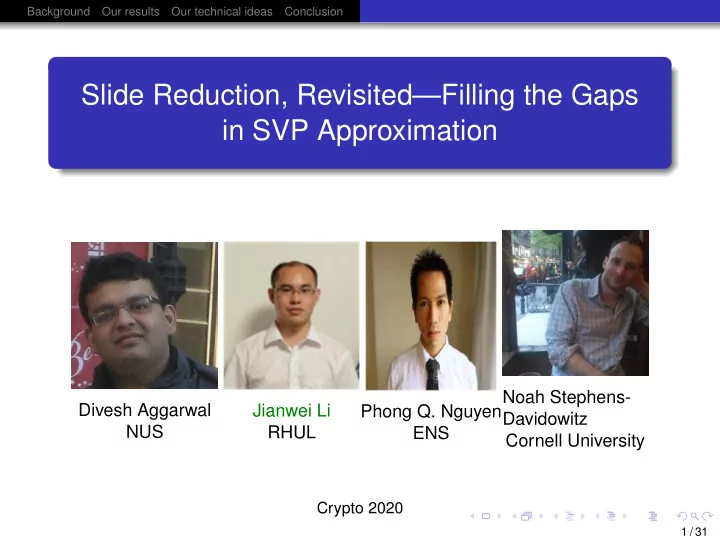
Slide Reduction, Revisited—Filling the Gaps in SVP Approximation

Divesh Aggarwal NUS Jianwei Li RHUL Phong Q. Nguyen ENS Noah Stephens- Davidowitz Cornell University

Crypto 2020

1 / 31

slide-2
SLIDE 2

Background Our results Our technical ideas Conclusion

Outline

1

Background

2

Our results

3

Our technical ideas

4

Conclusion

2 / 31

slide-3
SLIDE 3

Background Our results Our technical ideas Conclusion

1

Background

2

Our results

3

Our technical ideas

4

Conclusion

3 / 31

slide-4
SLIDE 4

Background Our results Our technical ideas Conclusion

Lattice and basis An n-rank lattice L is a set of all integer linear combinations

  • f n linearly independent vectors b1, . . . , bn:

L = {z1b1 + · · · + znbn, zi ∈ Z} . B := (b1, . . . , bn) is called a basis of L.

A Lattice of rank 2

4 / 31

slide-5
SLIDE 5

Background Our results Our technical ideas Conclusion

Lattice and basis An n-rank lattice L is a set of all integer linear combinations

  • f n linearly independent vectors b1, . . . , bn:

L = {z1b1 + · · · + znbn, zi ∈ Z} . B := (b1, . . . , bn) is called a basis of L.

A Lattice of rank 2

4 / 31

slide-6
SLIDE 6

Background Our results Our technical ideas Conclusion

Lattice and basis An n-rank lattice L is a set of all integer linear combinations

  • f n linearly independent vectors b1, . . . , bn:

L = {z1b1 + · · · + znbn, zi ∈ Z} . B := (b1, . . . , bn) is called a basis of L.

A Lattice of rank 2

4 / 31

slide-7
SLIDE 7

Background Our results Our technical ideas Conclusion

The most important lattice problem is the shortest vector problem (SVP) Given a basis of a lattice L, SVP is to find a shortest nonzero vector v in L, i.e., v = minx∈L=0 x λ1(L). Two natural relaxations f-approximate SVP (f-SVP): Given a lattice L, find a non-zero vector v ∈ L s.t. v ≤ f · λ1(L). f-Hermite SVP (f-HSVP): Given an n-rank lattice L, find a non-zero vector v ∈ L s.t. v ≤ f · vol(L)1/n, where vol(L) is the determinant of L.

5 / 31

slide-8
SLIDE 8

Background Our results Our technical ideas Conclusion

The most important lattice problem is the shortest vector problem (SVP) Given a basis of a lattice L, SVP is to find a shortest nonzero vector v in L, i.e., v = minx∈L=0 x λ1(L). Two natural relaxations f-approximate SVP (f-SVP): Given a lattice L, find a non-zero vector v ∈ L s.t. v ≤ f · λ1(L). f-Hermite SVP (f-HSVP): Given an n-rank lattice L, find a non-zero vector v ∈ L s.t. v ≤ f · vol(L)1/n, where vol(L) is the determinant of L.

5 / 31

slide-9
SLIDE 9

Background Our results Our technical ideas Conclusion

The most important lattice problem is the shortest vector problem (SVP) Given a basis of a lattice L, SVP is to find a shortest nonzero vector v in L, i.e., v = minx∈L=0 x λ1(L). Two natural relaxations f-approximate SVP (f-SVP): Given a lattice L, find a non-zero vector v ∈ L s.t. v ≤ f · λ1(L). f-Hermite SVP (f-HSVP): Given an n-rank lattice L, find a non-zero vector v ∈ L s.t. v ≤ f · vol(L)1/n, where vol(L) is the determinant of L.

5 / 31

slide-10
SLIDE 10

Background Our results Our technical ideas Conclusion

The most important lattice problem is the shortest vector problem (SVP) Given a basis of a lattice L, SVP is to find a shortest nonzero vector v in L, i.e., v = minx∈L=0 x λ1(L). Two natural relaxations f-approximate SVP (f-SVP): Given a lattice L, find a non-zero vector v ∈ L s.t. v ≤ f · λ1(L). f-Hermite SVP (f-HSVP): Given an n-rank lattice L, find a non-zero vector v ∈ L s.t. v ≤ f · vol(L)1/n, where vol(L) is the determinant of L.

5 / 31

slide-11
SLIDE 11

Background Our results Our technical ideas Conclusion

Hardness of SVP There is some constant c > 0 s.t. nc/ log log n-SVP on n-rank lattices is NP-hard under reasonable complexity theoretic assumptions.a b c d

  • aM. Ajtai. The shortest vector problem in L2 is NP-hard for randomized
  • reductions. STOC 1998.
  • bD. Micciancio. The shortest vector in a lattice is hard to approximate to

within some constant. SIAM J. Comput 2000 and FOCS 1998.

  • cS. Khot. Hardness of approximating the shortest vector problem in
  • lattices. JACM 2005 and FOCS 2004.
  • dI. Haviv and O. Regev. Tensor-based hardness of the shortest vector

problem to within almost polyno-mial factors.Theory of Computing 2012 and STOC 2007.

6 / 31

slide-12
SLIDE 12

Background Our results Our technical ideas Conclusion

Cryptography VS Cryptanalysis

Lattice cryptography From Ajtai 1996’s beginning, many cryptographic primitives have been constructed whose security is based on the (worst-case) hardness of nc-SVP for some constant c. a NIST PQC Round 3 submission

  • aM. Ajtai.Generating Hard Instances of Lattice Problems. STOC 1996.

Lattice cryptanalysis How to do lattice cryptanalysis? How to estimate the concrete security of lattice cryptographic schemes?

⇒ Solve nc-(H)SVP ⇒ Lattice reduction

7 / 31

slide-13
SLIDE 13

Background Our results Our technical ideas Conclusion

Cryptography VS Cryptanalysis

Lattice cryptography From Ajtai 1996’s beginning, many cryptographic primitives have been constructed whose security is based on the (worst-case) hardness of nc-SVP for some constant c. a NIST PQC Round 3 submission

  • aM. Ajtai.Generating Hard Instances of Lattice Problems. STOC 1996.

Lattice cryptanalysis How to do lattice cryptanalysis? How to estimate the concrete security of lattice cryptographic schemes?

⇒ Solve nc-(H)SVP ⇒ Lattice reduction

7 / 31

slide-14
SLIDE 14

Background Our results Our technical ideas Conclusion

Cryptography VS Cryptanalysis

Lattice cryptography From Ajtai 1996’s beginning, many cryptographic primitives have been constructed whose security is based on the (worst-case) hardness of nc-SVP for some constant c. a NIST PQC Round 3 submission

  • aM. Ajtai.Generating Hard Instances of Lattice Problems. STOC 1996.

Lattice cryptanalysis How to do lattice cryptanalysis? How to estimate the concrete security of lattice cryptographic schemes?

⇒ Solve nc-(H)SVP ⇒ Lattice reduction

7 / 31

slide-15
SLIDE 15

Background Our results Our technical ideas Conclusion

Cryptography VS Cryptanalysis

Lattice cryptography From Ajtai 1996’s beginning, many cryptographic primitives have been constructed whose security is based on the (worst-case) hardness of nc-SVP for some constant c. a NIST PQC Round 3 submission

  • aM. Ajtai.Generating Hard Instances of Lattice Problems. STOC 1996.

Lattice cryptanalysis How to do lattice cryptanalysis? How to estimate the concrete security of lattice cryptographic schemes?

⇒ Solve nc-(H)SVP ⇒ Lattice reduction

7 / 31

slide-16
SLIDE 16

Background Our results Our technical ideas Conclusion

Cryptography VS Cryptanalysis

Lattice cryptography From Ajtai 1996’s beginning, many cryptographic primitives have been constructed whose security is based on the (worst-case) hardness of nc-SVP for some constant c. a NIST PQC Round 3 submission

  • aM. Ajtai.Generating Hard Instances of Lattice Problems. STOC 1996.

Lattice cryptanalysis How to do lattice cryptanalysis? How to estimate the concrete security of lattice cryptographic schemes?

⇒ Solve nc-(H)SVP ⇒ Lattice reduction

7 / 31

slide-17
SLIDE 17

Background Our results Our technical ideas Conclusion

Cryptography VS Cryptanalysis

Lattice cryptography From Ajtai 1996’s beginning, many cryptographic primitives have been constructed whose security is based on the (worst-case) hardness of nc-SVP for some constant c. a NIST PQC Round 3 submission

  • aM. Ajtai.Generating Hard Instances of Lattice Problems. STOC 1996.

Lattice cryptanalysis How to do lattice cryptanalysis? How to estimate the concrete security of lattice cryptographic schemes?

⇒ Solve nc-(H)SVP ⇒ Lattice reduction

7 / 31

slide-18
SLIDE 18

Background Our results Our technical ideas Conclusion

Lattice reduction Given a lattice, find a good basis consisting of reasonably short and almost orthogonal vectors.

8 / 31

slide-19
SLIDE 19

Background Our results Our technical ideas Conclusion

Importance Lattice reduction is the classical approach for solving f-(H)SVP: It has proved invaluable in many fields of computer science and mathematics. Notably in cryptology:

It is a popular tool to both public-key cryptography and cryptanalysis; Its importance is growing as lattice-based cryptography becomes the most popular candidate for PQC.

9 / 31

slide-20
SLIDE 20

Background Our results Our technical ideas Conclusion

Importance Lattice reduction is the classical approach for solving f-(H)SVP: It has proved invaluable in many fields of computer science and mathematics. Notably in cryptology:

It is a popular tool to both public-key cryptography and cryptanalysis; Its importance is growing as lattice-based cryptography becomes the most popular candidate for PQC.

9 / 31

slide-21
SLIDE 21

Background Our results Our technical ideas Conclusion

Importance Lattice reduction is the classical approach for solving f-(H)SVP: It has proved invaluable in many fields of computer science and mathematics. Notably in cryptology:

It is a popular tool to both public-key cryptography and cryptanalysis; Its importance is growing as lattice-based cryptography becomes the most popular candidate for PQC.

9 / 31

slide-22
SLIDE 22

Background Our results Our technical ideas Conclusion

Importance Lattice reduction is the classical approach for solving f-(H)SVP: It has proved invaluable in many fields of computer science and mathematics. Notably in cryptology:

It is a popular tool to both public-key cryptography and cryptanalysis; Its importance is growing as lattice-based cryptography becomes the most popular candidate for PQC.

9 / 31

slide-23
SLIDE 23

Background Our results Our technical ideas Conclusion

Importance Lattice reduction is the classical approach for solving f-(H)SVP: It has proved invaluable in many fields of computer science and mathematics. Notably in cryptology:

It is a popular tool to both public-key cryptography and cryptanalysis; Its importance is growing as lattice-based cryptography becomes the most popular candidate for PQC.

9 / 31

slide-24
SLIDE 24

Background Our results Our technical ideas Conclusion

SVP: λ1(L) = minv∈L\{0} v. Hermite’s constant: γn = max λ1(L)2 over all n-rank lattices L of unit determinant. γn = Θ(n) measures the output quality of lattice reduction algorithms.

10 / 31

slide-25
SLIDE 25

Background Our results Our technical ideas Conclusion

SVP: λ1(L) = minv∈L\{0} v. Hermite’s constant: γn = max λ1(L)2 over all n-rank lattices L of unit determinant. γn = Θ(n) measures the output quality of lattice reduction algorithms.

10 / 31

slide-26
SLIDE 26

Background Our results Our technical ideas Conclusion

SVP: λ1(L) = minv∈L\{0} v. Hermite’s constant: γn = max λ1(L)2 over all n-rank lattices L of unit determinant. γn = Θ(n) measures the output quality of lattice reduction algorithms.

10 / 31

slide-27
SLIDE 27

Background Our results Our technical ideas Conclusion

Prior work 1

Previous best algorithms for nc≥1-SVP in theory GN-slide-reduction is the previously best polynomial time lattice reduction algorithm for solving nc≥1-SVP in theory: a

  • For n = pk ≥ 2k, with polynomially many calls to exact

SVP-oracle in rank k, it outputs a basis (b1, . . . , bn) of the input lattice L s.t. b1 ≤ 2γ

n−1 2(k−1)

k

· vol(L)1/n, b1 ≤ 2γ

n−k k−1

k

· λ1(L).

  • aN. Gama and P

. Q. Nguyen. Finding short lattice vectors within Mordell’s

  • inequality. STOC 2008.

11 / 31

slide-28
SLIDE 28

Background Our results Our technical ideas Conclusion

Prior work 2

Previous best algorithms for nc≥ 1

2 -HSVP in theory

DBKZ is the previously best polynomial time lattice reduction algorithm for solving nc≥ 1

2 -HSVP in theory: a

  • For n ≥ k ≥ 2, with polynomially many calls to exact

SVP-oracle in rank k, it outputs a basis (b1, . . . , bn) of the input lattice L s.t. b1 ≤ 2γ

n−1 2(k−1)

k

· vol(L)1/n, b1 ≤ 2γ

n−1 k−1

k

· λ1(L).

  • aD. Micciancio and M. Walter. Practical, predictable lattice basis reduction.

EUROCRYPT 2016.

12 / 31

slide-29
SLIDE 29

Background Our results Our technical ideas Conclusion

Slide-reduction VS DBKZ For n = pk ≥ 2k, GN-slide-reduction achieves: b1 ≤ 2γ

n−1 2(k−1)

k

· vol(L)1/n and b1 ≤ 2γ

n−k k−1

k

· λ1(L). For n ≥ k ≥ 2, DBKZ achieves: b1 ≤ 2γ

n−1 2(k−1)

k

· vol(L)1/n and b1 ≤ 2γ

n−1 k−1

k

· λ1(L). Two natural questions Can we extend GN-sldie-reduction algorithm into the case that k might not divide n? ⇒ Exponential speedup for solving nc-SVP over 1 < c / ∈ Z. The best (proven) approximation factor for appximating SVP and HSVP is now achieved by a single algorithm:

  • Can we get the best of both [GN08] and [MW16]?

13 / 31

slide-30
SLIDE 30

Background Our results Our technical ideas Conclusion

Slide-reduction VS DBKZ For n = pk ≥ 2k, GN-slide-reduction achieves: b1 ≤ 2γ

n−1 2(k−1)

k

· vol(L)1/n and b1 ≤ 2γ

n−k k−1

k

· λ1(L). For n ≥ k ≥ 2, DBKZ achieves: b1 ≤ 2γ

n−1 2(k−1)

k

· vol(L)1/n and b1 ≤ 2γ

n−1 k−1

k

· λ1(L). Two natural questions Can we extend GN-sldie-reduction algorithm into the case that k might not divide n? ⇒ Exponential speedup for solving nc-SVP over 1 < c / ∈ Z. The best (proven) approximation factor for appximating SVP and HSVP is now achieved by a single algorithm:

  • Can we get the best of both [GN08] and [MW16]?

13 / 31

slide-31
SLIDE 31

Background Our results Our technical ideas Conclusion

Slide-reduction VS DBKZ For n = pk ≥ 2k, GN-slide-reduction achieves: b1 ≤ 2γ

n−1 2(k−1)

k

· vol(L)1/n and b1 ≤ 2γ

n−k k−1

k

· λ1(L). For n ≥ k ≥ 2, DBKZ achieves: b1 ≤ 2γ

n−1 2(k−1)

k

· vol(L)1/n and b1 ≤ 2γ

n−1 k−1

k

· λ1(L). Two natural questions Can we extend GN-sldie-reduction algorithm into the case that k might not divide n? ⇒ Exponential speedup for solving nc-SVP over 1 < c / ∈ Z. The best (proven) approximation factor for appximating SVP and HSVP is now achieved by a single algorithm:

  • Can we get the best of both [GN08] and [MW16]?

13 / 31

slide-32
SLIDE 32

Background Our results Our technical ideas Conclusion

Slide-reduction VS DBKZ For n = pk ≥ 2k, GN-slide-reduction achieves: b1 ≤ 2γ

n−1 2(k−1)

k

· vol(L)1/n and b1 ≤ 2γ

n−k k−1

k

· λ1(L). For n ≥ k ≥ 2, DBKZ achieves: b1 ≤ 2γ

n−1 2(k−1)

k

· vol(L)1/n and b1 ≤ 2γ

n−1 k−1

k

· λ1(L). Two natural questions Can we extend GN-sldie-reduction algorithm into the case that k might not divide n? ⇒ Exponential speedup for solving nc-SVP over 1 < c / ∈ Z. The best (proven) approximation factor for appximating SVP and HSVP is now achieved by a single algorithm:

  • Can we get the best of both [GN08] and [MW16]?

13 / 31

slide-33
SLIDE 33

Background Our results Our technical ideas Conclusion

Slide-reduction VS DBKZ For n = pk ≥ 2k, GN-slide-reduction achieves: b1 ≤ 2γ

n−1 2(k−1)

k

· vol(L)1/n and b1 ≤ 2γ

n−k k−1

k

· λ1(L). For n ≥ k ≥ 2, DBKZ achieves: b1 ≤ 2γ

n−1 2(k−1)

k

· vol(L)1/n and b1 ≤ 2γ

n−1 k−1

k

· λ1(L). Two natural questions Can we extend GN-sldie-reduction algorithm into the case that k might not divide n? ⇒ Exponential speedup for solving nc-SVP over 1 < c / ∈ Z. The best (proven) approximation factor for appximating SVP and HSVP is now achieved by a single algorithm:

  • Can we get the best of both [GN08] and [MW16]?

13 / 31

slide-34
SLIDE 34

Background Our results Our technical ideas Conclusion

Slide-reduction VS DBKZ For n = pk ≥ 2k, GN-slide-reduction achieves: b1 ≤ 2γ

n−1 2(k−1)

k

· vol(L)1/n and b1 ≤ 2γ

n−k k−1

k

· λ1(L). For n ≥ k ≥ 2, DBKZ achieves: b1 ≤ 2γ

n−1 2(k−1)

k

· vol(L)1/n and b1 ≤ 2γ

n−1 k−1

k

· λ1(L). Two natural questions Can we extend GN-sldie-reduction algorithm into the case that k might not divide n? ⇒ Exponential speedup for solving nc-SVP over 1 < c / ∈ Z. The best (proven) approximation factor for appximating SVP and HSVP is now achieved by a single algorithm:

  • Can we get the best of both [GN08] and [MW16]?

13 / 31

slide-35
SLIDE 35

Background Our results Our technical ideas Conclusion

Approximating SVP with sublinear factors The security of many lattice-based cryptographic constructions is based on the worst-case hardness of nc-SVP with constant c ∈ [ 1

2, 1].

Awkward: There is no known non-trivial algorithm for approximating SVP with sublinear factors. Question: Is there an non-trivial (lattice reduction) algorithm for approximating SVP with sublinear factors? ⇒ At least exponential speedup.

14 / 31

slide-36
SLIDE 36

Background Our results Our technical ideas Conclusion

Approximating SVP with sublinear factors The security of many lattice-based cryptographic constructions is based on the worst-case hardness of nc-SVP with constant c ∈ [ 1

2, 1].

Awkward: There is no known non-trivial algorithm for approximating SVP with sublinear factors. Question: Is there an non-trivial (lattice reduction) algorithm for approximating SVP with sublinear factors? ⇒ At least exponential speedup.

14 / 31

slide-37
SLIDE 37

Background Our results Our technical ideas Conclusion

Approximating SVP with sublinear factors The security of many lattice-based cryptographic constructions is based on the worst-case hardness of nc-SVP with constant c ∈ [ 1

2, 1].

Awkward: There is no known non-trivial algorithm for approximating SVP with sublinear factors. Question: Is there an non-trivial (lattice reduction) algorithm for approximating SVP with sublinear factors? ⇒ At least exponential speedup.

14 / 31

slide-38
SLIDE 38

Background Our results Our technical ideas Conclusion

Approximating SVP with sublinear factors The security of many lattice-based cryptographic constructions is based on the worst-case hardness of nc-SVP with constant c ∈ [ 1

2, 1].

Awkward: There is no known non-trivial algorithm for approximating SVP with sublinear factors. Question: Is there an non-trivial (lattice reduction) algorithm for approximating SVP with sublinear factors? ⇒ At least exponential speedup.

14 / 31

slide-39
SLIDE 39

Background Our results Our technical ideas Conclusion

1

Background

2

Our results

3

Our technical ideas

4

Conclusion

15 / 31

slide-40
SLIDE 40

Background Our results Our technical ideas Conclusion

Our paper solves the three questions: Q1 Is there an non-trivial (lattice reduction) algorithm for approximating SVP with sublinear factors? Q2 Can we extend GN-slide-reduction algorithm into the case that k does not divide n exactly, so that it can faster solve nc-SVP over any fractional constant c ≥ 1? Q3 Is there a single algorithm which is the best in theory for solving both nc≥1-SVP and nc≥ 1

2 -HSVP? 16 / 31

slide-41
SLIDE 41

Background Our results Our technical ideas Conclusion

Our paper solves the three questions: Q1 Is there an non-trivial (lattice reduction) algorithm for approximating SVP with sublinear factors? Q2 Can we extend GN-slide-reduction algorithm into the case that k does not divide n exactly, so that it can faster solve nc-SVP over any fractional constant c ≥ 1? Q3 Is there a single algorithm which is the best in theory for solving both nc≥1-SVP and nc≥ 1

2 -HSVP? 16 / 31

slide-42
SLIDE 42

Background Our results Our technical ideas Conclusion

Our paper solves the three questions: Q1 Is there an non-trivial (lattice reduction) algorithm for approximating SVP with sublinear factors? Q2 Can we extend GN-slide-reduction algorithm into the case that k does not divide n exactly, so that it can faster solve nc-SVP over any fractional constant c ≥ 1? Q3 Is there a single algorithm which is the best in theory for solving both nc≥1-SVP and nc≥ 1

2 -HSVP? 16 / 31

slide-43
SLIDE 43

Background Our results Our technical ideas Conclusion

Our paper solves the three questions: Q1 Is there an non-trivial (lattice reduction) algorithm for approximating SVP with sublinear factors? Q2 Can we extend GN-slide-reduction algorithm into the case that k does not divide n exactly, so that it can faster solve nc-SVP over any fractional constant c ≥ 1? Q3 Is there a single algorithm which is the best in theory for solving both nc≥1-SVP and nc≥ 1

2 -HSVP? 16 / 31

slide-44
SLIDE 44

Background Our results Our technical ideas Conclusion

Our first result

Theorem (Approximating SVP with sublinear factor) Let 2k > n ≥ k ≥ 2 be integers and δ ≥ 1. There is an algorithm that with polynomially many calls to δ-SVP-oracle in rank k, it outputs an nonzero vector b of the input lattice L s.t. b ≤ O(δ(δ2γk)

n 2k ) · λ1(L).

⋆ This is the first non-trivial algorithm for approximating SVP with sublinear factors n

1 2 ≤ f ≤ n1−ε.

Corollary For any constant c ∈ (1/2, 1) and any factor δ ≥ 1, there is an efficient reduction from O(δ2c+1nc)-SVP in rank n to δ-SVP in rank ⌈ n

2c⌉.

17 / 31

slide-45
SLIDE 45

Background Our results Our technical ideas Conclusion

Our first result

Theorem (Approximating SVP with sublinear factor) Let 2k > n ≥ k ≥ 2 be integers and δ ≥ 1. There is an algorithm that with polynomially many calls to δ-SVP-oracle in rank k, it outputs an nonzero vector b of the input lattice L s.t. b ≤ O(δ(δ2γk)

n 2k ) · λ1(L).

⋆ This is the first non-trivial algorithm for approximating SVP with sublinear factors n

1 2 ≤ f ≤ n1−ε.

Corollary For any constant c ∈ (1/2, 1) and any factor δ ≥ 1, there is an efficient reduction from O(δ2c+1nc)-SVP in rank n to δ-SVP in rank ⌈ n

2c⌉.

17 / 31

slide-46
SLIDE 46

Background Our results Our technical ideas Conclusion

Our first result

Theorem (Approximating SVP with sublinear factor) Let 2k > n ≥ k ≥ 2 be integers and δ ≥ 1. There is an algorithm that with polynomially many calls to δ-SVP-oracle in rank k, it outputs an nonzero vector b of the input lattice L s.t. b ≤ O(δ(δ2γk)

n 2k ) · λ1(L).

⋆ This is the first non-trivial algorithm for approximating SVP with sublinear factors n

1 2 ≤ f ≤ n1−ε.

Corollary For any constant c ∈ (1/2, 1) and any factor δ ≥ 1, there is an efficient reduction from O(δ2c+1nc)-SVP in rank n to δ-SVP in rank ⌈ n

2c⌉.

17 / 31

slide-47
SLIDE 47

Background Our results Our technical ideas Conclusion

Our first result

Theorem (Approximating SVP with sublinear factor) Let 2k > n ≥ k ≥ 2 be integers and δ ≥ 1. There is an algorithm that with polynomially many calls to δ-SVP-oracle in rank k, it outputs an nonzero vector b of the input lattice L s.t. b ≤ O(δ(δ2γk)

n 2k ) · λ1(L).

⋆ This is the first non-trivial algorithm for approximating SVP with sublinear factors n

1 2 ≤ f ≤ n1−ε.

Corollary For any constant c ∈ (1/2, 1) and any factor δ ≥ 1, there is an efficient reduction from O(δ2c+1nc)-SVP in rank n to δ-SVP in rank ⌈ n

2c⌉.

17 / 31

slide-48
SLIDE 48

Background Our results Our technical ideas Conclusion

Our second result

Theorem (Approximating SVP with (at least) polynomial factor) Let n ≥ 2k ≥ 4 be integers and δ ≥ 1. There is an algorithm that with polynomially many calls to δ-SVP-oracle in rank k, it

  • utputs a basis (b1, . . . , bn) of the input lattice L s.t.

b1 ≤ 2(δ2γk)

n−1 2(k−1) · vol(L)1/n,

b1 ≤ 2(δ2γk)

n−k k−1 · λ1(L).

Corollary For any constant c ≥ 1 and any factor δ ≥ 1, there is an efficient reduction from O(δ2c+1nc)-SVP in rank n to δ-SVP in rank ⌊

n c+1⌋.

18 / 31

slide-49
SLIDE 49

Background Our results Our technical ideas Conclusion

Our second result

Theorem (Approximating SVP with (at least) polynomial factor) Let n ≥ 2k ≥ 4 be integers and δ ≥ 1. There is an algorithm that with polynomially many calls to δ-SVP-oracle in rank k, it

  • utputs a basis (b1, . . . , bn) of the input lattice L s.t.

b1 ≤ 2(δ2γk)

n−1 2(k−1) · vol(L)1/n,

b1 ≤ 2(δ2γk)

n−k k−1 · λ1(L).

Corollary For any constant c ≥ 1 and any factor δ ≥ 1, there is an efficient reduction from O(δ2c+1nc)-SVP in rank n to δ-SVP in rank ⌊

n c+1⌋.

18 / 31

slide-50
SLIDE 50

Background Our results Our technical ideas Conclusion

Our second result

Theorem (Approximating SVP with (at least) polynomial factor) Let n ≥ 2k ≥ 4 be integers and δ ≥ 1. There is an algorithm that with polynomially many calls to δ-SVP-oracle in rank k, it

  • utputs a basis (b1, . . . , bn) of the input lattice L s.t.

b1 ≤ 2(δ2γk)

n−1 2(k−1) · vol(L)1/n,

b1 ≤ 2(δ2γk)

n−k k−1 · λ1(L).

Corollary For any constant c ≥ 1 and any factor δ ≥ 1, there is an efficient reduction from O(δ2c+1nc)-SVP in rank n to δ-SVP in rank ⌊

n c+1⌋.

18 / 31

slide-51
SLIDE 51

Background Our results Our technical ideas Conclusion

Impact

Our two algorithms provide currently the best polynomial-time lattice reduction algorithm: ⇒ Achieve the best time/quality trade-off in theory. With well-chosen SVP-oracles in lower rank, our work implies the exponentially faster provable/heuristic algorithm for approximating SVP with factor n1/2 ≤ f ≤ nO(1): ⇒ This is the regime most relevant for cryptography.

19 / 31

slide-52
SLIDE 52

Background Our results Our technical ideas Conclusion

Impact

Our two algorithms provide currently the best polynomial-time lattice reduction algorithm: ⇒ Achieve the best time/quality trade-off in theory. With well-chosen SVP-oracles in lower rank, our work implies the exponentially faster provable/heuristic algorithm for approximating SVP with factor n1/2 ≤ f ≤ nO(1): ⇒ This is the regime most relevant for cryptography.

19 / 31

slide-53
SLIDE 53

Background Our results Our technical ideas Conclusion

Impact: the faster provable/heuristic algorithm

Table: Provable algorithms for approximating SVP .1 Approx-factor Previous best This work nc for c ∈ [ 1

2, 1)

20.802n [WLW15] 2

0.802n 2c

nc for c ≥ 1 2

n ⌊c+1⌋

[GN08]+[ADRS15] 2

0.802n c+1

Table: Heuristic algorithms for approximating SVP .2 Approx-factor Previous best This work nc for c ∈ [ 1

2, 1)

20.292n [BDGL16] 2

0.292n 2c

nc for c ≥ 1 2

0.292n ⌊c+1⌋

[GN08]+[BDGL16] 2

0.292n c+1

  • 1W. Wei, M. Liu, and X. Wang. Finding shortest latticevectors in the

presence of gaps. CT-RSA 2015.

  • 2A. Becker, L. Ducas, N. Gama, and T. Laarhoven. New directions in

nearest neighbor searching with applications to lattice sieving. SODA 2016.

20 / 31

slide-54
SLIDE 54

Background Our results Our technical ideas Conclusion

1

Background

2

Our results

3

Our technical ideas

4

Conclusion

21 / 31

slide-55
SLIDE 55

Background Our results Our technical ideas Conclusion

Warning For simplicity, we describe our ideas with exact SVP-oracle; It is easy to replace exact SVP-oracle with approximate-SVP-oracle.

22 / 31

slide-56
SLIDE 56

Background Our results Our technical ideas Conclusion

Warning For simplicity, we describe our ideas with exact SVP-oracle; It is easy to replace exact SVP-oracle with approximate-SVP-oracle.

22 / 31

slide-57
SLIDE 57

Background Our results Our technical ideas Conclusion

Warning For simplicity, we describe our ideas with exact SVP-oracle; It is easy to replace exact SVP-oracle with approximate-SVP-oracle.

22 / 31

slide-58
SLIDE 58

Background Our results Our technical ideas Conclusion

Preliminaries

GSO Given a basis B = (b1, . . . , bn), define the orthogonal projection: πi : span(b1, . . . , bn) → span(b1, . . . , bi−1)⊥.

  • Each vector b∗

i = πi(bi) is the Gram-Schmidt vector of B.

  • The projected block B[i,j] = (πi(bi), πi(bi+1), . . . , πi(bj)).

23 / 31

slide-59
SLIDE 59

Background Our results Our technical ideas Conclusion

Preliminaries

Several reduction notions Let B be a basis of a lattice L. B is SVP-reduced if its first basis vector is a shortest nonzero vector of L. B is DSVP-reduced if its dual basis is SVP-reduced. B is DBKZ-reduced if it is produced by the DBKZ algorithm with blocksize k.a B is GN-slide-reduced if it is produced by the GN-slide reduction algorithm with blocksize k.b

  • aD. Micciancio and M. Walter. Practical, predictable lattice basis reduction.

EUROCRYPT 2016.

  • bN. Gama and P

. Q. Nguyen. Finding short lattice vectors within Mordell’s

  • inequality. STOC 2008.

24 / 31

slide-60
SLIDE 60

Background Our results Our technical ideas Conclusion

Preliminaries

Several reduction notions Let B be a basis of a lattice L. B is SVP-reduced if its first basis vector is a shortest nonzero vector of L. B is DSVP-reduced if its dual basis is SVP-reduced. B is DBKZ-reduced if it is produced by the DBKZ algorithm with blocksize k.a B is GN-slide-reduced if it is produced by the GN-slide reduction algorithm with blocksize k.b

  • aD. Micciancio and M. Walter. Practical, predictable lattice basis reduction.

EUROCRYPT 2016.

  • bN. Gama and P

. Q. Nguyen. Finding short lattice vectors within Mordell’s

  • inequality. STOC 2008.

24 / 31

slide-61
SLIDE 61

Background Our results Our technical ideas Conclusion

Preliminaries

Several reduction notions Let B be a basis of a lattice L. B is SVP-reduced if its first basis vector is a shortest nonzero vector of L. B is DSVP-reduced if its dual basis is SVP-reduced. B is DBKZ-reduced if it is produced by the DBKZ algorithm with blocksize k.a B is GN-slide-reduced if it is produced by the GN-slide reduction algorithm with blocksize k.b

  • aD. Micciancio and M. Walter. Practical, predictable lattice basis reduction.

EUROCRYPT 2016.

  • bN. Gama and P

. Q. Nguyen. Finding short lattice vectors within Mordell’s

  • inequality. STOC 2008.

24 / 31

slide-62
SLIDE 62

Background Our results Our technical ideas Conclusion

Preliminaries

Several reduction notions Let B be a basis of a lattice L. B is SVP-reduced if its first basis vector is a shortest nonzero vector of L. B is DSVP-reduced if its dual basis is SVP-reduced. B is DBKZ-reduced if it is produced by the DBKZ algorithm with blocksize k.a B is GN-slide-reduced if it is produced by the GN-slide reduction algorithm with blocksize k.b

  • aD. Micciancio and M. Walter. Practical, predictable lattice basis reduction.

EUROCRYPT 2016.

  • bN. Gama and P

. Q. Nguyen. Finding short lattice vectors within Mordell’s

  • inequality. STOC 2008.

24 / 31

slide-63
SLIDE 63

Background Our results Our technical ideas Conclusion

Preliminaries

Several reduction notions Let B be a basis of a lattice L. B is SVP-reduced if its first basis vector is a shortest nonzero vector of L. B is DSVP-reduced if its dual basis is SVP-reduced. B is DBKZ-reduced if it is produced by the DBKZ algorithm with blocksize k.a B is GN-slide-reduced if it is produced by the GN-slide reduction algorithm with blocksize k.b

  • aD. Micciancio and M. Walter. Practical, predictable lattice basis reduction.

EUROCRYPT 2016.

  • bN. Gama and P

. Q. Nguyen. Finding short lattice vectors within Mordell’s

  • inequality. STOC 2008.

24 / 31

slide-64
SLIDE 64

Background Our results Our technical ideas Conclusion

Approximating SVP with sublinear factor

Given a lattice L of rank n ∈ (k, 2k) and a SVP-oracle in rank k. Ideas Partition the input basis into two blocks s.t. the first block has smaller rank n − k and the second block has rank k:

b1 b∗

q+1

b∗

k

b∗

k+q = b∗ n

25 / 31

slide-65
SLIDE 65

Background Our results Our technical ideas Conclusion

Approximating SVP with sublinear factor

Given a lattice L of rank n ∈ (k, 2k) and a SVP-oracle in rank k. Ideas Partition the input basis into two blocks s.t. the first block has smaller rank n − k and the second block has rank k:

b1 b∗

q+1

b∗

k

b∗

k+q = b∗ n

25 / 31

slide-66
SLIDE 66

Background Our results Our technical ideas Conclusion

Approximating SVP with sublinear factor

Given a lattice L of rank n ∈ (k, 2k) and a SVP-oracle in rank k. Ideas Partition the input basis into two blocks s.t. the first block has smaller rank n − k and the second block has rank k; Alternately SVP-reduce and DSVP-reduce some projected blocks on the input basis s.t. the head basis vectors b1, . . . , bk become: min

  • λ1(L(b1, . . . , bk)), vol(b1, . . . , bk)1/k

γ(n−k)/(2k)

n−k

)

  • λ1(L).

Extra SVP-reduce b1, . . . , bk to find: b γ

n 2k

k

· λ1(L). Please refer to our Sect. 1.2 and Sect. 3 for details.

26 / 31

slide-67
SLIDE 67

Background Our results Our technical ideas Conclusion

Approximating SVP with sublinear factor

Given a lattice L of rank n ∈ (k, 2k) and a SVP-oracle in rank k. Ideas Partition the input basis into two blocks s.t. the first block has smaller rank n − k and the second block has rank k; Alternately SVP-reduce and DSVP-reduce some projected blocks on the input basis s.t. the head basis vectors b1, . . . , bk become: min

  • λ1(L(b1, . . . , bk)), vol(b1, . . . , bk)1/k

γ(n−k)/(2k)

n−k

)

  • λ1(L).

Extra SVP-reduce b1, . . . , bk to find: b γ

n 2k

k

· λ1(L). Please refer to our Sect. 1.2 and Sect. 3 for details.

26 / 31

slide-68
SLIDE 68

Background Our results Our technical ideas Conclusion

Approximating SVP with sublinear factor

Given a lattice L of rank n ∈ (k, 2k) and a SVP-oracle in rank k. Ideas Partition the input basis into two blocks s.t. the first block has smaller rank n − k and the second block has rank k; Alternately SVP-reduce and DSVP-reduce some projected blocks on the input basis s.t. the head basis vectors b1, . . . , bk become: min

  • λ1(L(b1, . . . , bk)), vol(b1, . . . , bk)1/k

γ(n−k)/(2k)

n−k

)

  • λ1(L).

Extra SVP-reduce b1, . . . , bk to find: b γ

n 2k

k

· λ1(L). Please refer to our Sect. 1.2 and Sect. 3 for details.

26 / 31

slide-69
SLIDE 69

Background Our results Our technical ideas Conclusion

Approximating SVP with sublinear factor

Given a lattice L of rank n ∈ (k, 2k) and a SVP-oracle in rank k. Ideas Partition the input basis into two blocks s.t. the first block has smaller rank n − k and the second block has rank k; Alternately SVP-reduce and DSVP-reduce some projected blocks on the input basis s.t. the head basis vectors b1, . . . , bk become: min

  • λ1(L(b1, . . . , bk)), vol(b1, . . . , bk)1/k

γ(n−k)/(2k)

n−k

)

  • λ1(L).

Extra SVP-reduce b1, . . . , bk to find: b γ

n 2k

k

· λ1(L). Please refer to our Sect. 1.2 and Sect. 3 for details.

26 / 31

slide-70
SLIDE 70

Background Our results Our technical ideas Conclusion

Approximating SVP with (at least) polynomial factor

Recall ideas of GN-slide-reduction Given a basis B of rank n = pk ≥ 2k, GN partitions the basis into p blocks of equal rank k:

27 / 31

slide-71
SLIDE 71

Background Our results Our technical ideas Conclusion

Approximating SVP with (at least) polynomial factor

Given as input a basis B of a lattice L of rank n = pk + q with p, k ≥ 2 and 0 ≤ q < k and a SVP-oracle in rank k. Ideas Partition B into p blocks s.t. the first block has larger rank k + q and the other block has the same rank k;

b1 b∗

k+q+1

b∗

2k+q+1

b∗

(p−1)k+q+1

b∗

pk+q = b∗ n

28 / 31

slide-72
SLIDE 72

Background Our results Our technical ideas Conclusion

Approximating SVP with (at least) polynomial factor

Given as input a basis B of a lattice L of rank n = pk + q with p, k ≥ 2 and 0 ≤ q < k and a SVP-oracle in rank k. Ideas Partition B into p blocks s.t. the first block has larger rank k + q and the other block has the same rank k;

b1 b∗

k+q+1

b∗

2k+q+1

b∗

(p−1)k+q+1

b∗

pk+q = b∗ n

28 / 31

slide-73
SLIDE 73

Background Our results Our technical ideas Conclusion

Approximating SVP with (at least) polynomial factor

Given as input a basis B of a lattice L of rank n = pk + q with p, k ≥ 2 and 0 ≤ q < k and a SVP-oracle in rank k. Ideas Partition B into p blocks s.t. the first block has larger rank k + q and the other block has the same rank k; Alternately SVP-reduce and DSVP-reduce some projected blocks on B s.t. B[1,k+q] becomes DBKZ-reduced, B[k+q+1,n] becomes GN-slide-reduced, and both blocks are glued by DBKZ-reducedness of B[2,k+q+1] The output basis (b1, . . . , bn) satisfies: b1 γ

n−1 2(k−1)

k

vol(L)1/n, b1 γ

n−k k−1

k

λ1(L).

29 / 31

slide-74
SLIDE 74

Background Our results Our technical ideas Conclusion

Approximating SVP with (at least) polynomial factor

Given as input a basis B of a lattice L of rank n = pk + q with p, k ≥ 2 and 0 ≤ q < k and a SVP-oracle in rank k. Ideas Partition B into p blocks s.t. the first block has larger rank k + q and the other block has the same rank k; Alternately SVP-reduce and DSVP-reduce some projected blocks on B s.t. B[1,k+q] becomes DBKZ-reduced, B[k+q+1,n] becomes GN-slide-reduced, and both blocks are glued by DBKZ-reducedness of B[2,k+q+1] The output basis (b1, . . . , bn) satisfies: b1 γ

n−1 2(k−1)

k

vol(L)1/n, b1 γ

n−k k−1

k

λ1(L).

29 / 31

slide-75
SLIDE 75

Background Our results Our technical ideas Conclusion

Approximating SVP with (at least) polynomial factor

Given as input a basis B of a lattice L of rank n = pk + q with p, k ≥ 2 and 0 ≤ q < k and a SVP-oracle in rank k. Ideas Partition B into p blocks s.t. the first block has larger rank k + q and the other block has the same rank k; Alternately SVP-reduce and DSVP-reduce some projected blocks on B s.t. B[1,k+q] becomes DBKZ-reduced, B[k+q+1,n] becomes GN-slide-reduced, and both blocks are glued by DBKZ-reducedness of B[2,k+q+1] The output basis (b1, . . . , bn) satisfies: b1 γ

n−1 2(k−1)

k

vol(L)1/n, b1 γ

n−k k−1

k

λ1(L).

29 / 31

slide-76
SLIDE 76

Background Our results Our technical ideas Conclusion

Approximating SVP with (at least) polynomial factor

Given as input a basis B of a lattice L of rank n = pk + q with p, k ≥ 2 and 0 ≤ q < k and a SVP-oracle in rank k. Ideas Partition B into p blocks s.t. the first block has larger rank k + q and the other block has the same rank k; Alternately SVP-reduce and DSVP-reduce some projected blocks on B s.t. B[1,k+q] becomes DBKZ-reduced, B[k+q+1,n] becomes GN-slide-reduced, and both blocks are glued by DBKZ-reducedness of B[2,k+q+1] The output basis (b1, . . . , bn) satisfies: b1 γ

n−1 2(k−1)

k

vol(L)1/n, b1 γ

n−k k−1

k

λ1(L).

29 / 31

slide-77
SLIDE 77

Background Our results Our technical ideas Conclusion

1

Background

2

Our results

3

Our technical ideas

4

Conclusion

30 / 31

slide-78
SLIDE 78

Background Our results Our technical ideas Conclusion

Conclusion

The best polynomial-time lattice reduction in theory, including the first non-trivial algorithm for approximating SVP with sublinear factors n

1 2 ≤ f ≤ n1−ε:

The exponentially faster provable/heuristic algorithm for approximating SVP with factor n1/2 ≤ f ≤ nO(1); ⇒ The regime most relevant for cryptography. ⇒ Lattice security estimates.

Provable: 20.802n → 20.405n n0.99-SVP Heuristic: 20.292n → 20.148n Provable: 20.401n → 20.269n n1.99-SVP Heuristic: 20.146n → 20.098n

For more details please refer to our paper.

31 / 31

slide-79
SLIDE 79

Background Our results Our technical ideas Conclusion

Conclusion

The best polynomial-time lattice reduction in theory, including the first non-trivial algorithm for approximating SVP with sublinear factors n

1 2 ≤ f ≤ n1−ε:

The exponentially faster provable/heuristic algorithm for approximating SVP with factor n1/2 ≤ f ≤ nO(1); ⇒ The regime most relevant for cryptography. ⇒ Lattice security estimates.

Provable: 20.802n → 20.405n n0.99-SVP Heuristic: 20.292n → 20.148n Provable: 20.401n → 20.269n n1.99-SVP Heuristic: 20.146n → 20.098n

For more details please refer to our paper.

31 / 31

slide-80
SLIDE 80

Background Our results Our technical ideas Conclusion

Conclusion

The best polynomial-time lattice reduction in theory, including the first non-trivial algorithm for approximating SVP with sublinear factors n

1 2 ≤ f ≤ n1−ε:

The exponentially faster provable/heuristic algorithm for approximating SVP with factor n1/2 ≤ f ≤ nO(1); ⇒ The regime most relevant for cryptography. ⇒ Lattice security estimates.

Provable: 20.802n → 20.405n n0.99-SVP Heuristic: 20.292n → 20.148n Provable: 20.401n → 20.269n n1.99-SVP Heuristic: 20.146n → 20.098n

For more details please refer to our paper.

31 / 31