SLIDE 1 Slide 1 / 37 Slide 2 / 37
AP Physics C
Simple Harmonic Motion
Multiple Choice www.njctl.org
Slide 3 / 37
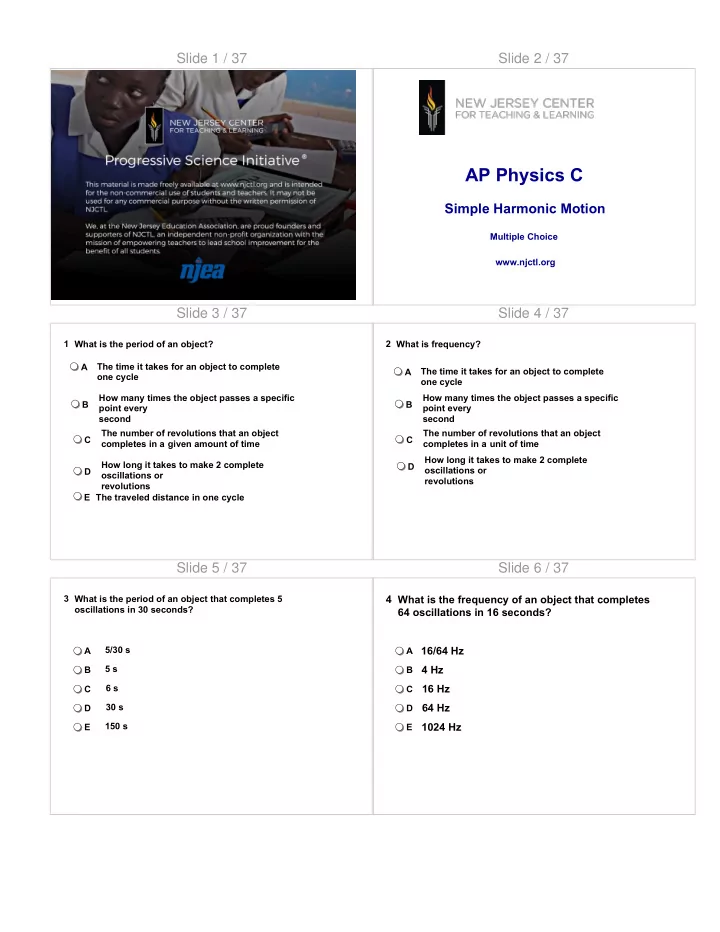
1 What is the period of an object? A The time it takes for an object to complete
B How many times the object passes a specific point every second C The number of revolutions that an object completes in a given amount of time D How long it takes to make 2 complete
revolutions E The traveled distance in one cycle
Slide 4 / 37
2 What is frequency? A The time it takes for an object to complete
B How many times the object passes a specific point every second C The number of revolutions that an object completes in a unit of time D How long it takes to make 2 complete
revolutions
Slide 5 / 37
3 What is the period of an object that completes 5
- scillations in 30 seconds?
A 5/30 s B 5 s C 6 s D 30 s E 150 s
Slide 6 / 37
4 What is the frequency of an object that completes 64 oscillations in 16 seconds?
A 16/64 Hz B
4 Hz
C
16 Hz
D
64 Hz
E
1024 Hz
SLIDE 2
Slide 7 / 37
5 If an object has a frequency of .25 Hz, what is its period?
A
1 s
B
2 s
C
4 s
D
.5 s
E
.25 s
Slide 8 / 37
6 If an object has a period of 8 s, what is its frequency?
A
.0625 Hz
B
.125 Hz
C
.25 Hz
D
.5 Hz
E
.75 Hz
Slide 9 / 37
7 What is the term for the maximum displacement in Simple Harmonic Motion?
A
The Amplitude
B
The Cycle
C
The Period
D
The Frequency
E
The Equilibrium Point
Slide 10 / 37
8 An ideal spring has a spring constant K. If the spring was cut in half, what would be the spring constant of one of the halves?
A
K/4
B
K/2
C
K
D
2K
E
4K
Slide 11 / 37
9 For Questions 9-10: A 2 kg block is hanging from an un- stretched spring with a spring constant of 50 N/m. What is the amplitude of the object's oscillations? A .04 m
B
.40 cm
C
40 cm
D
4 m
E
40 m
Slide 12 / 37
10 For Questions 9-10: A 2 kg block is hanging from an unstretched spring with a spring constant of 50 N/m. When will the object complete ¼ of a full cycle?
A B C D E
SLIDE 3 Slide 13 / 37
11 A spring on the earth is sent into Simple Harmonic Motion and has a period T. If that same spring is brought to another planet with 1/5 the surface gravity, what will be the new period?
A
T/25
B
T/5
C
T
D
2T/5
E
5T
Slide 14 / 37
12 For Questions 12-13 An object is undergoing Simple Harmonic Motion and its position is given by x = 2 cos (5t). What is the amplitude of the object's motion?
A
/4
B
/2
C D
2
E
4
Slide 15 / 37
13 For Questions 12-13 An object is undergoing Simple Harmonic Motion and its position is given by x = 2 cos (5t). At which of these points in time is the object at its amplitude? A 0 s
B C D E
/10 s /8 s /4 s /2 s
Slide 16 / 37
14 For Questions 14-16 Use the graph below. What is the equation for the position of the object?
A B C D E
Slide 17 / 37
15 For Questions 14-16 Use the graph below. What is the equation for the velocity of the object?
A B C D E
Slide 18 / 37
16 For Questions 14-16 Use the graph below. What is the equation for the acceleration of the
A B C D E
SLIDE 4
Slide 19 / 37
17 For Questions 17-19 A block with a mass of 4 kg is attached to a horizontal spring whose value of k is 64 N/m. The block is displaced 50cm from its initial position. What is the total amount of energy stored in the spring? A 16 J
B
8 J
C
32 J
D
2 J
E
4 J
Slide 20 / 37
18 For Questions 17-19 A block with a mass of 4 kg is attached to a horizontal spring whose value of k is 64 N/m. The block is displaced 50cm from its initial position. What is the maximum velocity the block reaches?
A B
2 m/s
C D
4 m/s
E
6 m/s
Slide 21 / 37
19 For Questions 17-19 A block with a mass of 4 kg is attached to a horizontal spring whose value of k is 64 N/m. The block is displaced 50cm from its initial position. What is the period of this objects oscillation?
A B C D E
Slide 22 / 37
20 For Questions 20-23 A ball is attached to a string of length L and is held at an angle #. The ball is then released. What is the objects potential energy in terms of m, g, and L?
A B C D E
Slide 23 / 37 Slide 24 / 37
22 For Questions 20-23 A ball is attached to a string of length L and is held at an angle #. The ball is then released. Which graph below shows the change in the Gravitational Potential energy? (The origin is the lowest point in the objects swing) A
B C D E
SLIDE 5 Slide 25 / 37
23 For Questions 20-23 A ball is attached to a string of length L and is held at an angle #. The ball is then released. What is the period of the pendulum?
A B C D E
Slide 26 / 37
24 What would happen to the period of a pendulum if the object were to be moved to another planet with less gravity?
A
Nothing
B
Period increases
C
Period Decreases
D
Not enough information is given
Slide 27 / 37
25 A spring of initial length Lo supports a mass of weight m which extends the spring a distance x. If the spring were cut in half and both parts were used to hold up the mass in parallel what would be the new x?
A
x/4
B
x/2
C
x
D
2x
E
4x m Lo m Lo/2
Slide 28 / 37
26 A pendulum of length L has a period T. What would have to be done to the length in order to make the new period T/3?
A
9L
B
3L
C
L/3
D
L/9
E
m/9
Slide 29 / 37
27 An object of mass 5 kg is pivoted about point P which is 25cm away from its center of gravity. The
- bject has a moment of inertia of 50 kg/m2 and is on
the surface of the Earth. What is the physical pendulum’s period?
A B C D E
Slide 30 / 37
SLIDE 6
Slide 31 / 37
29 In a horizontal mass spring system, the maximum displacement is x. When is the velocity the greatest?
A
x
B
–x
C D
x/2
E
–x/2
Slide 32 / 37
30 For a simple pendulum the total energy
A
decreases as the object falls
B
increases as the object rises
C
remains the same
D
is always zero
E
not enough information is given
Slide 33 / 37
31 In experiment with mass-spring oscillating system, measurements of the period are made for different masses. When plotted on a graph, which of the following should result straight-line fit of the measured data? A T Versus m B T Versus m2 C T2 Versus m D √T Versus m E √T Versus m2
Slide 34 / 37 Slide 35 / 37
33 Spring -mass oscillating system undergoes SHM with the amplitude A. At what location from the equilibrium point the kinetic energy of the system equals its potential energy? A x = A/2 B x = A/√2 C x = A/4 D x = A/3 E x = A/√3
Slide 36 / 37
34 A small mass is suspended at the end of a light string of length L that is attached to the ceiling. The pendulum is placed close to a wall with a nail coming out of it that limits the pendulum oscillations. When the mass is displaced from its equilibrium by a small angle, how long does it take to return to the starting point? A B C D E
SLIDE 7
Slide 37 / 37
35 A torsion pendulum has a disk with rotational inertia I that is suspended at the end of a light elastic rod. When the disk is twisted by a small angle θ, the rod exerts a restoring torque τ = -γθ, where γ is a constant. Which of the following differential equations could be used to describe the pendulum motion? A B C D E