SLIDE 1
Slide 7 / 32 Slide 8 / 32 5 A satellite is orbiting the Earth a - - PDF document
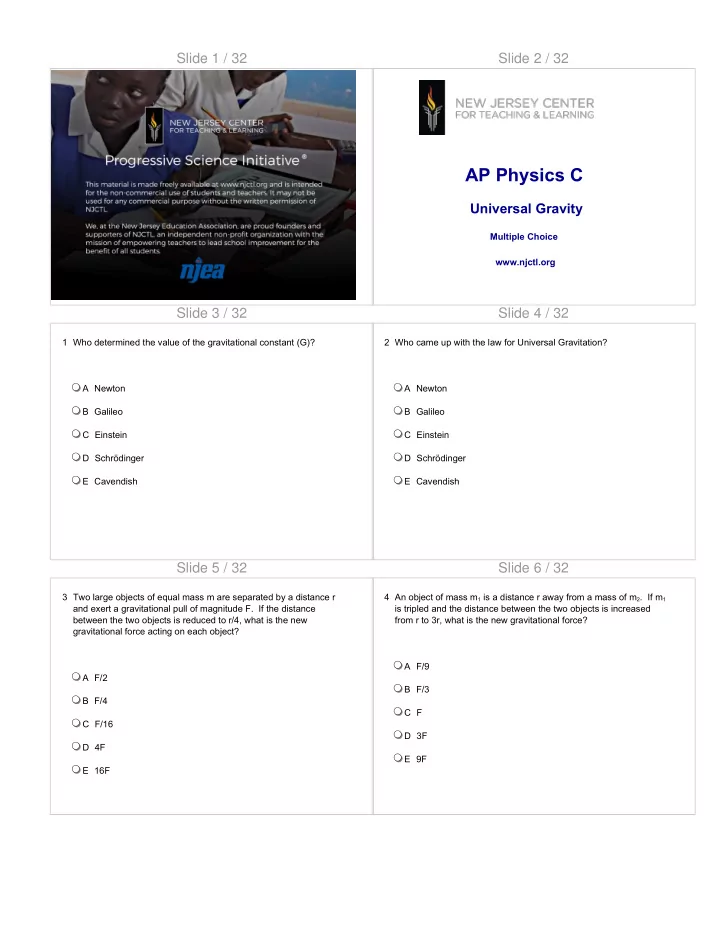
Slide 1 / 32 Slide 2 / 32 AP Physics C Universal Gravity Multiple Choice www.njctl.org Slide 3 / 32 Slide 4 / 32 1 Who determined the value of the gravitational constant (G)? 2 Who came up with the law for Universal Gravitation? A Newton A
SLIDE 2
SLIDE 3
Slide 13 / 32
11 A mass of 10 kg is placed on the surface of Mars. What is its weight? (The acceleration due to gravity on Mars is 3.7 m/s2) A 0.37 N B 3.7 N C 37 N D 10 N E 100 N
Slide 14 / 32
12 How much work is done by the force due to gravity when an object moves from the surface of the Earth to a height above its surface equal to its radius R? A w=GMm/R B w=(-GMm)/2R C w=2GMm/R D w=GM/R E w=(-GMm)/R
Slide 15 / 32
13 What is the gravitational potential energy of an object located 32,000m above the Earth’s Surface? A U=-GMm/(32km+R_E) B U=-GMm/(32,000 km+RE)〗 C U=-GMm/RE D U=-GMm/(RE-32 km) E U=-GM/RE
Slide 16 / 32
14 As an object moves away from the surface of the Earth, the graph
- f the gravitational potential energy is:
A B C D E
Slide 17 / 32
15 A rocket ship is sitting on the surface of a planet with a mass of 1x1027 kg and a radius of 6.67x10¹² m. What is the planet’s escape velocity? A √200 m/s B 100 m/s C 100√2 m/s D 50 m/s E 10 m/s
Slide 18 / 32
16 There are two Planets, each with the same surface gravity, but Planet 1 has a greater radius and is less massive then Planet 2. Which of these planets has a greater escape velocity? A Planet 1 B Planet 2 C Both have the same escape velocity because surface gravity is equal D Not enough information is given E
SLIDE 4
Slide 19 / 32
17 Satellite A remains in a stable circular orbit of 2 R
E above the
earth’s center. If satellite B were to maintain a stable circular orbit
- f 4RE above the Earth’s center, what velocity must it maintain with
respect to satellite 1? A VB = VA √2 B VB = 2V〗
A
C VB = VA D VB =VA⁄√2 E VB =VA⁄2
Slide 20 / 32
18 A meteor follows an elliptical orbit around the sun. When does the meteor swipe through the greatest area in time t? A When it is the closest to the sun B When it is the furthest away from the sun C It is impossible for the meteor to maintain an elliptical orbit therefore the question is not valid D The meteor sweeps through equal areas in the same amount of time anywhere in the orbit E None from the above
Slide 21 / 32
19 A satellite of mass m is traveling in an elliptical orbit about the
- Earth. At its furthest distance of its velocity is . What is its velocity
at point A, which is a distance from the Earth’s center? A B C D E
Slide 22 / 32
20 A satellite orbiting around Jupiter at a distance r from its center has a period of T1. What would the period of an identical satellite
- rbiting at a distance r/4 from Jupiter’s center?
A T2 = T1/2 B T2 = T1/4 C T2 = T1/8 D T2 = 4T1 E T2 = 8T1
Slide 23 / 32
21 A satellite orbiting a planet at a distance of 8x10⁶ m from its center has a period of 16 hours. What would be the period of a satellite
- rbiting at a distance of 2x10⁶ m above the planet’s center?
A 2 hr B 4 hr C 6 hr D 8 hr E 32 hr
Slide 24 / 32
22 A satellite is orbiting a planet at distance r above its surface and has a period of T. What would the distance above the surface have to be in order for the period to become eight times greater? A Rnew = R/7 B Rnew = R/4 C Rnew = R D Rnew = 4R E Rnew = 7 R
SLIDE 5
Slide 25 / 32
23 What is the total mechanical energy of a satellite of mass m
- rbiting the Earth at a distance equal to 2 times the Earth’s radius
above its surface? A B C D E
Slide 26 / 32
24 Why does an astronaut appear to be weightless in a satellite
- rbiting the Earth?
A The astronaut is unaffected by the Earth’s gravitational pull at this distance B The Moon is exerting a force equal to and in the opposite direction of the force that the Earth is exerting. Therefore there is no net force acting on the astronaut C The astronaut is not accelerating D The astronaut is in a constant state of free fall E When in space the astronaut has no mass
Slide 27 / 32 Slide 28 / 32
26 For all gravitational problems involving F=-GMm/r2, where do we consider the mass to be concentrated? A All of the mass is concentrated on the objects surface B All of the mass is concentrated at the objects center C The mass is distributed throughout the object D The mass is considered to be concentrated halfway between the center and the surface E Its varies depending on the density of the planet
Slide 29 / 32
27 If a hole could be cut straight through the earth and a person dropped a ball of mass m what path would the ball follow? A The ball will fall straight through the hole and come out the
- ther side
B The ball will oscillate C The ball will stop once it reaches the center D The ball will never make it to the center E The ball will rebound as if it hit a floor and bounce back up to the person
Slide 30 / 32
28 A satellite is orbiting Earth in an elliptical orbit with radii rA and rB. If radius rB is five time of radius rA, what is the ration vB/vA of the speed of the satellite at point B to the speed at point A? A 5/1 B 10/1 C 1/5 D 1/1 E 1/100
SLIDE 6