Slide 1 ___________________________________ Optimal Staging of the - - PDF document

slide 1
SMART_READER_LITE
LIVE PREVIEW

Slide 1 ___________________________________ Optimal Staging of the - - PDF document

Slide 1 ___________________________________ Optimal Staging of the ___________________________________ Mediastinum for Lung Cancer ___________________________________ Jack A. Roth, M.D. University of Texas MD Anderson Cancer


slide-1
SLIDE 1

Slide 1

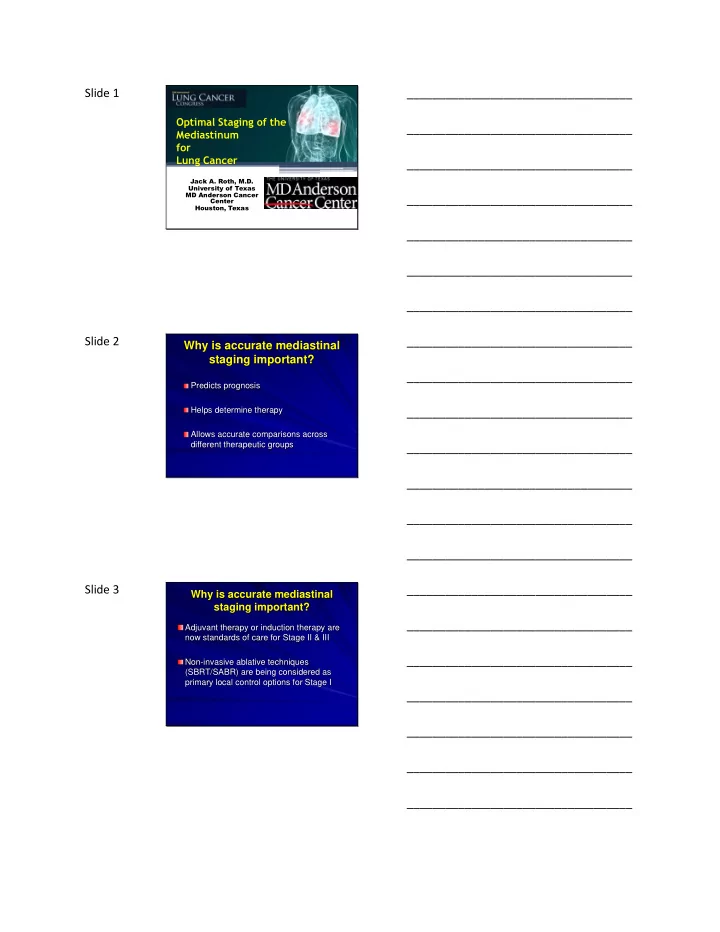
Optimal Staging of the Mediastinum for Lung Cancer

Jack A. Roth, M.D. University of Texas MD Anderson Cancer Center Houston, Texas
___________________________________ ___________________________________ ___________________________________ ___________________________________ ___________________________________ ___________________________________ ___________________________________ Slide 2

Why is accurate mediastinal staging important?

Predicts prognosis Helps determine therapy Allows accurate comparisons across different therapeutic groups

___________________________________ ___________________________________ ___________________________________ ___________________________________ ___________________________________ ___________________________________ ___________________________________ Slide 3

Why is accurate mediastinal staging important?

Adjuvant therapy or induction therapy are now standards of care for Stage II & III Non-invasive ablative techniques (SBRT/SABR) are being considered as primary local control options for Stage I

___________________________________ ___________________________________ ___________________________________ ___________________________________ ___________________________________ ___________________________________ ___________________________________

slide-2
SLIDE 2

Slide 4

Staging of NSCLC

  • Non-invasive:

– CT – PET (PET/CT)

  • Invasive:

– Mediastinoscopy – Chamberlain – Transbronchial needle biopsy / EBUS – Transthoracic needle biopsy – EUS/FNA – VATS

___________________________________ ___________________________________ ___________________________________ ___________________________________ ___________________________________ ___________________________________ ___________________________________ Slide 5 ___________________________________ ___________________________________ ___________________________________ ___________________________________ ___________________________________ ___________________________________ ___________________________________ Slide 6 Mediastinoscopy

Surgical Staging

___________________________________ ___________________________________ ___________________________________ ___________________________________ ___________________________________ ___________________________________ ___________________________________

slide-3
SLIDE 3

Slide 7

Morbidity of Mediastinoscopy

RLN paresis 12 (0.55%) Hemorrhage 7 (0.32%) Tracheal injury 2 (0.09%) Pneumothorax 2 (0.09%) Death 1 (0.05%)

Lemaire, Ann Thorac Surg 2006;82:1185

___________________________________ ___________________________________ ___________________________________ ___________________________________ ___________________________________ ___________________________________ ___________________________________ Slide 8

Mediastinoscopy

Little et al, 2005 >11,000 surgically treated patients with NSCLC Mediastinoscopy 27% Nodal tissue

  • btained in 47% !!

___________________________________ ___________________________________ ___________________________________ ___________________________________ ___________________________________ ___________________________________ ___________________________________ Slide 9

Endobronchial ultrasound guided transbronchial needle aspiration for staging of lung cancer Kazuhiro Yasufuku, Masako Chiyo, Eitetsu Koh, Yasumitsu Moriya, Akira Iyoda, Yasuo Sekine, Kiyoshi Shibuya, Toshihiko Iizasa, Takehiko Fujisawa, Chiba University Lung Cancer (2005) 50, 347—354

___________________________________ ___________________________________ ___________________________________ ___________________________________ ___________________________________ ___________________________________ ___________________________________

slide-4
SLIDE 4

Slide 10

  • Cervical mediastinoscopy

Paratracheal and subcarinal nodes

  • VATS and Chamberlain

hilar and A-P window nodes

  • EUS

periaortic, subcarinal, and periesophageal nodes.

  • EBUS

Paratracheal, hilar, and subcarinal nodes

___________________________________ ___________________________________ ___________________________________ ___________________________________ ___________________________________ ___________________________________ ___________________________________ Slide 11

EBUS Accessible

___________________________________ ___________________________________ ___________________________________ ___________________________________ ___________________________________ ___________________________________ ___________________________________ Slide 12

EBUS Inaccessible

___________________________________ ___________________________________ ___________________________________ ___________________________________ ___________________________________ ___________________________________ ___________________________________

slide-5
SLIDE 5

Slide 13

Lymphatic Collectors

3 on each side Right side:

R paratracheal (large) R tracheoesophageal R phrenic

Left side:

Paraaortic (large) L phrenic (large) L paratracheal

___________________________________ ___________________________________ ___________________________________ ___________________________________ ___________________________________ ___________________________________ ___________________________________ Slide 14

Patterns of Nodal Metastases

  • Right upper lobe – highest rate of skip

metastases (N2 in the absence of N1)

  • Right upper lobe –metastasizes to 2R,4R
  • Right middle and lower lobe – subcarinal,

then 2R, 4R

  • Left upper lobe – AP window and

periaortic (5, 6), then subcarinal and paratracheal (2L, 4L)

  • Left lower lobe – metastasize to 2R, 4R

___________________________________ ___________________________________ ___________________________________ ___________________________________ ___________________________________ ___________________________________ ___________________________________ Slide 15

Lymph Node Dissection

1986- 1992 1993- 2001 P- value

Total nodes retrieved

15.7 16.2 0.56

N2 stations sampled

3.1 3.0 0.68

Involved N2 levels:

1.5 1.4 0.14

1 station

66% 70% 0.31

2 station

22% 22%

>2 station

12% 7%

___________________________________ ___________________________________ ___________________________________ ___________________________________ ___________________________________ ___________________________________ ___________________________________

slide-6
SLIDE 6

Slide 16

Lymph Node Dissection

1986- 1992 1993- 2001 P- value

Total nodes retrieved

15.7 16.2 0.56

N2 stations sampled

3.1 3.0 0.68

Involved N2 levels:

1.5 1.4 0.14

1 station

66% 70% 0.31

2 station

22% 22%

>2 station

12% 7%

___________________________________ ___________________________________ ___________________________________ ___________________________________ ___________________________________ ___________________________________ ___________________________________ Slide 17

Lymph Node Dissection

1986- 1992 1993- 2001 P- value

Total nodes retrieved

15.7 16.2 0.56

N2 stations sampled

3.1 3.0 0.68

Involved N2 levels:

1.5 1.4 0.14

1 station

66% 70% 0.31

2 station

22% 22%

>2 station

12% 7%

___________________________________ ___________________________________ ___________________________________ ___________________________________ ___________________________________ ___________________________________ ___________________________________ Slide 18

Survival by Lymph Node Stations Involved

Cumulative Survival Probability

10 20 30 40 50 60 0.0 0.2 0.4 0.6 0.8 1.0

1 Station 2 Stations >2 Stations

P<0.001

Time (months)

Median Survival 25.3 16.8 15.5

___________________________________ ___________________________________ ___________________________________ ___________________________________ ___________________________________ ___________________________________ ___________________________________

slide-7
SLIDE 7

Slide 19

Nodal Metastases Indicating Unresectablity

N3 - Contralateral paratracheal nodal metastases N2 - Ipsilateral paratracheal nodal metastases for left lung cancers

___________________________________ ___________________________________ ___________________________________ ___________________________________ ___________________________________ ___________________________________ ___________________________________ Slide 20

ASCO Discussion: Dr. Frank Detterbeck

Disease Absent Disease Present Formula Parameters Based on Test Results Test Negative NTN (True Negative) NFN (False Negative) NFN NTN + NFN False Negative Rate Test Positive NFP (False Positive) NTP (True Positive) NFP NFP + NTP False Positive Rate Formula NTN NTN + NFP NTP NFN + NTP Specificity Sensitivity Parameters Based On Disease Status

___________________________________ ___________________________________ ___________________________________ ___________________________________ ___________________________________ ___________________________________ ___________________________________ Slide 21

Parameters to Assess the Value of a Test

You can NOT use Sensitivity or Specificity to interpret a test result in an individual patient For example: reliability of PET to identify distant metastases (Saunders ATS 1999;67:790-7; 97

pts with lung cancer that had PET, no data on clinical eval, 29% prevalence of mets, gold standard: Bx or recurrence/lack thereof in 12 mo.)

Sensitivity 97% Specificity 53% False Neg. 16% False Pos. 12%

ASCO Discussion: Dr. Frank Detterbeck

___________________________________ ___________________________________ ___________________________________ ___________________________________ ___________________________________ ___________________________________ ___________________________________

slide-8
SLIDE 8

Slide 22

Mediastinoscopy

– Toloza 2003 – meta-analysis of 5,687 pts – Lemaire 2006 – single institution, 1,019 consecutive pts 300 pts N2/N3 56 false negatives (5.5%) 32 were at inaccessible stations (5,6,8,9)

Sensitivity Specificity PPV NPV Toloza 2003 81 100 100 93 Lemaire 2006 86 100 100 94.5 Toloza, CHEST 2003;123:157S Lemaire, Ann Thorac Surg 2006;82:1185

___________________________________ ___________________________________ ___________________________________ ___________________________________ ___________________________________ ___________________________________ ___________________________________ Slide 23

CT Scan Staging

CT scan meta-analysis

– Toloza, 2003 – Meta-analysis of 4,793 patients

Sensitivity Specificity PPV NPV CT 60% 51% 53% 82%

Toloza, CHEST 2003;123:137S

___________________________________ ___________________________________ ___________________________________ ___________________________________ ___________________________________ ___________________________________ ___________________________________ Slide 24

Lymph node status comparing PET with final stage By PET Final stage(No.patients) N0/N1 N2/N3 Total N0/N1 191 29 220 N2/N3 36 46 82 Total 227 75 302 Sensitivity 61%; specificity 84%; PPV 56%; NPV 87%.

ACOSOG Z0050 Reed et al., J Thorac Cardiovasc Surg 2003;126:1943-51

___________________________________ ___________________________________ ___________________________________ ___________________________________ ___________________________________ ___________________________________ ___________________________________

slide-9
SLIDE 9

Slide 25

Pozo-Rodriguez et al. J Clin Oncol 23:8348-8356, 2005

PET and CT (non-integrated) Compared to Mediastinoscopy/Thoracotomy

Negative predictive value 0.98 Positive predictive value 0.51

___________________________________ ___________________________________ ___________________________________ ___________________________________ ___________________________________ ___________________________________ ___________________________________ Slide 26

Integrated PET/CT Compared to Surgical Staging

Assessment of Lymph Node Involvement Variables PET PET/CT Sensitivity 50 (5/10; 19 to 81) 60 (6/10; 26 to 88) Specificity 77 (20/26; 56 to 91) 85% (22/26; 65 to 96) PPV 45 (5/11; 17 to 77) 60 (6/10; 26 to 88) NPV 80 (20/25; 59 to 93) 85 (22/26; 65 to 96) Accuracy 69 (25/36; 52 to 84) 78 (28/36; 61 to 90)

Halpern, 2005;128;2289-2297 Chest

___________________________________ ___________________________________ ___________________________________ ___________________________________ ___________________________________ ___________________________________ ___________________________________ Slide 27

PET Staging

PET scan meta-analyses

– Birim, 2005 - 833 pts from 17 studies – Toloza, 2003 – 1,111 pts from 19 studies

Sensitivity Specificity PPV NPV Toloza 2003 85% 88% 78% 93% Birim 2005 83% 92%

  • Toloza, CHEST 2003;123:137S

Birim, Ann Thorac Surg 2005;79:375

___________________________________ ___________________________________ ___________________________________ ___________________________________ ___________________________________ ___________________________________ ___________________________________

slide-10
SLIDE 10

Slide 28 ___________________________________ ___________________________________ ___________________________________ ___________________________________ ___________________________________ ___________________________________ ___________________________________ Slide 29 ___________________________________ ___________________________________ ___________________________________ ___________________________________ ___________________________________ ___________________________________ ___________________________________ Slide 30 ___________________________________ ___________________________________ ___________________________________ ___________________________________ ___________________________________ ___________________________________ ___________________________________

slide-11
SLIDE 11

Slide 31

Consensus Statements

European Society of Thoracic Surgeons:

‘PET positive mediastinal findings should be histologically or cytologically confirmed.’

2007

American College of Chest Physicians:

‘In patients with abnormal FDG-PET scan findings, further evaluation of the mediastinum with sampling of the abnormal lymph node should be performed prior to surgical resection of the primary tumor.’

2003

___________________________________ ___________________________________ ___________________________________ ___________________________________ ___________________________________ ___________________________________ ___________________________________ Slide 32

PET Negative and cStage I

Incidence of mediastinal metastases

Author n N2 med N2 surg Total Cerfolio 136 9 (7%) 6 (4%) 11% Meyers 178 5 (3%) 8 (5%) 7% Lee 76 11(14%) 5 (6%) 21%

___________________________________ ___________________________________ ___________________________________ ___________________________________ ___________________________________ ___________________________________ ___________________________________ Slide 33

N2 metastases % Tumor size (cm)

Lee, Ann Thorac Surg 2007;84:177

PET Negative and cStage I

___________________________________ ___________________________________ ___________________________________ ___________________________________ ___________________________________ ___________________________________ ___________________________________

slide-12
SLIDE 12

Slide 34

Routine PET and selective mediastinoscopy: 2004

  • M. Serra et al, ASCO Proceedings 2006, 24: 371s

PET

Positive hilar or mediastinal uptake

Negative

*Tumour contacting mediastinum Mediastinal nodes ≥1 cm in CT Without these criteria

Thoracotomy Mediastinoscopy

*Verhagen Lung Cancer 2004

___________________________________ ___________________________________ ___________________________________ ___________________________________ ___________________________________ ___________________________________ ___________________________________ Slide 35

Compariso rison n of RM versus us PET and SM

Thoracotomy with pN2 disease

  • M. Serra et al, ASCO Proceedings 2006, 24: 371s

 Routine mediastinoscopy

  • 40/655: 6.1%

 Routine PET and selective mediastinoscopy

  • 7/90: 7.8%

___________________________________ ___________________________________ ___________________________________ ___________________________________ ___________________________________ ___________________________________ ___________________________________ Slide 36

Comparison of RM versus routine PET and RM

CT* PET* RM PET +SM PET

Sensitivity 0.43-0.81 0.67-1 0.85 0.75 0.71 Specificity 0.56-0.94 0.81-1 1 1 0.88 Accuracy 0.59-0.85 0.8-1 0.94 0.92 0.82 PPV 1 1 0.74 NPV 0.9 0.89 0.87

*Fritscher-Ravens Chest 2003

  • M. Serra et al, ASCO Proceedings 2006, 24: 371s

___________________________________ ___________________________________ ___________________________________ ___________________________________ ___________________________________ ___________________________________ ___________________________________

slide-13
SLIDE 13

Slide 37

Routine PET and SM: Results

33/90: Negative PET and non pN2 after

direct thoracotomy

Mediastinoscopy avoided: 36.6%

  • M. Serra et al, ASCO Proceedings 2006, 24: 371s

___________________________________ ___________________________________ ___________________________________ ___________________________________ ___________________________________ ___________________________________ ___________________________________ Slide 38

ASCO Discussion: Dr. Frank Detterbeck

Discrete Lymph Node Enlargement

___________________________________ ___________________________________ ___________________________________ ___________________________________ ___________________________________ ___________________________________ ___________________________________ Slide 39

ASCO Discussion: Dr. Frank Detterbeck

Discrete Nodal Enlargement (cN2,3)

Reliability of CT: FP rate 40% (~ 5000 pts, 10 studies) Reliability of PET:

FN rate estimated ~25% (Dietlein 00, Gould 03) FN rate 28% together with cN1 (Serra 06)

Invasive biopsy is necessary EUS-NA Sens 85%, FN 20% (if neg then Med) Mediastinoscopy Sens 90%, FN 10%

___________________________________ ___________________________________ ___________________________________ ___________________________________ ___________________________________ ___________________________________ ___________________________________

slide-14
SLIDE 14

Slide 40

ASCO Discussion: Dr. Frank Detterbeck

Central Stage I or II NSCLC

___________________________________ ___________________________________ ___________________________________ ___________________________________ ___________________________________ ___________________________________ ___________________________________ Slide 41

ASCO Discussion: Dr. Frank Detterbeck

Central or cN1 (negative Mediastinum)

Reliability of CT: FN rate ~25% (790 pts, 9 studies) Reliability of PET:

FN rate 24% (Poco-Rodriguez 05, 21 pts) FN rate 83% (Verhagen 04, 12 pts) FN rate 28% together with cN2 (Serra 06)

Invasive biopsy is necessary FN rate for Med ~ 10%; FN rate for EUS-NA ~30%

___________________________________ ___________________________________ ___________________________________ ___________________________________ ___________________________________ ___________________________________ ___________________________________ Slide 42

Cerfolio, J Thorac Cardiovasc Surg 2006;131:1229-35

___________________________________ ___________________________________ ___________________________________ ___________________________________ ___________________________________ ___________________________________ ___________________________________

slide-15
SLIDE 15

Slide 43

A prospective controlled trial of EBUS compared to mediastinoscopy for mediastinal lymph node staging of lung cancer

EBUS-TBNA followed by mediastinoscopy TBNA for all nodes >5mm short axis with dedicated needle for each node station Rapid on-site cytology Surgeon blinded to EBUS-TBNA result The clinical staging prior to EBUS-TBNA and MS were 47 stage IA, 26 stage IB, 3 stage IIA, 10 stage IIB, 59 stage IIIA, 5 stage IIIB and 3 stage IV disease EBUS-TBNA and MS sampled an average of 3.0 and 3.8 lymph node stations/patient No complications from EBUS-TBNA. Complications from MS were seen in 4 patients (2.6%) including 1 RN injury

Yasufuku et al., AATS, 2011

___________________________________ ___________________________________ ___________________________________ ___________________________________ ___________________________________ ___________________________________ ___________________________________ Slide 44

A prospective controlled trial of EBUS compared to mediastinoscopy for mediastinal lymph node staging of lung cancer

Yasufuku et al., AATS, 2011

EUS-TBNA (%) Mediastinoscopy (%) Sensitivity 84.3 86.3 Specificity 100 100 NPV 92.7 93.6 Accuracy 94.8 95.4

___________________________________ ___________________________________ ___________________________________ ___________________________________ ___________________________________ ___________________________________ ___________________________________ Slide 45 ___________________________________ ___________________________________ ___________________________________ ___________________________________ ___________________________________ ___________________________________ ___________________________________

slide-16
SLIDE 16

Slide 46

Conclusions

  • The negative predictive value of PET/CT is

high and additional mediastinal staging is unnecessary for cT1N0

  • Equivocal negative PET/CT findings need to

be investigated with invasive staging

  • Positive PET/CT findings need to be

confirmed with invasive staging

  • EBUS-TBNA and mediastinoscopy have

equivalent accuracy

___________________________________ ___________________________________ ___________________________________ ___________________________________ ___________________________________ ___________________________________ ___________________________________