Slide 1 ___________________________________ - - PDF document

slide 1
SMART_READER_LITE
LIVE PREVIEW

Slide 1 ___________________________________ - - PDF document

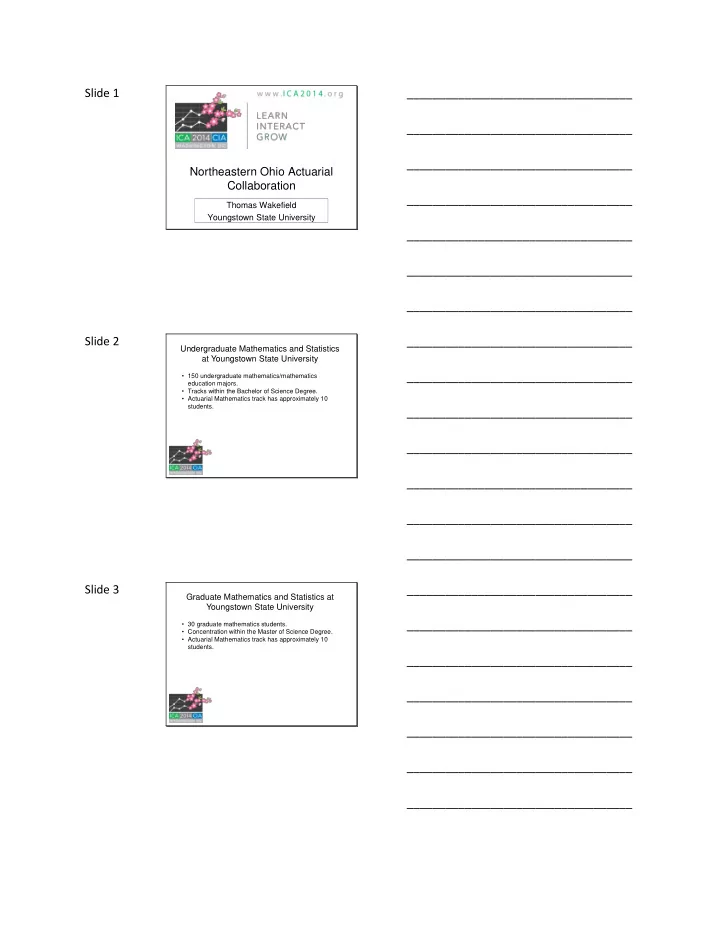
Slide 1 ___________________________________ ___________________________________ ___________________________________ Northeastern Ohio Actuarial Collaboration ___________________________________ Thomas Wakefield Youngstown State University


slide-1
SLIDE 1

Slide 1

Northeastern Ohio Actuarial Collaboration

Thomas Wakefield Youngstown State University

___________________________________ ___________________________________ ___________________________________ ___________________________________ ___________________________________ ___________________________________ ___________________________________ Slide 2

Undergraduate Mathematics and Statistics at Youngstown State University

  • 150 undergraduate mathematics/mathematics

education majors.

  • Tracks within the Bachelor of Science Degree.
  • Actuarial Mathematics track has approximately 10

students.

___________________________________ ___________________________________ ___________________________________ ___________________________________ ___________________________________ ___________________________________ ___________________________________ Slide 3

Graduate Mathematics and Statistics at Youngstown State University

  • 30 graduate mathematics students.
  • Concentration within the Master of Science Degree.
  • Actuarial Mathematics track has approximately 10

students.

___________________________________ ___________________________________ ___________________________________ ___________________________________ ___________________________________ ___________________________________ ___________________________________

slide-2
SLIDE 2

Slide 4

Degree Structure

Structure of current master's degree: The core requirements are Theory of Interest and Life Contingency Modeling I, the Mathematical Statistics sequence, and Linear Models. Additionally, two courses from:

  • Math Found of Actuarial Science
  • Data Mining
  • Statistical Computing
  • Life Contingency Modeling II
  • Loss Models
  • Stochastic Processes
  • Modeling in Financial Economics.

The Finance and Economics sequences are recommended.

___________________________________ ___________________________________ ___________________________________ ___________________________________ ___________________________________ ___________________________________ ___________________________________ Slide 5

Stat 5800: Mathematical Foundations of Actuarial Science

Course Description: A survey of probability theory and an introduction to risk management. Emphasis of the course will be

  • n problem solving with applications in actuarial science.

Prerequisite: Theory of Probability or consent of instructor. 3 semester hours.

___________________________________ ___________________________________ ___________________________________ ___________________________________ ___________________________________ ___________________________________ ___________________________________ Slide 6

Stat 5802: Theory of Interest

Course Description: Mathematical theory and techniques in analysis of interest. Topics include measurement of interest, force of interest, annuities, amortization, pricing of investment products, and applications to actuarial sciences. Prerequisite: Calculus II and an upper-level mathematics, finance, or economics course. 3 semester hours.

___________________________________ ___________________________________ ___________________________________ ___________________________________ ___________________________________ ___________________________________ ___________________________________

slide-3
SLIDE 3

Slide 7

Stat 6904: Life Contingency Modeling I

Course Description: An introduction to various statistical, financial, and mathematical models used to determine insurance

  • premiums. These models identify contingent risks and are based

upon individual risk model frameworks. Prerequisite: Theory of Probability. 3 semester hours.

___________________________________ ___________________________________ ___________________________________ ___________________________________ ___________________________________ ___________________________________ ___________________________________ Slide 8

Stat 6905: Life Contingency Modeling II

Course Description: An introduction to multiple life functions, multiple decrement models, valuation theory for pension plans, insurance models including expenses, nonforfeiture benefits and dividends, and other means to determine benefit premiums. Prerequisite: Life Contingency Modeling I. 3 semester hours.

___________________________________ ___________________________________ ___________________________________ ___________________________________ ___________________________________ ___________________________________ ___________________________________ Slide 9

Stat 6910: Loss Models

Course Description: An introduction to the development of loss and severity models used in actuarial science and the statistical methods used to estimate the parameters of such models. Additional topics, including credibility and simulation, may be covered. Prerequisite: Theory of Statistics. 3 semester hours.

___________________________________ ___________________________________ ___________________________________ ___________________________________ ___________________________________ ___________________________________ ___________________________________

slide-4
SLIDE 4

Slide 10

Stat 6988: Modeling in Financial Economics

Course Description: A study of modeling and evaluation of derivatives and bonds and risk management using derivatives. Topics cover various models in asset evaluation, such as bond price models, the Black-Scholes model, diffusion processes, and risk management. Prerequisite: Theory of Probability. 3 semester hours.

___________________________________ ___________________________________ ___________________________________ ___________________________________ ___________________________________ ___________________________________ ___________________________________ Slide 11

Collaboration Background

  • Youngstown State, University of Akron, Kent State, Cleveland

State, and Case Western Reserve all offer similar actuarial science programs.

  • Because our enrollment in these programs is often not

enough to support the programs at each individual institution, we have sought ways to collaborate.

  • Also seek to involve other institutions with undergraduate

focus, including private colleges and universities in the area, such as Slippery Rock University and Westminster College.

___________________________________ ___________________________________ ___________________________________ ___________________________________ ___________________________________ ___________________________________ ___________________________________ Slide 12

Area Survey

  • Surveys sent to Department Chairs of area colleges and

universities to gauge interest in an actuarial science graduate

  • program. Fifteen schools responded.

___________________________________ ___________________________________ ___________________________________ ___________________________________ ___________________________________ ___________________________________ ___________________________________

slide-5
SLIDE 5

Slide 13

Do you currently offer undergraduate courses for students interested in actuarial science? Yes: 10 No: 4 Somewhat: 1

___________________________________ ___________________________________ ___________________________________ ___________________________________ ___________________________________ ___________________________________ ___________________________________ Slide 14

Do you currently offer undergraduate courses for students interested in actuarial science? We have courses covering all of the learning objectives for the 5 preliminary exams of SOA. Also electives in health insurance, pensions and general insurance. Courses offered annually. We have a certificate in “Actuarial Mathematics and Statistics”. Entry level stat/business/finance classes are offered every

  • semester. Prep for the P/1 exam is offered every other year

(although the demand is increasing, so this may change). Prep for the FM/2 exam is offered once a year. Demand is difficult to assess, as students from multiple majors take each class.

___________________________________ ___________________________________ ___________________________________ ___________________________________ ___________________________________ ___________________________________ ___________________________________ Slide 15

Do you currently offer undergraduate courses for students interested in actuarial science? We offer a year long probability and statistics course (a total of 8 credit hours) that is sufficient to prepare students for the preliminary actuarial examination. The enrollment is about 20- 25. We teach a 300-level probability course that has a Calc II

  • prerequisite. It usually has around 10 students offered every
  • ther year.

Introduction to Actuarial Science - About 10 students, every

  • ther year

___________________________________ ___________________________________ ___________________________________ ___________________________________ ___________________________________ ___________________________________ ___________________________________

slide-6
SLIDE 6

Slide 16

Do you currently offer undergraduate courses for students interested in actuarial science? Exam P -Mathematical Statistics I \& II (every other year) (about 20-25 students) Exam FM - Theory of Interest (every other Fall) (10 -12 students) Probability and Mathematical Statistics - 2 courses, every other year We have an undergraduate major in mathematics/actuarial science, covering required courses in all of the VEE and exams P/1, FM/2, MLC/3L. Enrollment varies. The number of majors is typically between 45-50.

___________________________________ ___________________________________ ___________________________________ ___________________________________ ___________________________________ ___________________________________ ___________________________________ Slide 17

How many mathematics majors at your institution express interest in actuarial science? Less than 5: 8 5-15: 2 16-30: 2 Over 50: 2 Don't Know: 1

___________________________________ ___________________________________ ___________________________________ ___________________________________ ___________________________________ ___________________________________ ___________________________________ Slide 18

Have you had any students participate in summer internships for actuarial science firms? Yes: 10 No: 5 If so, how many students? 1-2 per year: 4 5-8 per year: 2 10-20 per year: 1 Dozen: 1

___________________________________ ___________________________________ ___________________________________ ___________________________________ ___________________________________ ___________________________________ ___________________________________

slide-7
SLIDE 7

Slide 19

Do you have students attempting or passing actuarial examinations annually? If so, approximately how many in each category? No: 3 Attempted: About 3 or 4 a year. Passed: Everyone has passed. About 1 out of 8 requires two tries. We get about 3-5 passing the P/1 exam each year. We have just started the FM/2 prep, so I don't have any numbers. 1 or 2 attempting per year (program is very new)

___________________________________ ___________________________________ ___________________________________ ___________________________________ ___________________________________ ___________________________________ ___________________________________ Slide 20

Do you have students attempting or passing actuarial examinations annually? If so, approximately how many in each category? In the future, I expect about 5-10 students will attempt to pass the Probability exam in the summer of even years and 5-10 students will attempt to pass the Financial Math Exam in the summer of odd years. Passing 3 exams - about 1 per year Passing 2 exams - about 5 per year Passing 1 Exam - about 12 per year

  • Yes. Roughly five students per year sit for Exam P.

___________________________________ ___________________________________ ___________________________________ ___________________________________ ___________________________________ ___________________________________ ___________________________________ Slide 21

Does your school provide courses that fulfill the Validation by Educational Experience (VEE) criteria of the Society of Actuaries? No: 2 Yes: 7 Some: 4 Have you seen a growth in the number of students interested in actuarial science at your institution? Yes: 11 No: 3

___________________________________ ___________________________________ ___________________________________ ___________________________________ ___________________________________ ___________________________________ ___________________________________

slide-8
SLIDE 8

Slide 22

What skills would you like to see emphasized in a graduate program in actuarial science?

  • Regression, ANOVA, statistics in general. Solid math skills.

Good Access (database) skills. SAS and R training.

  • Work towards passing exams MFE, MLC and C.
  • I would only recommend a graduate program in actuarial

science to a student who did not pursue actuarial science as an undergrad.

  • Coursework related to exams after P and FM

___________________________________ ___________________________________ ___________________________________ ___________________________________ ___________________________________ ___________________________________ ___________________________________ Slide 23

What skills would you like to see emphasized in a graduate program in actuarial science?

  • A steady progression towards Associate in Society of

Actuaries.

  • Learning about self-motivation for studying.
  • Awareness that an actuary will be an executive in the

insurance business and some knowledge about what is expected in the business setting.

  • Maybe a general course about the sequence of

courses/topics that are important for actuaries and are expected to know in order to develop insurance policies. For instance, there are all the math things and mathematics of insurance topics, but there are also economics, law, ethics-- and as they progress through their training, they will need to become very conversant in these topics.

___________________________________ ___________________________________ ___________________________________ ___________________________________ ___________________________________ ___________________________________ ___________________________________ Slide 24

Does your school offer a business and/or technical communication course required of majors? Yes: 11 No: 4

___________________________________ ___________________________________ ___________________________________ ___________________________________ ___________________________________ ___________________________________ ___________________________________

slide-9
SLIDE 9

Slide 25

Other Comments and Suggestions If a student's undergraduate program offers any type of actuarial program, students who graduate with exams passed will likely find jobs. In my opinion, a Master's level program will attract students whose undergrad didn't not have any actuarial classes and those that have not yet passed exams. A quality, motivated student doesn't need a Master's degree to find a great job in this

  • field. I think it is a great idea, just trying to help identify your

audience.

___________________________________ ___________________________________ ___________________________________ ___________________________________ ___________________________________ ___________________________________ ___________________________________ Slide 26

Other Comments and Suggestions Our students have been very successful in our undergraduate

  • program. The only purpose for pursuing a graduate program in

actuarial science (from my point of view) would be for a person to try to get into the field if they had already received their Bachelors but didn't pursue the courses or exams while they were an undergrad. A student who pursued actuarial science as an undergrad and did not do well enough (either through grades, exam performance, or other reason) would be unlikely to benefit from a graduate program (unless they wanted to improve on their lackluster undergrad performance and those are not really the students I would want to build a graduate program around). Was just wondering what YOU would want in an undergraduate (math student?) who may be considering becoming part of your graduate actuary program?

___________________________________ ___________________________________ ___________________________________ ___________________________________ ___________________________________ ___________________________________ ___________________________________ Slide 27

Objectives

Objective 1: Distance Courses

  • We would capitalize on each institution's strengths and offer

distance courses through videoconferencing and/or travel to a central facility. These courses could include the VEE courses in statistics and the actuarial models course.

  • Distance education versions of actuarial models and theory of

interest have been developed.

  • Currently working out the “finer” details of such an

arrangement.

___________________________________ ___________________________________ ___________________________________ ___________________________________ ___________________________________ ___________________________________ ___________________________________

slide-10
SLIDE 10

Slide 28

Objectives

Objective 1: Collaboration in Courses

  • Both Kent State and Youngstown State taught Theory of

Interest in Spring 2013.

  • Goal was to create uniformity in the course so that it could be
  • ffered at one institution in the future.

___________________________________ ___________________________________ ___________________________________ ___________________________________ ___________________________________ ___________________________________ ___________________________________ Slide 29

Common Courses and Subjects

  • Both YSU and Kent offer Theory of Interest and two life

contingency courses. They both also offer courses that teach the basics of derivatives markets.

  • Kent State does not have a statistics program so YSU,

Cleveland State, and Akron are better poised to offer more statistics and data mining courses.

  • All universities offer a theory of interest course.

___________________________________ ___________________________________ ___________________________________ ___________________________________ ___________________________________ ___________________________________ ___________________________________ Slide 30

Objectives

Objective 2: Joint Degree Programs

  • The template for such degree programs has already been

established.

  • Considering a joint master's degree in actuarial science to be
  • ffered by the consortium.
  • In the design phase of the proposal, would welcome feedback

from actuaries regarding relevant courses and programming.

___________________________________ ___________________________________ ___________________________________ ___________________________________ ___________________________________ ___________________________________ ___________________________________

slide-11
SLIDE 11

Slide 31

Proposal for Master's Degree in Actuarial Science Core:

  • Mathematical Foundations of Actuarial Science, Theory
  • f Interest, Life Contingency Modeling I, Financial

Economics, Theory of Statistics, Business and Technical Communication, Loss Models and at least one of the following:

  • Research in Actuarial Science, Internship/Co-Op in

Actuarial Science, or Statistical Consulting

___________________________________ ___________________________________ ___________________________________ ___________________________________ ___________________________________ ___________________________________ ___________________________________ Slide 32

Proposal for Master's Degree in Actuarial Science (cont’d) Two courses chosen from:

  • Life Contingency Modeling II, Corporate Finance,

Microeconomics, Macroeconomics, Statistical Data Mining, Statistical Computing, Nonparametric Statistics, Simulation, Linear Methods, Multivariate Statistical Analysis, Stochastic Processes More hours from this list will be required if courses are waived due to undergraduate or actuarial exam credit. Two qualifying examinations (offered each August); may be waived by passing two SOA exams.

___________________________________ ___________________________________ ___________________________________ ___________________________________ ___________________________________ ___________________________________ ___________________________________ Slide 33

Objectives

Objective 3: Outreach

  • Also want to expand outreach to high school students and

undergraduates in the region through contests, speakers, and

  • ther events to raise awareness.
  • Piloted Project Math Minds at Youngstown State MathFest for

four years. Last year, one student won $3000 scholarship for her entry in the contest.

___________________________________ ___________________________________ ___________________________________ ___________________________________ ___________________________________ ___________________________________ ___________________________________

slide-12
SLIDE 12

Slide 34

Analysis of Collaboration

Pros of Collaboration

  • Facing limited budgets and hesitancy to grow new programs,

collaboration offers an opportunity to serve students while conserving resources.

  • A variety of courses could be offered that would not run

individually at each institution.

  • Opportunities for outreach in larger areas.
  • The ability to try something new and be on the “cutting edge”
  • f this growing field.

___________________________________ ___________________________________ ___________________________________ ___________________________________ ___________________________________ ___________________________________ ___________________________________ Slide 35

Analysis of Collaboration

Cons of Collaboration

  • Bureaucracy!!
  • Loss of control over individual programs.

___________________________________ ___________________________________ ___________________________________ ___________________________________ ___________________________________ ___________________________________ ___________________________________ Slide 36

Quality Control

  • The respective department chairs will jointly coordinate and

determine the scheduling of classes, hiring of faculty, and assignment of teaching responsibilities.

  • An Academic Council comprised of the university graduate deans or

their appointed representatives will approve all major policy and program matters.

  • Operating expenses at each of the campuses will be the

responsibility of that campus. Already existing private funding for programming at each of the institutions will remain with those institutions.

  • An advisory board of Fellows and Associates of the SOA and CAS

will be consulted for programmatic development and changes.

  • Assessment practices at each university will be used to gauge the

effectiveness of each program.

___________________________________ ___________________________________ ___________________________________ ___________________________________ ___________________________________ ___________________________________ ___________________________________

slide-13
SLIDE 13

Slide 37

SWOT Analysis of Collaboration

Strengths What do we do well? What unique resources can we draw on? What do others see as our strengths? Weaknesses What could we improve? Where do we have fewer resources than others? What are others likely to see as weaknesses?

___________________________________ ___________________________________ ___________________________________ ___________________________________ ___________________________________ ___________________________________ ___________________________________ Slide 38

SWOT Analysis of Collaboration

Opportunities What opportunities are open to us? What trends could we take advantage of? How can we turn our strengths into opportunities? Threats What threats could harm us? What is our competition doing? What threats do our weaknesses expose us to?

___________________________________ ___________________________________ ___________________________________ ___________________________________ ___________________________________ ___________________________________ ___________________________________ Slide 39

Questions/Comments

We welcome any questions, comments, and suggestions to make the collaboration even stronger. Please contact Tom Wakefield, tpwakefield@ysu.edu.

___________________________________ ___________________________________ ___________________________________ ___________________________________ ___________________________________ ___________________________________ ___________________________________