
SLIDE 1
Slide 1
Tina Liebrecht MSN, RN Assistant Professor of Nursing Ohio Northern University
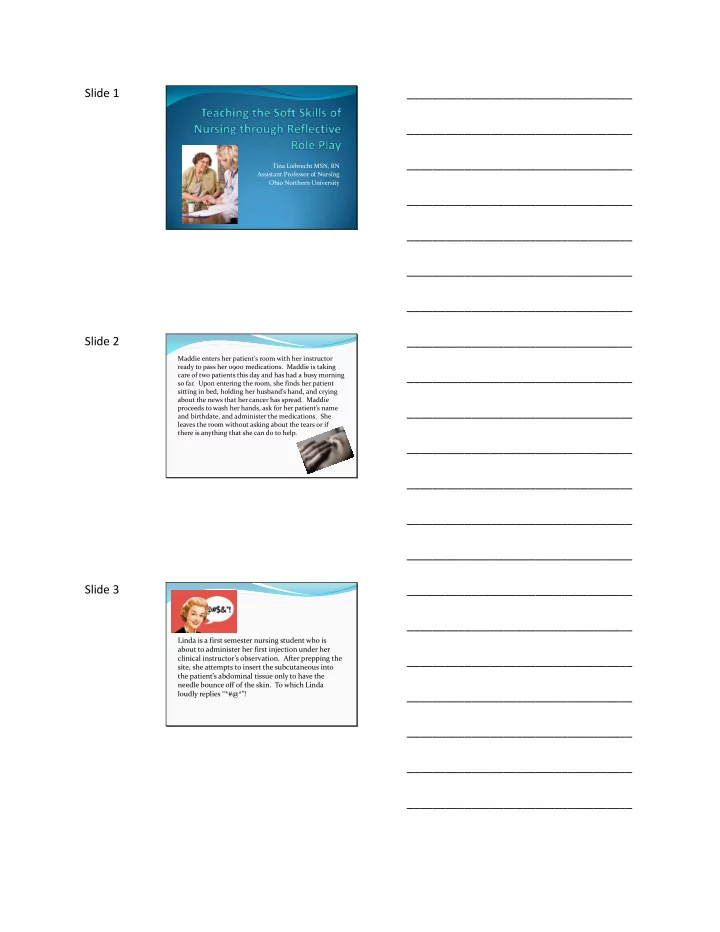
Slide 1 ___________________________________ - - PDF document
Slide 1 ___________________________________ ___________________________________ ___________________________________ Tina Liebrecht MSN, RN Assistant Professor of Nursing Ohio Northern University ___________________________________
Tina Liebrecht MSN, RN Assistant Professor of Nursing Ohio Northern University
Direct link between patient’s perception of quality care and interpersonal relationship with their nurses (Fosbinder, 1994). Formation of a caring relationship based on warmth, empathy, and respect (Ashmore & Banks, 2004). Offering of reassurance Conveying understanding of patient problems Basis for thorough assessment
Lack of effective communication between the nurse and patients, colleagues, or other health care providers Patients voice dissatisfaction with ineffective communication with their nurse Nurse time spent with patients is often insufficient, unstructured, unhelpful Nurses may actively avoid or block communication (Ashmore & Banks, 2004) 98% of practicing nurses want more education to help them develop their “soft skills” (Sommer, 2012).
Phone calls to/from family/support systems Tearful patient/family Actively dying patient Angry/violent patient/family Phone calls to health care providers
Theory-practice gap Difficult skills to practice realistically Students may be:
Young/immature Unexperienced Untested
Teamwork Delegation Professionalism
Senior students presented realistic 3-5 minute skits to sophomore nursing students in Fundamentals course Set in nursing skills lab Based on common nurse-patient, nurse-family, or nurse-health care team member interactions Incorporated concepts of :
Therapeutic communication Interpersonal interaction Active listening Empathy
First day taking care of a patient Grumpy patient Patient with poor hygiene and strong body odor Student shows up late/unprepared for clinical Tearful patient/family member Staff member using foul language in nurses’ station New graduate nurse on committee
Talkative patient HIPAA violation at lunch table Agitated patient Family members asking many questions Confused patient becomes violent/combative
Communication/Interpersonal Skills Skit Grading Rubric Group members: _______________________________________________________________________ Skit topic: ____________________________________________________________________________ Skit was presented in a realistic manner (1 pt) _____ Skit topic was portrayed clearly and accurately (1 pt) _____ All group members acted in a professional manner (1 pt) _____ Skit was well prepared and practiced (1 pt) _____ All group members were present and on time (1 pt) _____ Total: _____ (out of 5 pts) Evaluator: ____________________________
1. When I am interacting with another person, I am able to comfortably maintain eye contact. 2. I am able to sense the mood and tone of a situation when interacting with another. 3. I am aware of my body language and what it is communicating to others. 4. I am able to read and understand another person’s body language accurately. 5. I avoid or am reluctant to interact with another when sensitive or personal issues arise. 6. I feel comfortable in voicing my disagreement with someone in a position of authority in an appropriate manner.
willing to learn.
and creatively problem solve.
example to others.
including classroom, clinical, and lab experiences.
Live performance for morning labs; Videotaped for afternoon labs Skits took 1-2 minutes Debriefing lasted 4-5 minutes
Discussed:
Key soft skills observed Body language Right and wrong approaches Clinical examples
Sophomore Senior
Ashmore, R., & Banks, D. (2004). Student nurses’ use of their interpersonal skills within clinical role-plays. Nurse Education Today, 24, 20-29. Chant, S., Jenkinson, T., Randle, J., & Russell, G. (2002). Communication skills: Some problems in nursing education and practice. Journal of Clinical Nursing, 11, 12-21. Fosbinder, D. (1994). Patient perceptions of nursing care: An emerging theory of interpersonal competence. Journal of Advanced Nursing, 20, 1085-1093. Jones, A. (2007). Putting practice into teaching: An exploratory study of nursing undergraduates’ interpersonal skills and the effects of using empirical data as a teaching and learning resource. Journal of Clinical Nursing, 2297-2307. Sommer, S. (2012). The soft skills of nursing. Retrieved on 1/3/13 from www.minoritynurse.com/nursing-careers/soft-skills-nursing