SLIDE 1 Directions: Select/State the answer that best completes the statement or answers the question. Show work when appropriate.
Slide 1 / 39
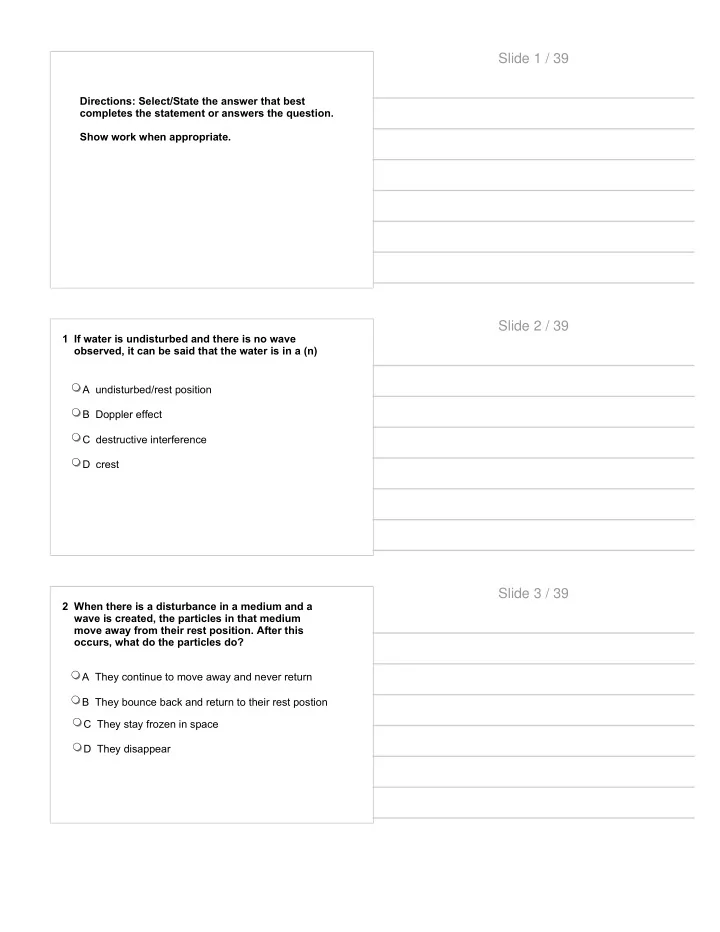
1 If water is undisturbed and there is no wave
- bserved, it can be said that the water is in a (n)
A undisturbed/rest position B Doppler effect C destructive interference D crest
Slide 2 / 39
2 When there is a disturbance in a medium and a wave is created, the particles in that medium move away from their rest position. After this
- ccurs, what do the particles do?
A They continue to move away and never return B They bounce back and return to their rest postion C They stay frozen in space D They disappear
Slide 3 / 39
SLIDE 2
3 How do a "pulse" and a "wave" compare?
Students type their answers here
Slide 4 / 39
4 A medium can be any A solid B liquid C gas D All of the above
Slide 5 / 39
5 The particles in a transverse wave vibrate at right angles to the direction of energy movement. A True B False
Slide 6 / 39
SLIDE 3
For questions 6 and 7, use the following diagram. A. B.
Slide 7 / 39
6 Box A is pointing to a ________ on a wave. A crest B trough
Slide 8 / 39
7 Box B is pointing to a ________ on a wave. A crest B trough
Slide 9 / 39
SLIDE 4 8 ________ is the distance away from the rest position
- f a wave. It’s symbol is y.
A Frequency B Wavelength C Crest D Amplitude
Slide 10 / 39
9 The symbol for wavelength is the Greek letter
A Lambda (λ) B Beta (B) C Gamma D Phi
Slide 11 / 39
10 Period and frequency are inversely related to one another. A True B False
Slide 12 / 39
SLIDE 5
11 What is the velocity of a wave that has a wavelength of 10 cm and a frequency of 2 Hz?
Slide 13 / 39
12 What is the velocity of a wave that has a wavelength of 5 m and a frequency of 5 Hz?
Slide 14 / 39
13 What is the frequency of a wave traveling at 200 m/s when it’s wavelength is 10 m?
Slide 15 / 39
SLIDE 6
14 What is the wavelength of a wave that is traveling at 63 m/s when it’s frequency is 21 Hz?
Slide 16 / 39
15 When waves hit a boundary or an obstacle and are reflected, they A continue through the obstacle B disappear C bounce back D break apart
Slide 17 / 39
16 When refraction occurs, which changes, the wavelength or the frequency? A Wavelength B Frequency
Slide 18 / 39
SLIDE 7
17 When is diffraction most notable? A When the wavelength of the waves are much bigger in size than the opening they are passing through B When the wavelength of the waves are much smaller in size than the opening they are passing through C When the wavelength of the waves are similar in size to the opening they are passing through
Slide 19 / 39
18 Diffraction is increased when waves pass through a large opening. A True B False
Slide 20 / 39
19 When waves that are in phase (both vibrating in the same direction) with each other add up in amplitude to reinforce each other and get bigger, _____ occurs. A Constructive Interference B Destructive Interference
Slide 21 / 39
SLIDE 8 20 When waves that are out of phase (both vibrating in the opposite direction) with each other cancel
- ut their amplitudes and get smaller, _______
- ccurs.
A Constructive Interference B Destructive Interference
Slide 22 / 39
21 The smaller the vibrating object, the lower the frequency sound produced. A True B False
Slide 23 / 39
22 The SI unit for sound intensity is: A hertz B amplitude C frequency D decibel
Slide 24 / 39
SLIDE 9 23 As a vibrating object swings forward, it creates compression in the medium that moves outward. This is an area of A high pressure B low pressure
Slide 25 / 39
24 When the vibrating object swings backward, it creates a rarefaction. This is an area of A high pressure B low pressure
Slide 26 / 39
25 Choose the correct timeline of events which make up the “Path of Hearing”
- I. The waves vibrate bones (hammer, anvil, stirrup)
- II. The cochlea changes vibrations into electrical impulses
- III. Sound waves strike the eardrum
- IV. The signal is sent through the auditory nerve to the brain
A IV, III, I, II B III, I, II, IV C III, I, IV, II D I, III, IV, II
Slide 27 / 39
SLIDE 10
26 The ear
A is part of the auditory system B aids in balance and body position C is an organ that detects sound D All of the above
Slide 28 / 39
27 The reflection of sound is known as a(n) A decibel B cochlea C echo D hertz
Slide 29 / 39
28 SONAR uses the reflection of sound waves to map the sea floor of our oceans. A True B False
Slide 30 / 39
SLIDE 11
29 Echolocation uses ___________ sound waves to “see” how far away food is. A refracted B diffracted C reflected
Slide 31 / 39
30 What is the speed of sound in air if a sound wave travels 3,000 meters in 10 seconds?
Slide 32 / 39
31 What is the speed of sound in air if a sound wave travels 2,424 meters in 3 seconds?
Slide 33 / 39
SLIDE 12
32 How far away from a wall are we if a sound returns in 5 seconds (NOTE: speed of sound is 343 m/s)?
Slide 34 / 39
33 Describe, in terms of wavelength and frequency, what an observer may hear from a moving sound source as the source approaches the observer, and then moves away from the observer.
Slide 35 / 39
34 An observer moves toward a stationary alarm from a car going off. The moving observer hears A A lower pitched sound B A higher pitched sound C The same pitched that is produced
Slide 36 / 39
SLIDE 13 35 The same observer turns around and begins to walk away from the blaring car alarm. The moving
A A lower pitched sound B A higher pitched sound C The same pitched that is produced
Slide 37 / 39
36 When is a sonic boom produced?
Slide 38 / 39
37 Traveling faster than the speed of sound is called “supersonic”. A True B False
Slide 39 / 39