SLIDE 1
Multiple Choice Slide 1 / 156
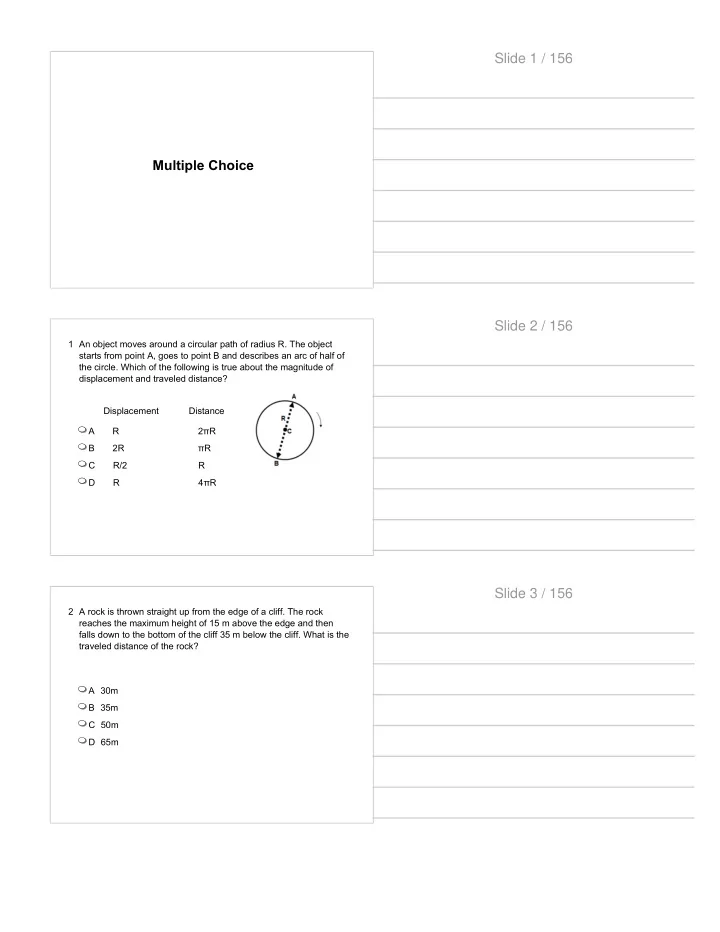
1 An object moves around a circular path of radius R. The object starts from point A, goes to point B and describes an arc of half of the circle. Which of the following is true about the magnitude of displacement and traveled distance? Displacement Distance A R 2πR B 2R πR C R/2 R D R 4πR
Slide 2 / 156
2 A rock is thrown straight up from the edge of a cliff. The rock reaches the maximum height of 15 m above the edge and then falls down to the bottom of the cliff 35 m below the cliff. What is the traveled distance of the rock? A 30m B 35m C 50m D 65m
Slide 3 / 156
SLIDE 2
3 A rock is thrown straight up from the edge of a cliff. The rock reaches the maximum height of 15 m above the edge and then falls down to the bottom of the cliff 35 m below the cliff. What is the displacement of the rock? A 15m B 35m C 50m D 65m
Slide 4 / 156
4 Can an object’s average velocity equal zero when object’s speed is greater than zero? A Yes, when the object moves in a straight line at a constant rate. B Yes, when the object returns to its original position. C No, it is impossible because they are always equal. D No, it is impossible because the magnitude of the velocity is always greater that speed .
Slide 5 / 156
5 A car accelerates from rest at a constant rate 5 m/s2. Which of the following statements is true? A The car travels 5 m in every second B The car decreases its velocity 5 m/s in every second C The car increases its velocity 5 m/s in every second D The car’s velocity doesn’t change
Slide 6 / 156
SLIDE 3
6 An object is thrown straight up with an initial velocity v0. The graph represents the object’s vertical displacement as a function of time. What is the total flying time of the object? A 2s B 4s C 6s D 8s
Slide 7 / 156
7 An object is thrown straight up with an initial velocity v0. The graph represents the object’s vertical displacement as a function of time. At what time the object reaches its maximum height? A 2s B 4s C 6s D 8s
Slide 8 / 156
8 An object is thrown straight up with an initial velocity v0. The graph represents the object’s vertical displacement as a function of time. What is the initial velocity of the object? A 20m/s B 60m/s C 80m/s D 50m/s
Slide 9 / 156
SLIDE 4 9 Which of the following graphs represents the velocity as a function
- f time of an object thrown straight up?
A B C D
Slide 10 / 156
10 Which of the following graphs represents the acceleration as a function of time of an object thrown straight up? A B C D
Slide 11 / 156
11 The relationship between the position and time of a moving object is shown on the graph. What is the instantaneous speed of the
A 1 m/s B 2 m/s C 3 m/s D 4 m/s
Slide 12 / 156
SLIDE 5
12 The relationship between the position and time of a moving object is shown on the graph. During which of the following times does the object accelerate? A 0 to 2s B 2 to 4s C 0 to 4s D 4 to 8s
Slide 13 / 156
13 The graph to the right describes the relationship between velocity and time for a moving object. What is the acceleration at time t = 1 s? A 4 m/s2 B 2 m/s2 C -2 m/s2 D -4 m/s2
Slide 14 / 156
14 The graph to the right describes the relationship between velocity and time for a moving object. What is the acceleration at time t = 8 s? A 4 m/s2 B -2 m/s2 C -4 m/s2 D 0 m/s2
Slide 15 / 156
SLIDE 6
15 The graph to the right describes the relationship between velocity and time for a moving object. What is the acceleration at time t = 6 s? A 1 m/s2 B 2 m/s2 C -4 m/s2 D 0 m/s2
Slide 16 / 156
16 The graph to the right describes the relationship between velocity and time for a moving object. What is the total displacement for the entire trip? A 18 m B 12 m C 6 m D 30 m
Slide 17 / 156
17 The graph to the right describes the relationship between velocity and time for a moving object. What is the total traveled distance for the entire trip? A 18 m B 12 m C 6 m D 30 m
Slide 18 / 156
SLIDE 7 18 The graph to the right describes the relationship between velocity and time for a moving object. Between what times does the object approach the origin at the constant speed? A 2 to 5s B 6 to 7s C 7 to 9s D 9 to 10s
Slide 19 / 156
19 A rock is thrown straight up with twice the initial velocity of another. How much higher will the first rock be at its apex? A 2 times B 4 times C 16 times D They will reach the same apex.
Slide 20 / 156
20 A student drops a pebble from the edge of a vertical cliff. The pebble hits the ground 4 s after it was dropped. What is the speed
- f the pebble just before it hits the ground?
A 20 m/s B 40 m/s C 60 m/s D 80 m/s
Slide 21 / 156
SLIDE 8 21 A student drops a pebble from the edge of a vertical cliff. The pebble hits the ground 4 s after it was dropped. What is the height
A 20m B 40m C 60m D 80m
Slide 22 / 156
22 An Astronaut on the Moon simultaneously drops a bird feather and a screw driver. The fact that two objects reach the surface at the same time can be explained by which of the following? A The Moon has no gravity B The Moon’s gravity is much weaker than the Earth’s gravity C The same gravitational force is applied on both objects on the Moon D At the given location all objects fall with the same acceleration in the absence of air resistance
Slide 23 / 156
23 A marble launcher shoots a marble horizontally from the height of 0.2 m above a horizontal floor. The marble lands on the floor 5 m away from the launcher. How long did the marble stay in are? A 0.1s B 0.2s C 0.3s D 0.4s
Slide 24 / 156
SLIDE 9
24 A marble launcher shoots a marble horizontally from the height of 0.2 m above a horizontal floor. The marble lands on the floor 5 m away from the launcher. What is the initial speed of the marble? A 5 m/s B 10 m/s C 15 m/s D 25 m/s
Slide 25 / 156
25 A bicyclist moves a long a straight line with an initial velocity v0 and slows down. Which of the following the best describes the signs set for the initial position, initial velocity and the acceleration? Position Velocity Acceleration A Positive Positive Negative B Negative Positive Negative C Negative Negative Positive D Negative Negative Negative
Slide 26 / 156
26 Which of the following is a vector quantity? A Traveled distance B Displacement C Area D Mass
Slide 27 / 156
SLIDE 10
27 Which of the following is not a vector quantity? A Velocity B Displacement C Momentum D Traveled distance
Slide 28 / 156
28 A vector of displacement D is placed in X-Y coordinate system shown in the diagram to the right. What is the x-component of vector D? A 2m B 3m C 4m D 5m
Slide 29 / 156
29 A vector of displacement D is placed in X-Y coordinate system shown in the diagram to the right. What is the y-component of vector D? A 2m B 3m C 4m D 5m
Slide 30 / 156
SLIDE 11 30 A vector of displacement D is placed in X-Y coordinate system shown in the diagram to the right. What is the magnitude of vector D? A 2m B 3m C 4m D 5m
Slide 31 / 156
31 An object changes its velocity from V1 to V2 during a time interval Δt. Which
- f the following is the correct direction
for the object’s acceleration? A B C D
Slide 32 / 156
32 A projectile is fired at 60 ̊ above the horizontal line with an initial velocity v0. At which of the following angles the projectile will land at the same distance as it is landed in the first trial? A 20o B 30o C 40o D 45o
Slide 33 / 156
SLIDE 12 33 When a projectile reaches the highest point the vertical component
A Greater than g B Positive g C Negative g D Zero
Slide 34 / 156
34 When a projectile reaches the highest point the horizontal component of the acceleration is: A Greater than g B Positive g C Negative g D Zero
Slide 35 / 156
35 An object is thrown in horizontal with an initial velocity v0= 5 m/s from the roof of a building 40 m tall. How much later does it hit the ground? A 4s B √5s C √8s D 10s
Slide 36 / 156
SLIDE 13
36 An object is thrown in horizontal with an initial velocity v0= 10 m/s from the roof of a building 20 m tall. How far from the building does it hit the ground? A 5m B 10m C 15m D 20m
Slide 37 / 156
37 The diagram to the right represents a swimmer. The swimmer is capable to swim in a still water with a velocity V1 = 1 m/s. He aims his body directly across a 100 m wide river whose current has a velocity V2 = 2 m/s. How much time it will take for the swimmer to cross the river? A 10s B 20s C 50s D 100s
Slide 38 / 156
38 The diagram to the right represents a swimmer. The swimmer is capable to swim in a still water with a velocity V1 = 1 m/s. He aims his body directly across a 100 m wide river whose current has a velocity V2 = 2 m/s. How far downstream will he land? A 100m B 200m C 150m D 180m
Slide 39 / 156
SLIDE 14 39 The diagram to the right represents a swimmer. The swimmer is capable to swim in a still water with a velocity V1 = 1 m/s. He aims his body directly across a 100 m wide river whose current has a velocity V2 = 2 m/s. What is the velocity of the swimmer relative to the river bank? A 1m/s B 2m/s C √3m/s D √5m/s
Slide 40 / 156
40 The graphs above represent the position, velocity, and acceleration as a function of time for a marble moving in one dimension. Which
- f the following could describe the motion of the marble?
A Rolling along the floor and then bouncing off a wall. B Rolling down one side of a bowl and then rolling up the other side. C Rolling up a ramp and then rolling back down. D Falling and then bouncing elastically off a hard floor.
Slide 41 / 156 Multiple Answer Slide 42 / 156
SLIDE 15 41 Position as a function of time of a moving object is presented by the
- graph. Which of the following is
true about the type of motion? A The object moves with a constant positive acceleration B The object moves with a constant positive velocity C The slope of this graph is equal to the object’s acceleration D The slope of this graph is equal to the object’s velocity
Slide 43 / 156
42 Position as a function of time of two moving objects is presented by the
- graph. Which of the following
statements is true? A Object I has a greater velocity than object II B Object II has a greater velocity that object I C At time t0 they have the same velocity D At time t0 object II passes by object I
Slide 44 / 156
43 A projectile is fired from the ground level with an initial velocity v0. Which of the following statements is true? A Vertical component of the velocity at point C is v0 sinθ B Horizontal component of the velocity at point C is v0 cosθ C The projectile travels with the same speed at point B and D D The acceleration at point C is zero
Slide 45 / 156
SLIDE 16 44 An object accelerates from rest at a constant rate. Which of the following graphs could be used to describe the motion of the
A B C D
Slide 46 / 156
45 A tennis ball is thrown straight up and caught at the same height. Which of the following can describe the motion of the ball when it reaches the apex? A The velocity of the ball is zero. B The acceleration of the ball is zero C The acceleration of the ball is 9.8 m/s2 down. D The acceleration of the ball is 9.8 m/s2 up.
Slide 47 / 156 Free Response Slide 48 / 156
SLIDE 17 Slide 49 / 156
- 1. A car whose speed is 20 m/s passes a stationary motorcycle
which immediately gives chase with a constant acceleration of 2.4 m/s2.
- b. How fast will it be going at that time?
Slide 50 / 156
- 1. A car whose speed is 20 m/s passes a stationary motorcycle
which immediately gives chase with a constant acceleration of 2.4 m/s2.
- c. How does that compare to the car’s velocity?
Slide 51 / 156
SLIDE 18
- 1. A car whose speed is 20 m/s passes a stationary motorcycle
which immediately gives chase with a constant acceleration of 2.4 m/s2.
- d. Draw the following graphs for the car: x(t), v(t), a(t).
Slide 52 / 156
- 1. A car whose speed is 20 m/s passes a stationary motorcycle
which immediately gives chase with a constant acceleration of 2.4 m/s2.
- e. Draw the following graphs for the motorcycle: x(t), v(t), a(t).
Slide 53 / 156
- 1. A car whose speed is 20 m/s passes a stationary motorcycle
which immediately gives chase with a constant acceleration of 2.4 m/s2.
- f. Write the equation of motion for the car.
Slide 54 / 156
SLIDE 19
- 1. A car whose speed is 20 m/s passes a stationary motorcycle
which immediately gives chase with a constant acceleration of 2.4 m/s2.
- g. Write the equation of motion for the motorcycle.
Slide 55 / 156
- 2. A lab cart moves a long a
straight horizontal track. The graph describes the relationship between the velocity and time of the cart.
interval for which speed (magnitude of the velocity) of the cart is decreasing.
Slide 56 / 156
- 2. A lab cart moves a long a
straight horizontal track. The graph describes the relationship between the velocity and time of the cart.
at which the cart is at rest.
Slide 57 / 156
SLIDE 20
- 2. A lab cart moves a long a
straight horizontal track. The graph describes the relationship between the velocity and time of the cart.
horizontal position x of the cart at t = 4 s if the cart is located at x0 = when t0 = 0.
Slide 58 / 156
- 2. A lab cart moves a long a
straight horizontal track. The graph describes the relationship between the velocity and time of the cart.
traveled distance of the cart over 10 s from the beginning.
Slide 59 / 156
- 2. A lab cart moves a long a
straight horizontal track. The graph describes the relationship between the velocity and time of the cart.
average speed of the cart for this time interval.
Slide 60 / 156
SLIDE 21
- 2. A lab cart moves a long a
straight horizontal track. The graph describes the relationship between the velocity and time of the cart.
- f. Find the acceleration
- f the cart during time:
0 s -4 s, 4 s – 8 s, 8 s – 10 s, 10 s – 14 s, 14 s – 16 s, 16 s – 20 s.
Slide 61 / 156
- 2. A lab cart moves a long a
straight horizontal track. The graph describes the relationship between the velocity and time of the cart.
sketch the acceleration graph for the motion of the cart from t = 0 s to t = 20 s.
Slide 62 / 156
- 3. Find the magnitude and the direction of vector C for
the following cases.
- a. A = 10 N at 0 ̊, B = 20 N at 0 ̊, C = A + B
Slide 63 / 156
SLIDE 22
- 3. Find the magnitude and the direction of vector C for
the following cases.
- b. A = 10 N at 0 ̊, B = 20 N at 180 ̊, C = A + B
Slide 64 / 156
- 3. Find the magnitude and the direction of vector C for
the following cases.
- c. A = 10 N at 180 ̊, B = 20 N at 180 ̊, C = A + B
Slide 65 / 156
- 3. Find the magnitude and the direction of vector C for
the following cases.
- d. A = 10 N at 0 ̊, B = 20 N at 90 ̊, C = A + B
Slide 66 / 156
SLIDE 23
- 3. Find the magnitude and the direction of vector C for
the following cases.
- e. A = 10 N at 90 ̊, B = 20 N at 0 ̊, C = A + B
Slide 67 / 156
- 4. Find the magnitude and the direction of vector G as a sum of two
vectors D and E by going through the following steps.
- a. D = 10 N at 37 ̊. Find Dx and Dy.
Slide 68 / 156
- 4. Find the magnitude and the direction of vector G as a sum of two
vectors D and E by going through the following steps.
- b. E = 20 N at 25 ̊. Find Ex and Ey.
Slide 69 / 156
SLIDE 24
- 4. Find the magnitude and the direction of vector G as a sum of two
vectors D and E by going through the following steps.
Slide 70 / 156
- 4. Find the magnitude and the direction of vector G as a sum of two
vectors D and E by going through the following steps.
Slide 71 / 156
- 4. Find the magnitude and the direction of vector G as a sum of two
vectors D and E by going through the following steps.
- e. Find the magnitude of G from its components
Slide 72 / 156
SLIDE 25
- 4. Find the magnitude and the direction of vector G as a sum of two
vectors D and E by going through the following steps.
- f. Find the direction of G.
Slide 73 / 156
- 5. Find the magnitude and the direction of vector C for the following
cases.
- a. A = 40 N at 0 ̊, B = 10 N at 0 ̊, C = A + B
Slide 74 / 156
- 5. Find the magnitude and the direction of vector C for the following
cases.
- b. A = 40 N at 0 ̊, B = 10 N at 180 ̊, C = A + B
Slide 75 / 156
SLIDE 26
- 5. Find the magnitude and the direction of vector C for the following
cases.
- c. A = 40 N at 180 ̊, B = 10 N at 180 ̊, C = A + B
Slide 76 / 156
- 5. Find the magnitude and the direction of vector C for the following
cases.
- d. A = 40 N at 0 ̊, B = 10 N at 90 ̊, C = A + B
Slide 77 / 156
- 5. Find the magnitude and the direction of vector C for the following
cases.
- e. A = 40 N at 90 ̊, B = 10 N at 0 ̊, C = A + B
Slide 78 / 156
SLIDE 27
- 6. Find the magnitude and the direction of vector G as a sum of two
vectors D and E by going through the following steps.
- a. D = 30 N at 65 ̊. Find Dx and Dy.
Slide 79 / 156
- 6. Find the magnitude and the direction of vector G as a sum of two
vectors D and E by going through the following steps.
- b. E = 45 N at 15 ̊. Find Ex and Ey.
Slide 80 / 156
- 6. Find the magnitude and the direction of vector G as a sum of two
vectors D and E by going through the following steps.
Slide 81 / 156
SLIDE 28
- 6. Find the magnitude and the direction of vector G as a sum of two
vectors D and E by going through the following steps.
Slide 82 / 156
- 6. Find the magnitude and the direction of vector G as a sum of two
vectors D and E by going through the following steps.
- e. Find the magnitude of G from its components
Slide 83 / 156
- 6. Find the magnitude and the direction of vector G as a sum of two
vectors D and E by going through the following steps.
- f. Find the direction of G.
Slide 84 / 156
SLIDE 29
- 7. Two forces 300 N at 0 ̊ and 400 N at 90 ̊pull on an object. Answer
the following:
- a. Draw a diagram showing the forces acting on the object.
Slide 85 / 156
- 7. Two forces 300 N at 0 ̊ and 400 N at 90 ̊pull on an object. Answer
the following:
- b. Draw a sketch showing the vector sum of two forces.
Slide 86 / 156
- 7. Two forces 300 N at 0 ̊ and 400 N at 90 ̊pull on an object. Answer
the following:
- c. Find the magnitude of the resultant force.
Slide 87 / 156
SLIDE 30
- 7. Two forces 300 N at 0 ̊ and 400 N at 90 ̊pull on an object. Answer
the following:
- d. Find the direction of the resultant force.
Slide 88 / 156
- 8. A ship makes three displacements in the following order:
1) 76 mi, 48 ̊ north of east 2) 50 mi, 56 ̊north of west; and 3) 47 mi, south
- a. Draw a clear diagram showing all three displacement vectors
with respect to horizontal points (north, east, south, and west).
Slide 89 / 156
- 8. A ship makes three displacements in the following order:
1) 76 mi, 48 ̊ north of east 2) 50 mi, 56 ̊north of west; and 3) 47 mi, south
- b. Find the X and Y components of displacement D1.
Slide 90 / 156
SLIDE 31
- 8. A ship makes three displacements in the following order:
1) 76 mi, 48 ̊ north of east 2) 50 mi, 56 ̊north of west; and 3) 47 mi, south
- c. Find the X and Y components of displacement D2.
Slide 91 / 156
- 8. A ship makes three displacements in the following order:
1) 76 mi, 48 ̊ north of east 2) 50 mi, 56 ̊north of west; and 3) 47 mi, south
- d. Find the X and Y components of displacement D3.
Slide 92 / 156
- 8. A ship makes three displacements in the following order:
1) 76 mi, 48 ̊ north of east 2) 50 mi, 56 ̊north of west; and 3) 47 mi, south
- e. Find the magnitude of the resultant vector.
Slide 93 / 156
SLIDE 32
- 8. A ship makes three displacements in the following order:
1) 76 mi, 48 ̊ north of east 2) 50 mi, 56 ̊north of west; and 3) 47 mi, south
- f. Find the direction of the resultant vector.
Slide 94 / 156
- 9. A bus makes three displacements I the following order:
1) 58 mi, 38 ̊ east of north 2) 69 mi, 46 ̊ west of north; and 3) 75 mi, south-east
- a. Draw a clear diagram showing all three displacement vectors
with respect to horizontal points (north, east, south, and west).
Slide 95 / 156
- 9. A bus makes three displacements I the following order:
1) 58 mi, 38 ̊ east of north 2) 69 mi, 46 ̊ west of north; and 3) 75 mi, south-east
- b. Find the X and Y components of displacement D1.
Slide 96 / 156
SLIDE 33
- 9. A bus makes three displacements I the following order:
1) 58 mi, 38 ̊ east of north 2) 69 mi, 46 ̊ west of north; and 3) 75 mi, south-east
- c. Find the X and Y components of displacement D2.
Slide 97 / 156
- 9. A bus makes three displacements I the following order:
1) 58 mi, 38 ̊ east of north 2) 69 mi, 46 ̊ west of north; and 3) 75 mi, south-east
- d. Find the X and Y components of displacement D3.
Slide 98 / 156
- 9. A bus makes three displacements I the following order:
1) 58 mi, 38 ̊ east of north 2) 69 mi, 46 ̊ west of north; and 3) 75 mi, south-east
- e. Find the magnitude of the resultant vector.
Slide 99 / 156
SLIDE 34
- 9. A bus makes three displacements I the following order:
1) 58 mi, 38 ̊ east of north 2) 69 mi, 46 ̊ west of north; and 3) 75 mi, south-east
- f. Find the direction of the resultant vector.
Slide 100 / 156
10. A ball is thrown horizontally from the roof of a building 75 m tall with a speed of 4.6 m/s.
- a. How much later does the ball hit the ground?
Slide 101 / 156
10. A ball is thrown horizontally from the roof of a building 75 m tall with a speed of 4.6 m/s.
- b. How far from the building will it land?
Slide 102 / 156
SLIDE 35 10. A ball is thrown horizontally from the roof of a building 75 m tall with a speed of 4.6 m/s.
- c. What is the velocity of the ball just before it hits the ground?
Slide 103 / 156
11. A projectile is fired with an initial speed of 150 m/s at an angle of 47 ̊ above the horizontal.
- a. Determine the total time in the air.
Slide 104 / 156
11. A projectile is fired with an initial speed of 150 m/s at an angle of 47 ̊ above the horizontal.
- b. Determine the maximum height reached by the projectile.
Slide 105 / 156
SLIDE 36 11. A projectile is fired with an initial speed of 150 m/s at an angle of 47 ̊ above the horizontal.
- c. Determine the maximum horizontal distance covered by the
projectile.
Slide 106 / 156
11. A projectile is fired with an initial speed of 150 m/s at an angle of 47 ̊ above the horizontal.
- d. Determine the velocity of the projectile 5 s after firing.
Slide 107 / 156
12. A projectile is fired from the edge of a cliff 95 m high with an initial speed of 50 m/s at an angle of 37 ̊ above the horizontal.
- a. Determine the total time in the air.
Slide 108 / 156
SLIDE 37 12. A projectile is fired from the edge of a cliff 95 m high with an initial speed of 50 m/s at an angle of 37 ̊ above the horizontal.
- b. Determine the maximum height reached by the
projectile.
Slide 109 / 156
12. A projectile is fired from the edge of a cliff 95 m high with an initial speed of 50 m/s at an angle of 37 ̊ above the horizontal.
- c. Determine the maximum horizontal distance covered
by the projectile.
Slide 110 / 156
12. A projectile is fired from the edge of a cliff 95 m high with an initial speed of 50 m/s at an angle of 37 ̊ above the horizontal.
- d. Determine the velocity of the projectile just before it
hits the bottom of the cliff.
Slide 111 / 156
SLIDE 38
- 13. A ball is thrown horizontally from the roof of a
building 55 m tall with a speed of 3.8 m/s.
- a. How much later does it hit the ground?
Slide 112 / 156
- 13. A ball is thrown horizontally from the roof of a
building 55 m tall with a speed of 3.8 m/s.
- b. How far from the building will it land?
Slide 113 / 156
- 13. A ball is thrown horizontally from the roof of a
building 55 m tall with a speed of 3.8 m/s.
- c. What is the velocity of the ball just before it
hits the ground?
Slide 114 / 156
SLIDE 39
- 14. A projectile is fired with an initial speed of 110 m/s at an
angle of 36 above the horizontal.
- a. Determine the total time in the air.
Slide 115 / 156
- 14. A projectile is fired with an initial speed of 110 m/s at an
angle of 36 above the horizontal.
- b. Determine the maximum height reached by the
projectile.
Slide 116 / 156
- 14. A projectile is fired with an initial speed of 110 m/s at an
angle of 36 above the horizontal.
- c. Determine the total horizontal distance covered by
the projectile.
Slide 117 / 156
SLIDE 40
- 14. A projectile is fired with an initial speed of 110 m/s at an
angle of 36 above the horizontal.
- d. Determine the velocity of the projectile 4s after firing.
Slide 118 / 156
15. A ball rolls off a 1.5 m tall horizontal table and lands on the floor .70 m away.
- a. How much time is the ball in the air?
Slide 119 / 156
15. A ball rolls off a 1.5 m tall horizontal table and lands on the floor .70 m away.
- b. How does that time compare with the time it takes for a
dropped ball to fall that same distance.
Slide 120 / 156
SLIDE 41 15. A ball rolls off a 1.5 m tall horizontal table and lands on the floor .70 m away.
- c. What is the ball’s velocity while it was on the table top?
Slide 121 / 156
15. A ball rolls off a 1.5 m tall horizontal table and lands on the floor .70 m away.
- d. What is the horizontal component of its velocity just prior to
impact?
Slide 122 / 156
15. A ball rolls off a 1.5 m tall horizontal table and lands on the floor .70 m away.
- e. What is the vertical component of its velocity just prior to
impact?
Slide 123 / 156
SLIDE 42 15. A ball rolls off a 1.5 m tall horizontal table and lands on the floor .70 m away.
- f. What is the magnitude of its velocity just prior to impact?
Slide 124 / 156
15. A ball rolls off a 1.5 m tall horizontal table and lands on the floor .70 m away.
- g. What is the direction of its velocity just prior to impact?
Slide 125 / 156
16. An archer fires an arrow with a velocity of 42 m/s at an angle
- f 35 degrees above horizontal?
- a. What is the horizontal component of its initial velocity?
Slide 126 / 156
SLIDE 43 16. An archer fires an arrow with a velocity of 42 m/s at an angle
- f 35 degrees above horizontal?
- b. What is the vertical component of its initial velocity?
Slide 127 / 156
16. An archer fires an arrow with a velocity of 42 m/s at an angle
- f 35 degrees above horizontal?
- c. What is the maximum height attained by the arrow?
Slide 128 / 156
16. An archer fires an arrow with a velocity of 42 m/s at an angle
- f 35 degrees above horizontal?
- d. How long does it take the arrow to reach that height?
Slide 129 / 156
SLIDE 44 16. An archer fires an arrow with a velocity of 42 m/s at an angle
- f 35 degrees above horizontal?
- e. What is the total amount of time that it’s in the air?
Slide 130 / 156
16. An archer fires an arrow with a velocity of 42 m/s at an angle
- f 35 degrees above horizontal?
- f. How far away does it strike the ground?
Slide 131 / 156
16. An archer fires an arrow with a velocity of 42 m/s at an angle
- f 35 degrees above horizontal?
- g. What is the horizontal component of its velocity just prior to
impact?
Slide 132 / 156
SLIDE 45 16. An archer fires an arrow with a velocity of 42 m/s at an angle
- f 35 degrees above horizontal?
- h. What is the vertical component of its velocity just prior to
impact?
Slide 133 / 156
16. An archer fires an arrow with a velocity of 42 m/s at an angle
- f 35 degrees above horizontal?
- i. What is the magnitude of its velocity just prior to impact?
Slide 134 / 156
16. An archer fires an arrow with a velocity of 42 m/s at an angle
- f 35 degrees above horizontal?
- j. What is the direction of its velocity just prior to impact?
Slide 135 / 156
SLIDE 46
- 17. A cannon is fired horizontally from a cliff 112m high with a speed
- f 25 m/s.
- a. How much later does the cannon ball hit the ground?
Slide 136 / 156
- 17. A cannon is fired horizontally from a cliff 112m high with a speed
- f 25 m/s.
- b. How far from the cliff will it land?
Slide 137 / 156
- 17. A cannon is fired horizontally from a cliff 112m high with a speed
- f 25 m/s.
- c. What is the velocity of the cannon ball just before it hits the
ground?
Slide 138 / 156
SLIDE 47 18. A ball is thrown horizontally from the roof of a building 12 m tall with a speed of 3.1 m/s.
- a. How much later does the ball hit the ground?
Slide 139 / 156
18. A ball is thrown horizontally from the roof of a building 12 m tall with a speed of 3.1 m/s.
- b. How far from the building will it land?
Slide 140 / 156
18. A ball is thrown horizontally from the roof of a building 12 m tall with a speed of 3.1 m/s.
- c. What is the velocity of the ball just before it hits the ground?
Slide 141 / 156
SLIDE 48
- 19. A gazelle leaps from a cliff 2.5 m high with a speed of
5.6 m/s.
- a. How much later does the gazelle hit the ground?
Slide 142 / 156
- 19. A gazelle leaps from a cliff 2.5 m high with a speed of
5.6 m/s.
- b. How far from the cliff will it land?
Slide 143 / 156
- 19. A gazelle leaps from a cliff 2.5 m high with a speed of
5.6 m/s.
- c. What is the velocity of the gazelle just before it hits
the ground?
Slide 144 / 156
SLIDE 49
- 20. A projectile is fired with an initial speed of 40 m/s at an angle of
23 degrees above the horizontal.
- a. Determine the total time in the air.
Slide 145 / 156
- 20. A projectile is fired with an initial speed of 40 m/s at an angle of
23 degrees above the horizontal.
- b. Determine the maximum height reached by the projectile.
Slide 146 / 156
- 20. A projectile is fired with an initial speed of 40 m/s at an angle of
23 degrees above the horizontal.
- c. Determine the maximum horizontal distance covered by the
projectile.
Slide 147 / 156
SLIDE 50
- 20. A projectile is fired with an initial speed of 40 m/s at an angle of
23 degrees above the horizontal.
- d. Determine the velocity of the projectile 2s after firing.
Slide 148 / 156
- 21. A hose held near the ground shoots water at a speed of
3.5 m/s at an angle of 72 degrees above the horizontal.
- a. Determine the total time of the water in the air.
Slide 149 / 156
- 21. A hose held near the ground shoots water at a speed of
3.5 m/s at an angle of 72 degrees above the horizontal.
- b. Determine the maximum height reached by the water.
Slide 150 / 156
SLIDE 51
- 21. A hose held near the ground shoots water at a speed of
3.5 m/s at an angle of 72 degrees above the horizontal.
- c. Determine the maximum horizontal distance covered
by the water.
Slide 151 / 156
- 22. You are riding your bike at 10 m/s when you see your friend
20 m in front of you. You apply the brakes and slow down with a rate of 2.5 m/s2.
- a. Write and equation that can describe your position at a
function of time.
Slide 152 / 156
- 22. You are riding your bike at 10 m/s when you see your friend
20 m in front of you. You apply the brakes and slow down with a rate of 2.5 m/s2.
- b. Write and equation that can describe your velocity as a
function of time.
Slide 153 / 156
SLIDE 52
- 22. You are riding your bike at 10 m/s when you see your friend
20 m in front of you. You apply the brakes and slow down with a rate of 2.5 m/s2.
- c. On the graphs below sketch the velocity vs. time and
position vs. time graphs.
Slide 154 / 156
- 22. You are riding your bike at 10 m/s when you see your friend
20 m in front of you. You apply the brakes and slow down with a rate of 2.5 m/s2.
- d. How long will it take you to come to a complete stop?
Justify your answer.
Slide 155 / 156
- 22. You are riding your bike at 10 m/s when you see your friend
20 m in front of you. You apply the brakes and slow down with a rate of 2.5 m/s2.
- e. Will you come to a stop before you get to your friend,
exactly where your friend is standing, or after you pass your friend? Justify your answer.
Slide 156 / 156