Sleep Modes Pacemaker Training Program The heart benefits from a - - PDF document

sleep modes pacemaker training program
SMART_READER_LITE
LIVE PREVIEW

Sleep Modes Pacemaker Training Program The heart benefits from a - - PDF document

Sleep Modes Pacemaker Training Program The heart benefits from a decreased heart rate at night Special Functions: Without this nightly rest diastolic function Sleep Modes and systolic function decline Affects


slide-1
SLIDE 1

1

Pacemaker Training Program

Special Functions: Sleep Modes

Scott Streckenbach, M.D. Director of Perioperative Electrophysiology Cardiac Anesthesia Division Mass General Hospital Harvard Medical School

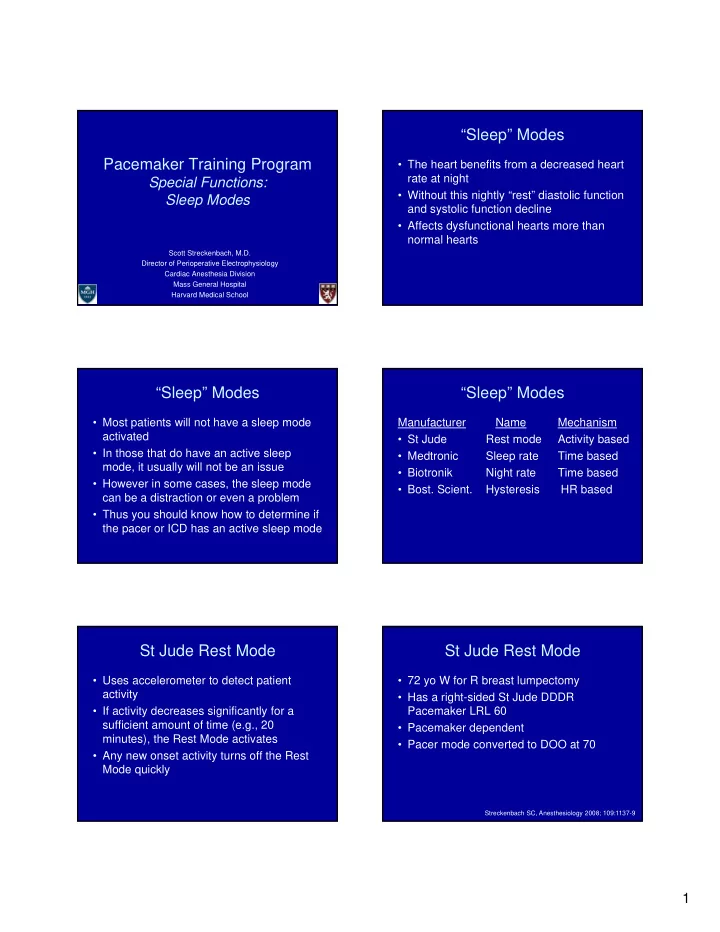
“Sleep” Modes

  • The heart benefits from a decreased heart

rate at night

  • Without this nightly “rest” diastolic function

and systolic function decline

  • Affects dysfunctional hearts more than

normal hearts

“Sleep” Modes

  • Most patients will not have a sleep mode

activated

  • In those that do have an active sleep

mode, it usually will not be an issue

  • However in some cases, the sleep mode

can be a distraction or even a problem

  • Thus you should know how to determine if

the pacer or ICD has an active sleep mode

“Sleep” Modes

Manufacturer Name Mechanism

  • St Jude

Rest mode Activity based

  • Medtronic

Sleep rate Time based

  • Biotronik

Night rate Time based

  • Bost. Scient.

Hysteresis HR based

St Jude Rest Mode

  • Uses accelerometer to detect patient

activity

  • If activity decreases significantly for a

sufficient amount of time (e.g., 20 minutes), the Rest Mode activates

  • Any new onset activity turns off the Rest

Mode quickly

St Jude Rest Mode

  • 72 yo W for R breast lumpectomy
  • Has a right-sided St Jude DDDR

Pacemaker LRL 60

  • Pacemaker dependent
  • Pacer mode converted to DOO at 70

Streckenbach SC, Anesthesiology 2008; 109:1137-9

slide-2
SLIDE 2

2

Rest Mode: St Jude Medical

Streckenbach SC, Anesthesiology 2008; 109:1137-9 Rest mode on at rate of 50

Clinical Outcome

  • The heart rate decreases did not affect the

patient

  • However the anesthesiologist was

distracted

  • Once I turned off the rest mode, he was

able to focus on the patient and not the pacer.

How can one determine if the Rate Response Mode is active?

  • Programmer report
  • Programmer interrogation

St Jude Programmer Report Rest Rate ON St Jude Programmer Report Rest Rate Off How to Check if Rest Rate Programmed ON with a St Jude Programmer

slide-3
SLIDE 3

3

St Jude Rest Rate On St Jude Rest Rate Summary

  • Activity based
  • Heart rate decreases with inactivity
  • Easy to find on the programmer report or

with the programmer

  • Easy to turn off

Medtronic Sleep Rate

  • Decreases pacer base rate during a

specified time interval

– Ex. Base rate decreased from 9 pm to 5 am

Medtronic Sleep Rate Case

  • Clinical scenario

– Late night bowel resection – Pt pacing at 60 – At 9 pm the paced HR decreases to 50

How to determine if the Rate Response Mode is active in a Medtronic Pacer

  • Programmer report
  • Programmer interrogation

Medtronic Programmer Report Sleep Rate OFF

slide-4
SLIDE 4

4

Medtronic Programmer Report Sleep Rate ON

At 12:45 am her pacer’s lower rate limit decreases from 50 to 40.

How can you find out if this patient has a Medtronic Sleep Rate Activated using the programmer?

  • Slightly more challenging than with the St

Jude devices

Medtronic Programmer Parameters Tab Medtronic Sleep Rate On Medtronic Sleep Rate On Medtronic Sleep Rate Case

  • 48 yo s/p Fontan
  • AAI pacing at 60
  • Had TAH-BSOICU post op

– Pacing rate increased to 95 to increase BP/CO

  • Abrupt decrease in HR and BP at 9 pm

– Increase in pressor and volume requirement – Called EP to interrogate the pacer for presumed malfunction

slide-5
SLIDE 5

5

Medtronic Sleep Rate Case

  • Atrial lead impedance, threshold, and

sensing all OK

  • Sleep mode detected and turned off
  • Patient’s output and pressure improved

significantly

Clinical Management

  • If you are concerned that the lower paced

HR associated with a sleep rate would compromise the patient’s condition during surgery or in the post-op period, simply turn off the Sleep Rate

Biotronik Night Rate

  • Works just like Medtronic Sleep Rate
  • Time based

Biotronik Programmer Report Night Rate Off Biotronik Programmer Report Night Rate On

The key concept here is that if the pacer has a Night Rate active, and the HR slows after midnight, you do not need to worry about the pacemaker

Biotronik Programmer Night Rate Programmed OFF

Click on the box for Basic rate/Night rate specific details

slide-6
SLIDE 6

6

Biotronik Programmer Night Rate Programmed ON Boston Scientific

  • No sleep mode per se
  • This company uses a Hysteresis program

in lieu of a sleep mode

Boston Scientific Hysteresis

  • Hysterein (Greek)=to be late
  • Def=the lagging of a physical effect on a

body behind its cause

  • Delayed onset of pacing

Example

  • Pacemaker with Base Rate=60
  • If patient has NSR at 62, then goes to

sleep and the NSR decreases to 55, do we want the pacer to activate and pace at 60?

  • Hysteresis rate set at 50
  • No pacing until intrinsic rhythm falls below

50, then the pacer paces at 60

Hysteresis Example Boston Scientific Programmer Hysteresis

slide-7
SLIDE 7

7

Boston Scientific Hysteresis Hysteresis

  • Allows more extensive use of the patient’s

intrinsic rhythm

  • Saves battery life
  • Allows heart to have slower rate at night

Sleep Mode Summary

  • All pacers and ICDs have modes that can

slow the paced heart rate during inactivity or at night

  • Low incidence of utilization
  • Can surprise the Anesthesiologist and

possibly compromise patient care

  • Use the programmer or programmer report to

ascertain if such a program is on

  • You can modify these modes with a

programmer

The End