
SLIDE 1
6/16/2003 5:18 PM Skip Lists 1
Skip Lists
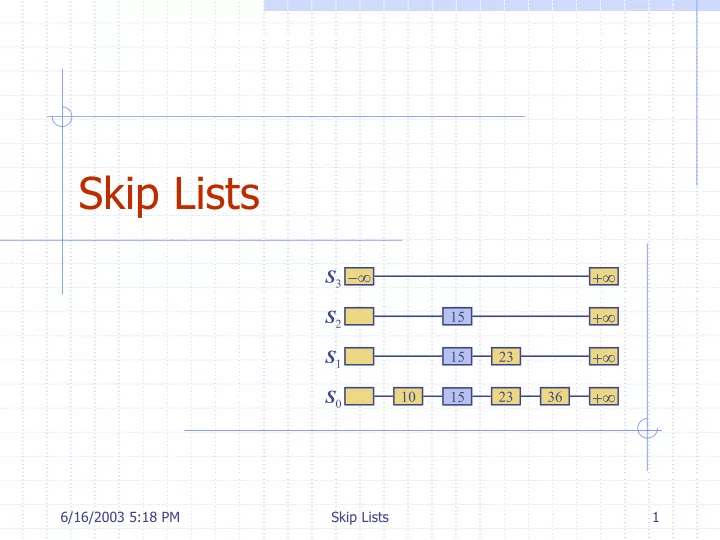
+∞ −∞ S3 S2 −∞ +∞
15
S1 −∞ +∞
23 15
S0 −∞ +∞
10 36 23 15
Skip Lists + S 3 S 2 + 15 S 1 + 15 23 S 0 + 10 15 - - PowerPoint PPT Presentation
Skip Lists + S 3 S 2 + 15 S 1 + 15 23 S 0 + 10 15 23 36 6/16/2003 5:18 PM Skip Lists 1 Outline and Reading What is a skip list (8.4) Operations Search (8.4.1) Insertion (8.4.2)
6/16/2003 5:18 PM Skip Lists 1
+∞ −∞ S3 S2 −∞ +∞
15
S1 −∞ +∞
23 15
S0 −∞ +∞
10 36 23 15
6/16/2003 5:18 PM Skip Lists 2
Search (§8.4.1) Insertion (§8.4.2) Deletion (§8.4.2)
Space usage Search and update times
6/16/2003 5:18 PM Skip Lists 3
A skip list for a set S of distinct (key, element) items is a series of lists S0, S1 , … , Sh such that
Each list Si contains the special keys +∞ and −∞ List S0 contains the keys of S in nondecreasing order Each list is a subsequence of the previous one, i.e.,
S0 ⊇ S1 ⊇ … ⊇ Sh
List Sh contains only the two special keys
We show how to use a skip list to implement the dictionary ADT
+∞ −∞
+∞
31
+∞
23 31 34 64
56 64 78
+∞
31 34 44
−∞
12 23 26
6/16/2003 5:18 PM Skip Lists 4
We search for a key x in a a skip list as follows:
We start at the first position of the top list At the current position p, we compare x with y ← key(after(p))
x = y: we return element(after(p)) x > y: we “scan forward” x < y: we “drop down”
If we try to drop down past the bottom list, we return NO_SUCH_KEY
Example: search for 78
+∞ −∞ −∞
+∞
31
64
+∞
23 31 34
−∞ +∞
12 23 26 31 34 44 56 64 78
6/16/2003 5:18 PM Skip Lists 5
A randomized algorithm performs coin tosses (i.e., uses random bits) to control its execution It contains statements of the type
b ← random() if b = 0 do A … else { b = 1} do B …
Its running time depends on the outcomes of the coin tosses We analyze the expected running time of a randomized algorithm under the following assumptions
the coins are unbiased, and the coin tosses are
independent
The worst-case running time
probability (e.g., it occurs when all the coin tosses give “heads”) We use a randomized algorithm to insert items into a skip list
6/16/2003 5:18 PM Skip Lists 6
To insert an item (x, o) into a skip list, we use a randomized algorithm:
We repeatedly toss a coin until we get tails, and we denote with i
the number of times the coin came up heads
If i ≥ h, we add to the skip list new lists Sh+1, … , Si +1, each
containing only the two special keys
We search for x in the skip list and find the positions p0, p1 , …, pi
For j ← 0, …, i, we insert item (x, o) into list Sj after position pj
Example: insert key 15, with i = 2
+∞ −∞ S3 +∞
23
p0 p1 −∞ S0
10 36
−∞ S2 p2 S2 −∞ +∞ +∞
15
−∞ S1 S1 −∞ +∞ +∞
23 15
S0 −∞ +∞
10 36 23 15 23
6/16/2003 5:18 PM Skip Lists 7
To remove an item with key x from a skip list, we proceed as follows:
We search for x in the skip list and find the positions p0, p1 , …, pi
We remove positions p0, p1 , …, pi from the lists S0, S1, … , Si We remove all but one list containing only the two special keys
Example: remove key 34
−∞ S3 +∞ −∞ +∞
45 12
−∞ +∞
23 23
−∞ +∞ S0 S1 S2 S0 −∞ S1 −∞ S2 −∞ +∞
45 12 23 34
+∞
34
p1 p2 +∞
23 34
p0
6/16/2003 5:18 PM Skip Lists 8
We can implement a skip list with quad-nodes A quad-node stores:
item link to the node before link to the node after link to the node below link to the node after
Also, we define special keys PLUS_INF and MINUS_INF, and we modify the key comparator to handle them
6/16/2003 5:18 PM Skip Lists 9
The space used by a skip list depends on the random bits used by each invocation of the insertion algorithm We use the following two basic probabilistic facts:
Fact 1: The probability of getting i consecutive heads when flipping a coin is 1/2i Fact 2: If each of n items is present in a set with probability p, the expected size
Consider a skip list with n items
By Fact 1, we insert an item
in list Si with probability 1/2i
By Fact 2, the expected size
The expected number of nodes used by the skip list is
n n n
h i i h i i
2 2 1 2 < = ∑
= =
Thus, the expected space usage of a skip list with n items is O(n)
6/16/2003 5:18 PM Skip Lists 10
The running time of the search an insertion algorithms is affected by the height h of the skip list We show that with high probability, a skip list with n items has height O(log n) We use the following additional probabilistic fact:
Fact 3: If each of n events has probability p, the probability that at least one event
Consider a skip list with n items
By Fact 1, we insert an item in
list Si with probability 1/2i
By Fact 3, the probability that
list Si has at least one item is at most n/2i
By picking i = 3log n, we have that the probability that S3log n has at least one item is at most n/23log n = n/n3 = 1/n2 Thus a skip list with n items has height at most 3log n with probability at least 1 − 1/n2
6/16/2003 5:18 PM Skip Lists 11
The search time in a skip list is proportional to
the number of drop-down
steps, plus
the number of scan-forward
steps
The drop-down steps are bounded by the height of the skip list and thus are O(log n) with high probability To analyze the scan-forward steps, we use yet another probabilistic fact:
Fact 4: The expected number of coin tosses required in order to get tails is 2
When we scan forward in a list, the destination key does not belong to a higher list
A scan-forward step is
associated with a former coin toss that gave tails
By Fact 4, in each list the expected number of scan- forward steps is 2 Thus, the expected number of scan-forward steps is O(log n) We conclude that a search in a skip list takes O(log n) expected time The analysis of insertion and deletion gives similar results
6/16/2003 5:18 PM Skip Lists 12
The expected space used
is O(n)
The expected search,
insertion and deletion time is O(log n)