Skills & Outcomes You should know and be able to apply the - - PowerPoint PPT Presentation

skills outcomes
SMART_READER_LITE
LIVE PREVIEW

Skills & Outcomes You should know and be able to apply the - - PowerPoint PPT Presentation

2.1 2.2 Skills & Outcomes You should know and be able to apply the following skills with confidence Unit 2 Perform addition & subtraction in unsigned & 2's complement system Integer Operations Determine if overflow has


slide-1
SLIDE 1

2.1

Unit 2

Integer Operations (Arithmetic, Overflow, Bitwise Logic, Shifting)

2.2

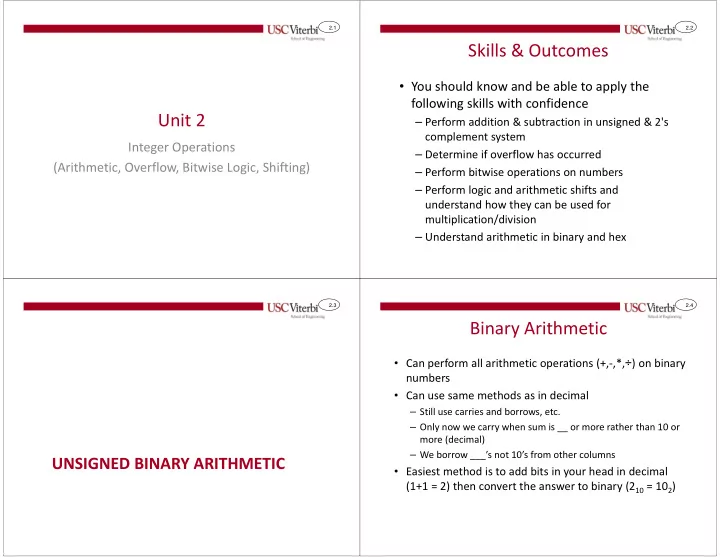
Skills & Outcomes

  • You should know and be able to apply the

following skills with confidence

– Perform addition & subtraction in unsigned & 2's complement system – Determine if overflow has occurred – Perform bitwise operations on numbers – Perform logic and arithmetic shifts and understand how they can be used for multiplication/division – Understand arithmetic in binary and hex

2.3

UNSIGNED BINARY ARITHMETIC

2.4

Binary Arithmetic

  • Can perform all arithmetic operations (+,-,*,÷) on binary

numbers

  • Can use same methods as in decimal

– Still use carries and borrows, etc. – Only now we carry when sum is __ or more rather than 10 or more (decimal) – We borrow ___’s not 10’s from other columns

  • Easiest method is to add bits in your head in decimal

(1+1 = 2) then convert the answer to binary (210 = 102)

slide-2
SLIDE 2

2.5

Binary Addition

  • In decimal addition we carry when the sum is 10 or

more

  • In binary addition we carry when the sum is 2 or more
  • Add bits in binary to produce a sum bit and a carry bit

+ 0 00

no need to carry sum bit

+ 1 01

no need to carry sum bit

1 + 0 01

no need to carry sum bit

1 + 1 10

carry 1 into next column

  • f bits

sum bit

1

2.6

Binary Addition & Subtraction

(10) (5) 0 1 1 1 + 0 0 1 1 (7) (3) 1 0 1 0

  • 0 1 0 1

2.7

Binary Addition

0110 + 0111 1101 (6) (7) (13) 110

8 4 2 1

2.8

Binary Addition

0110 + 0111 1101 (6) (7) (13) + 1 01

carry bit sum bit

0110 + 0111 1101 (6) (7) (13) 1 + 1 10 10

carry bit sum bit

0110 + 0111 1101 (6) (7) (13) 1 + 1 11 110 1

carry bit sum bit

0110 + 0111 1101 (6) (7) (13) + 0 01 110 1

carry bit sum bit

1 2 4 3

slide-3
SLIDE 3

2.9

Hexadecimal Arithmetic

  • Same style of operations

– Carry when sum is 16 or more, etc.

4 D16 + B 516

16 1 16 1

2.10

Binary Multiplication

  • Like decimal multiplication, find each partial product

and _________ them, then sum them up

  • Multiplying two n-bit numbers yields at most a

______-bit product

0 1 1 0 * 0 1 0 1 (6) (5)

Sum of the partial products

+

Partial Products

2.11

Binary Division

  • Use the same long division techniques as in

decimal

  • Dividing two n-bit numbers may yield an

n-bit quotient and n-bit remainder

10 1 0 1 1 0 1 0 1 r.1

  • 1 0

0 1

  • 0 0

1 1

  • 1 0

0 1 (2)10 (11)10 (5 r.1)10

2.12

SUBTRACTION THE EASY WAY

"Taking the 2's complement"

slide-4
SLIDE 4

2.13

Modulo Arithmetic

  • The primary difference between how humans

and computers perform arithmetic is the finite _______________ of computers

– As humans we can use more digits (precision) as needed – Computers can only used a _________ set of bits

  • Much like the odometer on your car once you go too

many miles the values will wrap from 999999 to 000000

  • Essentially all computer arithmetic is ___________

arithmetic

  • If we have a width of w bits, then all operations are

module ______

  • This leads to alternate approaches to arithmetic

– Example: Consider how you could change the clock time from 5 p.m. to 3 p.m. if you can't ________ hours

2.14

Taking the Negative

  • Question: Given a number in 2’s complement how

do we find its negative (i.e. -1 * X)

  • Answer: By "__________________________"

– 0110 = +6 => -6 = 1010 – Operation defined as:

  • 1. ______________________________
  • 2. ______________________________

(i.e. finish with the same # of bits as we start with)

– See next slides for example

CS:APP 2.3.3

2.15

Taking the 2’s Complement

  • Invert (flip) each bit

(take the 1’s complement)

– 1’s become 0’s – 0’s become 1’s

  • Add 1 (drop final

carry-out, if any)

010011

Bit flip is called the 1’s complement of a number Original number = +19

  • 32 16 8 4 2 1

Resulting number = -19 Important: Taking the 2’s complement is equivalent to taking the negative (negating)

2.16

Taking the 2’s Complement

101010

Original number = -22

  • 32 16 8 4 2 1

Resulting number = +22 Take the 2’s complement yields the negative of a number Taking the 2’s complement again yields the original number (the operation is symmetric) Back to original = -22

0000 1000

Original # = 0 2’s comp. of 0 is __ Original # = -8 Negative of -8 is ___ (i.e. no positive equivalent, but this is not a huge problem) Take the 2’s complement Take the 2’s complement

1 2 3

slide-5
SLIDE 5

2.17

ADDITION AND SUBTRACTION

The same algorithms regardless of unsigned or signed

2.18

Radix Complement

12 1 2 3 9 10 11 4 8 7 5 6 12 1 2 3 9 10 11 4 8 7 5 6 . 00 01 02 03 98 99 04 . . . . 00 01 02 03 98 99 04 . . . .

0000 0001 0010 0011 1110 1111 0100

. . . .

0000 0001 0010 0011 1110 1111 0100

. . . . 10’s complement 04-02 = 04 + 98 2’s complement 0100 - 0010 = 0100 + 1110 Clock Analogy 4-2 = 4+10

When using modulo arithmetic, subtraction can always be converted to addition.

2.19

2’s Complement Addition/Subtraction

  • Addition

– Sign of the numbers _______________ – Add column by column – Drop any final ______________

  • The secret to modulo arithmetic
  • Subtraction

– Any subtraction (A-B) can be converted to addition (_______) by taking the ______________of B – (A-B) becomes (A + _________ ) – Drop any carry-out

  • The secret to modulo arithmetic

CS:APP 2.3.1 CS:APP 2.3.2

2.20

2’s Complement Addition

  • No matter the sign of the operands just add as normal
  • Drop any extra carry out

0011 + 0010 (3) (2) 1101 + 0010 (-3) (2) 0011 + 1110 (3) (-2) 1101 + 1110 (-3) (-2)

slide-6
SLIDE 6

2.21

Unsigned and Signed Addition

  • Addition process is the _________ for both

unsigned and signed numbers

– Add columns right to left

  • Examples:

1001 + 0011

If unsigned If signed

2.22

2’s Complement Subtraction

  • Take the 2’s complement of the subtrahend (bottom #)

and add to the original minuend (top #)

  • Drop any extra carry out

0011

  • 0010

(+3) (+2) 1101

  • 1110

(-3) (-2)

2.23

Unsigned and Signed Subtraction

  • Subtraction process is the same for both

unsigned and signed numbers

– Convert A – B to A + Comp. of B – Drop any final carry out

  • Examples:

(12) (2) (-4) (2)

If unsigned If signed

1100

  • 0010

If unsigned If signed

2.24

Important Note

  • Almost all computers use 2's complement

because…

  • The same addition and subtraction

___________ can be used on unsigned and 2's complement (signed) numbers

  • Thus we only need one set of

_____________________________ to perform operations on both unsigned and signed numbers

slide-7
SLIDE 7

2.25

OVERFLOW

2.26

Overflow

  • Overflow occurs when the result of an

arithmetic operation is _____________ ________________________________

  • Conditions and tests to determine
  • verflow depend on the ________ being

used

–Different algorithms for detecting overflow based on _____________________

CS:APP 2.3.1 CS:APP 2.3.2

2.27

Unsigned Overflow

0000 0001 0010 0011 0100 0101 0110 0111 1000 1111 1110 1101 1100 1011 1010 1001 +1 +2 +3 +4 +5 +6 +7 +8 +9 +10 +11 +12 +13 +14 +15

Overflow occurs when you cross this discontinuity

10 Plus 7

10 + 7 = 17

With 4-bit unsigned numbers we can only represent 0 – 15. Thus, we say overflow has occurred.

2.28

2’s Complement Overflow

0000 0001 0010 0011 0100 0101 0110 0111 1000 1111 1110 1101 1100 1011 1010 1001 +1 +2 +3 +4 +5 +6 +7

  • 8
  • 7
  • 6
  • 5
  • 4
  • 3
  • 2
  • 1

Overflow occurs when you cross this discontinuity

  • 6 + -4 = -10

With 4-bit 2’s complement numbers we can only represent

  • 8 to +7. Thus, we say overflow

has occurred.

5 + 7 = +12

slide-8
SLIDE 8

2.29

Overflow in Addition

  • Overflow occurs when the result of the addition

cannot be represented with the given number

  • f bits.
  • Tests for overflow:

– Unsigned: if _________ [result __________ than inputs] – Signed: if _____________ [result has inappropriate sign]

1101 + 0100 0001

1 1

(13) (4) (17) (-3) (4) (+1)

If unsigned If signed Overflow Cout = 1 No Overflow n + p

0110 + 0101 1011

1

(6) (5) (11) (6) (5) (-5)

If unsigned If signed No Overflow Cout = 0 Overflow p + p = n

2.30

Overflow in Subtraction

  • Overflow occurs when the result of the subtraction

cannot be represented with the given number of bits.

  • Tests for overflow:

– Unsigned: if _______ [expect negative result] – Signed: ________________[result has inappropriate sign] (7) (8) (-1) (7) (-8) (15)

If unsigned If signed

0111

  • 1000

0111_ 0111 0111 + 1 1111

1’s comp. of B Add 1 A If unsigned Overflow Cout = 0 If signed Overflow p + p = n

(15) (-1)

Desired Results

2.31

MULTIPLICATION AND DIVISION

2.32

Binary Multiplication

  • Multiplying two n-bit numbers yields at most a

2*n-bit product

  • Multiplication operations on a modern processor can

take ______ times longer than addition operations

0 1 1 0 * 0 1 0 1 0 1 1 0 (6) (5)

Sum of the partial products

0 0 0 0 0 1 1 0 + 0 0 0 0 0 0 1 1 1 1 0

Partial Products

CS:APP 2.3.4

slide-9
SLIDE 9

2.33

Binary Division

  • Dividing two n-bit numbers may yield an

n-bit quotient and n-bit remainder

  • Division operations on a modern processor can take

________ times longer than addition operations

10 1 0 1 1 0 1 0 1 r.1

  • 1 0

0 1

  • 0 0

1 1

  • 1 0

0 1 (2)10 (11)10 (5 r.1)10

2.34

Unsigned Multiplication Review

  • Same rules as decimal multiplication
  • Multiply each bit of Q by M shifting as you go
  • An m-bit * n-bit mult. produces an m+n bit result
  • Notice each partial product is a shifted copy of M or

0 (zero)

1010 * 1011 1010 1010_ 0000__ + 1010___ 01101110 M (Multiplicand) Q (Multiplier) PP(Partial Products) P (Product)

2.35

Signed Multiplication Techniques

  • When multiplying signed (2’s comp.) numbers, some

new issues arise

  • Must sign extend partial products (out to 2n bits)

1001 * 0110 0000 1001_ 1001__ + 0000___ 00110110 = -7 = +6 = +54

Without Sign Extension… Wrong Answer!

1001 * 0110 00000000 1111001_ 111001__ + 00000___ 11010110 = -7 = +6 = -42

With Sign Extension… Correct Answer!

2.36

Signed Multiplication Techniques

  • Also, must worry about negative multiplier

– MSB of multiplier has negative weight – If MSB=1, multiply by -1 (i.e. take 2’s comp. of multiplicand)

1100 * 1010 00000000 1111100_ 000000__ + 11100___ 11011000 = -4 = -6 = -40

With Sign Extension but w/o consideration of MSB… Wrong Answer! With Sign Extension and w/ consideration of MSB… Correct Answer!

1100 * 1010 00000000 1111100_ 000000__ + 00100___ 00011000 = -4 = -6 = +24

Place Value: -8 Multiply by -1

Main Point: Signed and Unsigned Multiplication require different techniques…Thus different instructions.

slide-10
SLIDE 10

2.37

BITWISE & LOGIC OPERATIONS

2.38

Modifying Individual Bits

  • Suppose we want to change only a single bit (or a few bits)

in a variable [i.e. char v;] _________________ the other bits

– Set the LSB of v to 1 w/o affecting other bits

  • Would this work? v = 1;

– Set the upper 4 bits of v to 1111 w/o affecting other bits

  • Would this work? v = 0xf0;

– Clear the lower 2 bits of v to 00 w/o affecting other bits

  • Would this work? v = 0;

– No!!! Assignment changes ALL bits in a variable

  • Because the smallest unit of data in computers is usually a

__________, manipulating individual bits requires us to use BITWISE OPERATIONS.

– AND = & – OR = | – XOR = ^ – NOT = ~

? ? ? ? ? ? ? ? ? Desired v

(change LSB to 1)

? ? ? ? ? ? 1 1-byte variable 1 Desired v

(change upper 4 bits to 1111)

1 1 1 ? ? ? ? ? Desired v

(change lower 2 bits to 00)

? ? ? ? ? 0 0

7 6 5 4 3 2 1 0 Bit:

CS:APP 2.1.7

2.39

Using Bitwise Ops to Change Bits

  • ANDs can be used to clear a bit (make it '0') or leave it unchanged
  • ORs can be used to set a bit (make it '1') or leave it unchanged
  • XORs can be used to invert a bit (flip it) or leave it unchanged

X Y AND 1 1 1 1 1

Pass Force '0'

X Y XOR 1 1 1 1 1 1

Pass Invert

X Y OR 1 1 1 1 1 1 1

Pass Force '1' 0 OR y = __ 1 OR y = __ y OR y = 1 0 AND y = __ 1 AND y = __ y AND y = y 0 XOR y = __ 1 XOR y = NOT __ y XOR y = 0 Identity 0 OR Y = __ 1 AND Y = __ Null Ops 1 OR Y = __ 0 AND Y = __ Idempotency Y OR Y = Y Y AND Y = Y

2.40

Bitwise Operations

  • The C AND , OR, XOR, NOT bitwise operations perform

the operation on each pair of bits of 2 numbers

0xa5 AND 0xf0 1010 0101 & 1111 0000 0xa5 OR 0xf0 1010 0101 | 1111 0000 0xa5 XOR 0xf0 1010 0101 ^ 1111 0000

#include <stdio.h> // C-Library // for printf() int main() { char a = 0xa5; char b = 0xf0; printf("a & b = %x\n", a & b); printf("a | b = %x\n", a | b); printf("a ^ b = %x\n", a ^ b); printf("~a = %x\n", ~a); return 0; }

NOT 0xa5 ~ 1010 0101 C bitwise operators: & = AND | = OR ^ = XOR ~ = NOT CS:APP 2.1.7

slide-11
SLIDE 11

2.41

Logical vs. Bitwise Operations

  • The C language has two types of logic operations

– Logical and Bitwise

  • Logical Operators (______________)

– Interpret entire value as either _____ (non-zero) or _____ (zero)

  • Bitwise Operators (_____________)

– Applies the logical operation on each __________ of the inputs

0000 0001=T && 0000 0010=T 0000 0001=T 0000 0001 & 0000 0010 F = 0000 0000 ! 0000 0001=T 0000 0000=F ~ 0000 0001 T = 1111 1110

#include <stdio.h> int main() { int x = 1, y = 2; int z1 = x && y; int z2 = x & y; printf("z1=%d, z2=%d\n",z1,z2); char x = 1; if( !x ) { printf("L1\n"); } if( ~x ) { printf("L2\n"); } return 0; }

CS:APP 2.1.8 Important Note: Since !(non-zero) = 0; and !0 = 1 So !!35=1. And !!-109=1

!! 0101 0111=T 0000 0001=T

2.42

Application: Swapping via XORs

  • Swapping variables can be done

with a 3rd 'temp' variable

  • For bitwise swapping, XORs can

be used

0101 1001=x

#include <stdio.h> int main() { int x = 0x59, y = 0xd3; return 0; }

1101 0011=y

#include <stdio.h> int main() { int x = 0x59, y = 0xd3; int temp = x; x = y; y = temp; return 0; }

Traditional swap with 'temp' XOR swap

2.43

Exercises

  • Determine if an integer is
  • dd (w/o % operator).
  • Determine if an integer is

a multiple of 4 (w/o %

  • perator).

bool isOdd(int x) { } bool isMultOf4(int x) { }

2.44

SHIFT OPERATIONS

Arithmetic and Logical Shifts

slide-12
SLIDE 12

2.45

Shift Operations

  • Shifts data bits either left or right

– Bits shifted out and __________________ on one side – Usually (but not always) 0’s are shifted in on the other side

  • Shifting is equivalent to multiplying or dividing by powers of __
  • 2 kinds of shifts

– Logical shifts (used for ________________ numbers) – Arithmetic shifts (used for ______________ numbers)

0 0 0 0 0 0 1 1 Right Shift by 2 bits:

Original Data Shifted by 2 bits

0 0 0 0 1 1 0 0 0 0 0 0 1 0 1 0 0 0 Left Shift by 2 bits:

Original Data Shifted by 2 bits

0 0 0 0 1 0 1 0 0 0

0’s shifted in… 0’s shifted in…

CS:APP 2.1.9

2.46

Logical Shift vs. Arithmetic Shift

  • Logical Shift

– Use for ___________ or non- numeric data – Will always shift in ___’s whether it be a left or right shift

  • Arithmetic Shift

– Use for ____________ data – Left shift will shift in 0’s – Right shift will sign extend (___________ the sign bit) rather than shift in 0’s

  • If negative number…stays

________ by shifting in __’s

  • If positive…stays _________ by

shifting in ___’s

Right shift Left shift Right shift Left shift

_ _ _

2.47

Logical Shift

  • 0’s shifted in
  • Only use for operations on unsigned data

– Right shift by n-bits = ____________ by 2n – Left shift by n-bits = ____________ by 2n

0 0 Logical Right Shift by 2 bits: 0 0 0 Logical Left Shift by 3 bits:

0’s shifted in… 0’s shifted in…

0 ... 0 1 1 0 0 = +12 = ____ = ___ 0 x 0 0 0 0 0 0 0 C

2.48

Arithmetic Shift

  • Use for operations on signed data
  • Arithmetic Right Shift – replicate MSB

– Right shift by n-bits = Dividing by 2n

  • Arithmetic Left Shift – shifts in 0’s

– Left shift by n-bits = Multiplying by 2n

1 1 Arithmetic Right Shift by 2 bits: 0 0 Arithmetic Left Shift by 2 bits:

MSB replicated and shifted in… 0’s shifted in…

1 1 ... 1 1 0 0 = -4 = ____ = -16

Notice if we shifted in 0’s (like a logical right shift) our result would be a positive number and the division wouldn’t work

0 x F F F F F F F C

Notice there is no difference between an arithmetic and logical left shift. We always shift in 0’s.

slide-13
SLIDE 13

2.49

Multiplying by Non-Powers of 2

  • Left shifting by n-bits allow us to

multiply by 2n

  • But what if I have to multiply a

number by a non-power of 2 (i.e. 17*x). Can we still use shifting?

– _______. Break constant into a _____ using ____________ coefficients – 17x = _________________

  • Exercise: How many adds/shift

would be needed to compute 14*x

– ____________________________ OR – ____________________________

int mul17(int x) { return 17*x; }

17=

1 2 4 8 16

sall $4, %edx addl %edx, %eax int mul17(int x) { int x16 = _________; return ____________; }

Written Code Optimized Assembly (Equivalent C) CS:APP 2.3.6 Compiler will determine when ___________ become ________ than constant multiplication

2.50

Integer Division By Shifting

  • What is 5/2?
  • ______
  • Is 5/2 = (5 >> 1)
  • _______

5 = 0 1 0 1

1 2 4

  • 8

5>>1 =

1 2 4

  • 8

0.5

  • 5>>1 =

1 2 4

  • 8

0.5

  • 5 =

1 2 4

  • 8
  • What is -5/2?
  • _____
  • Is -5/2 = (-5 >> 1)
  • _____

Main Point: Rounding ______ when using shifting to divide a ________ number. CS:APP 2.3.7

2.51

Dividing Negative Numbers

5 >> 1

0 0 1 0

1 2 4

  • 8

1

0.5

  • 5 >> 1
  • 4
  • 8
  • 3 -2.5

2.5 2 Rounding (by dropping fractional portion) Rounding (by dropping fractional portion)

+5>>1

1 2 4

  • 8

1

0.5

  • 5>>1

1 1 0 1

2.5 2

  • 2
  • 2.5

Traditional integer division ______________________ (i.e. ______ fractional portion)

Traditional integer rounding

Main Point: Dividing numbers in the 2's complement system causes rounding to the _________________________, not toward _____ as desired.

2.52

Biasing

  • Summary: Dividing x / 2k by

performing (x >> k)…

– Works when ______ OR when ______ & x is a multiple of __ – Doesn't work when _____and x is NOT a multiple of ____

  • Idea to solve the problem:

– ______ some value (aka a ___ value) to x before _______ that will correct for the rounding issue – Add ________ (i.e. _______)

  • 4>>1 = 1 1 1 0
  • 4 = 1 1 0 0
  • 5>>1 = 1 1 0 1
  • 5 = 1 0 1 1
  • 5 1 0 1 1
  • 4>>1 = 1 1 1 0 -2
  • 3
  • 2
slide-14
SLIDE 14

2.53

More Examples

  • -8 / 4 = (-8 >> 2)

– Bias by ________ – (-8 + ___) >> 2

  • -7 / 4 = (-7 >> 2)

– Bias by ________ – (-7 + ___) >> 2

  • -20 / 16 = (-20 >> 4)

– Bias by _______ – (-20 + ____) >> 4

  • 8 = 1 0 0 0
  • 8>>2 = 1 1 1 0
  • 7 = 1 0 0 1
  • 7>>2 = 1 1 0 0
  • 1
  • 2
  • 2
  • 2

2.54

CS:APP Practice 2.43 (tweaked)

#define M /* mystery number 1 */ #define N /* mystery number 2 */ int arith(int x, int y) { int result = x*M + y/N; return result; } /* Translation of assembled code for a given value of M and N */ int optarith(int x, int y) { int t = x; x <<= 5; x -= t; if(y < 0) y += 3; y >>= 2; return x + y; }

What were M and N when the code was compiled?