Six Best Practices for Creating a Comprehensive Plan Mitchell - - PowerPoint PPT Presentation

six best practices for creating a
SMART_READER_LITE
LIVE PREVIEW

Six Best Practices for Creating a Comprehensive Plan Mitchell - - PowerPoint PPT Presentation

Six Best Practices for Creating a Comprehensive Plan Mitchell Silver, FAICP Memphis, TN 2.1.17 1. Purpose of a comprehensive plan 2. Be clear on the problems you are solving 3. Setting the framework 4. Understand the value of land 5.


slide-1
SLIDE 1

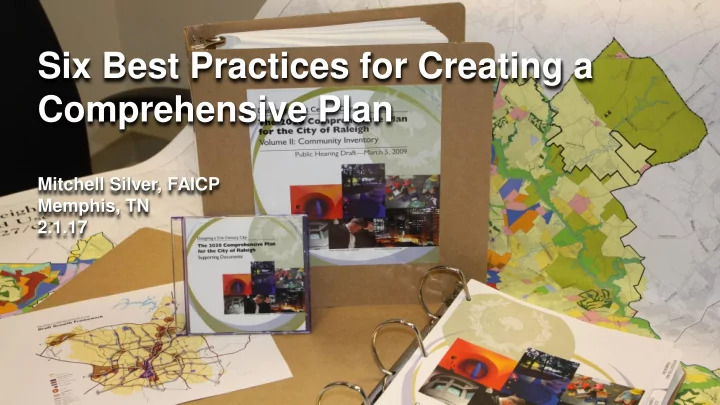
Six Best Practices for Creating a Comprehensive Plan

Mitchell Silver, FAICP Memphis, TN 2.1.17
slide-2
SLIDE 2

1. Purpose of a comprehensive plan 2. Be clear on the problems you are solving 3. Setting the framework 4. Understand the value of land 5. Engagement process 6. Adoption and Implementation

slide-3
SLIDE 3

Purpose of a comprehensive plan

slide-4
SLIDE 4

Role of planning

  • Manage growth and change. Planning deals with risk and

uncertainty about the future. Plans for present and future

  • generations. Planning is about place, but also about people.
  • Planners shall have special concern for the long-term

consequences of present actions. There are also consequences for no action!

  • Have ONE comprehensive plan and not many fragmented

and diassocated plans.

  • When you say no to something, you are saying yes to

something else. What are you saying yes to?

slide-5
SLIDE 5

Plan vs. Code

  • The Comprehensive Plan is a public

policy document – a blueprint. It should represent your city’s vision and values for the future. A plan helps local government manage growth or change, decision-making, public improvements and capital investment.

  • The Development Code “codifies” part of

the vision and values to ensure the future is predictable. The purpose of zoning is to protect the public health, safety and welfare.

slide-6
SLIDE 6

Be clear on the problems you are solving

slide-7
SLIDE 7
  • Graying and browning of America
  • Rise of the single person households
  • Traditional family is changing
  • Aging infrastructure
  • Climate change
  • Water
  • Energy
  • Obesity, public health, food security
  • Jobs and the economy
  • Equity, Income Inequality
  • Affordable places, Gentrification

21st Century Issues and Challenges

slide-8
SLIDE 8

The “Planning Raleigh 2030” Challenge

How will Raleigh manage growth over the next 20 years? Raleigh must find where to place:

  • 120,000 dwellings units (270,000 people)
  • 170,000 jobs (85 million s.f. of non-residential)
  • Land for infrastructure and open space

As of 2010, Raleigh has about:

  • 19,000 acres to develop within Raleigh’s jurisdiction
  • 20,000 acres outside our ETJ
  • Low density and sprawl was no longer an option!
slide-9
SLIDE 9
slide-10
SLIDE 10
  • Not everyone believed proactive planning was vital to our competiveness
  • Had a small town identity. Had to transition from “Mayberry to Metro”
  • Growing fast – 12,000 to 15,000 newcomers a year
  • Would run out land to develop in 20 years. Running out of water.
  • Sprawl was fiscally irresponsible and too expensive to maintain
  • Was not aware demographics shifts and its implications
  • Did not offer housing, transportation and lifestyle choices for new markets

Selected List of Challenges

slide-11
SLIDE 11

The New Reality in the U.S.

  • More older Americans. Longer life expectancy.
  • More diversity and multiculturalism.
  • More people with disabilities. More multi-gen households
  • More single mothers. Fewer couples getting married
  • Immigration and migration will continue.
  • By 2030, majority of households will be single persons.
  • By 2044, no majority race.
slide-12
SLIDE 12

Household Change in the U.S (1960-2025)

Source: US Census for 1960 and 2000; Arthur Nelson’s projections based on Riche (2003) and Masnick, Belsky and Di (2004)

1960 2000 2025

Households with children 48% 33% 28% Households without children 52% 67% 72% Single person households 13% 26% 28%

slide-13
SLIDE 13

Implications of an Aging Population

  • Land use patterns and transportation choices will

change as millions of aging Americans realize they can no longer drive.

  • 600,000 over the age of 70 stop driving every year.

Visits to friends will drop by 65%.

  • NIMBYism may grow.

Source: Transportation for America, Center for Neighborhood Technology and Mitchell Silver

slide-14
SLIDE 14

Source: Mitchell Silver adapted from various sources Photos: NYC Parks

Plan for the Generations

Greatest Generation 1901-1924 Silent/Mature Generation 1923-1945 Baby Boom Generation 1946-1964 Generation X 1965-1981 Generation Y 1982-1995 Generation Z 1996-today

slide-15
SLIDE 15

Future Consumer Demand

Photos: xxxxxxx Source: James Chung, Reach Advisors

Future consumer preferences and market demands

slide-16
SLIDE 16

Raleigh Nashville Memphis Tenn. United States Greatest 1.1% 1.4% 1.5% 1.7% 1.8% Silent/Mature 6.7% 8.9% 9.0% 12.0% 11.5% Boomer 20.8% 23.8% 24.4% 27.0% 26.5% Gen X 25.1% 22.7% 20.7% 19.9% 19.7% Gen Y 26.2% 24.4% 23.7% 20.1% 20.9% Gen Z 20.1% 18.8% 20.7% 19.2% 19.6% Median Age 32.2 33.6 33.6 38.3 37.3 XYZ Gen Split 71.4% 65.9% 65.1% 59.2% 60.2%

The “XYZ Factor”

Source: Methodology developed by Mitchell Silver based on 2011 American Community Survey

slide-17
SLIDE 17

Implications of the Generational Shift

  • It’s not just about “What’s Next” but “Who’s

next”

  • There will be tension between over the

next 10 years as generations transform attitudes and values. Generation X and Y will begin to influence laws and public policy.

  • 20th Century belongs to us. 21st Century

belongs to them. Let them own it.

Source: Mitchell Silver

slide-18
SLIDE 18

Setting the framework

slide-19
SLIDE 19

Comprehensive Plan

slide-20
SLIDE 20

2030 Comp Plan Is Defined by Six Themes

Economic Prosperity & Equity Expanding Housing Choices Managing Our Growth Coordinating Land Use & Transportation Greenprint Raleigh—Sustainable Development Growing Successful Neighborhoods & Communities

slide-21
SLIDE 21
slide-22
SLIDE 22
slide-23
SLIDE 23

Growth Framework Map

Source: City of Raleigh

New direction: 60% to 70% of all new growth will be directed to 8 growth centers and 12 multi-modal corridors.

slide-24
SLIDE 24

Understand the value of land

slide-25
SLIDE 25

Strategic planning adds value

  • It would take 600-single family homes on a

150-acre subdivision to equal the tax value

  • f the Wells Fargo Capital Center, which sits
  • n 1.2 acres of land.
  • Wells Fargo Capital Center in downtown

Raleigh has 90 times the tax value per acre than the average suburban acre.

Source: Kristopher Larson and Mitchell Silver, 2008

slide-26
SLIDE 26

Return on Investment

  • Downtown high rise residential on 3-acre

site pays off its infrastructure in 3 years. The return on infrastructure investment is 35%.

  • Suburban multi-family complex on a 30-acre

site pays off its infrastructure in 42 years. The return on infrastructure investment is 2%.

Source: Public Interest Projects, Inc.

slide-27
SLIDE 27
slide-28
SLIDE 28

6

slide-29
SLIDE 29
slide-30
SLIDE 30
slide-31
SLIDE 31

Leveraged Public Investment

  • B
slide-32
SLIDE 32

The engagement process

slide-33
SLIDE 33
  • Greatest Generation

Public Meetings, direct mail, votes

  • Silent/Chosen/Mature Public Meetings, direct mail, votes
  • Baby Boom

Public Meetings, Social Media, web, votes

  • Gen. X

Public & Interactive Meetings, Social Media, web

  • Gen. Y

Social media, web, interactive meetings

  • Gen. Z

Social media, web, interactive meetings

Sources: Mitchell Silver

Engaging Generations

slide-34
SLIDE 34
slide-35
SLIDE 35
slide-36
SLIDE 36

Big Ideas and Kids City

slide-37
SLIDE 37
slide-38
SLIDE 38
slide-39
SLIDE 39
slide-40
SLIDE 40

Implementation

slide-41
SLIDE 41

Comprehensive Plan Development Code Public and/or Private Investment Policy Guidance Capital, Equity

  • r Incentives

How to implement a Plan

slide-42
SLIDE 42

Focus on implementation!

  • Policy recommendations
  • Action items
  • Development code
  • Design Guidelines or standards
  • Incentives
  • Special assessment districts
  • Tax increment financing
  • Capital improvement program
  • Bonds or General Fund
  • Referenda (sales tax, property tax)
  • Public Private Partnerships
  • Grants
slide-43
SLIDE 43

New Implementation Team

  • Moving from plan to action
  • Oversee Comprehensive Plan implementation
  • Ensures consistency with other department

plans

  • Creates a matrix for all plan recommendations
  • Cost estimates in area plans and/or studies
  • Annual reports to City Council about

progress

  • Identify funding options
  • Capital Improvement Program, GIS mapping
slide-44
SLIDE 44
slide-45
SLIDE 45

Annual Progress Reports

  • Emerging issues
  • Policies or actions implemented
  • Policies or actions to be added
  • r removed
slide-46
SLIDE 46

Right Rules, Right Places

Next generation coding Rethink purpose of codes Meet demands of future markets

slide-47
SLIDE 47
slide-48
SLIDE 48
slide-49
SLIDE 49
  • Ensure everyone understands the purpose of a comprehensive plan
  • Make sure you know the problems you are solving
  • Have a vision, communicate your values and set a framework
  • You must understand the value of land
  • Have a diverse, creative and inclusive engagement process
  • Implementation is the most important part of the plan