Sir John Cockcroft FRS b. Todmorden (Lancashire and Yorkshire!) ed. - - PowerPoint PPT Presentation

sir john cockcroft frs
SMART_READER_LITE
LIVE PREVIEW

Sir John Cockcroft FRS b. Todmorden (Lancashire and Yorkshire!) ed. - - PowerPoint PPT Presentation

Cockcroft John Dainton August 11th 2006 Institute Sir Keith ONions at CI and DL Daresbury THE COCKCROFT INSTITUTE of ACCELERATOR SCIENCE and TECHNOLOGY http://www.lancs.ac.uk/cockcroft-institute/ Sir John Cockcroft FRS b. Todmorden


slide-1
SLIDE 1

John Dainton August 11th 2006 Sir Keith O’Nions at CI and DL

THE COCKCROFT INSTITUTE of ACCELERATOR SCIENCE and TECHNOLOGY

http://www.lancs.ac.uk/cockcroft-institute/

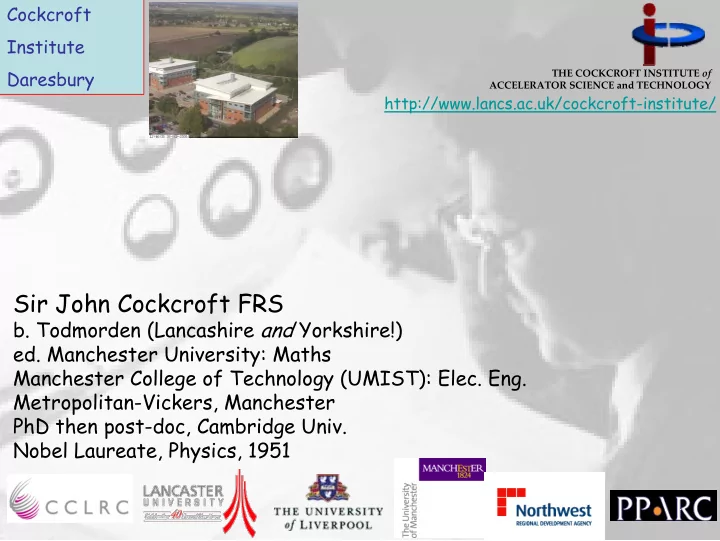
Sir John Cockcroft FRS

  • b. Todmorden (Lancashire and Yorkshire!)
  • ed. Manchester University: Maths

Manchester College of Technology (UMIST): Elec. Eng. Metropolitan-Vickers, Manchester PhD then post-doc, Cambridge Univ. Nobel Laureate, Physics, 1951

Cockcroft Institute Daresbury

slide-2
SLIDE 2

John Dainton August 11th 2006 Sir Keith O’Nions at CI and DL

THE COCKCROFT INSTITUTE of ACCELERATOR SCIENCE and TECHNOLOGY

History History

  • why here in NW England ?
  • Daresbury ↔ accelerator-lead research univs

Liverpool Lancaster Manchester Nuclear Physics (since Rutherford !) High Energy Physics (since Chadwick !) Synchrotron Radiation science (since SRF 1970s)

  • all require new accelerator systems for progress
  • all have been on Daresbury campus in their time

“… they were fortunate to have the support of Metropolitan Vickers: … the Manchester company.”

B Cathcart in “The Fly in the Cathedral”

“… they were fortunate to have the support of Metropolitan Vickers: … the Manchester company.”

B Cathcart in “The Fly in the Cathedral”

  • Cockcroft/Walton experience 70 years on

Cockcroft Institute Daresbury

slide-3
SLIDE 3

John Dainton August 11th 2006 Sir Keith O’Nions at CI and DL

THE COCKCROFT INSTITUTE of ACCELERATOR SCIENCE and TECHNOLOGY

R&D Challenge R&D Challenge

ILC LHC LCLS ν-Factory

High Energy Physics “light”

  • universal
  • MV/m
  • intensity
  • nm delivery

Cockcroft Institute +UK plc

XFEL DIAMOND

  • global

ESS

neutrons

Cockcroft Institute Daresbury

slide-4
SLIDE 4

John Dainton August 11th 2006 Sir Keith O’Nions at CI and DL

THE COCKCROFT INSTITUTE of ACCELERATOR SCIENCE and TECHNOLOGY

  • UK Funding Sources

! SNS (1 MW) from 2007 ! JPARC (1 MW) from 2009/10 ? ! !

A A A A A A A A

A accelerator science and technology

EPSRC EPSRC EPSRC EPSRC EPSRC EPSRC

EPSRC science PPARC science

RC-UK Facilities RC-UK Facilities

PPARC PPARC

Cockcroft Institute Daresbury

slide-5
SLIDE 5

John Dainton August 11th 2006 Sir Keith O’Nions at CI and DL

THE COCKCROFT INSTITUTE of ACCELERATOR SCIENCE and TECHNOLOGY

Accelerators Today Accelerators Today

  • accelerators today drive wealth creation
  • accelerator technology of the 20th Century
  • from the physics of the 20th Century
  • accelerators tomorrow ?
  • accelerator science ↔ KT ↔ UK plc

Cockcroft Institute +UK plc

Cockcroft Institute Daresbury

slide-6
SLIDE 6

John Dainton August 11th 2006 Sir Keith O’Nions at CI and DL

THE COCKCROFT INSTITUTE of ACCELERATOR SCIENCE and TECHNOLOGY

Mission Mission

The Institute’s “mission” is summarised in the following “deliverables”:

  • generic R&D in Accelerator Science and Technology (AST);
  • project specific R&D in AST

(e.g. a linear collider and a Neutrino Factory);

  • leadership and management of national deliverables to

international facilities (which may be UK-situated);

  • competence in crucial and specific technologies;
  • technology transfer to industry;
  • staff complement of internationally acknowledged expertise;
  • seamless involvement of the HEI and CCLRC sectors;
  • education and training to ensure a flourishing staff

supply side.

Cockcroft Institute Daresbury

slide-7
SLIDE 7

John Dainton August 11th 2006 Sir Keith O’Nions at CI and DL

THE COCKCROFT INSTITUTE of ACCELERATOR SCIENCE and TECHNOLOGY

Participation Participation

  • unique, seamless, collaboration of established

research excellence in NW England

  • seamless synergy of basic science

engineering and technology industry UK inward investment

  • science → people, skills, innovation, progress
  • high-tech → industrial production
  • economic development (national + regional)

“faculty” + pdocs + students now 30 FTE on to 60 FTE senior + junior scientists + students now 50 FTE Cockcroft Institute Daresbury

slide-8
SLIDE 8
slide-9
SLIDE 9

New mathematical modelling of ultra-relativistic charge

David Burton Jonathan Gratus Robin Tucker Lancaster University and the Cockcroft Institute

New mathematical modelling of ultra-relativistic charge – p.1/??

slide-10
SLIDE 10

Charged Continua with Self- Fields

  • A new approach for analysing the dynamic behaviour of

distributions of charged particles in an electromagnetic field

New mathematical modelling of ultra-relativistic charge – p.2/??

slide-11
SLIDE 11

Charged Continua with Self- Fields

  • A new approach for analysing the dynamic behaviour of

distributions of charged particles in an electromagnetic field

  • Yields hierarchy of mainly linear equations for an

asymptotic approximation for self-consistent radiation fields and charged currents in ultra-relativistic configurations

New mathematical modelling of ultra-relativistic charge – p.2/??

slide-12
SLIDE 12

Charged Continua with Self- Fields

  • A new approach for analysing the dynamic behaviour of

distributions of charged particles in an electromagnetic field

  • Yields hierarchy of mainly linear equations for an

asymptotic approximation for self-consistent radiation fields and charged currents in ultra-relativistic configurations

  • Employs intrinsic tensor analysis and exploits the

symmetries and light-cone structure of spacetime

New mathematical modelling of ultra-relativistic charge – p.2/??

slide-13
SLIDE 13

Charged Continua with Self- Fields

  • A new approach for analysing the dynamic behaviour of

distributions of charged particles in an electromagnetic field

  • Yields hierarchy of mainly linear equations for an

asymptotic approximation for self-consistent radiation fields and charged currents in ultra-relativistic configurations

  • Employs intrinsic tensor analysis and exploits the

symmetries and light-cone structure of spacetime

  • Offers a powerful and systematic method for the analysis of

coherent radiation from collections of charge in complex accelerating devices

New mathematical modelling of ultra-relativistic charge – p.2/??

slide-14
SLIDE 14

Lorentz-Dirac Equation for a Point Charge

In the presence of an external Maxwell field Fext the motion of a point charge based on a particular mass-renormalisation contains in addition to the Lorentz force, q0iV Fext, a radiation reaction force proportional to the proper rate of change of the particle’s 4−acceleration ˙ A: m0c2A = q0iV Fext + 2 3 q2 4πǫ0 ΠV ˙ A where m0 is the rest mass of the particle with electric charge q0. Although solutions to this system that self-accelerate can be eliminated by demanding contrived data at different points along the world-line there remain solutions that pre-accelerate in situations where the external field is piecewise defined in spacetime.

New mathematical modelling of ultra-relativistic charge – p.3/??

slide-15
SLIDE 15

Landau-Lifshitz Reduction

One resolution of these difficulties is to assume that the right hand side of the equation should be expanded as a series in q0 with leading term for ˜ A given by

q0 mc2 iV Fext. Then to some order in q0

A = q0 m0c2 iV Fext − 2 3m0c2 q2 4πǫ0 iV ( V ∧ ∇V Aext) + . . . where Aext =

q0 m0c2 iV Fext. The system is now manifestly a second order

system of evolution equations. Although this offers a workable scheme it is unclear what its limitations are in different types of external field. In situations where one has to contemplate the radiation from a large number

  • f accelerating high-energy particles in close proximity the neglect of higher
  • rder terms in the expansion may be suspect.

New mathematical modelling of ultra-relativistic charge – p.4/??

slide-16
SLIDE 16

Material Stress-Energy Tensor

  • A thermodynamically inert (cold) fluid can be modelled with the material

stress-energy-momentum tensor T (f) = m0 cǫ0 N V ⊗ V where N is a scalar number density field, m0 some constant with the dimensions of mass, V the unit time-like 4-velocity field of the fluid (g(V, V ) = −1).

  • This tensor can be added to the stress-energy-momentum tensor of the

electromagnetic field to yield the total stress-energy-momentum tensor for the complete interacting system.

New mathematical modelling of ultra-relativistic charge – p.5/??

slide-17
SLIDE 17

Charged Fluid Dynamics

If one assumes that the electric current 3-form is j = q0N ⋆ V for some electric charge constant q0, symmetry vector fields Kµ and that N is regular then the conservation laws d j = 0 d(τ (EM)

+ τ (f)

Kµ) = 0

yield the field equation of motion ∇V V = q0 m0c2 iV F. This equation must be solved consistently with the Maxwell equations to determine V , N and F for prescribed initial and boundary conditions.

New mathematical modelling of ultra-relativistic charge – p.6/??

slide-18
SLIDE 18

The Charged Fluid System

If the flow has a well defined velocity V at all times the complete set of field equations is dF = 0 , d ⋆ F = −ρ ⋆ V , ∇V V = iV F , V · V = −1 for the triple (V, ρ, F).

New mathematical modelling of ultra-relativistic charge – p.7/32

slide-19
SLIDE 19

The Charged Fluid System

In general the state of the fluid may develop sheets of high density charge separating regions in space containing multiple electric currents Jn. The the field follows from the Maxwell system dF = 0 d ⋆ F = −

N

  • n=1

Jn where the partial currents Jn are calculated in a "Lagrangian" picture in terms of a (folded one to many) map. In this approach the number N of currents in different regions of space is dynamical and depends on the initial conditions for the charge distributions.

New mathematical modelling of ultra-relativistic charge – p.8/32

slide-20
SLIDE 20

Field Equations for a Charged Laminar Flow in terms of p, ρ, e and b ∇ · e = m0c2 q0 γρ, ∇ × b = 1 q0 ρp + 1 c2 ∂e ∂t , ∇ × e + ∂b ∂t = 0, ∇ · b = 0, γ∂p ∂t + p m0 · ∇

  • p = q0
  • γe + 1

m0 p × b

  • ,

− γ2 + p · p m2

0c2 = −1,

m0 ∂ ∂t(γρ) + ∇ · (ρp) = 0

New mathematical modelling of ultra-relativistic charge – p.9/32

slide-21
SLIDE 21

Charge Density Singular Sheets

  • The proper charge densities can form regions of high density

reminiscent of turbulence mixing in fluid dynamics. The region outside the “fan” has only one partial current whereas the region inside the “fan” contains three partial currents.

  • Each new partial current generates an additional

contribution to the self-field of the charged bunched.

  • The Lagrangian theory discussed here features an N-phase

electric current where N is dynamically determined and has a point-wise dependence on spacetime. Configurations with N = 1 initially may evolve into highly complicated “turbulent” configurations where N is arbitrarily large.

New mathematical modelling of ultra-relativistic charge – p.28/??

slide-22
SLIDE 22

Bunch Constituent Worldlines

Spherical Gaussian Bunch expanding Under Self Forces

0.0 0.5 1.0 0.5 1.5 1.0 1.5 0.0

t r Figure 0: History of a spherically symmetric Gaus-

New mathematical modelling of ultra-relativistic charge – p.26/??

slide-23
SLIDE 23

Charge Density Singular Sheets

Dynamic formation of “multi-component”currents

–1.5 –1 –0.5 0.5 1 1.5 z 0.5 1 1.5 2 2.5 3 t 1 2 3 4 5

%

New mathematical modelling of ultra-relativistic charge – p.27/??

slide-24
SLIDE 24

Bunch Constituent Worldlines

Colliding Charged Bunches Expanding Under Self Forces

0.5 1 1.5 2 2.5 3 t –1.5 –1 –0.5 0.5 1 1.5 z New mathematical modelling of ultra-relativistic charge – p.25/??

slide-25
SLIDE 25

Exact Symmetric Solutions

  • Plane symmetric solutions reduce the system to a field theory on a 2-dimensional

Lorentzian spacetime (with global coordinates t, z).

  • The system is solved exactly using a co-moving coordinate system (τ, σ) adapted

to the charged continuum.

  • However, expressing the solutions in terms of laboratory coordinates (t, z)

requires the inverse of the mapping (τ, σ) → (t, z), which is generally difficult to

  • btain in closed form.
  • A running parameter ε > 0 is introduced into the mapping (τ, σ) → (t, z) and a

perturbation scheme in ε facilitates an order-by-order construction of the inverse

  • f the mapping (τ, σ) → (t, z) leading to 1-parameter families (V ε, ρε, F ε) of

solutions in ε.

  • F ε = Σ∞

n=−1εnFn,

V ε = Σ∞

n=−1εnVn,

ρε = Σ∞

n=1εnρn

  • ver some range of ε where the coefficients Fn, Vn and ρn are 2-forms, vector

fields and scalar fields respectively.

New mathematical modelling of ultra-relativistic charge – p.9/??

slide-26
SLIDE 26

Exact Solutions

Exact solutions take the form F = E(t, z) dt ∧ dz, V = 1

  • 1 − µ2(t, z)

(∂t + µ(t, z)∂z) where µ is the magnitude of the Newtonian velocity field of the charged continuum measured by an inertial (laboratory) observer. The electric field satisfies dE = ρ# V , ∇V V = E# V where # is the Hodge map associated with the volume 2-form #1 ≡ dt ∧ dz and E is constant along the integral curves of V .

New mathematical modelling of ultra-relativistic charge – p.10/??

slide-27
SLIDE 27

Charged Bunch

Charge Density ρ moving Under Self Field

1 2 3 4 5 6 –6 –4 –2 2 4 6 0.2 0.4 0.6 0.8 1 1.2

  • t
z

New mathematical modelling of ultra-relativistic charge – p.15/??

slide-28
SLIDE 28

Charged Bunch

Charge Density ρ moving Under Self and External Fields

1 2 3 4 5 6 –6 –4 –2 2 4 6 0.2 0.4 0.6 0.8 1 1.2

  • z
t

New mathematical modelling of ultra-relativistic charge – p.16/??

slide-29
SLIDE 29

Proposed New Representation

This example suggests that more general solutions be represented

  • rder-by-order in ε with.

F ε = Σ∞

n=−1εnFn,

V ε = Σ∞

n=−1εnVn,

ρε = Σ∞

n=1εnρn

where F−1 is an external field (a solution to the source-free Maxwell equations). The electric 4-current then has the form Jε = ρεV ε = Σ∞

n=0εnJn.

The above expansions partially decouple the non-linear field system yielding an infinite hierarchy of equations that are amenable to solution when supplemented with appropriate boundary conditions and initial data.

New mathematical modelling of ultra-relativistic charge – p.17/??

slide-30
SLIDE 30

Perturbation about the Light Cone

  • There exists a class of solutions representing configurations
  • f charged particles in ultra-relativistic collective motion.
  • To leading order the velocity field of the charged continuum

is light-like.

  • The full series will be considered as an asymptotic

expansion for a solution and physically represents an ultra-relativistic configuration.

  • Such configurations are chosen to be representative of the

class relevant to charged beams in high-energy accelerators.

New mathematical modelling of ultra-relativistic charge – p.18/??

slide-31
SLIDE 31

Conclusions

  • A description based on charged continua rather than a

collection of classical point particles has been explored.

  • Pathologies (such as pre-acceleration) associated with

radiating point particles are avoided by relying on field-theoretical notions.

  • A novel analysis of charged beam dynamics has been

presented and a model of a freely propagating charged bunch discussed. The approach relies on an asymptotic series representation of solutions to self-consistent spacetime covariant field equations for a charged continuum.

New mathematical modelling of ultra-relativistic charge – p.29/??

slide-32
SLIDE 32

Conclusions

  • The asymptotic series for the charge 4−velocity field V is

based on a light-like vector field (V−1) that generates an ultra-relativistic approximation.

  • The hierarchy of equations obtained are more amenable to

analysis than the original non-linear field system and particular solutions have been presented.

  • Avenues for development include ultra-relativistic charged

beams in the vicinity of beam pipes, RF cavities, spoilers,

  • etc. leading to dynamical effects that are often described in

terms of “wake-fields” and a clearer understanding of radiation-reaction and coherent radiation exhibited by continuum models of charged particle beams.

New mathematical modelling of ultra-relativistic charge – p.30/??

slide-33
SLIDE 33

References

Asymptotic analysis of ultra-relativistic charge, Annals of Physics, 2006 Multiple currents in charged beams, EPAC 06: The Electrodynamics of Charged Continua:

Cockcroft-05-04 (http://www.lancaster.ac.uk/cockcroft-institute/papers.htm) and physics/0512218 (http://uk.arXiv.org/) David A. Burton, Jonathan Gratus, Robin W. Tucker,

New mathematical modelling of ultra-relativistic charge – p.31/??