Single Period Models (continued) One-step Binary Model Pricing a - - PowerPoint PPT Presentation

single period models continued one step binary model
SMART_READER_LITE
LIVE PREVIEW

Single Period Models (continued) One-step Binary Model Pricing a - - PowerPoint PPT Presentation

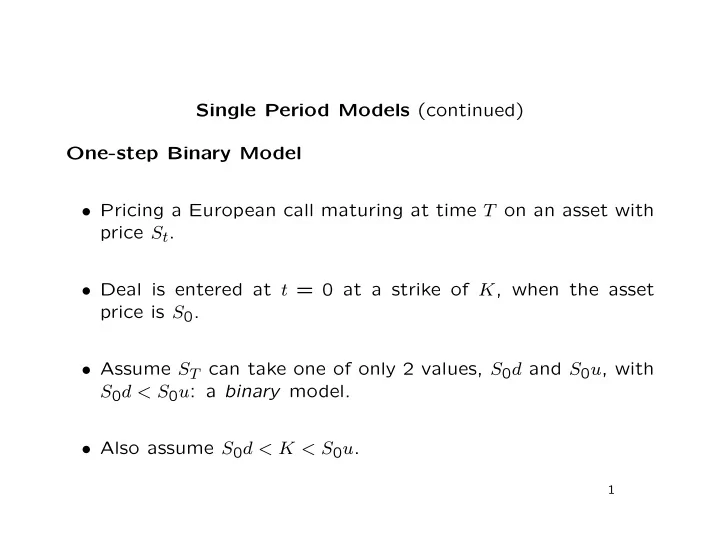
Single Period Models (continued) One-step Binary Model Pricing a European call maturing at time T on an asset with price S t . Deal is entered at t = 0 at a strike of K , when the asset price is S 0 . Assume S T can take one of only 2


slide-1
SLIDE 1

Single Period Models (continued) One-step Binary Model

  • Pricing a European call maturing at time T on an asset with

price St.

  • Deal is entered at t = 0 at a strike of K, when the asset

price is S0.

  • Assume ST can take one of only 2 values, S0d and S0u, with

S0d < S0u: a binary model.

  • Also assume S0d < K < S0u.

1

slide-2
SLIDE 2
  • How to replicate?
  • Try a portfolio of x1 in cash and x2 units of the asset, with

value at time t Vt = x1ert + x2St.

  • Choose x1 and x2 to match the payoff of the call: if ST =

S0d < K, the payoff is 0, so VT = x1erT + x2S0d = 0, and if ST = S0u > K, the payoff is S0u − K, so VT = x1erT + x2S0u = S0u − K.

2

slide-3
SLIDE 3
  • Solving:

x1 = −de−rT (S0u − K) u − d , x2 = S0u − K S0(u − d).

  • We can set up this portfolio at t = 0 with a cost of

x1 + x2S0 =

  • 1 − de−rT

(S0u − K) u − d .

  • If the price of the option is different, an arbitrage is possible,

so this is the no-arbitrage price.

  • Note: no probabilities were needed for the two values of ST.

3

slide-4
SLIDE 4

A Ternary Model

  • We can make the model marginally more realistic by allowing

three (or more) values for ST.

  • For a general European contingent claim with payoff C(ST),

we now have 3 (or more) equations in the two unkowns x1 and x2, and in general no solution.

  • That is, some contingent claims cannot be replicated; the

market is said to be not complete, and no unique no-arbitrage price exists.

4

slide-5
SLIDE 5

Characterization of No Arbitrage

  • General single-period model, with N assets.
  • Asset prices at t = 0 are

S0 =

  • S1

0, S2 0, . . . , SN

t ∈ RN.

  • Market has n possible states at t = T.
  • Price of asset i if, at t = T, market is in state j is Di,j.
  • That is, prices in state j are the vector Dj, column j of the

N × n matrix D =

  • Di,j
  • .

5

slide-6
SLIDE 6
  • A portfolio is an investment in these assets with weight θi
  • n asset i, i = 1, 2, . . . , N; it is defined by

θ = (θ1, θ2, . . . , θN)t ∈ RN.

  • The value of the portfolio at t = 0 is the scalar product

S1

0θ1 + S2 0θ2 + · · · + SN 0 θN = S0 · θ.

  • Similarly the value at t = T, if the market is in state j, is the

scalar product D1,jθ1 + D2,jθ2 + · · · + DN,jθN

  • We can write these as a vector Dtθ ∈ Rn.

6

slide-7
SLIDE 7

Notation:

  • Rn

+ = {x ∈ Rn; xi ≥ 0, i = 1, 2, . . . , n};

  • for x ∈ Rn

+, we write x ≥ 0;

  • if x ≥ 0 and x = 0, we write x > 0;
  • Rn

++ = {x ∈ Rn; xi > 0, i = 1, 2, . . . , n};

  • for x ∈ Rn

++, we write x ≫ 0.

7

slide-8
SLIDE 8
  • An arbitrage is a portfolio θ ∈ RN satisfying either

S0 · θ ≤ 0 and Dtθ > 0

  • r

S0 · θ < 0 and Dtθ ≥ 0.

  • That is, either:

– the portfolio costs nothing to set up, loses money in no market state at time T, and gains money in at least one state; or – the portfolio yields cash when it is set up and loses money in no market state.

8

slide-9
SLIDE 9
  • Characterization: there is no arbitrage if and only if there is

a state price vector: a vector ψ ∈ Rn

++ such that

S0 = D1ψ1 + D2ψ2 + · · · + Dnψn = Dψ.

  • That is, the vector of asset prices at t = 0 is a positively

weighted linear combination of the vectors of prices in the various states of the market at t = T.

  • Proof involves a separating hyperplane theorem and the Riesz

representation theorem; it is basically finite-dimensional con- vex geometry.

  • Note that the state price vector may not be unique.

9