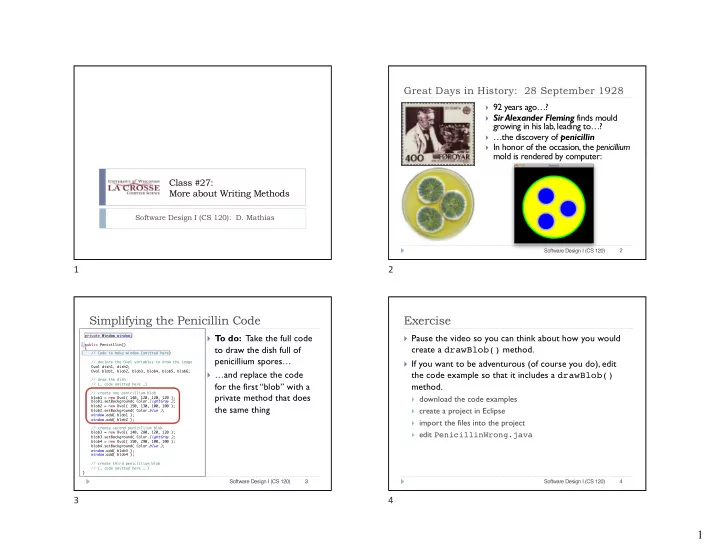
Simplifying the Penicillin Code Exercise private Window window; } - - PowerPoint PPT Presentation

simplifying the penicillin code exercise
SMART_READER_LITE
LIVE PREVIEW

Simplifying the Penicillin Code Exercise private Window window; } - - PowerPoint PPT Presentation

Great Days in History: 28 September 1928 } 92 years ago? } Sir Alexander Fleming finds mould growing in his lab, leading to? } the discovery of penicillin } In honor of the occasion, the penicillium mold is rendered by computer: Class


slide-1
SLIDE 1

1

Class #27: More about Writing Methods

Software Design I (CS 120): D. Mathias

1 Great Days in History: 28 September 1928

} 92 years ago…? } Sir Alexander Fleming finds mould

growing in his lab, leading to…?

} …the discovery of penicillin } In honor of the occasion, the penicillium

mold is rendered by computer:

Software Design I (CS 120) 2

2

private Window window; public Penicillin() { // Code to make window (omitted here) // declare the Oval variables to draw the image Oval dish1, dish2; Oval blob1, blob2, blob3, blob4, blob5, blob6; // draw the dish // (… code omitted here …) // create one penicillium blob blob1 = new Oval( 140, 120, 120, 120 ); blob1.setBackground( Color.lightGray ); blob2 = new Oval( 150, 130, 100, 100 ); blob2.setBackground( Color.blue ); window.add( blob1 ); window.add( blob2 ); // create second penicillium blob blob3 = new Oval( 140, 280, 120, 120 ); blob3.setBackground( Color.lightGray ); blob4 = new Oval( 150, 290, 100, 100 ); blob4.setBackground( Color.blue ); window.add( blob3 ); window.add( blob4 ); // create third penicillium blob // (… code omitted here … ) }

Simplifying the Penicillin Code

} To do: Take the full code

to draw the dish full of penicillium spores…

} …and replace the code

for the first “blob” with a private method that does the same thing

Software Design I (CS 120) 3

3

Exercise

} Pause the video so you can think about how you would

create a drawBlob() method.

} If you want to be adventurous (of course you do), edit

the code example so that it includes a drawBlob() method.

} download the code examples } create a project in Eclipse } import the files into the project } edit PenicillinWrong.java

Software Design I (CS 120) 4

4

slide-2
SLIDE 2

2

private Window window; public Penicillin() { // Code to make window (omitted here) // declare the Oval variables to draw the image Oval dish1, dish2; Oval blob1, blob2, blob3, blob4, blob5, blob6; // draw the dish dish1 = new Oval( 50, 50, 400, 400 ); dish1.setBackground( Color.green ); dish2 = new Oval( 60, 60, 380, 380 ); dish1.setBackground( Color.yellow ); window.add( dish1 ); window.add( dish2 ); // create second penicillium blob blob3 = new Oval( 140, 280, 120, 120 ); blob3.setBackground( Color.lightGray ); blob4 = new Oval( 150, 290, 100, 100 ); blob4.setBackground( Color.blue ); window.add( blob3 ); window.add( blob4 ); // create third penicillium blob // (… code omitted here … ) }

Simplifying the Penicillin Code

} To do: Let’s do the same

thing for the dish

Software Design I (CS 120) 5

5

Exercise

} Now that you’ve seen how to add drawBlob(), add

drawDish()

Software Design I (CS 120) 6

6

public static void main( String[] args ) { Penicillin p = new Penicillin(); p.drawDish(); p.drawBlob(); } public Penicillin() { // code to draw window and dish // (code omitted here) } // draw Petri dish private void drawDish() { // (… code omitted here … ) } // draw one penicillium blob private void drawBlob() { // (… code omitted here … ) }

Control Flow with Methods

}

Now, when main() runs:

1.

Creates new Penicillin()

  • bject by calling constructor

2.

Control passes to constructor, which makes window elements and basic dish image

3.

Control returns to main()

4.

drawDish() method is called

5.

Control passes to that method, which also executes and then returns again to main()

6.

drawBlob() method is called

7.

Process repeats one last time, and then we come back to main() for the last time, and program is done

Software Design I (CS 120) 7

7

private void drawBlob() { Oval blob1, blob2; blob1 = new Oval( 140, 120, 120, 120 ); blob1.setBackground( Color.lightGray ); blob2 = new Oval( 150, 130, 100, 100 ); blob2.setBackground( Color.blue ); window.add( blob1 ); window.add( blob2 ); }

Method Variables

} We place local variables (only used by this method) inside method

} Not visible to or usable by any other part of the class

} Problem: this drawBlob() method is too specific!

} T

  • draw the other blobs in their different locations, we would need two

more private methods, one for each blob

} T

  • do: Fix this problem. (That is, add input parameters to the

method, so that you only need one method to draw all the blobs, with each at a different locations)

Software Design I (CS 120) 8

8

slide-3
SLIDE 3

3 Exercise

} Pause the video and attempt to add parameters to the

drawBlob method so that with a single method for drawing blobs we can put blobs anywhere we want.

Software Design I (CS 120) 9

9

private void drawBlob( int x, int y ) { Oval blob1, blob2; blob1 = new Oval( x, y, 120, 120 ); blob1.setBackground( Color.lightGray ); blob2 = new Oval( x + 10, y + 10, 100, 100 ); blob2.setBackground( Color.blue ); window.add( blob1 ); window.add( blob2 ); } private void drawBlob() { Oval blob1, blob2; blob1 = new Oval( 140, 120, 120, 120 ); blob1.setBackground( Color.lightGray ); blob2 = new Oval( 150, 130, 100, 100 ); blob2.setBackground( Color.blue ); window.add( blob1 ); window.add( blob2 ); }

Adding Parameters to a Method

} T

  • add input parameters:

1.

Figure out what you want to make different each time the method runs (here, we want to vary the (x, y) location)

2.

Add a parameter for each value you want to differ

3.

Find every occurrence of the things to change, and replace each fixed value with the corresponding parameter instead

}

Now you have a much more powerful method!

Software Design I (CS 120) 10

10

Method Parameters

} Method parameters are variables like any other

} Each must be properly declared when first introduced } This requires that each one be given a type and an identifier,

following all the normal rules for each

} Each parameter in the list is separated by commas

Software Design I (CS 120) 11

private void drawBlob( int x, int y ) { // Code goes here… }

Parameter type Parameter identifier

11

Parameters as Local Variables

} When we add parameters to a method, they also act like

local variables during code execution

} x and y are only visible/usable inside this method } They take different values, depending upon what is passed to

them as input

Software Design I (CS 120) 12

private void drawBlob( int x, int y ) { Oval blob1, blob2; blob1 = new Oval( x, y, 120, 120 ); blob1.setBackground( Color.lightGray ); blob2 = new Oval( x + 10, y + 10, 100, 100 ); blob2.setBackground( Color.blue ); window.add( blob1 ); window.add( blob2 ); }

12

slide-4
SLIDE 4

4

public static void main( String[] args ) { // run constructor to set up window Penicillin pen = new Penicillin(); // Draw the dish. pen.drawBlob(); // create the penicillium blobs pen.drawBlob( 140, 120 ); pen.drawBlob( 140, 280 ); pen.drawBlob( 280, 200 ); } // draw one penicillium blob private void drawBlob( int x, int y ) { Oval blob1, blob2; blob1 = new Oval( x, y, 120, 120 ); blob1.setBackground( Color.lightGray ); blob2 = new Oval( x + 10, y + 10, 100, 100 ); blob2.setBackground( Color.blue ); window.add( blob1 ); window.add( blob2 ); }

Local Values of Input Parameters

} Now, each time the

method is called, the values of x and y change.

1.

1st call sets our variables:

x == 140, y == 120

2.

Runs, after which point x, y are forgotten (and they no longer exist!)

3.

2nd call runs with new parameter values:

x == 140, y == 280

4.

Runs, then forgets again

5.

etc…

Software Design I (CS 120) 13

13

The return Statement

} We can mark the end of a method using simple code:

return;

} This will return control to the exact location in the code

where the method was originally called

} For simple void methods, we often do not bother

} The method automatically returns control when it reaches the

end of its code-block

} Sometimes, however, we will want to explicitly return

control, particularly when we want to end the method early in some situations

Software Design I (CS 120) 14

14 Review: public vs. private Method Access

} If we make a method in a class C private, it can only

be used by object instances of the class C itself

} If we make a method in C public, it can be used by:

1.

Any object instance from the class C itself

2.

Any other class that runs the C() class constructor and creates an instance of an object of type C to use

}

When we write methods, we should decide if we want

  • ther coders to be able to use those methods or not

}

YES: then make it public

}

NO: then make it private

Software Design I (CS 120) 15

15

public vs. private Methods

} Suppose we made the blob-drawing method public in Penicillin } Then, if we give someone the Penicillin class code to use (like we

have been using pre-written code for Window, Oval, etc.), they can write more code, like the following:

Software Design I (CS 120) 16

Do you want this to be possible? You decide! If you don’t: make method private, in which case the compiler will not allow it.

public class Main { public static void main( String[] args ) { Penicillin pen = new Penicillin(); pen.drawBlob( 0, 0 ); pen.drawBlob( 0, 400 ); pen.drawBlob( 400, 0 ); } }

Note: if we don’t want them to even be able to instantiate a Penicillin

  • bject at all, then we could also make

the constructor private.

16