Antibiotics Quiz (c) McGraw Hill Ryerson 2007 Antibiotics- - - PowerPoint PPT Presentation

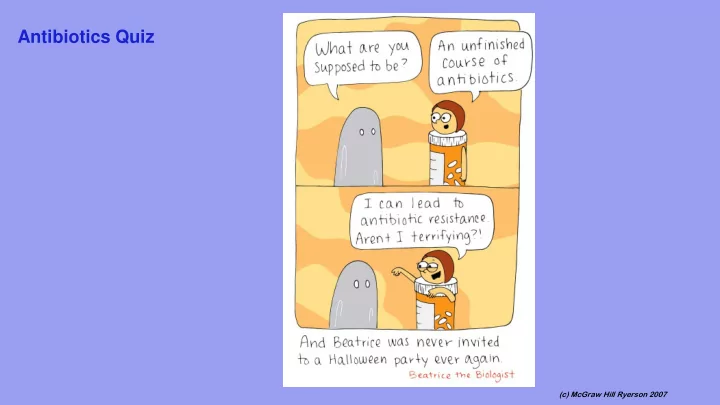
antibiotics quiz
SMART_READER_LITE
LIVE PREVIEW

Antibiotics Quiz (c) McGraw Hill Ryerson 2007 Antibiotics- - - PowerPoint PPT Presentation

Antibiotics Quiz (c) McGraw Hill Ryerson 2007 Antibiotics- Penicillin Penicillin was the first antibiotic to be discovered. It was discovered in 1928 by Alexander Fleming, a Scottish scientist working in St Mary's Hospital London.


slide-1
SLIDE 1

Antibiotics Quiz

(c) McGraw Hill Ryerson 2007
slide-2
SLIDE 2

Antibiotics- Penicillin

  • Penicillin was the first antibiotic to be

discovered.

  • It was discovered in 1928 by Alexander

Fleming, a Scottish scientist working in St Mary's Hospital London.

  • Fleming discovered that mould from a

Penicillium fungus had antibacterial

  • properties. The antibiotic was named

penicillin after the fungus.

  • Antibiotics can be derived from fungi,
  • ther microorganisms or can be

synthetically produced

(c) McGraw Hill Ryerson 2007

slide-3
SLIDE 3

Antibiotics

  • Used only to fight Bacterial

Infections

  • Can be broad or specific
  • Work by

 attacking the cell wall of bacteria  Prevent bacteria from synthesizing peptidoglycan  Inhibit DNA replication  Inhibit protein synthesis

  • Will not work on Viruses

 Why?

(c) McGraw Hill Ryerson 2007

slide-4
SLIDE 4

Antibiotics resistance

  • Bacteria are continually adapting to develop ways of

not being killed by antibiotics.

 This is called antibiotic resistance.  Resistance develops due to mutations in the bacterial DNA.  The genes for antibiotic resistance can spread between different bacteria in our bodies through

  • Conjugation
  • Reproduction

(c) McGraw Hill Ryerson 2007

slide-5
SLIDE 5
  • Antibiotic resistant bacteria can be carried by healthy
  • r ill people and can spread to others just as other

types of microbes would

 by shaking hands or touching all types of surfaces on animals, vegetables or food where bacteria are present.

  • Antibiotic resistance arises in our bodies bacteria, or

in animals, due to the overuse and misuse of antibiotics.

  • The more often a person takes antibiotics, the more

likely they are to develop antibiotic resistant bacteria in their body.

(c) McGraw Hill Ryerson 2007

slide-6
SLIDE 6

Preventing Resistance

  • To prevent resistance, antibiotics

should only be taken as prescribed by a doctor or nurse.

  • The important points to remember are:

 1. antibiotics do not need to be taken for colds and flu or most coughs, sore throats, ear infections or sinusitis as these usually get better on their own  2. it is important to take the antibiotic exactly as instructed and complete the course of antibiotics, to decrease the risk

  • f emergence of resistance

 3. antibiotics are personal and prescribed for individuals and for a particular

  • infection. They should not be shared or

taken for a different illness

(c) McGraw Hill Ryerson 2007

slide-7
SLIDE 7

Antibiotic Resistance

  • Antibiotic Resistance TedX
  • Resistance Documentary- Netflix

(c) McGraw Hill Ryerson 2007