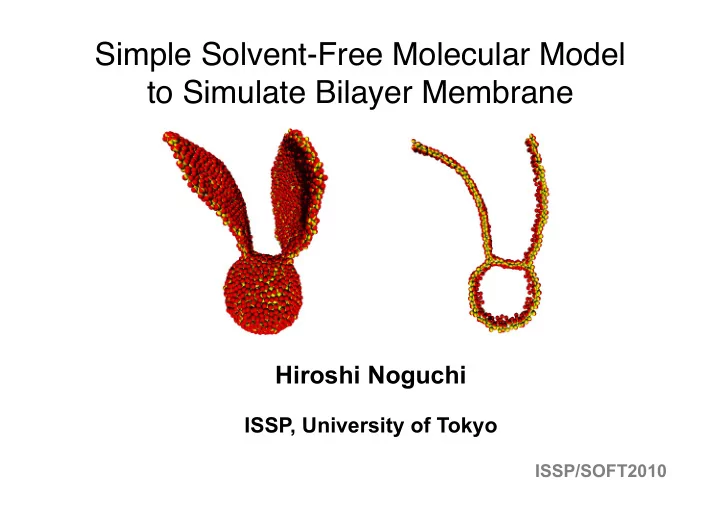
SLIDE 1
Hiroshi Noguchi
ISSP, University of Tokyo
ISSP/SOFT2010
Simple Solvent-Free Molecular Model
to Simulate Bilayer Membrane
SLIDE 2 ~10µm 10nm
・ Biomembrane
Plasma membrane Large scale gap Cell
http://upload.wikimedia.org/wikipedia/commons/1/10/Illu_cell_structure.jpg
SLIDE 3 Membrane models
curved surface ( no bilayer structure) atomistic model
∼ µm
molecular model
~ nm
Numerically faster More detailed information
length and time scale
Tieleman, et al. BBA 1331, 225 (1997)
coarse grained molecule bottom up
Shinoda etc.
go down
SLIDE 4 C1, C2:principal curvatures、C0:spontaneous curvature
- curved surface
- simulation: discretized surface
- theory: continuous surface
- mesh methods ● meshless methods
A particle represents a membrane patch.
SLIDE 5 Ochanomizu Lecture (Aug. 23) by G. Gompper
degrees of freedom: positions and connections of particles fluid membrane by bond flip (Monte Carlo) for fixed topology dynamics with topological changes disadvantage works very well
SLIDE 6
Naturally applied to the topological changes Advantage: 1) degrees of freedom: positions and orientation 2) degrees of freedom: only positions
Drouffe, Maggs, S. Leibler Science 254, 1353 (1991). Del Popolo (2008); T. Kohyama (2009);
- P. Liu (2009); H. Yuan (2010).
Noguchi and Gompper Phys. Rev. E 73, 021903 (2006).
SLIDE 7 kα and ε dependence
1.45 1.5 20 40 60 18 19 20 4 6 2 4 6
ε / T
A /Nσ 2
2
K σ / T Γσ / T κ / T
A
1.2 1.4 20 40 20 40 2 4 10 20
k / T
α
A /Nσ 2
2
K σ / T Γσ / T κ / T
A
area of tensionless membrane area compress modulus line tension bending rigidity 2d kα/T=10 ε /T=4
κ and Γ can be independently varied.
SLIDE 8
Vesicle formation Very large membrane Rdis/σ >> 8kα/ε Buckling into two vesicles is also possible.
SLIDE 9
ε/T= 1.5 -> 1.3
100 1000 10000 1.2 1.3 1.4
<t >D /σ 2
rup
ε /k T
B BD MPC
Noguchi and Gompper J. Chem. Phys. 125, 164908 (2006).
SLIDE 10
curved surface molecular model
1 particle or segment > 100 lipid molecules 1 coarse-grained molecule
= 1~4 lipid molecules σ > thickness ~
length scale > 10 times ~
~
SLIDE 11
atomistic models
0.1nm 0.4 nm 1nm
coarse-grained models
without explicit solvent ・Coarse-graining of lipids with explicit solvent
?
Klein et al.
SLIDE 12
- H. Noguchi, M. Takasu (2001)
- O. Farago (2003)
- G. Brannigan, F.L.H. Brown (2004)
- G. Brannigan, P.F. Philips, F.L.H. Brown (2005)
I.R. Cooke, K. Kremer, M. Deserno (2005) Z.J. Wang, D. Frenkel (2005) J.D. Revalee, M. Laradji, P.B.S.Kumar (2008).
- M. Hoemberg, M. Mueller (2010).
modifications solvent-free molecular model for bilayer membrane Only narrow parameter range Aim 1: make a model for wide parameter range
SLIDE 13
3 spheres 1 sphere Aim 2: Coarse graining more to simulate larger scale
SLIDE 14
Fournier, EPL 43, 725 (1998).
Continuum theory for bilayer membrane Membrane bending, area dilation, molecular tilt, chain stretching.
SLIDE 15
Tilt + bending of membrane tilt + bending tilt only bending only
Kozlovsky and Kozlov, Biophys. J. 2002
u = n u n n u
SLIDE 17
Vesicle formation
SLIDE 18
surface tension tensionless membrane bilayer structure
SLIDE 19 bending rigidity κ linear dependence
SLIDE 20 line tension line tension
l i n e t e n s i
m e m b r a n e e d g e
SLIDE 22
- droplet-vesicle transition
Bilayer is metastable at ktilt = 0.
SLIDE 23 Preliminary simulation: Membrane fusion
Dai et al., J. Neurosci. 18, 6681 (1998). 2.5mm
Optical tweezers External force
Fusion!
SLIDE 24 Experimental studies
Quick-freezing Electron microscopy images Bars, 100 nm.
Kanaseki et al. J. Cell Biol. 137, 1041 (1997).
Electric resistance measurement
V.A. Frolov et al. Biophys. J. 85, 1725 (2003).
SLIDE 25
fusion pathways found by simulations
Solvent-free models Noguchi et al. 2001 Lattice MC Mueller, et al. 2002 LJ model Marrink et al. 2003 Stevens et al. 2003 Smeijers, et al. 2006 Kasson et al. 2007 DPD model Li and Liu 2005 Shillcock et al. 2005 Atomistic model Knecht and Marrink 2007
SLIDE 26
Membrane fusion by mechanical force Pathway of modified stalk model
SLIDE 27 10 20 30 5000 10000
Time step t
ns nm
My previous simulation
Distance between nanoparticles Xnp
Stochastically
Noguchi J. Chem. Phys. 117, 8130 (2002).
SLIDE 28 Summary ○ A new CG model is proposed. ・ Minimum molecular size: a sphere and orientation ・ Membrane properties can be varied in wide range (including metastable bilayer). ・ Application: membrane fusion etc.
T h a n k y
f
y
r a t t e n t i
!
Supported by KAKENHI (Grant-in-Aid for Scientific Research)
SLIDE 29
ISSP Supercomputer
http://fujibakama.issp.u-tokyo.ac.jp/supercom/