Simple Harmonic Motion Practice Problems Slide 2 / 46 Multiple - - PDF document
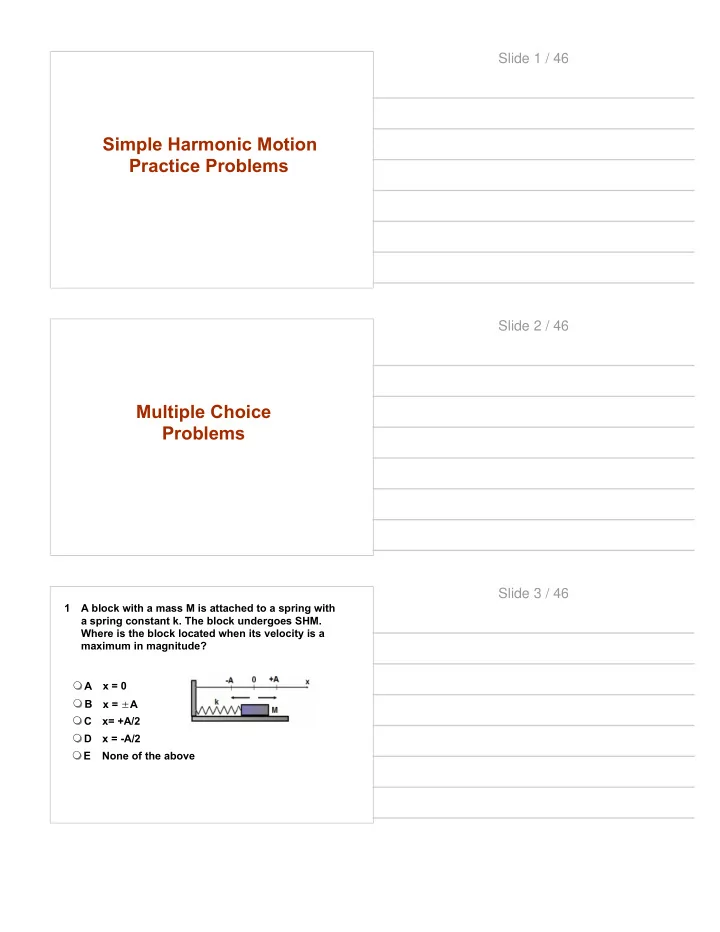
Slide 1 / 46 Simple Harmonic Motion Practice Problems Slide 2 / 46 Multiple Choice Problems Slide 3 / 46 1 A block with a mass M is attached to a spring with a spring constant k. The block undergoes SHM. Where is the block located when its
2 A block with a mass M is attached to a spring with a spring constant k. The block undergoes SHM. Where is the block located when its potential energy is a maximum? A x = 0 B x = ±A C x= +A/2 D x = -A/2 E None of the above
Slide 4 / 46
3 A block with a mass M is attached to a spring with a spring constant k. The block undergoes SHM. Where is the block located when its acceleration is a minimum in magnitude? A x = 0 B x = ±A C x= +A/2 D x = -A/2 E None of the above
Slide 5 / 46
4 A mass-spring oscillating system undergoes SHM with a period T. What is the period of the system if the amplitude is doubled? A 2T B 4T C T D 1/2T E 1/4T
Slide 6 / 46
5 A mass-spring oscillating system undergoes SHM with a period T when it is located on Earth. What is the period of the system when it is located on Moon? A 6T B T/6 C T/(√6) D (√6)T E T
Slide 7 / 46
6 A block with a mass M is attached to a vertical spring with a spring constant k. When the block is displaced from equilibrium and released its period is T. A second identical spring k is added to the first spring in parallel. What is the period of
- scillations when the block is suspended from two
springs? A 2T B 4T C T D T/(√2) E (√2)T
Slide 8 / 46
7 Two oscillating systems: spring-mass and simple pendulum undergo SHM with an identical period T. If the mass in each system is doubled which of the following is true about the new period? A T T/(√2) B T/(√2) T C T T D (√2)T T E T (√2)T Mass- Simple spring pendulum
Slide 9 / 46
8 An object undergoes SHM and position as a function of time is presented by the following formula: x= (0.1 m) Sin (4πt). What is the period of
- scillations?
A 2 s B 1 s C 0.5 s D 0.1 s E 4 s
Slide 10 / 46
9 An object undergoes SHM and position as a function of time is presented by the following formula: x= (0.5 m) Cos (πt). What is the amplitude
- f oscillations?
A 2 m B 1 m C 0.5 m D 0.1 m E 4 m
Slide 11 / 46
10 The position as a function of time of a mass-spring
- scillating system is presented by the graph. Which
- f the following is true about velocity and
acceleration at the time 1.5 s? A v >0 a < 0 B v = 0 a = 0 C v =0 a > 0 D v >0 a = 0 E v < 0 a = 0 Velocity Acceleration
Slide 12 / 46
11 A particle undergoes SHM represented by the
- graph. Which of the following is true about the
amplitude and period of oscillations? A 1 m 0.1 s B 2 m 0.5 s C 1 m 0.6 s D 1 m 0.8 s E 2 m 0.4 s Amplitude Period
Slide 13 / 46
12 An object oscillates at the end of a spring. The position as a function of time is presented by the graph. Which of the following formulas represent the position and velocity of the
- bject?
A x = (0.5) Sin(πt) v = (0.5π) Sin(πt) B x = (0.5) Sin(πt) v = (0.5π) Cos(πt) C x = (0.5) Cos(πt) v = (0.5π) Sin(πt) D x = (0.5π) Sin(πt) v = (0.5) Sin(πt) E x = (0.5) Cos(πt) v = (0.5π) Cos(πt) Position Velocity
Slide 14 / 46
13 A simple pendulum oscillates with a period T. If the mass of the pendulum is doubled what is the new period of the pendulum? A T/2 B 2T C T D (√2)T E T/(√2)
Slide 15 / 46
14 A simple pendulum oscillates with a period T. If the length of the pendulum is doubled what is the new period of the pendulum? A T/2 B 2T C T D (√2)T E T/(√2)
Slide 16 / 46
15 What is the length of a simple pendulum if it
- scillates with a period of 2 s?
A 2.0 m B 1.0 m C 0.5 m D 0.4 m E 0.1 m
Slide 17 / 46
16 A simple pendulum consists of a mass M attached to a vertical string L. When the string is displaced to the right the ball moves up by a distance 0.2 m. When the ball is released from rest what is the maximum speed? A 1 m/s B 2 m/s C 3 m/s D 4 m/s E 5 m/s
Slide 18 / 46
17 A simple pendulum consists of a mass M attached to a vertical string L. The string is displaced to the right by an angle ϴ. When the pendulum is released from rest what is the speed of the ball at the lowest point? A 2 gL B C D E
Slide 19 / 46
18 A block of mass M is attached to a horizontal spring k. The block undergoes SHM with amplitude of A. Which of the following graphs represents the elastic potential energy as a function of position x? A B C
D E
Slide 20 / 46
19 A block of mass M is attached to a horizontal spring k. The block undergoes SHM with amplitude of
- A. Which of the following graphs
represents the elastic potential energy as a function of position x? A B C D E
Slide 21 / 46
20 A 0.9 kg block is attached to an unstretched spring with a spring constant of 10 N/m. The block is released from rest. How long does it take for the block to return to its initial position? A 0.3π s B 0.5π s C 0.4π s D 0.9π s E 0.6π s
Slide 22 / 46
Free Response Problems
Slide 23 / 46
1. A 0.4 kg object is attached to a horizontal spring undergoes SHM with the total energy of 0.2 J. The potential energy as a function of position presented by the graph below:
- a. What is the amplitude of oscillations?
- b. What is the spring constant?
- c. What is the kinetic energy of the system at point x = 2.5 cm?
- d. Indicate point or points where the kinetic energy equals
the potential energy of the system.
- e. What is the maximum speed of the object?
Slide 24 / 46
1. A 0.4 kg object is attached to a horizontal spring undergoes SHM with the total energy of 0.2 J. The potential energy as a function of position presented by the graph below:
- a. What is the amplitude of oscillations?
Slide 25 / 46
1. A 0.4 kg object is attached to a horizontal spring undergoes SHM with the total energy of 0.2 J. The potential energy as a function of position presented by the graph below:
- b. What is the spring constant?
Slide 26 / 46
1. A 0.4 kg object is attached to a horizontal spring undergoes SHM with the total energy of 0.2 J. The potential energy as a function of position presented by the graph below:
- c. What is the kinetic energy of the system at point x = 2.5 cm?
Slide 27 / 46
1. A 0.4 kg object is attached to a horizontal spring undergoes SHM with the total energy of 0.2 J. The potential energy as a function of position presented by the graph below:
- d. Indicate point or points where the kinetic energy equals
the potential energy of the system.
Slide 28 / 46
1. A 0.4 kg object is attached to a horizontal spring undergoes SHM with the total energy of 0.2 J. The potential energy as a function of position presented by the graph below:
- e. What is the maximum speed of the object?
Slide 29 / 46
- 2. A 0.2 kg object is attached to a
horizontal spring undergoes SHM with the total energy of 0.4 J. The kinetic energy as a function of position presented by the graph below:
- a. What is the maximum displacement from equilibrium?
- b. What is the maximum speed of the object?
- c. What is the spring constant?
- e. What is the potential energy of the system at point x = 2 cm?
- d. Indicate point or points where the kinetic energy equals the
potential energy of the system.
Slide 30 / 46
- 2. A 0.2 kg object is attached to a
horizontal spring undergoes SHM with the total energy of 0.4 J. The kinetic energy as a function of position presented by the graph below:
- a. What is the maximum displacement from equilibrium?
Slide 31 / 46
- 2. A 0.2 kg object is attached to a
horizontal spring undergoes SHM with the total energy of 0.4 J. The kinetic energy as a function of position presented by the graph below:
- b. What is the maximum speed of the object?
Slide 32 / 46
- 2. A 0.2 kg object is attached to a
horizontal spring undergoes SHM with the total energy of 0.4 J. The kinetic energy as a function of position presented by the graph below:
- c. What is the spring constant?
Slide 33 / 46
- 2. A 0.2 kg object is attached to a
horizontal spring undergoes SHM with the total energy of 0.4 J. The kinetic energy as a function of position presented by the graph below:
- d. Indicate point or points where the kinetic energy equals the
potential energy of the system.
Slide 34 / 46
- 2. A 0.2 kg object is attached to a
horizontal spring undergoes SHM with the total energy of 0.4 J. The kinetic energy as a function of position presented by the graph below:
- e. What is the potential energy of the system at point x = 2 cm?
Slide 35 / 46
- 3. A 20 g piece of clay moving at a speed of 50
m/s strikes a 500 g pendulum bob at rest. The length of a string is 0.8 m. After the collision the clay-bob system starts to oscillate as a simple pendulum.
- a. What is the speed of the clay-bob system after the collision?
- b. What is the maximum angular displacement of the pendulum?
- c. What is the period of the clay-bob oscillating system?
- d. What is the total energy of the oscillating system?
The pendulum bob makes one complete oscillation and the string breaks at the lowest point.
- e. What is the maximum horizontal distance of the bob when it
strikes the floor 0.7 m below?
Slide 36 / 46
- 3. A 20 g piece of clay moving at a speed of 50
m/s strikes a 500 g pendulum bob at rest. The length of a string is 0.8 m. After the collision the clay-bob system starts to oscillate as a simple pendulum.
- a. What is the speed of the clay-bob system after the collision?
Slide 37 / 46
- 3. A 20 g piece of clay moving at a speed of 50
m/s strikes a 500 g pendulum bob at rest. The length of a string is 0.8 m. After the collision the clay-bob system starts to oscillate as a simple pendulum.
- b. What is the maximum angular displacement of the pendulum?
Slide 38 / 46
- 3. A 20 g piece of clay moving at a speed of 50
m/s strikes a 500 g pendulum bob at rest. The length of a string is 0.8 m. After the collision the clay-bob system starts to oscillate as a simple pendulum.
- c. What is the period of the clay-bob oscillating system?
Slide 39 / 46
- 3. A 20 g piece of clay moving at a speed of 50
m/s strikes a 500 g pendulum bob at rest. The length of a string is 0.8 m. After the collision the clay-bob system starts to oscillate as a simple pendulum.
- d. What is the total energy of the oscillating system?
Slide 40 / 46
- 3. A 20 g piece of clay moving at a speed of 50
m/s strikes a 500 g pendulum bob at rest. The length of a string is 0.8 m. After the collision the clay-bob system starts to oscillate as a simple pendulum. The pendulum bob makes one complete oscillation and the string breaks at the lowest point.
- e. What is the maximum horizontal distance of the bob when it
strikes the floor 0.7 m below?
Slide 41 / 46
1. A small block moving with a constant speed v collides inelastically with a block M attached to one end of a spring k. The
- ther end of the spring is connected to a stationary wall. Ignore
friction between the blocks and the surface.
- a. What is the speed of the system of two blocks after the
collision?
- b. What is amplitude of oscillations of the system of two blocks?
- c. What is the period of oscillations?
- d. What is the total energy of the oscillating system?
Slide 42 / 46
1. A small block moving with a constant speed v collides inelastically with a block M attached to one end of a spring k. The
- ther end of the spring is connected to a stationary wall. Ignore
friction between the blocks and the surface.
- a. What is the speed of the system of two blocks after the
collision?
Slide 43 / 46
1. A small block moving with a constant speed v collides inelastically with a block M attached to one end of a spring k. The
- ther end of the spring is connected to a stationary wall. Ignore
friction between the blocks and the surface.
- b. What is amplitude of oscillations of the system of two blocks?
Slide 44 / 46
1. A small block moving with a constant speed v collides inelastically with a block M attached to one end of a spring k. The
- ther end of the spring is connected to a stationary wall. Ignore
friction between the blocks and the surface.
- c. What is the period of oscillations?
Slide 45 / 46
1. A small block moving with a constant speed v collides inelastically with a block M attached to one end of a spring k. The
- ther end of the spring is connected to a stationary wall. Ignore
friction between the blocks and the surface.
- d. What is the total energy of the oscillating system?