
SLIDE 1
Similarities and Differences
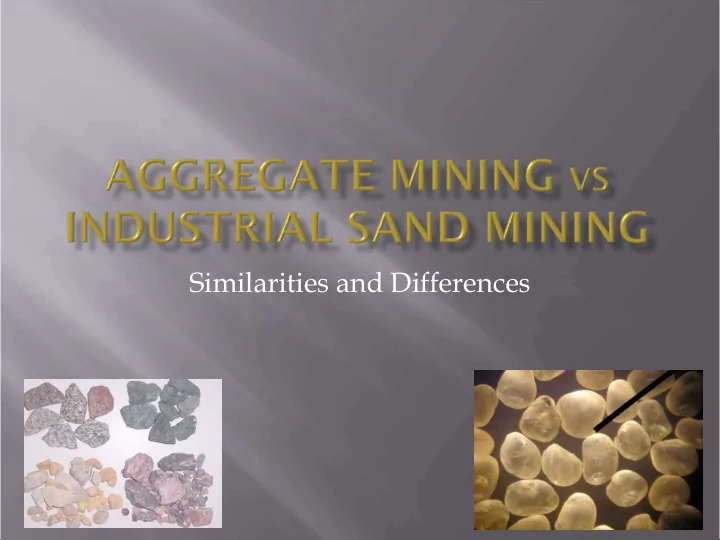
Similarities and Differences Mathy Construction / Milestone - - PowerPoint PPT Presentation
Similarities and Differences Mathy Construction / Milestone Materials Corporate office in Onalaska, WI Mathy Construction was established locally in 1945 Primary businesses are asphalt paving, pavement maintenance, aggregate
Similarities and Differences
Mathy Construction / Milestone Materials
Corporate office in Onalaska, WI Mathy Construction was established locally in 1945 Primary businesses are asphalt paving, pavement
maintenance, aggregate production, transportation and oil related products.
We have Aggregate pit and quarry operations in the
western Wisconsin, northeast Iowa, southeast Minnesota and UP of Michigan.
We also are mining Industrial Sand in a few
locations in NW Wisconsin.
Define Industrial Sand vs Construction
Aggregate
Current Mining Regulations Economic and Environmental Comparison Reclamation and Final Land Uses Final Comments
following uses: glassmaking, metal casting, metal production, chemical production, paint and coatings, ceramics and refractories, and oil and gas recovery (i.e. “frac sand”). This sand is classified as 212322 Industrial Sand Mining according to the NAICS (North American Industry Classification System) Standard Industrial Classification (SIC) System.
(stone crushed from bedrock) that is predominately produced and used for local construction purposes (i.e., asphalt or concrete roads, concrete, asphalt, building stone, decorative stone, revetment stone, agricultural uses and other similar uses) or used for bedding sand in livestock
produced and used for other purposes such as water filtration systems in septic systems and landfills, mortar sand, and sand for ice control.
St Stone
Fe Feldsp spar Pe Perl rlite Ba Barite Pl Platinum um Rare re Ea Eart rths Gy Gypsum Br Brom
Di Diatomite Cla Clays
Aggreg egat ate
Ir Iron O
Sa Salt Phosp hosphate Zi Zinc So Soda A Ash Ind Indust strial al Sa Sand Bor Borates Mol Molybdenum num Lead ead Si SilverPo Potash Ta Talc Go Gold Co Coppe pper
Reference : USGS – Miscellaneous Reports & Talks
U.S. Mining Statistics
WGNHS Data 2000
Quarries = blue Pits = red
Mining in Wisconsin
Construction Aggregates in Wisconsin
Construction Aggregates vs. Industrial Sand
Economic Differences
Construction Aggregates
conditions.
than 50 miles from site.
Industrial Sand
costs.
transportation more than 100 miles.
Truck Transportation Railroad Transportation Barge/River Transportation Extremely variable – depending on a
variety of characteristics
2003 - http://www.aggman.com/0203_pages/0203marketing.html
Construction Aggregates vs. Industrial Sand
Environmental Due Diligence
Construction Aggregates vs. Industrial Sand
Current Regulatory Agencies
activities occurring on the property.
individually for specific conditions or regulations, such as hours of operation or traffic impact.
further regulated by local government.
Wisconsin.
Construction Aggregates vs. Industrial Sand
Industry Concerns
Legislature mandate in Chapter 295, Wisconsin
Statutes, that the DNR write rules containing uniform statewide reclamation standards and requirements for administering local reclamation programs.
This was accomplished in Chapter NR 135,
Wisconsin Administrative Code, which became effective in December 2000.
Counties regulate program, with DNR review. Fees paid to county yearly on all active acres. Surety bond on file with county to cover
reclamation cost in case of operator default.
Property can not change hands unless new
All areas affected by mining shall be graded in
accordance with the approved reclamation plan to achieve a stable and safe condition consistent with the post mining land use.
The reclamation plan may designate areas such
as stable slopes and rock faces that do not require final grading
Fox Ridge Pit, Baraboo, Wisconsin
Knuth Pit reclaimed to green space – passive recreation
Elroy Quarry Juneau County, WI.
Medary Quarry La Crosse County, WI.
Marshfield Quarry, 1988 Wood County, Wisconsin
Marshfield Quarry, Reclaimed Wood County, Wisconsin
Closing Comments
State, County and Local Laws and Ordinances.
we feel this Industry should be regulated separately.