Simherd III Advanced Herd Management A dynamic, mechanistic and - - PDF document

simherd iii
SMART_READER_LITE
LIVE PREVIEW

Simherd III Advanced Herd Management A dynamic, mechanistic and - - PDF document

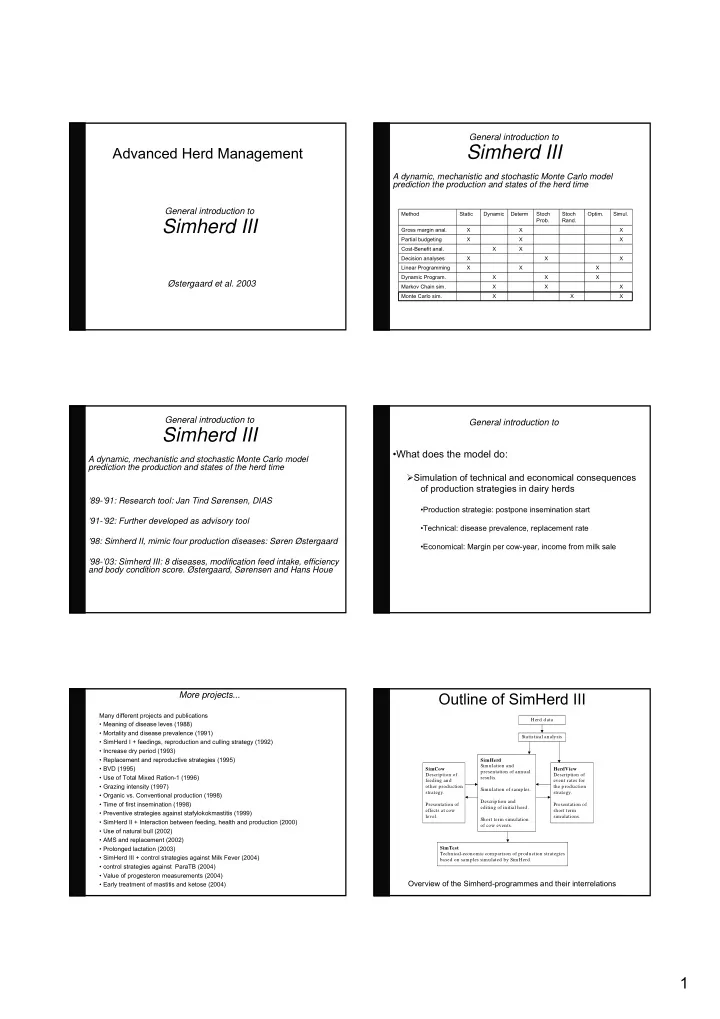
General introduction to Simherd III Advanced Herd Management A dynamic, mechanistic and stochastic Monte Carlo model prediction the production and states of the herd time General introduction to Method Static Dynamic Determ Stoch Stoch


slide-1
SLIDE 1

1

General introduction to

Simherd III

Advanced Herd Management

Østergaard et al. 2003 General introduction to

Simherd III

A dynamic, mechanistic and stochastic Monte Carlo model prediction the production and states of the herd time

X X X Monte Carlo sim. X X X Markov Chain sim. X X X Dynamic Program. X X X Linear Programming X X X Decision analyses X X Cost-Benefit anal. X X X Partial budgeting X X X Gross margin anal. Simul. Optim. Stoch Rand. Stoch Prob. Determ Dynamic Static Method

General introduction to

Simherd III

’89-’91: Research tool: Jan Tind Sørensen, DIAS ’91-’92: Further developed as advisory tool ’98: Simherd II, mimic four production diseases: Søren Østergaard ’98-’03: Simherd III: 8 diseases, modification feed intake, efficiency and body condition score. Østergaard, Sørensen and Hans Houe A dynamic, mechanistic and stochastic Monte Carlo model prediction the production and states of the herd time General introduction to

  • What does the model do:

Simulation of technical and economical consequences

  • f production strategies in dairy herds
  • Production strategie: postpone insemination start
  • Technical: disease prevalence, replacement rate
  • Economical: Margin per cow-year, income from milk sale

More projects...

Many different projects and publications

  • Meaning of disease leves (1988)
  • Mortality and disease prevalence (1991)
  • SimHerd I + feedings, reproduction and culling strategy (1992)
  • Increase dry period (1993)
  • Replacement and reproductive strategies (1995)
  • BVD (1995)
  • Use of Total Mixed Ration-1 (1996)
  • Grazing intensity (1997)
  • Organic vs. Conventional production (1998)
  • Time of first insemination (1998)
  • Preventive strategies against stafylokokmastitis (1999)
  • SimHerd II + Interaction between feeding, health and production (2000)
  • Use of natural bull (2002)
  • AMS and replacement (2002)
  • Prolonged lactation (2003)
  • SimHerd III + control strategies against Milk Fever (2004)
  • control strategies against ParaTB (2004)
  • Value of progesteron measurements (2004)
  • Early treatment of mastitis and ketose (2004)

Outline of SimHerd III

Statistical analysis HerdView Description of event rates for the production strategy. Presentation of short term simulations. SimHerd Simulation and presentation of annual results. Simulation of samples. Description and editing of initial herd. Short term simulation

  • f cow events.

SimCow Description of feeding and

  • ther production

strategy. Presentation of effects at cow level. SimTest Technical-economic comparison of production strategies based on samples simulated by SimHerd. Herd data

Overview of the Simherd-programmes and their interrelations

slide-2
SLIDE 2

2

Input and output

  • What does the model do:
  • Simulation of technical and economical

consequences of production strategies in dairy herds

  • Production strategie: postpone insemination start
  • Technical: disease prevalence, replacement rate
  • Economical: Margin per cow-year, income from milk sale

Input and output

Input

  • State of nature:

– Complete set of input parameters – Simherd: List of the cows’ and heifers’ ”starting values” on the starting date of simulation

  • Parameter values for relations in the model

– Biological parameters – Parameters describing production system (capacity of the stable) – Parameters describing production strategy (feeding plan, culling decisions)

Output:

  • Technical annual results

– 10 years, 500-1000 replications

Overview of steps in the simulation

  • Each cow at each week-step (dynamic)

– Lactation stage – Reproduction status (Heat; Pregnancy; Abortion; Calving) – Diseases, death, culling for replacement and involuntary replacement – Net energy intake = Feed intake capacity + Feed available – Milk yield and weight gain = Utilized net energy - Maintenance – Fetus

  • Each heifer at each week-step

– Age, Reproduction, Replacement, Feeding

Overview of steps in the simulation

  • The herd at each week-step

– Replacement (Max cow number, Culled cows, Available down calving heifers, Strategy of buying and selling heifers)

  • State is updated and production and

consumption are calculated

  • The herd after each year of simulation

– File annual results

  • Ten years of simulation

– Analyze averages of the last 5 years

Outline of SimHerd III

Events: stochastic

– Probability of events happening is calculated with a logistic regression model

  • Conception
  • Culling
  • Disease
  • ...

– Drawing samples from relevant probability distributions – Number generation by computer: X diseases does not occur

Outline of SimHerd III

Mechanistic

– Events on cow level determine ’behaviour’ on herd level – Replacement rate of the herd, determined by:

  • Culling strategy of the farmer (min. milk yield level, max. days open)
  • (Re)production of the individual cow

Functioning on cow level x number of year cows (årskøer) ≠ Functioning on herd level

slide-3
SLIDE 3

3 Outline of SimHerd III

Statistical analysis

Herd View Sim Herd Sim Cow SimTest

Herd data

SimCow: simulates the production of an individual cow given a production strategy

  • initial cow
  • weekly results
  • lactation statistics
  • milk production

Outline of Simcow: initial cow

Initial settings standard cow in Simcow

Outline of Simcow: weekly results Outline of Simcow: lactation statistics

  • Max. yield possible and yield currently realised

Outline of Simcow: milk production

Actual daily yield as function of weeks after calving

Outline of SimHerd III

Statistical analysis

Herd View Sim Herd Sim Cow SimTest

Herd data

Simherd: defining initial herd and strategy

  • biological variables
  • feeding and drying-off strategy
  • replacement strategy
  • milk production
slide-4
SLIDE 4

4 Simherd: defining initial herd and strategy

630 Mature weight (kg) 2

  • St. dev. Individual yield level

2

  • St. dev. Individual yield level

34,0 Yield level (kg ECM21-24 wpp, 3rd lact) 50

  • Prop. Heifer calves (pct)

280 Gestation length (days) 50 Change of pregnancy (pct) 2 St.dev. first heat (1,2 or 3) 280 Age at first heat (days) 2 Mortality in cows (pct per cow-year) 18 Involuntary culling (pct per cow-year) 6 Stillbirth older cows (pct) 10,9 Stillbirths 1. lactation (pct) 17 Time for 50% abortion1: 25 Abortion (pct) Biological Variables

291 variables!

Difference with SimFlock?

SimHerd Mature weight 630 kg SimFlock Marture weight mean 1637 gram standard deviation 143 gram

5,0 yield at drying off older cows (kg/day) 5,0 yield at drying off 1st lact. (kg/day) 22,0 yield at 2nd step., older cows (kg/day) 18,0 yield at 2nd step., 1st lact. (kg/day) 28,0 yield at 1st step., older cows (kg/day) 23,0 yield at 1st step., 1st lact. (kg/day)) Feeding and drying of strategy

Simherd: defining initial herd and strategy

291 variables!

  • f which

70 decision variables!

238 Last calendar day in summer season, heifers 119 First calendar day in summer season, heifers 238 Last calendar day in summer season, cows 119 First calendar day in summer season, cows 42 Pregnancy detection cows (days after insemination) 42 Pregnancy detection cows (days after insemination) 50 Heat detection eff. in summer, cows (pct) 50 Heat detection eff. in winter, cows (pct) 40 Heat detection eff. in summer, heifers (pct) 50 Heat detection eff. in winter, heifers (pct) 40 Start breed of other cows (days after calving) 40 Start breed of 1st lactation (days after calving) 450 Start breed of heifers (days) Reproduction strategy

Simherd: defining initial herd and strategy

291 variables!

  • f which

70 decision variables!

Min tons per year Milk quota: max tons per year 34 Threshold low yield older cows (kg 24) 33 Threshold low yield 2nd lactation (kg 24) 25 Threshold low yield 1st lactation (kg 24) 203 Max days open bef. cull. (low yield) old 203 Max days open bef. cull. (low yield) 1st 245 Max days open bef. cull. decision older 245 Max days open bef. cull. decision 1st lact 805 Max age of open heifers before culling 427 Max days open before culling older 427 Max days open before culling 1st lact 100 Min number of cows 120 Max number of cows Replacement strategy

Simherd: defining initial herd and strategy

Decision variables concerning health Modeling risk of disease at the cow level

  • Base risk (probability for parity 3, average producing, no previous cases)
  • Parity: 1, 2, 3, >3
  • Milk yield capacity
  • Lactational recurrence of the disease
  • Other diseases
  • Body condition score
  • Season

Logistic regression model and random numbers

slide-5
SLIDE 5

5

Decision variables concerning health

MF DOWN DYS RP MET KET DA MAS

Diseases and their interrelationships: disease complexes

Decision variables concerning health Effect of the disease at cow level

  • Milk yield
  • Body weight
  • Feed intake
  • Stillbirth
  • Conception probability
  • Voluntary culling
  • Involuntary replacement
  • Death

Decision variables concerning health

Risk factors if disease MF DYS RP MET DA KET MAS Base risk, probability 0.04 0.02 0.06 0.02 0.01 0.05 0.23 Parity 1 vs. parity 3, ORa 0.01 1.20 0.60 ⎯ ⎯ 0.30 0.80 Parity 2 vs. parity 3, OR 0.25 0.70 0.85 ⎯ ⎯ 0.70 0.90 Parity 4+ vs. parity 3, OR 1.8 1.3 1.15 ⎯ ⎯ 1.0 1.0 Milk yield potentential, OR per daily kg above herd average 1.04 ⎯ 1.0 ⎯ ⎯ 1.0 1.04 Same disease in previous lactation(s), OR 4.0 1.5 2.0 1.4 1.0 3.0 1.5 MF in current lactation vs. not, OR ⎯ 5.0 2.0 1.0 3.0 3.0 1.1 DYS in current lactation vs. not, OR ⎯ ⎯ 3.0 ⎯ ⎯ ⎯ ⎯ RP in current lactation vs. not, OR ⎯ ⎯ ⎯ 5.0 2.5 2.0 ⎯ MET in current lactation vs. not, OR ⎯ ⎯ ⎯ ⎯ 2.5 3.0 ⎯ DA in current lactation vs. not, OR ⎯ ⎯ ⎯ ⎯ ⎯ 7.0 ⎯ “High-risk BCS” - lower threshold value, BCSb

  • n 5-point scale

4.0 5.0 ⎯ ⎯ ⎯ 5.0 ⎯ High-risk BCS vs. normal-risk BCS, OR 4.3 1.0 ⎯ ⎯ ⎯ 1.0 ⎯ Lactation stage, a-parameter in gamma-dist. ⎯ ⎯ ⎯ ⎯ 2.3 2.3 0.60 Lactation stage, b-parameter in gamma-dist. ⎯ ⎯ ⎯ ⎯ 11.5 11.5 86 High-risk season, first calendar day ⎯ High-risk season, latest calendar day ⎯ High-risk season vs. remaining year, OR 1 1 1 ⎯ 1 1 1

Decision variables concerning health

Effects of disease MF DYS RP MET DA KET MAS Reduced daily milk yield, proportion

  • f

unaffected condition 0.94 ⎯ 0.87 0.87 1.00 0.85 0.95 Duration of reduced daily milk yield, d 21 ⎯ 14 14 21 EOLa Daily weight loss, proportion of current weight 0.10 ⎯ ⎯ ⎯ 0.23 0.18 ⎯ Duration of daily weight loss, d 21 ⎯ ⎯ ⎯ 28 21 ⎯ Reduced feed intake, proportion of unaffected condition 0.90 ⎯ ⎯ ⎯ 0.70 0.90 ⎯ Duration of reduced feed intake, d 21 ⎯ ⎯ ⎯ 28 21 ⎯ Increased risk of still birth, odds ratio ⎯ 14.6 ⎯ ⎯ ⎯ ⎯ ⎯ Reduced conception probability, odds ratio ⎯ ⎯ 0.62 0.62 ⎯ ⎯ ⎯ Duration of reduced conception probability, d ⎯ ⎯ 119 119 ⎯ ⎯ ⎯ Induced voluntary culling, d ⎯ ⎯ Death, probability 0.08 0.03 ⎯ ⎯ 0.10 ⎯ 0.01 Immediate involuntary removal, probability 0.04 0.01 ⎯ ⎯ 0.02 ⎯ 0.00

Decision variables concerning health Probability calculations of disease occurrence

Probability of ”cow 123” to get Milk Fever Cow 123

  • parity 4
  • had MF last lactation
  • produces 1 kg above herd average

Risk factors?

  • base risk

0.04

  • parity 4

OR 1.8

(par 3 is ref.)

  • had MF last lactation

OR 4

  • 1 kg above average

OR 1.04

Decision variables concerning health

Probability of ”cow 123” to get Milk Fever

Risk factors?

  • base risk

0.04

  • parity 4

OR 1.8

  • had MF last lactation

OR 4

  • 1 kg above average

OR 1.04

1 P(ref) = ------------------------------ 1+e-(β0+βpartiy+βrecurrence + βmilk yield)

Logit value

  • 3.17
  • LN((1-0.04)/0.04)

0.59

LN(1.8)

1.4 0.04

1 P(ref) = ------------------------------ 1+e-(-3.17 + 0 + 0 + 0) = 0.04

slide-6
SLIDE 6

6

Decision variables concerning health

Probability of ”cow 123” to get Milk Fever

Risk factors?

  • base risk

0.04

  • parity 4

OR 1.8

  • had MF last lactation

OR 4

  • 1 kg above average

OR 1.04

1 P(123) = ------------------------------ 1+e-(β0+βpartiy+βrecurrence + βmilk yield)

Logit value

  • 3.17
  • LN((1-0.04)/0.04)

0.59

LN(1.8)

1.4 0.04

1 P(123) = ------------------------------ 1+e-(-3.17 + 0.59 + 1.4 + 0.04) = 0.24

Decision variables concerning health Gamma distribution (2,60) (α,β)

1 2 3 4 5 6 7 8 9 10 11 12

months of lactation

25 20 15 10 5

Incidence

Disease occurs: yes Time of occurrence: triggered by drawing a random number from gamma-distribution

Simulation proces

  • Initial herd: state of the individual animals at the beginning
  • f the simulation

~5 years of simulation the effect of initial herd is diminished

  • Replication of the model: 500-1000 times: high precisions

Simulation proces

  • Average annual results of the last 5 years
  • Descriptive statistics, mean and median
  • Tests of significance: no significance ~ too few simulations

Output: Simherd Output: Simherd

slide-7
SLIDE 7

7 Outline of SimHerd III

Statistical analysis

Herd View Sim Herd Sim Cow SimTest

Herd data

Simtest:

  • financial quantification of

technical results

  • analysis of annual results
  • prices
  • comparison technical figures
  • comparison gross margin

Simtest: prices Simtest: comparison technical figures

LSD-value: smallest, significant difference at the 5% alpha-level

Simtest: comparison gross margin Simtest: 40 replications maximum!

>40 replications: SAS Studies in the past: 500 replications and more... Significance of results:

  • number of replications, precision
  • Be carefull with claiming significance

Simherd III and advanced herd management!

  • Case Example: economic consequences of lameness
  • Mandatory report: -lay-out assignment
  • software
  • explanation