Case Example 1: Friday: Simherd: This morning: SimFlock - - PDF document

case example 1
SMART_READER_LITE
LIVE PREVIEW

Case Example 1: Friday: Simherd: This morning: SimFlock - - PDF document

Different kinds of simulation Case Example 1: Friday: Simherd: This morning: SimFlock Profitability of using sexed semen: A s tatic and deterministic simulation This afternoon: Sexed semen model Sexed Semen Sexed Semen Economics


slide-1
SLIDE 1

1

Case Example 1:

Profitability of using sexed semen: A static and deterministic simulation

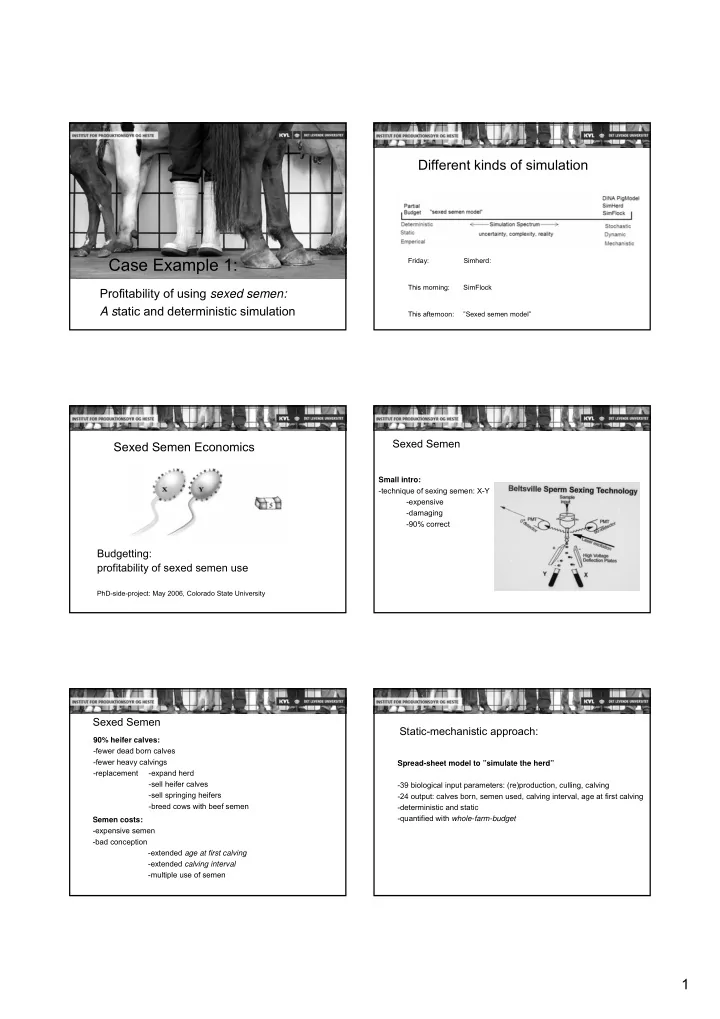
Different kinds of simulation

Friday: Simherd: This morning: SimFlock This afternoon: ”Sexed semen model”

Sexed Semen Economics

Budgetting: profitability of sexed semen use

PhD-side-project: May 2006, Colorado State University

Sexed Semen

Small intro:

  • technique of sexing semen: X-Y
  • expensive
  • damaging
  • 90% correct

90% heifer calves:

  • fewer dead born calves
  • fewer heavy calvings
  • replacement
  • expand herd
  • sell heifer calves
  • sell springing heifers
  • breed cows with beef semen

Semen costs:

  • expensive semen
  • bad conception
  • extended age at first calving
  • extended calving interval
  • multiple use of semen

Sexed Semen Static-mechanistic approach:

Spread-sheet model to ”simulate the herd”

  • 39 biological input parameters: (re)production, culling, calving
  • 24 output: calves born, semen used, calving interval, age at first calving
  • deterministic and static
  • quantified with whole-farm-budget
slide-2
SLIDE 2

2

Partial budgetting: present only the parts of the model that change Gain: Increasing revenues + decreasing costs Loss: Decreasing revenues + increasing costs Difference: Gain-loss = Profit (if +) or Loss (if -) Whole-farm-budgetting: present all revenues and expenses (US-tool)

Revenues: milk calves Expenses: feed labour housing Net Return to Assets Profit/loss

Sexed Semen Economics

Emperical: 1 cow x 1000 = 1 herd Disease and production ---x---> replacement Deterministic formulas: Conception chance normal semen: 0.6 1.7 ins/preg sexed semen: 80%*0.6=0.48 2.1 ins/preg Age at first calving normal semen: 14mo. + 0.7*21 + 9mo. = 23.1mo. sexed semen: 14mo. + 1.1*21 + 9mo. = 23.8mo. Static/Dynamic: Models year after year, doesn’t follow a cow

Sexed Semen Economics

Step 1: parameter estimates

60% Conception rate 0.6 Lower Risk (RR) for heifer calf 2% Mortalitity dams, around parturition 20% Probability stillbirth, bull calf 24% Probability dystocia, bull calf 1.85% Twin births 49% Sex ratio ratio (% heifer calves) Normal Semen 90% 90% of normal CR Sexed semen

Normal Semen €11 Sexed semen €31 HF bull calf €188 (1400 DKK) Beef calf €255 (+500 DKK) Heifer raising costs €981 (10 DKK/day) Springing heifer €1075 (Kælvekvie, DKK 8.000) Dystocia losses €82 Step 2: Estimates relevant prices Step 3: Design scenarios Default scenario

  • all nulliparous heifers and lactating cows are bred with normal, dairy semen
  • all bull calves are sold a.s.a.p.
  • surplus springing heifers (kælvekvier) are sold for market price

Main scenario under study:

  • all nulliparous heifers with sexed semen
  • other lactating cows with unsexed, beef semen

Results: Technical comparison

Default Sexed Semen Difference Sold # week-old HF bull calves 503 123

  • 380

# beef calves (both bull and heifer) 495 495 # springing heifers 100

  • 100

# infertile and aborted heifers 14 11

  • 3
slide-3
SLIDE 3

3

Bought Sexed semen # ins with sexed semen for heifers 673 +673 # ins with sexed semen for cows Normal semen # ins with normal semen for cows 2165 573

  • 1591

# ins with normal semen for heifers 781

  • 781

Beef bull semen 1591 1591 Total doses of semen 2946 2838

  • 108

Default Sexed Semen Difference Sold # week-old HF bull calves 503 123

  • 380

# beef calves (both bull and heifer) 495 495 # springing heifers 100

  • 100

# infertile and aborted heifers 14 11

  • 3

Results: Technical comparison Results: Budget comparison: € per cow-year

Default Sexed semen Difference Revenues Milk sales 2731 2731 Beef calves 126 126 Cull income 291 289

  • 3

Week-old bull calves 95 23

  • 71

Spring heifers 107

  • 107

Loss due to dystocia

  • 9
  • 8

1 Gross revenue 3215 3161

  • 54

Default Sexed semen Difference Revenues Milk sales 2731 2731 Beef calves 126 126 Cull income 291 289

  • 3

Week-old bull calves 95 23

  • 71

Spring heifers 107

  • 107

Loss due to dystocia

  • 9
  • 8

1 Gross revenue 3215 3161

  • 54

Expenses Semen costs 32 48 17 Replacement costs 463 373

  • 91

Total operating expenses 2037 1964

  • 73

Gross Margin 1178 1198 20 Fixed ownership expenses 244 244 Total expenses 2281 2207

  • 73

Net Return to assets 934 954 20

+€ 20 +DKK 146

Results: Budget comparison: € per cow-year

Time Window: start sexed semen in year 1

910 920 930 940 950 960 970 980 1 2 3 4 5 6 Years Net Return to Assets €

Default Sexed Semen

Year 1: use of expensive semen, no income from beef-calves

  • €15

Year 2+3: income from beef-calves AND income from springing heifers

+€33 +€35

Year >4: expensive semen, income from beef-calves, no income from heifers

+€24 +€20

Results: Sensitivity analysis key-prices and figures

€ 1075

Break Even Value €215 Break Even Value €59

Results: Sensitivity analysis key-prices and figures

slide-4
SLIDE 4

4

Discussion: Profitability of sexed semen scenario: €20 per cow/year

No uncertainty represented: ALL animals need 1.6 inseminations Of ALL calves born, 6% dies Milk price Livestock prices Not really in the scope of AHM... No uncertainty represented: €20

  • (95% CI: -5, 45)
  • Probability of positive result: 75%

Discussion: Disease complex: costs per case of dystocia: €82 Simherd:

MF DOWN DYS RP MET KET DA MAS

Not mechanistic: Replacement rate is set by user Simherd: replacement rate is a result

  • f disease, reproduction, production,

available heifers...

Simherd: Friday

Advantage: detailed, mechanistic, dynamic, realistic, stochastic Disadvantage: user-friendly-ness, interpretation of results, over-parameterization Static/deterministic spread-sheet ↔ Simherd Static/deterministic spread-sheet ↔ other budget studies

Calves per cow-year:

  • calving interval

e.g. 405 days

  • 365/405 = 0.90
  • all cows that calf have 0.9 calves per year

First-calf heifers

  • 30% of animals in the herd is a primiparous cow
  • calving interval does not apply to them
  • higher replacement rate=more first-calf heifers

Calves/cow-year is not only dependend on calving interval also on replacement rate

Static/deterministic spread-sheet ↔ other budget studies

Relation between replacement rate (RR) and calves per cow (CPC)! SimHerd

  • run scenarios with different calving intervals

(CINT) and replacement rates Regression analysis on the outcome: CPC = (365/CINT) + RR * 0,005 + ε

Static/deterministic spread-sheet ↔ other budget studies

CPC = (365/CINT) + RR * 0.005 + ε 365/405 + 30% * 0.005 = 0.90 + 0.15 = 1.05

0.8 0.85 0.9 0.95 1 1.05 1.1 1.15 1.2 2 4 6 8 10 12 14 16 18 20 22 24 26 28 30 32 34 36 38 40

replacement rate % calves per cow-year

CINT 405 CINT 380

Intercept: Crosses Y-axis at (365/CINT)

Calves per cow = 365/CINT IF...replacement rate = 0%!!

slide-5
SLIDE 5

5

Let’s take a look at the spread-sheet

  • different strategies
  • introduce stochasticism