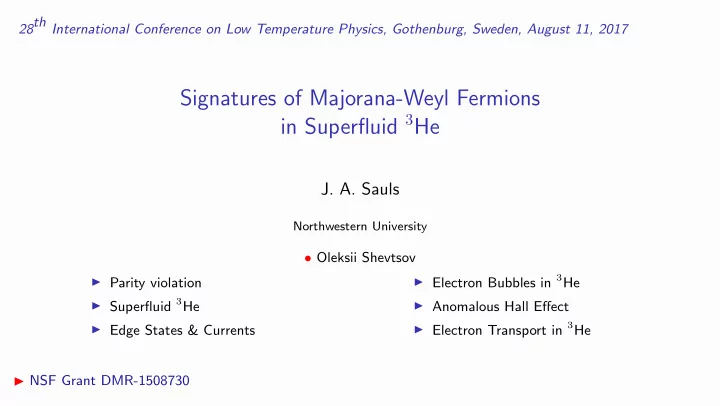
SLIDE 4 Parity Violation in Beta Decay of 60Co - Physical Review 105, 1413 (1957)
LETTERS
TO TH E E D I TOR 1413 The branching
ratio of the two modes of decay of Fm'",
i.e., E.C./n,
was found
to be about 8.5—
which gives
89.5% decay by electron
capture and 10.5% by alpha
not possible to measure the cross section for the Cf'"(n, 3n)Fm'" reaction because
Fm'" could also be produced
from other californium isotopes in the target. A previous publication4
identification
the values
the alpha-particle energy, and a half-life &10 days.
It is a pleasure
to thank the
crew of the 60-inch cyclotron for their extremely careful and skillful
ation
machine during the bombardment. We wish
to thank Professor
Glenn
for his continued interest. * On leave from the Israel Atomic Energy
Commission, Weiz- mann Institute
Israel. 'Thompson, Ghiorso, Harvey, and Choppin,
908 (1954).
~ Harvey,
Chetham-Strode, Ghiorso, Choppin, and Thompson,
- Phys. Rev. 104, 1315 (1956).
'Thompson, Harvey, Choppin, and Seaborg, J. Am. Chem.
- Soc. 76, 6229 (1954); Choppin,
Harvey, and Thompson,
J.
- Inorg. and Nuclear
- Chem. 2, 66 (1956).
4 Friedman,
Gindler, Barnes, Sjoblom, and Fields, Phys. Rev. 102, 585 (1956).
Experimental
Test of Parity Conservation
in Beta Decay*
University,
1Vem York, %em York AND
- E. AMBLER) R. W. HAYwARD) D. D. HQPPEs)
AND R, P. HUDsoN)
National, Bureau of Standards, W'ashington,
(Received January 15, 1957)
' 'N a recent paper'
in weak
~ - interactions,
Lee and Yang critically surveyed the experimental information concerning this question and reached the conclusion that there is no existing evidence either to support or to refute parity conservation
in weak
interactions. They proposed a number of experiments
beta decays and hyperon and meson decays which would provide the necessary evidence for parity conservation
In beta decay, one could measure
the angular distribution
coming from
beta decays of polarized
in the distribution between
8 and 180'— 8 (where 8 is the angle
between the orientation
nuclei and the momentum
is observed,
it provides
unequivocal proof that parity is not conserved in beta
effect has been observed in the case of oriented Co~.
It has been known for some time that Co" nuclei can
be polarized by the Rose-Gorter method in cerium magnesium (cobalt) nitrate, and the degree
zation detected by measuring the anisotropy
succeeding gamma rays. ' To apply this technique
to the present
problem, two major difhculties had to be over-
No ~Ocm
—
LUCITE ROD ~PUMPING TUBE FOR VACUUM SPACE
4I.5
—
RE-ENTRANT
VACUUM
SPACE MUTUAL INDUCTANCE THERMOMETER
COILS~ SPECIMEN~
HOUSING OF Ce Mg NITRATE ANTHRACENE CRYSTAL
r
46 cm
Nal
drawing
- f the lower part of the cryostat.
- come. The beta-particle
counter should be placedi~side the demagnetization cryostat, and the radioactive nuclei must be located in a thin surface layer and polarized. The schematic diagram
is shown in Fig. 1.
To detect beta particles, a thin
anthracene crystal
—
, 'in. in diameter)&
—,
'6 in. thick is located
inside the vacuum chamber about 2 cm above the Co~ source.
The scintillations are transmitted through a glass
window
and a Lucite light pipe 4 feet long to a photo- multiplier (6292) which is located at the top of the
- cryostat. The Lucite head is machined
to a logarithmic
spiral shape for maximum light collection. Under this condition, the Cs"' conversion line (624 kev) still retains
a resolution
- f 17%. The stability
- f the beta
counter was carefully checked for any magnetic
temperature effects and none were found. To measure the amount
- f polarization
- f Co", two additional
NaI
gamma scintillation counters were installed,
in the equatorial plane and
near the polar position. The
gamma-ray anisotropy was used as a measure
and, effectively, temperature. The bulk susceptibility was also mon- itored but this is
secondary significance due to surface heating effects, and the gamma-ray ani- sotropy alone provides a reliable measure
polarization. Specimens were made by taking good single crystals of cerium magnesium nitrate and growing
- n the upper surface only an additional
crystalline layer containing Co".One might point out here that since the allowed beta decay of Co~ involves a change of spin of ◮ T. D. Lee and C. N. Yang, Phys Rev 104, 204 (1956) 60Co → 60Ni + e− + ¯ ν
LETTE RS
TO
THE ED I TOR
l.3 I.I w A ld I.O K
+ Z
0'9 Z Z
I—
P Z
O.8
0.7— 0.3
O.I GAMMA-AN
I SOTROPY
0) EQUATORIAL
COUNTER
b) POLAR
COUNTER
x
g ~
x
, X
4 ' „
~
x x
I I
I
I I
OPY CALCULATED FROM (a) 8(b)
~i~ ) —W(0) W(~up)
0TH POLARIZING F I ELD
DOWN I.20
X
u n,
cf I.OO
Z Q
&z
O3O
~ o
O 0.80
I
I
METRY
I
I
I
(AT PULSE HEIGHT IOV) EXCHANGE
GAS IN
I I I I I I I
2
4 6 8
IO
l2 I4 T I ME
I N
M I NU TES
I
16 I8
and beta asymmetry for polarizing field pointing up and pointing down.
- ne unit and no change of parity, it can be given only
by the Gamow-Teller interaction. This is almost im- perative for this experiment. The thickness
radioactive layer used was about 0.002 inch and con- tained a few microcuries
- f activity. Upon demagnetiza-
tion, the magnet is opened and a vertical solenoid
is raised around
the lower part
cryostat. The
whole process takes about 20 sec. The beta and gamma counting is then started. The beta pulses are analyzed
pulse-height analyzer with a counting interval
and a recording interval
40 seconds. The two gamma counters are biased to accept only the pulses from the photopeaks
in order to discriminate against pulses from Compton
scattering.
A large beta asymmetry was observed. In Fig. 2 we have plotted the gamma anisotropy and
beta asym- metry
vs
time for polarizing field pointing up and pointing
- down. The time for disappearance
- f the beta
asymmetry coincides
well with
that
ani-
time is generally about 6 minutes, and the warm counting rates are independent
field direction. The observed
beta asymmetry does not change
sign with reversal
- f the direction
- f the de-
magnetization field, indicating that it is not caused by remanent magnetization in the sample. The sign of the asymmetry coeAicient,
that is, the emission of beta particles
is more favored in
the direction
- pposit. e to that of the nuclear
- spin. This
naturally implies that the sign for Cr and Cr' (parity conserved and pa.rity not conserved) must be opposite. The exact evaluation
because
many eA'ects involved. The lower limit
estimated roughly, however, from the observed value
corrected for backscattering.
AL velocity
v(c=0.6, the
value
0.4. The value
(I,)/I can be calculated
from the observed anisotropy
radiation to be about 0.6. These two quantities give the lower limit
asymmetry parameter P(n
P(=I,)/I)
approximately equal to 0.7.
In order to evaluate
many supplementary experiments must be carried
to
determine the various correction factors. It is estimated here only to show the large asymmetry
to I-ee and Yang' the present experiment indicates not only that conservation
is violated but also that invari- ance under charge conjugation is violated. 4 Further- more, the invariance under time reversal can also be decided from the momentum dependence
metry parameter
- P. This effect will be studied
later. The double nitrate cooling salt has a highly aniso- tropic g value. If the symmetry axis of a crysial is not set parallel to the polarizing
field, a small magnetic field vill be produced perpendicular
to the latter. To check whether the beta asymmetry
could be caused by such a magnetic field distortion, we allowed a drop of CoC12 solution to dry on a thin plastic disk and cemented the disk to the bottom of the same housing. In this way the cobalt nuclei should not be cooled su%ciently
to produce an appreciable nuclear polarization,
whereas the housing will behave as before. The large beta asym-
- mef. ry was not observed.
Furthermore, to investigate possible internal magnetic effects on the paths
electrons as they find their way to the surface
crystal,
we prepared
another source by rubbing
CoC1&
solution
the surface
cooling salt until a reasonable amount
- f the crystal was dissolved.
AVe then
allowed the solution to dry. No beta asymmetry was
with this specimen.
3lore
rigorous experimental checks are being initi- ated, but in view of the important implications
we report them now in the hope that they Diay
stimulate and encourage further experimental investigations
question in either beta or hyperon and meson decays. The inspiring discussions held with Professor T. D. Lee and Professor C. N. Yang by one of us (C. S. Ku) are gratefully acknowledged. * YVork
partially supported by the
Energy Commission.
' T. D. Lee and C. N. Yang, Phys. Rev. 104, 254 (1956).
~ Ambler,
Grace, Halban, Kurti, Durand, and Johnson, Phil.
' Lee, Oehme, and Yang, Phys. Rev. (to be published' ).
◮ Current of Beta electrons is (anti) correlated with the Spin of the 60Co nucleus.
p = 0 Parity violation