SLIDE 1
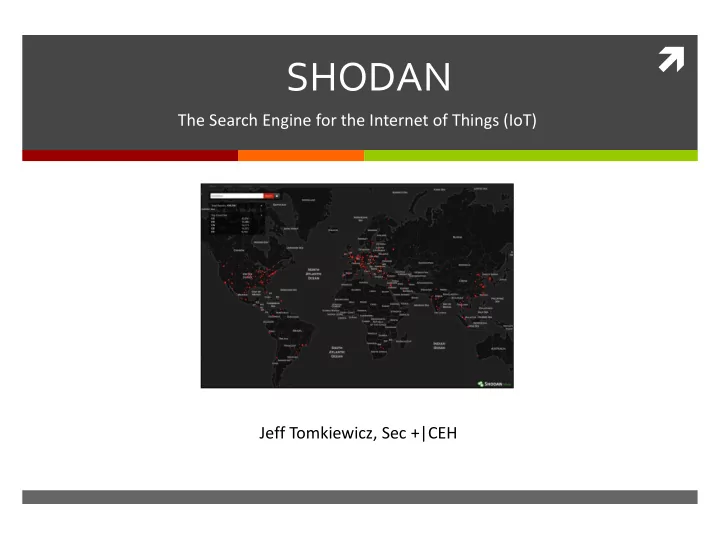
SHODAN
The Search Engine for the Internet of Things (IoT) Jeff Tomkiewicz, Sec +|CEH
SLIDE 2
Outline
- What is Shodan? - History behind Shodan - How Shodan Works - How to incorporate Shodan into Kali Linux - How to conduct searches - Questions
SLIDE 3 What is Shodan?
Shodan is considered the first search engine for Internet of
Things (IoT) devices.
Any thing from web cams, water treatment facilities, yachts, medical devices, traffic lights, wind turbines, license plate readers, smart TVs, refrigerators and many more.
SLIDE 4
History Behind Shodan
Created by John Matherly Launched in 2009 Developed as a “pet project”
based on the fact that large numbers of devices and computer systems are connected to the Internet.
Been described as the “The
scariest search engine on the Internet
SLIDE 5 How Shodan Works
Shodan works simply by:
Searches random IPv4 address
Generate a random port to test from the list of ports that Shodan understands
Check the random IPv4 address on the random port and grab a banner (Banner Grabbing)
YES IT IS LEGAL!
SLIDE 6
How Shodan Works
SLIDE 7
How to Incorporate Shodan into Kali Linux
First step is to create an account on Shodan.io
(https://www.shodan.io/)
SLIDE 8
How to Incorporate Shodan into Kali Linux
Next click on “My Account in the upper right side of
the page.
SLIDE 9 How to Incorporate Shodan into Kali Linux
You will now see QR Code and API Key on your
- account. At this time we will reduce this window
and open up our Kali Virtual Machine Box
SLIDE 10
How to Incorporate Shodan into Kali Linux
Once in on your Kali Linux box open a terminal and type in the
prompt “pip install shodan” and press enter.
SLIDE 11
How to Incorporate Shodan into Kali Linux
Go back to your Shodan account page and copy your API Key. Then go back to you Kali Linux Box and in the terminal type
“shodan init” followed by your API key. Then press enter.
SLIDE 12
How to Conduct Searches using the Command Line (CLI)
The Shodan CLI has a lot of commands. For the full list of
commands just run the tool without any arguments:
SLIDE 13
How to Conduct Searches using the Command Line (CLI)
count: Returns the number of results for a search query.
SLIDE 14 How to Conduct Searches using the Command Line (CLI)
download: this command is what you should be using most often. It lets you save the results and process them afterwards using the parse command.
NOTE: Because paging through results uses query credits, it makes sense to always store searches that you're doing so you won't need to use query credits for a search you already did in the past.
SLIDE 15 How to Conduct Searches using the Command Line (CLI)
parse: to analyze a file that was generated using the download command. It lets you filter out the fields that you're interested in, convert the JSON to a CSV and is friendly for pipe-ing to other scripts
SLIDE 16
How to Conduct Searches using the Command Line (CLI)
host: See information about the host such as where it's located,
what ports are open and which organization owns the IP.
SLIDE 17
How to Conduct Searches using the Command Line (CLI)
myip: Returns your Internet-facing IP address.
SLIDE 18 How to Conduct Searches using the Command Line (CLI)
search: This command lets you search Shodan and view the results in a terminal- friendly way. By default it will display the IP, port, hostnames and data. You can use the --fields parameter to print whichever banner fields you're interested in.
SLIDE 19 Additional Information
Complete Guide to Shodan:
https://leanpub.com/shodan Shodan – Search Engine For Hackers – Beginner Guide:
https://hsploit.com/shodan-search-engine-for-hackers-beginner- guide/
SLIDE 20
Questions?
SLIDE 21
Conclusion
- What is Shodan? - History behind Shodan - How Shodan Works - How to Incorporate Shodan into Kali Linux - How to Conduct Searches using the Command Line (CLI)