SHIPLAKE NEIGHBOURHOOD DEVELOPMENT PLAN 24 MAY 2017 PETER BOROS - - PowerPoint PPT Presentation

shiplake
SMART_READER_LITE
LIVE PREVIEW

SHIPLAKE NEIGHBOURHOOD DEVELOPMENT PLAN 24 MAY 2017 PETER BOROS - - PowerPoint PPT Presentation

SHIPLAKE NEIGHBOURHOOD DEVELOPMENT PLAN 24 MAY 2017 PETER BOROS WHAT IS A NEIGHBOURHOOD PLAN? A right for communities to influence how land use planning and development takes place very locally Introduced by Localism Act 2011


slide-1
SLIDE 1
slide-2
SLIDE 2

SHIPLAKE NEIGHBOURHOOD DEVELOPMENT PLAN

24 MAY 2017 PETER BOROS

slide-3
SLIDE 3

WHAT IS A NEIGHBOURHOOD PLAN?

  • A right for communities to influence how land use planning and development

takes place very locally

  • Introduced by Localism Act 2011
  • Becomes part of the Local Plan once adopted
  • Used in the determination of Planning Applications
  • BIG BUT……..the weasel words……
  • Unless material considerations indicate otherwise……
slide-4
SLIDE 4

WHY HAVE A NEIGHBOURHOOD PLAN? 1

  • England has a Plan led system of Development.
  • Local Plans are a Statutory Policy to provide the guidance for determining applications
  • SODC are developing their new Local Plan (to 2033)
  • SODC intend to adopt Neighbourhood Planning as Policy
  • No Local Plan or Out of Date Plan = Presumption in favour of ‘sustainable development’
slide-5
SLIDE 5

WHY HAVE A NEIGHBOURHOOD PLAN? 2

  • Have a say in where development takes place
  • To have a say in what form/scale of development happens locally
  • Identify things we want/need in the community eg.
  • We have a rapidly ageing local population
  • suitable accommodation for down sizing
  • accomodation suitable for younger families
  • footpaths and or cycle paths
  • more/better parking
slide-6
SLIDE 6

WHY HAVE A NEIGHBOURHOOD PLAN? 3

  • The 5 year rule!
  • If an authority cannot demonstrate a 5 year housing land supply then national rules say that the

Local Plan is out of date

  • Hence……
  • Open season for Planning Applications at present with large numbers of current applications

viz: Thames Farm, Retirement Villages, Sonning Common etc etc

  • This is the primary reason why PC has gathered support for producing a NP
  • Must accept at least 33 new units (+5%) in order to be able to have a NP
  • 13 already exist!
slide-7
SLIDE 7

THE PROCESS 1

  • Steering Group established of local residents in February
  • Road map and timetable (end of year)
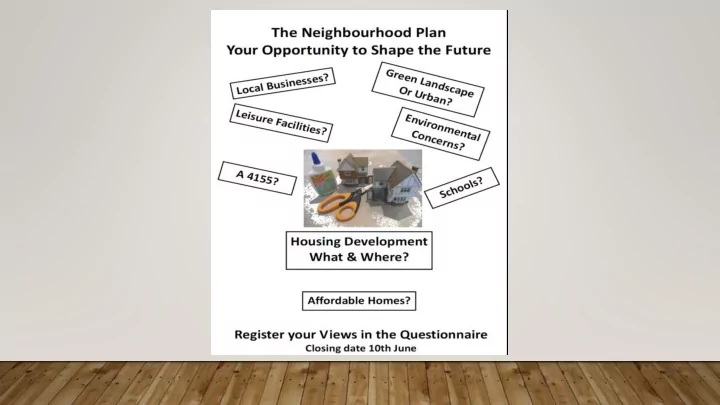
  • Developed Questionnaire…..your opportunity to tell us what matters to you!
  • June 10 is target to complete!
  • Analysis of responses
  • Creation of statements and policies
slide-8
SLIDE 8

THE PROCESS 2

  • Identification of sites suitable for development/ranking/discussions with owners
  • Public consultation regarding proposals
  • Prepare draft of plan/modify
  • Submit to PC for consideration and…….
  • Consultation with residents
  • Statutory consultation
  • General public consultation
slide-9
SLIDE 9

THE PROCESS 3

  • PC formally submits to SODC
  • Review by SODC and public exhibition
  • Examination by independent examiner
  • Update plan as necessary
  • Prepare and submit for local referendum
slide-10
SLIDE 10

THE PROCESS 4

  • Who can vote…………
  • All local residents of voting age in parish (as it existed in 2014)
  • People who voted in Henley and Harpsden referendum cannot vote again
  • Simple majority of voters required
  • Acceptance of NP by SODC at Committee
  • Adoption (mandatory if approved at referendum)
slide-11
SLIDE 11

TIMESCALES

  • Begin February 2017
  • Questionnaire June
  • Initial Working Draft July/August
  • Public Consultation September
  • Submit to PC November
  • Submit to SODC December/January
  • Referendum mid next year
slide-12
SLIDE 12

THE STEERING GROUP

  • Peter Boros
  • David Pheasant
  • David Bartholomew
  • Susan Mann
  • Emer Bollinghaus
  • Gareth Evans
  • Michael Reid
  • William Stevens
  • James Dalzell
  • Marnie McKendrick
  • John Walker
  • Shiplake X Resident ???
slide-13
SLIDE 13

QUESTIONS AND ANSWERS?

Please be gentle ……………!