
SLIDE 1
1
Stella Lamprianou (www.digipass.gr)
The four seasons and the circle of life
B.C.BROKHIN ROERMOND MOLETAI GYMNASIA MOLETAI GIMNAZJUM NUMER 4 ZORY GYMNASIUM OF ARCHAGELOS ARCHAGELOS EXTERNATO DE PENAFIRME SANTA CRUZ
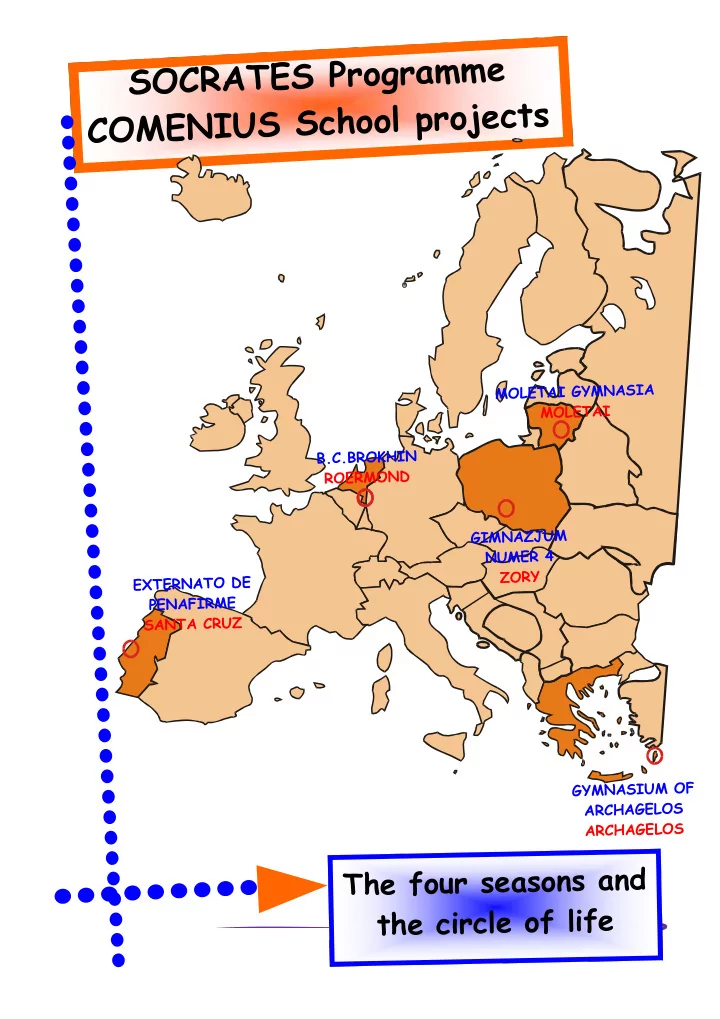
SOCRATES Programme COMENIUS School projects MOLETAI GYMNASIA - - PDF document
SOCRATES Programme COMENIUS School projects MOLETAI GYMNASIA MOLETAI B.C.BROKHIN ROERMOND GIMNAZJUM NUMER 4 ZORY EXTERNATO DE PENAFIRME SANTA CRUZ GYMNASIUM OF ARCHAGELOS ARCHAGELOS The four seasons and the circle of life 1 Stella
Stella Lamprianou (www.digipass.gr)
B.C.BROKHIN ROERMOND MOLETAI GYMNASIA MOLETAI GIMNAZJUM NUMER 4 ZORY GYMNASIUM OF ARCHAGELOS ARCHAGELOS EXTERNATO DE PENAFIRME SANTA CRUZ
Stella Lamprianou (www.digipass.gr)
Stella Lamprianou (www.digipass.gr)
PAGE CONTENTS
4-5 Comenius in general 6-7 Comenius ACTION 1 School partnerships 8 Our project in short 9-12 The four seasons and the circle of life. Description of project activities 13-14 Participant schools COUNTRIES AT A GLANCE 15-16 Greece 17 The Netherlands 18 Poland 19 Lithuania 20 Portugal 21 Weather charts 22-23 Europe 24 Europe by day. Europe at night 25-26 Europe-climate, weather maps 27 Europe-vegetation 28-29 Europe-animal life 30-31 European Union 32 History of the project 33-35 Photos
Stella Lamprianou (www.digipass.gr)
The Objectives of COMENIUS The overall objectives of COMENIUS are to enhance the quality and reinforce the European dimension of school education, in particular by encouraging transnational cooperation between schools, contributing to the improved professional development of staff directly involved in the school education sector, and promoting the learning of languages and intercultural awareness. COMENIUS seeks to help those learning and teaching in schools to develop a sense of belonging to a broader and outward-looking European community - a community characterised by diverse traditions, cultures and regional identities, but rooted nevertheless in a common history of European development. COMENIUS contributes to enhancing the quality and reinforcing the European dimension
school education by: promoting transnational cooperation and exchanges between schools and teacher training establishments; encouraging innovation in pedagogical methods and materials; promoting the transnational dissemination of good practice and innovation in the management of schools; developing and disseminating methods for combating educational exclusion and school failure, promoting the integration of pupils with special educational needs, and promoting equal opportunities in all sectors of education; promoting the use of information and communication technology in school
Stella Lamprianou (www.digipass.gr)
education and in the training of staff working in this sector. COMENIUS contributes to promoting the learning of languages in school education in Europe by transnational measures designed to: improve the quality of the teaching of European languages as foreign languages; improve the pedagogical skills of teachers of languages; improve the language skills of teachers of less widely used and less taught languages; increase the diversity of foreign languages taught; motivate all teachers and learners to increase the number of foreign languages they speak and the standard to which they speak them. COMENIUS contributes to promoting intercultural awareness in school education in Europe by transnational activities designed to: promote enhanced awareness of different cultures; develop intercultural education initiatives for the school education sector; improve the skills of teachers in the area of intercultural education; support the fight against racism and xenophobia; improve the education of children of migrant workers, occupational t r a v e l l e r s , gypsies and travellers.
Stella Lamprianou (www.digipass.gr)
Comenius School Projects promote transnational co-operation between schools. They give pupils and teachers from at least three participating countries an
co-operation enables participants to exchange experiences, explore different aspects of European cultural, social and economic diversity, increase their general knowledge and learn to understand and appreciate each other’s views. Comenius School Projects should be integrated into the regular activities of the school, take place within the curriculum, involve several class groups, and have as wide an impact on the school as possible. All pupils attending a school which is involved in a project may participate in project activities. Ideally, pupils should participate actively in all phases of the project, including the planning, organisation and evaluation of the
process itself - the carrying out of a project with a number of partners from other European
produce outcomes such as project diaries, booklets, objects, artistic performances, web sites, CD-ROMs and so on.
Stella Lamprianou (www.digipass.gr)
Who was Johann Amos Comenius ? The choice of the name COMENIUS for this part of the SOCRATES programme ia a reminder of Europe's rich educational heritage. A century before the Enlightenment, Comenius (1592-1670), born in what is today the Czech Republic, was a theologian, philosopher and pedagogue who believed that only through education could man achieve his full potential and lead a truly harmonious
for human rights, peace and unity between nations.
Mobility grants under Comenius 1 projects
The following transnational mobility activities are supported within School Partnerships (Comenius 1). Project meetings: transnational meetings between staff and pupils from different participating schools to discuss project planning,
Teacher exchanges: visits during which a teacher carries out mainly teaching activities at a partner school within the project. Head teacher study visits: should be directly linked to the project
involvement in and support for the project.
Stella Lamprianou (www.digipass.gr)
T I T L E A C T I V I T I E S C O U N T R I E S
their country, school, home- town, weather conditions, way
booklets and/or videotapes which are exchanged among participant schools.
exchange letters and e-mails.
ing to visit other participant schools as part of mutual edu- cational exchanges.
T H E M E S
Stella Lamprianou (www.digipass.gr)
GENERAL THEME Weather and life
Weather means what is happening in the atmosphere every day, contrasted with climate which means the aver- age weather over a period of time. Every country experi- ences sun and rain but the climate in each place is differ-
weather has an impact on our lives every day , on the types of plants and animals that live in any one area, on production of crops and on human survival in general. The project will investigate both general national characteristics and seasonal characteristics.
METHODOLOGY: Collection and exchange of material between participating
schools at the end of each school year. At every school letters, postcards, posters etc will be on display at school. Main groups of participants organize dissemination
OUTCOME: at the end of each school year, booklet and
video tape. At the end of the three year project, CD ROM in- cluding material of the previous years.
Stella Lamprianou (www.digipass.gr)
DURATION 3 school years, starting September
2000
PARTICIPANTS: Secondary schools from Greece,
The Netherlands, Poland, Lithuania, Portugal.
AIMS AND OBJECTIVES
We hope that the project will help pupils and teachers to acquire
PROJECT ACTIVITIES
A) NATIONAL CHARACTER- ISTICS
Stella Lamprianou (www.digipass.gr)
schools, year of studies, teaching year, opening hours, ex- ams.
jects, teachers, playground.
6.food typical national food, recipes and pictures
tistics B) SEASONAL CHARACTERISTICS
changes
temperature, rain- f a l l etc.
weather forecast sites
rainy days, ) in common recording sheets
each month)
Stella Lamprianou (www.digipass.gr)
ent landscapes
clothes we wear, special food,
description
15. flora
de- scription in common
Stella Lamprianou (www.digipass.gr)
Name of school: Gymnasium of Archagelos Postal address: Archagelos Rhodes 85102 GREECE Phone: 0030 244 22328 Fax: 0030 244 23960 E-mail: el-arxaggelou@rho.forthnet.gr Contact teacher: Ms Stella Lamprianou stella@mailbox.gr Number of teachers: 18 Number of pupils: 194 Foreign languages taught: English, German Name of school: Gymnazjum Numer 4 Postal address: Ksiecia Wladyslava 44240 Zory Poland Phone: 0048 324341762 Fax: 0048 324341762 E-mail: Contact teacher: Ms Izabela Staniec Number of teachers: 27 Number of pupils: 197 Foreign languages taught: French, German, English
G R E E C E P O L A N D
Stella Lamprianou (www.digipass.gr)
Name of school: Moletai Gymnasia Postal address: Jaunimo 5 Moletai 4150 Lithuania Phone: 00370 30 51034 Fax: 00370 30 51048 E-mail: vm2@2vm.mlt.soros.lt Contact teacher: Ms Danguole Dirmiene Number of teachers: 59 Number of pupils: 560 Name of school: Bisschoppelijk College Broekhin Postal address: Bob Boumanstraat 30-32, 6042 EH, Roermond, The Netherlands Phone: 0031 475 346666 Fax: 0031 475 346677 E-mail: broekhin@xs4all.nl Contact teacher: Mr Theo Versteegen theoversteegen@hotmail.com Number of teachers: 85 Number of pupils: 1290 Foreign languages taught: English, German, French Name of school: Externato De Penafirme Postal address: Santa Cruz P-2560 Torres Vedras Portugal Phone: 00351 61 937496 Fax: 00351 61 931002 E-mail: info@ext-penafirme.rcts.pt Contact teacher: Ms Eva Michel rosa_clara@yahoo.com Number of teachers: 122 Number of pupils: 1393 Foreign languages taught: English, German, French
P O R T U G A L T H E N E T H E R
A N D S L I T H U A N I A
Stella Lamprianou (www.digipass.gr)
OFFICIAL NAME : Hellenic Republic CAPITAL : Athens POPULATION : 10.6 million CURRENCY : Drachma OFFICIAL LANGUAGES : Greek The southernmost country of the Balkans, Greece is surrounded by the Aegean, Ionian and Cretan seas. Its mainly mountainous territory includes more than 2,000 islands. Only
seafaring tradition and some of the world's biggest ship-
is rare.
ARCHAGELOS
Stella Lamprianou (www.digipass.gr)
Greece (Greek Hellas), officially known as the Hellenic Republic (Ellinikí Dimokratía), is in southeastern Europe, occupying the southernmost part
Greece is dominated by mountains and sea. The Aegean, Mediterra- nean, and Ionian seas constitute the country's eastern, southern, and western borders, and no part of mainland Greece is more than 100 km (60 mi) from the water. Islands constitute about one-fifth of the country's land area. Greece has historically been poor with inadequate communications, but in the period after World War II ended in 1945 it has experienced rapid eco- nomic and social change. Tourism and shipping make major contribu- tions to the Greek economy. The country's merchant ship fleet is one of the largest in the world. Greece's capital and largest city is Athens. Although Greece did not come into being as a modern state until the 19th century, its people have a proud history that stretches back thousands of
made tremendous advances in government, philosophy, and the arts. The ancient Greek civilization was concentrated on the coastlines of present
today Turkey. The archaeological remains of many of the cities and sa- cred sites of ancient Greece are located in modern Greece. The Ottoman Empire gained control of Greece in stages beginning in the 15th century. After an eight-year war, Greece formally gained its inde- pendence from the Ottomans in 1830; it was the first nation in the em- pire to do so. Initially including just the Pelopónnisos (Peloponnesus) and the southern tip of the Balkan Peninsula, Greece more than tripled its area between 1880 and 1920, gaining mainland territory and islands from the Ottomans, Britain, and Bulgaria. German forces occupied Greece during World War II (1939-1945). In 1947 Dodecanese islands were united with
Greece voted in favor of a republic. In so doing, they brought an end to the Greek monarchy, which had been a controversial feature of the coun- try's government throughout most of its modern history. Greece's heritage and geographical position make it part of the Euro- pean, Balkan, and Mediterranean worlds.
Stella Lamprianou (www.digipass.gr)
THE NETHERLANDS
ROERMOND
OFFICIAL NAME : Kingdom of the Netherlands CAPITAL : Amsterdam, The Hague POPULATION : 15.7 million CURRENCY : Netherlands gulden (guilder)
OFFICIAL LANGUAGES : Dutch The Netherlands is located at the delta of five major rivers in northwest
a flat coastal area, bordered by the North Sea to the north and west. This is protected by a giant infrastructure of dunes, dikes, and canals, as 27% of the coast is below sea level. The Netherlands became one of the world's first confederative republics after Spain recognized its independence in 1648. Its highly successful economy has a long trading tradition, and Rotterdam, its main port, is also the world's largest.
Stella Lamprianou (www.digipass.gr)
P O L A N D
OFFICIAL NAME : Republic of Poland CAPITAL : Warsaw POPULATION : 38.7 million CURRENCY : Zloty OFFICIAL LANGUAGES : Polish Located in the heart of Europe, Poland's low-lying plains extend from the Baltic shore in the north to the Tatra Mountains on its southern border with the Czech Republic and Slovakia. Since the fall of the communist regime, Poland has undergone massive social, economic and political change. It has experienced rapid economic growth since the early 1990s and is negotiating to join the EU.
ZORY
Stella Lamprianou (www.digipass.gr)
MOLETAI
OFFICIAL NAME : Republic of Lithuania CAPITAL : Vilnius POPULATION : 3.7 million CURRENCY : Litas OFFICIAL LANGUAGES : Lithuanian Lying on the eastern coast of the Baltic Sea, Lithuania is bordered by Latvia, Belarus, Poland and the Kaliningrad area of the Russian
bogs. Now a multiparty democracy, Lithuania achieved independence from the former USSR in 1991. Industrial production and agriculture are the mainstays of the economy.
Stella Lamprianou (www.digipass.gr)
SANTA CRUZ
OFFICIAL NAME : Republic of Portugal CAPITAL : Lisbon POPULATION : 9.9 million CURRENCY : Portuguese escudo OFFICIAL LANGUAGES : Portuguese Portugal, with its long Atlantic coast, lies on the western side of the Iberian peninsula. The river Tagus divides the more mountainous north from the lower, undulating terrain to the south. In 1974, a bloodless military coup overthrew a long-standing conservative dictatorship. Democratic elections were held in 1975 and the armed forces withdrew from politics thereafter. The 1980s witnessed the implementation of a substantial program of socioeconomic modernization.
Stella Lamprianou (www.digipass.gr)
P O L A N D G R E E C E THE NETHERLANDS LITHUANIA PORTUGAL
Stella Lamprianou (www.digipass.gr)
The second smallest continent (Australia is the smallest), Europe has an area of about 10,355,000 sq km (about 3,998,000 sq mi), but it has the second largest population
referred to as a continent, Europe is actually just the western fifth of the Eura- sian landmass, which is made up primarily of Asia. Modern geographers generally de- scribe the Ural Mountains, the Ural River, part of the Caspian Sea, and the Cauca- sus Mountains as forming the main boundary between Europe and Asia. Europe has long been a center of great cultural and economic achievement. The ancient Greeks and Romans produced major civilizations, famous for their contri- butions to philosophy, literature, fine art, and government. The Renaissance, which began in the 14th century, was a period of great accomplishment for Euro- pean artists and architects, and the age of exploration, beginning in the 15th cen- tury, included voyages to new territories by European navigators. European na-
Stella Lamprianou (www.digipass.gr)
tions, particularly Spain, Portugal, France, and Britain, built large colo- nial empires, with vast holdings in Africa, the Americas, and Asia. In the 18th century modern forms
In the 20th century much of Europe was ravaged by the two world wars. After World War II ended in 1945, the continent was divided into two major political and economic blocs— Communist nations in Eastern Europe and non-Communist countries in Western Europe. Between 1989 and 1991, however, the Eastern bloc broke up. Communist regimes sur- rendered power in most Eastern European countries. East and West Germany were unified. The Soviet Communist Party collapsed, multilat- eral military and economic ties be- tween Eastern Europe and the Union
were severed, and the USSR itself ceased to exist.
The
n n a m a m e e E u E u r
p e e
is perhaps de- rived from that of Europa, the daughter of Phoenix in Greek my- thology, or possibly from E r e b , a Phoenician word for “sunset.” According to Greek mythology, Zeus spotted and fell in love with the young princess as she picked flow-
handsome bull and carried her off to the island of Crete, where she bore their three sons. The European con- tinent may have been named after Europa.
Stella Lamprianou (www.digipass.gr)
e a t n i g h t
Stella Lamprianou (www.digipass.gr)
Although much of Europe lies in the northern latitudes, the relatively warm seas that border the continent give most of central and western Europe a moderate climate, with cool winters and mild summers. The prevailing westerly winds, warmed in part by passing over the North Atlantic Drift
Greece—the summer months are usually hot and dry, with almost all rainfall occurring in winter. From approximately central Poland eastward, the moderating effects of the seas are reduced, and consequently cooler, drier conditions
type of climate. Most of Europe receives about 510 to 1530 mm (about 20 to 60 in) of precipitation per year.
Dry Climates Hot and Dry Hot and Very Dry Moderate and Very Dry Moderate and Dry Cold and Very Dry Cold and Dry Temperate Climates No Dry Season, Warm/Hot Summer Summer Dry and Warm/Hot Dry Winter, Warm/Hot Summer No Dry Season, Cool Summer Subpolar Climates Snowy Winter, Warm Summer Dry Winter, Warm Summer Snowy Winter, Cool Summer Dry Winter, Cool Summer Polar Climates Very Cold and Dry Extremely Cold and Dry
Stella Lamprianou (www.digipass.gr)
COLD COLDEST
Stella Lamprianou (www.digipass.gr)
Although much of Europe, particularly the west, was originally covered by for- est, the vegetation has been transformed by human habitation and the clearing
European Russia has the forest cover been relatively unaf- fected by human activity. On the other hand, a consider- able amount of Europe is covered by woodland that has been planted or has reoccupied cleared lands. The largest vegetation zone in Europe, cutting across the middle portion of the continent from the Atlantic to the Urals, is a belt of mixed deciduous and coniferous trees—
tic coastal regions of northern Europe and the upper slopes
tation, which consists mostly of lichens, mosses, shrubs, and wild flowers. The milder, but nevertheless cool tem- peratures of inland northern Europe create an environment
Tropical Wet Forests Tropical Dry Forests and Savannas Subtropical Deserts and Semideserts Mediterranean Woodlands Temperate and Sub- tropical Evergreen Forests Temperate Decidu-
Temperate Grass- lands Temperate Deserts and Semideserts Boreal Evergreen Forests Tundra, Polar De- serts, and Ice
Stella Lamprianou (www.digipass.gr)
favorable to a continuous cover of coniferous trees, especially spruce and pine, although birch and aspen also occur. Much of the Great European Plain is covered with prairies, areas of relatively tall grasses, and Ukraine is characterized by steppe, a flat and comparatively dry region with short
their fruit, especially olives, citrus fruit, figs, apri- cots, and grapes.
At one time Europe was home to large numbers of a wide variety of animals, such as deer, elk, bison, boar, wolf, and bear. Because humans have occu- pied or developed so much of Europe, however, many species of animals have either become extinct
wolf, and bear can be found in the wild state in sig- nificant numbers only in northern Scandinavia and
Stella Lamprianou (www.digipass.gr)
Russia and in the Balkan Peninsula. Elsewhere they exist mainly in protected preserves. Reindeer (domesticated caribou) are herded by the Saami
the higher elevations of the Pyrenees and Alps. Europe still has many smaller animals, such as weasel, ferret, hare, rabbit, hedgehog, lemming, fox, and squirrel. The large number of birds indige- nous to Europe include eagle, falcon, finch, nightin- gale, owl, pigeon, sparrow, and thrush. Storks are thought to bring good luck to the houses on which they nest, particularly in the Low Countries, and swans ornament many European rivers and lakes. Scottish, Irish, and Rhine salmon are prized fish here, and in the coastal marine waters are found a large variety of fish, including the commercially important cod, mackerel, her- ring, and tuna. The Black and Caspian seas
Stella Lamprianou (www.digipass.gr)
The Member States
The European Union (EU) is the result of a process of cooperation and integration which began in 1951 between six countries (Belgium, Germany, France, Italy, Luxembourg and the Netherlands). After nearly fifty years, with four waves of accessions (1973: Denmark, Ireland and the United Kingdom; 1981: Greece; 1986: Spain and Portugal; 1995: Austria, Finland and Sweden), the EU today has fifteen Member States and is preparing for its fifth enlargement, this time towards Eastern and Southern Europe.
Objectives
The European Union's mission is to organise relations between the Member States and between their peoples in a coherent manner and on the basis of solidarity. The main objectives are:
market was established in 1993; the single currency was launched in 1999);
international scene (through European humanitarian aid to non-EU countries, common foreign and security policy, action in international crises; common positions within international organisations);
replace national citizenship but complements it and confers a number of civil and politic rights on
Since 1986 the flag adopted by the Council of Europe has been used as the European Union flag. SYMBOLIC DESCRIPTION Against the background of blue sky, twelve golden stars form a circle, representing the union of the peoples
number of stars is fixed, twelve being the symbol of perfection and unity.
Stella Lamprianou (www.digipass.gr)
European citizens);
the internal market and more particularly the freedom of movement of persons);
European institutions, together with the founding treaties).
The institutions
There are five institutions involved in running the European Union: the European Parliament (elected by the peoples of the Member States), the Council (representing the governments of the Member States), the Commission (the executive and the body having the right to initiate legislation), the Court of Justice (ensuring compliance with the law), the Court of Auditors (responsible for auditing the accounts). These institutions are supported by other bodies: the Economic and Social Committee and the Committee of the Regions (advisory bodies which help to ensure that the positions
regions respectively are taken into account), the European Ombudsman (dealing with complaints from citizens concerning maladministration at European level), the European Investment Bank (EU financial institution) and the European Central Bank (responsible for monetary policy in the euro-area).
Stella Lamprianou (www.digipass.gr)
The first contact was in October 1998 between Bisschoppeljik Col- lege Broekhin and Gymnasium of Archagelos in order to organise a mu- tual student exchange. In December 1999, teachers from Bisschop- peljik College Broekhin visited Gymnasium of Archagelos. In April 1999 students from Gymnasium of Archagelos Rhodes GREECE visited Bisschop- peleijk College Broekhin in Roermond THE NETHERLANDS. In May 1999 students from Bisschoppeljik College Broekhin visited Gymnasium of Ar- chagelos. In September 1999, a contact seminar on Comenius was held in Poland, Sosnowiec where schools from Poland and Lithuania agreed to start a co operation. In October 1999 teachers from Gymnazjum Numer 4, Zory POLAND visited Gymnasium of Archagelos as a preparatory visit. At the same time, Externato De Penafirme, Santa Cruz PORTUGAL joined the pro- ject. In November 1999 all the schools applied at Comenius National agen- cies and in March 2000 the schools were informed that the project was approved. In May 2000 another group of students from Bisschoppeljik College Broekhin vis- ited Gymnasium of Archagelos. In June 2000, the first project meeting was held in Externato De Penafirme, Santa Cruz PORTUGAL in order to dis- cuss planning, organisation, implementation, monitoring, evaluation as well as the possibility of school ex- changes.
Stella Lamprianou (www.digipass.gr)
Greek and Dutch stu- dents at Gymnasium of Archagelos, Rodos, Greece MAY 1999 Greek and Dutch stu- dents at Stegna Beach, Archage- los,Rodos, Greece. MAY 2000 Greek and Dutch students at Rodos airport. MAY 2000
Stella Lamprianou (www.digipass.gr)
Contact seminar in Sosnowiec, Katowice, Poland SEPTEMBER 2000 Polish teachers with the director of Gymnasium of Archagelos and the Mayor
OCTOBER 2000
Stella Lamprianou (www.digipass.gr)
Project meeting at Externato De Penafirme, Santa Cruz, Portugal JUNE 2000
Stella Lamprianou (www.digipass.gr)
Microsoft
Microsoft
Websites
Stella Lamprianou (www.digipass.gr)
Gymnasium of Archagelos Archagelos P .C. 85102 Rodos island Greece