Shelley Fuld Nasso, MPP Kristin McNiff, MPH www.canceradvocacy.org - - PowerPoint PPT Presentation

shelley fuld nasso mpp kristin mcniff mph
SMART_READER_LITE
LIVE PREVIEW

Shelley Fuld Nasso, MPP Kristin McNiff, MPH www.canceradvocacy.org - - PowerPoint PPT Presentation

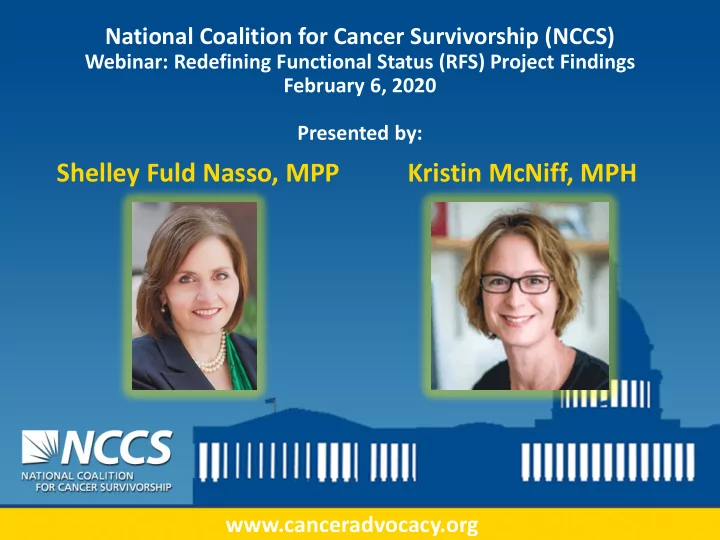
National Coalition for Cancer Survivorship (NCCS) Webinar: Redefining Functional Status (RFS) Project Findings February 6, 2020 Presented by: Shelley Fuld Nasso, MPP Kristin McNiff, MPH www.canceradvocacy.org FACEBOOK: CancerSurvivorship


slide-1
SLIDE 1

Shelley Fuld Nasso, MPP Kristin McNiff, MPH

National Coalition for Cancer Survivorship (NCCS)

Webinar: Redefining Functional Status (RFS) Project Findings February 6, 2020 Presented by:

www.canceradvocacy.org
slide-2
SLIDE 2

FACEBOOK: CancerSurvivorship TWITTER: @CancerAdvocacy HASHTAG: #LivingWithCancer

slide-3
SLIDE 3

Impacting Policy - Empowering Survivors - Transforming Care

slide-4
SLIDE 4

Survivors, Not Victims

slide-5
SLIDE 5

What does “living well” with cancer mean to you?

Provide your answer in the chat box

slide-6
SLIDE 6

Cancer Quality Measurement

  • Focused on process – did the patient get the right

test, right treatment, right procedure?

  • Limited outcome measures – avoidable

hospitalizations and emergency department visits

  • What would quality measurement look like if it

reflected what patients and caregivers say matter the most to them?

slide-7
SLIDE 7

Measuring Functional Status

  • Patient-centered measure development project to

define cancer outcome measure(s) in this critical area, using the Principles of Patient-Centered Measurement

  • Original Title: Return to Functional Status (RFS):

Patient-Led Cancer Outcome Measurement

  • Funded by the American Institutes for Research

(AIR), with support from the Robert Wood Johnson Foundation (RWJF): Pilot projects to implement Principles of Patient-Centered Measurement

#LivingWithCancer

slide-8
SLIDE 8

High Level Project Steps

Convened diverse committee of 10 cancer survivors, as well as Technical Expert Panel (TEP) Solicited input from cancer survivors through various social media platforms Developed conceptual definition of ‘return to functional status’ by cancer patients and survivors Evaluated existing validated surveys for best alignment with the conceptual definition Developed patient- centered specifications for RFS

  • utcome

measures (PRO- PMs)

Sufficiently detailed to allow for testing and validation in a subsequent initiative

slide-9
SLIDE 9

Project Committees

  • RFS Committee
  • Members invited to reflect a diverse range of experiences
  • Charged with leading development of the RFS measure by defining

the concept (via structured RAND Delphi approach); reviewing and contributing to the development of patient-centered specifications

  • Clinical/methodologist panel
  • Members who are experienced in cancer patient-reported
  • utcomes, functional status research, measurement methodology,

and implementation / clinical workflow

  • Charged with making recommendations to the RFS Committee and

project team on methodologic and implementation issues

slide-10
SLIDE 10

RFS Committee

  • Rebecca Esparza
  • Betsy Glosik
  • Matt Goldman
  • Candace Henley
  • Allen Hirsch
  • Kirby Lewis
  • Allison Rosen
  • Susan Strong
  • Desiree Walker
  • Dan Weber
slide-11
SLIDE 11

Conceptualization

Core challenge:

  • What does ‘return to functional status’ mean?
  • How can the concept be measured to evaluate

quality of oncology care?

slide-12
SLIDE 12

Project Methodology

RFS Committee brainstorm Social media

  • utreach

Detailed literature review RFS Delphi survey development Survey 1 completed and scored In-person Delphi meeting Survey 2 completed and scored Committee refined prioritized

  • utcomes
slide-13
SLIDE 13

Social Media Questions

  • What personal/life activities, events or

accomplishments do you consider when you think of a cancer survivor living well DURING cancer treatment?

  • What personal/life activities, events or

accomplishments do you consider when you think of a cancer survivor living well AFTER cancer treatment?

  • What are the most important impacts on your quality
  • f life from your cancer or cancer treatment? Did/does

your care team help you address these challenges?

slide-14
SLIDE 14

Conceptualization Methodology

RAND Delphi Process

Main steps:

  • 1. Structured survey prepared, informed by literature review,

committee brainstorming, social media outreach

  • 2. Structured survey completed by RFS Committee members
  • 3. In-person meeting to review and discuss survey responses;

attention to areas of disagreement and uncertainty

  • 4. Survey re-scored by RFS Committee
  • 5. Results and and conclusions reviewed by RFS Committee,

minor refinements made

slide-15
SLIDE 15

Expectations Confirmed

  • ‘We should measure…’: Commonly used jargon
  • ften lacks meaning
  • Putting patients in the driver’s seat significantly

changes the resulting measures

  • Patient committees can be successful in identifying

system gaps as measurement priorities

  • Everyone brings personal experience to the table
  • Gaps in current system are such that measurement

alone will be insufficient

slide-16
SLIDE 16

Lessons Learned

What we expected… What we found… Focus on/measurement of survivors in the post-treatment phase Commitment to include those receiving extended/chronic treatment as well Discussions of system gaps Reality of a system that lacks reliable expectations, norms, infrastructure to provide care that supports RFS Focus on return to previous activities (e.g. return to work) A group of prioritized outcomes and set of measures Concern about appropriate patient responsibility Concern about appropriate provider accountability

slide-17
SLIDE 17

Selected Results

  • 1. Renaming the concept
  • 2. Prioritized outcomes for

measurement of RFS

  • 3. Resulting measure set
slide-18
SLIDE 18

Renaming the Concept

  • Immediate feedback from Committee during

brainstorming – ‘return to functional status’ is not adequately descriptive

  • Following in-depth discussion at in-person meeting,

Committee renamed the concept Redefining Functional Status

slide-19
SLIDE 19

Prioritized Outcomes

  • Overall Quality of Life
  • Physical and mental health
  • Physical Function
  • Pain Interference
  • Fatigue Interference
  • Cognitive Function
  • Psychosocial Impact
slide-20
SLIDE 20

RFS Measure Set

Process: Survey- based assessment

  • f priority
  • utcomes

Process: Action taken when indicated by survey responses Outcomes: experience of care

(communication re: side/late effects and financial impact)

Outcomes: prioritized patient reported

  • utcomes
slide-21
SLIDE 21

How Survivors Shaped the Project

  • Name of project: changed from “return to

functional status” to “redefining functional status”

  • Composition of committee: added committee

members with metastatic and chronic cancers

  • Scope of measurement: considered people

currently in treatment, as well as people who have completed cancer treatment

  • Measures specified: included process measures

for functional status assessment, in addition to

  • utcome measures

2 1

“Patient centered measurements are hugely important and I didn’t recognize its value prior to participating in this study. Patients aren’t always comfortable letting their provider know what they are experiencing and having a quality measurement that allows a patient to share their concerns, issues or changes can overcome the fear of speaking up.”

  • Matt Goldman, Multiple Myeloma

Survivor and RFS Committee member

slide-22
SLIDE 22

RFS Committee Members

Allison Rosen, Colon Cancer Survivor Rebecca Esparza, Ovarian Cancer Survivor

slide-23
SLIDE 23

www.canceradvocacy.org Email Lindsay Houff at Lhouff@canceradvocacy.org