Shared Access Networks developed by Xerox PARC in mid-1970s roots - - PowerPoint PPT Presentation

shared access networks
SMART_READER_LITE
LIVE PREVIEW

Shared Access Networks developed by Xerox PARC in mid-1970s roots - - PowerPoint PPT Presentation

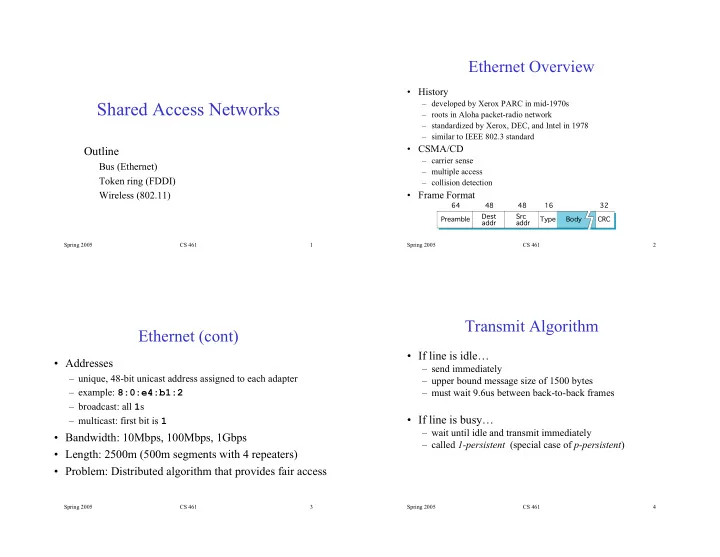
Ethernet Overview History Shared Access Networks developed by Xerox PARC in mid-1970s roots in Aloha packet-radio network standardized by Xerox, DEC, and Intel in 1978 similar to IEEE 802.3 standard CSMA/CD Outline


slide-1
SLIDE 1

Spring 2005 CS 461 1

Shared Access Networks

Outline

Bus (Ethernet) Token ring (FDDI) Wireless (802.11)

Spring 2005 CS 461 2

Ethernet Overview

  • History

– developed by Xerox PARC in mid-1970s – roots in Aloha packet-radio network – standardized by Xerox, DEC, and Intel in 1978 – similar to IEEE 802.3 standard

  • CSMA/CD

– carrier sense – multiple access – collision detection

  • Frame Format

Dest addr 64 48 32 CRC Preamble Src addr Type Body 16 48

Spring 2005 CS 461 3

Ethernet (cont)

  • Addresses

– unique, 48-bit unicast address assigned to each adapter – example: 8:0:e4:b1:2 – broadcast: all 1s – multicast: first bit is 1

  • Bandwidth: 10Mbps, 100Mbps, 1Gbps
  • Length: 2500m (500m segments with 4 repeaters)
  • Problem: Distributed algorithm that provides fair access

Spring 2005 CS 461 4

Transmit Algorithm

  • If line is idle…

– send immediately – upper bound message size of 1500 bytes – must wait 9.6us between back-to-back frames

  • If line is busy…

– wait until idle and transmit immediately – called 1-persistent (special case of p-persistent)

slide-2
SLIDE 2

Spring 2005 CS 461 5

Algorithm (cont)

  • If collision…

– jam for 32 bits, then stop transmitting frame – minimum frame is 64 bytes (header + 46 bytes of data) – delay and try again

  • 1st time: 0 or 51.2us
  • 2nd time: 0, 51.2, 102.4, or 153.6us
  • nth time: k x 51.2us, for randomly selected k=0..2n - 1
  • give up after several tries (usually 16)
  • exponential backoff

Spring 2005 CS 461 6

Collisions

(a) (b) (c) A B A B A B A B (d)

Spring 2005 CS 461 7

Token Ring Overview

  • Examples

– 16Mbps IEEE 802.5 (based on earlier IBM ring) – 100Mbps Fiber Distributed Data Interface (FDDI)

Spring 2005 CS 461 8

Token Ring (cont)

  • Idea

– Frames flow in one direction: upstream to downstream – special bit pattern (token) rotates around ring – must capture token before transmitting – release token after done transmitting

  • immediate release
  • delayed release

– remove your frame when it comes back around – stations get round-robin service

  • Frame Format

Body Checksum Src addr Variable 48 Dest addr 48 32 End delimiter 8 Frame status 8 Frame control 8 Access control 8 Start delimiter 8

slide-3
SLIDE 3

Spring 2005 CS 461 9

Timed Token Algorithm

  • Token Holding Time (THT)

– upper limit on how long a station can hold the token

  • Token Rotation Time (TRT)

– how long it takes the token to traverse the ring – TRT <= ActiveNodes x THT + RingLatency

  • Target Token Rotation Time (TTRT)

– agreed-upon upper bound on TRT

Spring 2005 CS 461 10

Algorithm (cont)

  • Each node measures TRT between successive tokens

– if measured-TRT > TTRT: token is late so don’t send – if measured-TRT < TTRT: token is early so OK to send

  • Two classes of traffic

– synchronous: can always send – asynchronous: can send only if token is early

  • Worse case: 2xTTRT between seeing token
  • Back-to-back 2xTTRT rotations not possible

Spring 2005 CS 461 11

Token Maintenance

  • Lost Token

– no token when initializing ring – bit error corrupts token pattern – node holding token crashes

  • Generating a Token (and agreeing on TTRT)

– execute when join ring or suspect a failure – send a claim frame that includes the node’s TTRT bid – when receive claim frame, update the bid and forward – if your claim frame makes it all the way around the ring:

  • your bid was the lowest
  • everyone knows TTRT
  • you insert new token

Spring 2005 CS 461 12

Maintenance (cont)

  • Monitoring for a Valid Token

– should periodically see valid transmission (frame or token) – maximum gap = ring latency + max frame < = 2.5ms – set timer at 2.5ms and send claim frame if it fires

slide-4
SLIDE 4

Spring 2005 CS 461 13

Wireless LANs

  • IEEE 802.11
  • Bandwidth: 1 - 11 Mbps
  • Physical Media

– spread spectrum radio (2.4GHz) – diffused infrared (10m)

Spring 2005 CS 461 14

Spread Spectrum

  • Idea

– spread signal over wider frequency band than required – originally designed to thwart jamming

  • Frequency Hopping

– transmit over random sequence of frequencies – sender and receiver share…

  • pseudorandom number generator
  • seed

– 802.11 uses 79 x 1MHz-wide frequency bands

Spring 2005 CS 461 15

Spread Spectrum (cont)

  • Direct Sequence

– for each bit, send XOR of that bit and n random bits – random sequence known to both sender and receiver – called n-bit chipping code – 802.11 defines an 11-bit chipping code

Random sequence: 0100101101011001 Data stream: 1010 XOR of the two: 1011101110101001 1 1 1 Spring 2005 CS 461 16

Collisions Avoidance

  • Similar to Ethernet
  • Problem: hidden and exposed nodes

A B C D

slide-5
SLIDE 5

Spring 2005 CS 461 17

MACAW

  • Sender transmits RequestToSend (RTS) frame
  • Receiver replies with ClearToSend (CTS) frame
  • Neighbors…

– see CTS: keep quiet – see RTS but not CTS: ok to transmit

  • Receive sends ACK when has frame

– neighbors silent until see ACK

  • Collisions

– no collisions detection – known when don’t receive CTS – exponential backoff

Spring 2005 CS 461 18

Supporting Mobility

  • Case 1: ad hoc networking
  • Case 2: access points (AP)

– tethered – each mobile node associates with an AP

C

B H A F G D AP-2 AP-3 AP-1 C E Distribution system

Spring 2005 CS 461 19

Mobility (cont)

  • Scanning (selecting an AP)

– node sends Probe frame – all AP’s w/in reach reply with ProbeResponse frame – node selects one AP; sends it AssociateRequest frame – AP replies with AssociationResponse frame – new AP informs old AP via tethered network

  • When

– active: when join or move – passive: AP periodically sends Beacon frame