Shape from shading Surface brightness and Surface Orientation --> - - PDF document

shape from shading
SMART_READER_LITE
LIVE PREVIEW

Shape from shading Surface brightness and Surface Orientation --> - - PDF document

Shape from shading Surface brightness and Surface Orientation --> Reflectance map READING: Nalwa Chapter 5. BKP Horn, Chapter 10. May 2004 SFS 1 Shading produces a compelling perception of 3-D shape. One way the brain simplifies the task


slide-1
SLIDE 1

1

May 2004 SFS 1

Shape from shading

Surface brightness and Surface Orientation --> Reflectance map READING: Nalwa Chapter 5. BKP Horn, Chapter 10.

May 2004 SFS 2
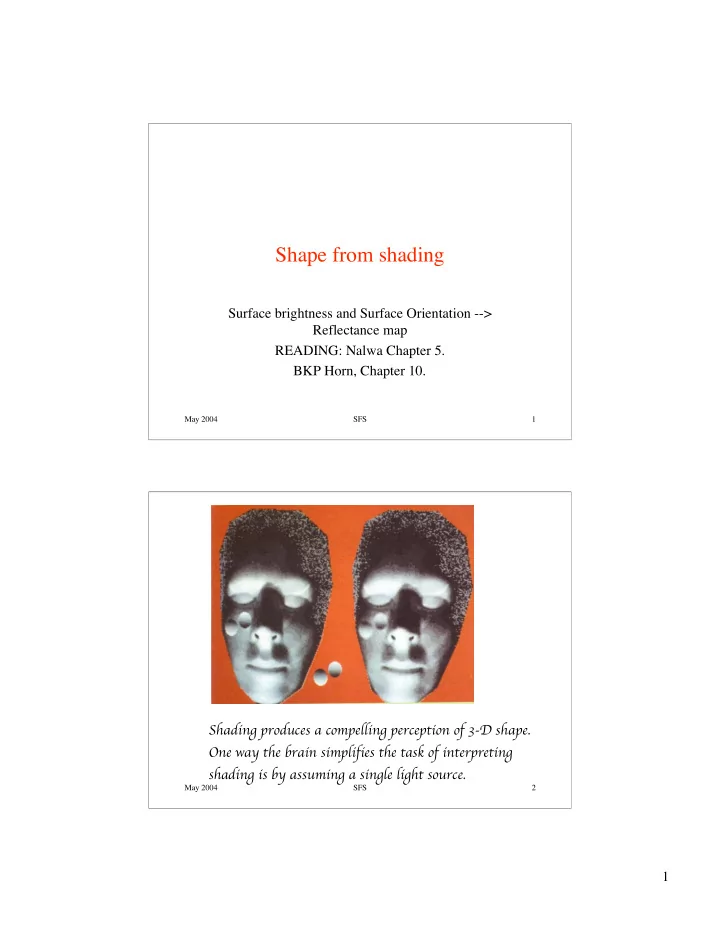
Shading produces a compelling perception of 3-D shape. One way the brain simplifies the task of interpreting shading is by assuming a single light source.

slide-2
SLIDE 2

2

May 2004 SFS 3

Shading as a cue to surface shape

May 2004 SFS 4

Boundaries influence the interpretation of shaded surfaces

slide-3
SLIDE 3

3

May 2004 SFS 5

..and perceptual grouping of elementary features helps to segregate the Dalmatian.

May 2004 SFS 6

Gradient Space

  • Orientation of a vector in 3-D space has two degrees of

freedom.

  • Suppose we are interested in representing all vectors in a

particular hemisphere, say z < 0 hemisphere:

– We can then represent any such vector with a negative z component as (p, q). See next slide.

slide-4
SLIDE 4

4

May 2004 SFS 7

Gradient space

May 2004 SFS 8

Gradient Space

Let the imaged surface be Then its surface normal can be obtained as a cross product of the two surface vectors: Surface normal:

slide-5
SLIDE 5

5

May 2004 SFS 9

Reflectance Map

  • Reflectance map captures the dependence of brightness on surface orientation.
  • At a particular point in the image, we measure the image irradiance E(x,y).
  • This irradiance is proportional to the radiance at the corresponding point on

the surface imaged.

  • If the surface gradient at that point is (p,q), then the radiance there is R(p,q).

– This assumes or ignores other contributing factors such as reflectance properties of the surface or distribution of light sources

  • Normalizing the proportionality constant, we get:

E(x,y) = R(p,q)

Image irradiance equation

May 2004 SFS 10

Reflectance Map

  • I(x,y) = R (p(x,y), q(x,y))
  • Both sides of the equation are normalized to have a maximum value of

1.

  • The reflectance map provides a normalized intensity for each surface
  • rientation (p, q).
  • Many to one mapping: several different surface orientations may map

to the same image intensity.

– Each image intensity value only constrains the corresponding surface normal to some isobrightness contour in gradient space. – R(p,q) encodes both the light source distribution and the surface reflectance characteristics. – However, it is independent of the way in which the imaged surfaces are configured.

slide-6
SLIDE 6

6

May 2004 SFS 11

Incident and emittance angles

May 2004 SFS 12

Lambertian surface

Lambertian surface: appears equally bright from all viewing angles. Let the incident light direction be

slide-7
SLIDE 7

7

May 2004 SFS 13

Reflectance Map

  • Illuminant direction: - [1 0.5 -1]
  • Isobrightness contours of a reflectance map of a Lambertian surface

are a set of conic sections in gradient space.

May 2004 SFS 14

  • Illuminated in the direction [1 0.5 -1] (from behind).
  • Note that the reflectance is minimum (i.e., 0) when
  • > when the angle between the direction from which the scene is lit and the

surface normal is greater than 90 deg.

  • > A straight line in gradient space separates the shadowed regions from

illuminated regions --this line is called the terminator.

slide-8
SLIDE 8

8

May 2004 SFS 15

Scene lit from -[0 0 -1]. Note that R(p, q) =1 only when

May 2004 SFS 16

Another Example

  • Consider a surface that emits radiation equally in all directions (not physically

possible).

– Such a surface appears brighter when viewed obliquely, since the same power comes from a foreshortened area. – Brightness now depends on the inverse of the cosine of emittance angle. – Taking into account the foreshortened area as seen from the source, the radiance is proportional to:

slide-9
SLIDE 9

9

May 2004 SFS 17

p q

Contours of constant brightness are parallel staright lines in gradient space

May 2004 SFS 18

Why full moon appears flat?

  • The material in the maria of the moon can be modeled reasonably well by a

function of

  • For such a surface:
  • For (p_s, q_s) = (0,0) , we would obtain a uniformly bright disk in the image.
  • Same conclusion if we start with the ratio

with the two angles being equal.

  • Such a sphere, illuminated from a position near that of the viewer, appears flat

to someone used to objects that are “Lambertian” like;

– That is why full moon looks like a flat disk marked with blotches, The blothces are brightness variations due to differences in the surface’s reflecting efficiency.

slide-10
SLIDE 10

10

May 2004 SFS 19

Photometric Stereo

  • Two images, taken with different lighting, will yield two

equations for each image point.

  • If these equations are linear and independent, there will be

a unique solution for p and q.

  • For best results, the two light source directions should be

far apart in gradient space.

  • For Lambertian surfaces, these lead to non-linear equations;

there can be two solutions, one solution, or none, depending on the particular values of the intensity.

May 2004 SFS 20

SFS: Shape determination

  • Characteristic Strip method [Section 5.1.3, Nalwa]
  • Given a point in the image and its counterpart in the reflectance map,

an infinetisimal step in the image plane in the direction of the gradient

  • f the reflectance map corresponds to an infinetismal step in gradient

space in the direction of the gradient of the image irradiance.

x y q p

slide-11
SLIDE 11

11

May 2004 SFS 21

SFS: end

  • Read the handout.
  • SFS, in general, provides a “qualitative” depth map
  • Reconstruction techniques, in general, are not very robust.
  • Applications: to estimating illuminant direction (Chellappa

et al.), image registration (Zheng), image restoration (photocopying of books), etc…